Will AI eliminate search?

On one hand, Google's Gemini 3 has made a high - profile entry, and AI unicorns are flocking in, regarding AI search as their favorite track. On the other hand, Elon Musk has made the astonishing assertion that "AI will eliminate search."
Search, the primary gateway to the internet world, why has it become both a fiercely contested territory and something on the verge of extinction? This article will conduct an in - depth analysis of how AI search has evolved from information distribution to service matching, and reveal the future of the trillion - level information service revolution in 5000 words.
Strategic Shift: The Blue Links are Melting Away
In March this year, Perplexity, an American AI search company and an AI unicorn, released a highly impactful advertisement: Lee Jung - jae, the lead actor of "Squid Game," was once again caught in a life - or - death game. He was trapped in a rapidly cooling chamber and had to answer the computer's tricky questions in seconds to save himself. Facing the difficult questions, he instinctively opened a traditional search engine called "Poogle," but all he got were rows of blue web links. Just as despair was setting in, he opened Perplexity and immediately got a complete and accurate answer, thus resolving the crisis.
This advertisement directly points to users' increasingly urgent need for an upgrade of traditional search engines in terms of information retrieval efficiency, content credibility, and user experience, under the anxiety of information explosion and cognitive overload.
This keyword - and - link model that has lasted for more than two decades once defined the information gateway and the commercial foundation of the internet.
Now, the gateway is being redefined by AI. The signs of the alternation between old and new driving forces can be seen from a set of comparative data: on one hand, Google's global market share of search engines has fallen below 90% for the first time in 10 years (Statcounter, October 2024); on the other hand, ChatGPT has covered about 10% of the adult population globally, and its weekly active users have exceeded 700 million. According to the analysis of the a16z August list, 8 out of the world's 10 most popular consumer - level AI applications, including ChatGPT and Perplexity, have search functions.
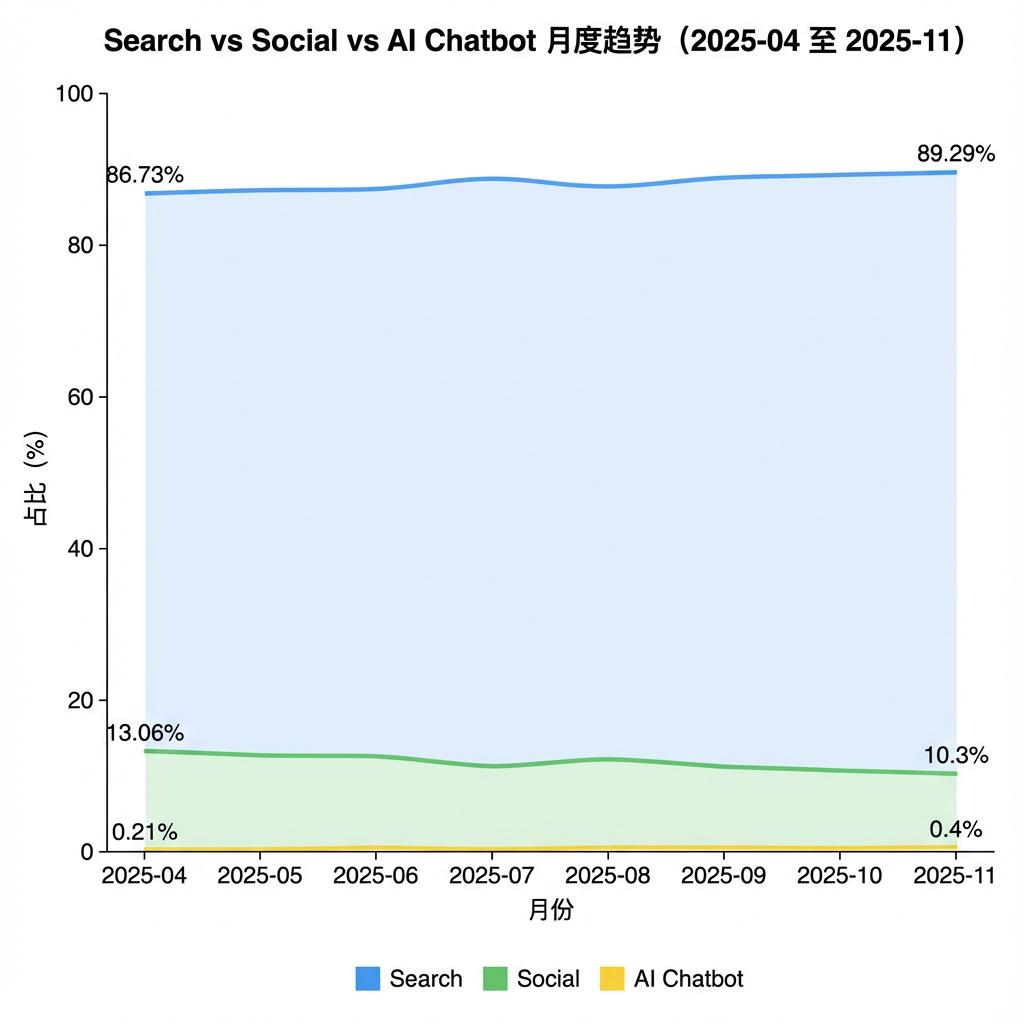
Chart 1: Market share of dedicated search, social applications, and AI chatbots. Source: Search Engine Market Share Worldwide, Nov 2024 - Nov 2025, Statcounter, AI - generated image
Product Form: New Forms of Human - Machine Interaction Emerge
The core value proposition of traditional search engines lies in providing information indexing and link distribution services. According to general observations in user experience and information retrieval research, in traditional search engines, users on average need to visit 3 - 5 web pages to complete a single information retrieval task, and keyword optimization often requires 2 - 3 rounds of iteration. The in - depth integration of artificial intelligence technology and search engines is reconstructing this underlying logic, driving the value leap of search engines from link distribution to intelligent decision - making assistants.
First, conversational interaction redefines the entry and experience of search.
AI search engines based on large language models (LLMs), with their profound understanding of natural language and the ability to remember the context of multi - round conversations, have completely changed the way of mining and presenting user intentions. Instead of passively listing links, they actively retrieve, compare, and integrate multi - source information, and directly upgrade the results to ready - to - use answers.
For example, when users initiate a query with a daily question, they can directly evoke AI - generated summaries (AI Overviews), thus avoiding the hassle of repeatedly jumping between web pages. AI applications with built - in internet search functions such as Tencent Yuanbao and ChatGPT can not only provide accurate answers with traceable links but also allow users to keep asking follow - up questions in the conversation to achieve in - depth exploration of information.
The enthusiastic response from the market validates the great potential of this model: Perplexity, a new star in AI search, has exceeded 30 million monthly active users by mid - 2025 with its innovative conversational interface; Google disclosed in its Q1 2025 earnings report that its AI overview function serves over 1.5 billion users per month. This trend shows that conversational interaction is no longer just a differentiating feature but a standard configuration for the new generation of search engines.
Second, multi - modal understanding breaks the dimensional boundaries of information interaction.
Current AI search has long gone beyond the shackles of pure text and fully supports the input and output of voice, images, and even videos. This technological evolution has greatly expanded the application scope of search engines, enabling their influence to seamlessly penetrate from traditional web browsers to mobile devices and various AI hardware terminals.
The commercial success of Google Lens is the best example of the market potential of multi - modal search: users can complete visual searches by simply taking a photo. By the end of 2024, its monthly visual query volume had soared to 20 billion, and it is widely used in various scenarios such as product price comparison, plant and animal identification, and real - time translation. Similarly, in the field of knowledge management, tools like Tencent Ima can conduct in - depth semantic retrieval of document images, extending the reach of search to private data.
Voice interaction shows its irreplaceable superiority in specific scenarios such as driving and cooking, and it has bridged the digital divide for groups such as the elderly and the visually impaired. This inherent inclusiveness not only demonstrates the social value of technology but also fundamentally detonates the huge growth potential of potential users.
Third, the value of search has risen to task execution and transaction matching.
The ultimate goal of AI search is to directly transform users' thinking into actions. By deeply integrating search behavior with subsequent operations, it constructs a seamless value - closed loop from decision - making to execution. On this value chain fully activated by AI, multi - modal understanding ability integrates different forms of data, enabling cross - modal retrieval and generation; and the powerful context memory allows AI to break free from isolated single - response and become an intelligent advisor capable of providing continuous decision - making support.
In the future, search engines will no longer be satisfied with providing links. Instead, by invoking a large number of service APIs, they will directly help users complete specific tasks such as ticket booking, reservation, and shopping. Amazon's AI shopping assistant Rufus is a powerful practice of this trend in the e - commerce field. It can transform vague shopping needs into precise product recommendations and cover the entire process of order tracking. In the final analysis, AI is endowing search with the ability to complete the "last - mile" transaction, which indicates the opening of a trillion - level service - matching market.
Fourth, search is being internalized as a general ability of information services.
The deployment form of AI search is undergoing a profound transformation. It is no longer an isolated application but is widely embedded as a basic ability in various scenarios such as social, e - commerce, and office, forming a distributed entry matrix. This trend marks that search is changing from a destination that users need to actively visit to a general service that can be called on as needed.
First, the embedded search ability greatly improves the user experience and the value of data assets of the platform. WeChat Search integrates text, videos, and services within its ecosystem, allowing users to complete the closed - loop of information acquisition and service consumption in the social scenario. Microsoft 365 Copilot deeply integrates search with the office scenario, automatically generating PPTs and organizing meeting minutes according to search instructions, and directly transforming information into productivity. Second, through personalized algorithms, AI search can precisely match users' intentions with the platform's commercialization goals. Xiaohongshu is a typical example. The COO of Xiaohongshu once said that more than one - third of users use search as the first action when opening the app, making the platform an important gateway for life - decision - making. By being invisible, AI search is maximizing its leverage effect in the digital economy and becoming the core engine driving the intelligent upgrade of various applications.

Chart 2: Functional features and value iteration of AI search in the era of information overload. Source: Self - developed by Tencent Research Institute, AI - generated image
Market Landscape: Four Routes Advance Side by Side
Since 2024, the AI search market has been surging with innovation. Based on differences in technological foundation, market position, and strategic choices, four evolutionary routes have emerged.
Route 1 - The Turn of the Giants: Gradual Upgrade of Traditional Search Engines
Traditional search engines represented by Google, Microsoft Bing, and Baidu are gradually introducing AI - generation capabilities on the basis of maintaining their original product architectures to enhance the core search experience.
The core capabilities of this route include massive data accumulation, a mature advertising monetization system, and an existing user base. In terms of technological maturity, AI - generation capabilities have been basically deployed, but aspects such as answer accuracy, source annotation, and business model adaptation are still in the optimization stage. The famous "public relations disaster" when Google AI Overview was first launched is the best example. In Perplexity's satirical "Poogle" advertisement, one of the questions the computer asked was "How to make cheese stick better to pizza?" At that time, Google AI Overview gave the wrong answer of using glue to stick the pizza.
Route 2 - Breaking through as a Native: Subversive Reconstruction of AI - Native Search Engines
The representatives of this route are AI - native search engines represented by Perplexity and OpenAI. From the very beginning of product design, they take conversational AI as the core to provide search services mainly in the form of direct answers, which is significantly different from the link - list - centered form of traditional search engines. Such products are usually characterized by a simple conversational interface and clear information source annotation.
Conversational interaction design, AI answer generation, and user experience optimization are the keys for AI - native enterprises to win users' hearts. However, it is also important to expand the coverage of indexed data and services and improve the accuracy and real - time performance of answers. Commercially, due to the high cost of large - model inference, these companies are actively exploring sustainable business models, such as paid subscription services. At the same time, the traditional advertising model is facing potential impacts, and new models such as subscription systems, API services, data authorization, and e - commerce sharing are being explored.
Route 3 - Ecosystem Building: Integration of Super - App Ecosystems
The representatives of this route are platforms such as WeChat that have a large number of users and their own content ecosystems. By integrating AI search functions as part of platform services, they deeply integrate with the content and services within their own ecosystems. For example, WeChat Search can retrieve information within the ecosystem such as official accounts, mini - programs, and video accounts.
Tencent executives outlined the strategic blueprint for WeChat's AI transformation in the Q3 earnings conference, clearly stating that "WeChat will eventually launch an AI agent," relying on WeChat's content, social, and business ecosystems to enable users to complete the entire process from demand understanding to service delivery within the ecosystem.
Route 4 - Vertical Deep Dive: Service - Driven Integrated Execution
The representatives of this route are vertical platforms focusing on specific business scenarios, such as e - commerce and lifestyle services, maps, and tourism. The goal is to provide integrated solutions from information retrieval to service execution. For example, when searching for "restaurants" in a map application, AI can not only provide information but also combine real - time traffic conditions and user reviews and directly connect to subsequent services such as reservation, ordering, or hailing a taxi. In a tourism application, AI can directly generate an executable plan including transportation, accommodation, and scenic - spot recommendations based on users' vague needs.
The core advantages of this route lie in the deep accumulation of vertical - domain data, the precise understanding of users' intentions in specific scenarios, and the ability to integrate with offline service execution. The technological maturity is related to the digitalization degree of specific fields, so it is more mature in scenarios such as e - commerce and local life.
In the future, there may be more intersections and integrations among these routes. For example, traditional search engines may invest in AI - native companies, and platforms may conduct data and service linkages to jointly promote the evolution of search services towards a more intelligent and scenario - based direction.
Industrial Landscape: Unlocking the Trillion - Dollar Market
Information services are undoubtedly undergoing an upgrade: the impact of AI is systematically spreading along the search engine itself to the upstream data sources, the mid - stream technical services, and the downstream application scenarios.
Upstream: Reconstruction of the Value of Trusted Information Sources
The demand of AI models for high - quality, structured, and traceable data has significantly increased the asset value of first - party data. First - party data, which refers to the original content directly produced by the platform or directly contributed by users, has become a key production factor for AI training due to its advantages in authenticity, timeliness, and credibility.
UGC (User - Generated Content) on community platforms is becoming a core asset. Take Reddit as an example. Its platform has accumulated a large amount of real user reviews, professional discussions, and consumption - decision - making content. In 2024, Google reached a data authorization agreement with Reddit to obtain access to its content for AI model training and search result optimization. This case clearly shows that in the AI era, the "trust assets" such as real - user - generated discussions, reviews, and experience sharing have become commercially quantifiable.
The role of knowledge - producing institutions is also changing. Authoritative information sources such as news media and academic journals are shifting from the past model of relying on search engines for traffic to exploring new forms of cooperation by authorizing content to AI platforms. There have been both successful cooperation cases and legal disputes due to copyright issues in the authorization negotiations between model companies such as OpenAI and many mainstream media. This shows that content producers are re - evaluating the asset attributes of their original content - it is not only a medium to attract readers but also the core raw material for driving AI - generated answers.
Mid - stream: The Marketing Paradigm Shifts to Winning AI Minds
The underlying logic of the core methodology of traditional digital marketing - Search Engine Optimization (SEO) - is facing a structural adjustment due to the emergence of AI search. In the past, the core of optimization was to improve the ranking of specific pages in the search result list.
Answer Engine Optimization (AEO) is becoming the new focus of the industry. Different from SEO, which pursues ranking, the core goal of AEO is to make content be adopted by AI as the direct source of answers. This requires corresponding adjustments to content strategies: from focusing on keyword density to providing structured, authoritative, and quotable high - quality information; from optimizing page titles to optimizing the logic, completeness, and source credibility of content. For example, for an article about "How to choose baby formula," the optimization direction will focus more on providing clear comparison tables, citing authoritative institutional suggestions, and integrating real user feedback to increase the probability of being adopted as a reliable information source by AI models.
Some marketing service providers have started to provide content optimization services for AI search, which marks that the focus of content marketing is shifting from traffic acquisition to trust building.
Downstream: Deep Integration of User Experience and Scenarios
In terms of new interaction entrances, browsers, AI hardware, and other carriers are exploring new ways to initiate searches. Browsers integrated with AI capabilities allow users to directly complete tasks such as answering questions and summarizing in the address bar, which bypasses traditional search engines to some extent and forms a decentralized search model. At the same time, AI - native hardware represented by Meta Ray - Ban smart glasses transforms search from an active screen - interaction behavior to a passive, context - aware response through functions such as visual Q&A, expanding the physical boundaries and application scenarios of search services.