Anshibo, the "Game Changer" in Power Supply: Entering the Hundred-Billion Data Center Power Supply Market with DC Solutions
It is estimated that by 2030, the total energy consumption of data centers in China will exceed 400 billion kilowatt - hours. If the proportion of renewable energy utilization is not increased, the carbon dioxide emissions of Chinese data centers may exceed 200 million tons in 2030.
Behind these figures, the limitations of the traditional power supply scheme for data centers are beginning to emerge. There is a high level of industry attention on how to provide high - reliability, high - efficiency, and cost - effective power support for AIDC, and there are demands for optimization.
Against this backdrop, Shanghai Anshibo Energy Technology Co., Ltd. (hereinafter referred to as: Anshibo) has targeted the link between the power grid and computing racks - converting alternating current into direct current required by high - power computing nodes. With a direct - current (DC) power supply scheme at its core, it has initiated a return to a new power supply architecture.
Recently, in the selection of the "WISE2025 Business King Series Annual Roster" launched by 36Kr, Shang Yunsi, the co - founder of Anshibo, and Guo Xingkuan, the CTO of the Data Center Power Supply Division, successively won two awards: the Pioneering Figure of the New Business Generation and the Annual Science and Technology Leader.
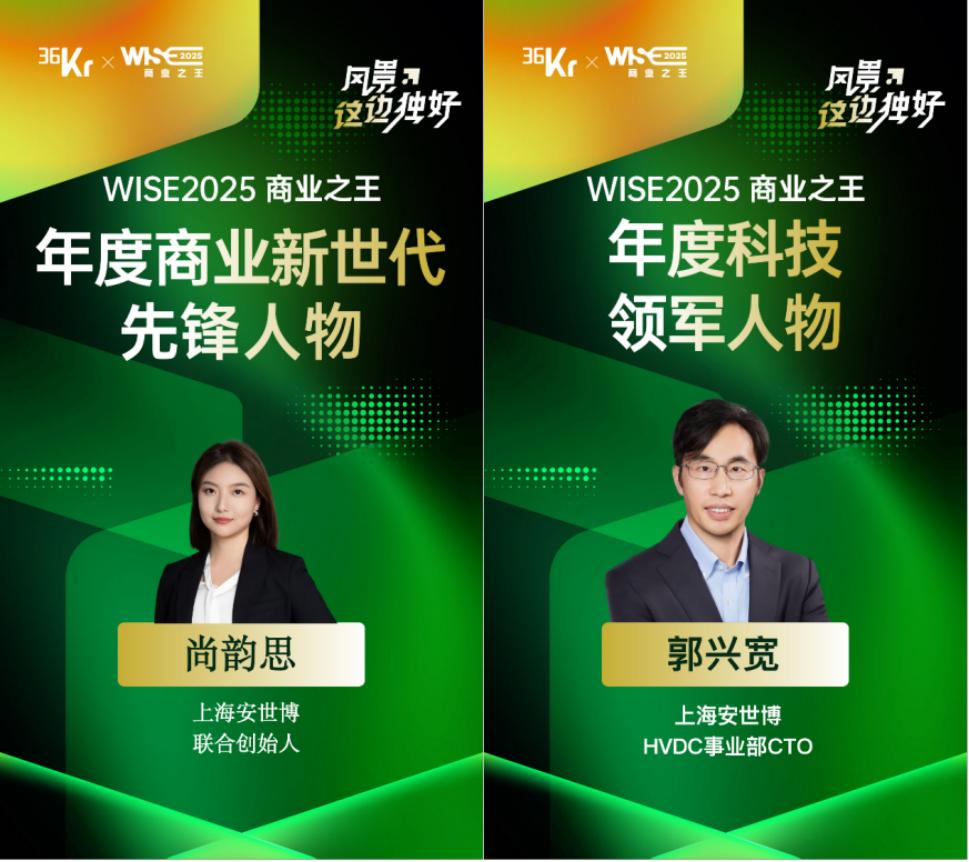
Behind these awards, Anshibo's DC power supply scheme has achieved phased implementation results in leading domestic Internet companies and some computing clusters - from some hub nodes of the "East - West Computing" project to relevant projects of the Yangtze River Delta Intelligent Computing Center. Its power supply system has provided a practical solution for the upgrade of the data center power supply architecture, with a full - link energy efficiency exceeding 97%, a significant reduction in the delivery cycle, and better full - life - cycle costs.
Solving the Pain Points of the Data Center Power Supply System with the DC Solution
The power supply revolution in data centers is driven by both macro - policies and industrial realities, pushing the Chinese data center power supply industry from the stage of "free growth" to the stage of "meticulous cultivation" for quality improvement.
On the one hand, the policy constraints are tightening. The "Special Action Plan for the Green and Low - Carbon Development of Data Centers" issued at the national level has drawn a clear roadmap and quantitative goals. By the end of 2025, the average Power Usage Effectiveness (PUE) of data centers across the country needs to be reduced to below 1.5. For newly built large and ultra - large data centers, the requirements are even more stringent, with the PUE required to be reduced to within 1.25. For the national hub nodes, which are the core of the "East - West Computing" project, the PUE is locked at 1.2 or below.
On the other hand, the transformation on the demand side is even more profound. The astonishing power consumption caused by the rapid development of AI computing power is like a "cost sword" and a "resource alarm" hanging overhead, making the improvement of power supply efficiency change from a technical pursuit to a crucial part related to the sustainable development of the industry.
Anshibo has observed that this round of industrial opportunities is very different from the Internet explosion in Silicon Valley in 2000: the previous one was driven by the popularization of personal PCs and the enterprise informatization needs, and the infrastructure followed linearly; in recent years, the in - depth application of AI has changed everyone's production and life, from programming and design to various industries. Large models directly contribute to the improvement of productivity, and this demand is long - term and solid.
"The explosion of computing power will ultimately be transmitted to the power supply end. 'The end of computing power is electricity' has become an industry consensus. How to efficiently, reliably, and cost - effectively meet the power demand of high - power computing has become the ultimate topic in the power electronics industry." Guo Xingkuan said.
Industry demand will ultimately drive technological evolution. The explosive growth of AI is reshaping the power supply pattern of data centers.
"The power of a whole cabinet has soared from more than 30 kilowatts to more than 130 kilowatts, and it is planned to reach more than 600 kilowatts, and may even exceed one megawatt in the future." Guo Xingkuan said bluntly in an interview. The development of GPUs and super - nodes has rapidly increased the power of a single cabinet. What's more troublesome is the "dynamic mutation" of the power load of super - nodes - the load may suddenly increase to 190% or 160% and then suddenly drop to zero. These dual challenges of power surge and dynamic fluctuation make it difficult for traditional power supply schemes to effectively cope.
36Kr has learned that the traditional AC UPS system uses a multi - stage conversion architecture of "AC - DC - AC", with a full - link efficiency of 96%. Its complex inverter link reduces the system availability, forcing data centers to adopt expensive redundant configurations, which further drives up the cost and space occupation. Although the existing 240V DC solution has some improvements, it is still insufficient in dealing with the high - dynamic load and ultra - high power density of AI.
The industry is calling for a more thorough architectural innovation.
According to the data from the Frost & Sullivan report, driven by the continuous expansion of data center capacity, it is estimated that the total market size of data center energy management in China will reach 187.9 billion yuan by 2029, of which the power supply system accounts for 114.5 billion yuan.
"In the DC power supply mode, with the help of batteries and capacitors, it is more convenient to deal with dynamic load fluctuations and solve the problem of backup power." Guo Xingkuan explained the logic behind Anshibo's technology selection. "At the same time, after the power density is increased, the DC architecture also provides a natural access interface for green power such as photovoltaics and energy storage, which can better adapt to the greening trend of data centers."
From "Components" to "Systems", Achieving Full - Scenario Verification
For the data center power supply industry, Anshibo's DC solution is not a single device, but a power supply system that covers "systems" based on "components" and is deeply adapted to different scenarios.
Among them, Anshibo DC1.0 adopts the core design of "batteries directly connected to the DC bus". The core advantages of this architecture lie in its strong compatibility and high overload capacity, which can seamlessly adapt to existing server power supplies and provide a smooth path for the transformation of existing data centers. At present, Anshibo DC1.0 has achieved phased large - scale deployment in leading Internet data centers.
Anshibo DC2.0 is upgraded to a "batteries not directly connected" architecture, with the DC bus voltage fixed at 400V. "After the voltage level is fixed, the efficiency of the downstream server power supply will be improved. On the one hand, the specification cost of downstream switches and cables will be reduced; on the other hand, this architecture can connect lithium batteries and automatically conduct battery capacity testing. The full - life - cycle cost is significantly reduced, and it is also convenient for operation and maintenance." Guo Xingkuan interpreted the engineering logic behind it.
Compared with the traditional mode, the Anshibo DC2.0 system supports online energy - feedback capacity testing of a single battery, eliminating the need for traditional manual on - site regular discharge. This not only simplifies the detection process but also eliminates the safety hazards of manual operation. At present, this architecture has successfully entered the data center scenarios of leading Internet companies and completed the initial market verification for large - scale deployment.
It is not difficult to see that through product iteration, Anshibo has optimized and upgraded the data center power supply in four dimensions: efficiency, reliability, operation and maintenance friendliness, and future scalability, providing a clear energy - efficiency improvement solution for the industry.
It is worth noting that in the DC series, Anshibo, in combination with the commercially deployed Panama 1.0 system in the industry, has jointly created the Panama 2.0 solution with leading Internet companies, which has more advantages and continuously enriches the power supply solutions for large - scale data centers.
"The core of the Panama system is to replace the traditional transformer with a phase - shifting transformer, which solves the two major problems of step - down isolation and power factor compensation at once." Guo Xingkuan revealed the secret of its high efficiency. "That's why we can remove the PFC conversion stage in the traditional three - phase rectifier. After reducing the conversion stages, the module efficiency exceeds 98.5%, and at the same time, the overall cost can be reduced by nearly 20%."
The Panama 2.0 jointly created by Anshibo and leading Internet companies has increased the full - link system efficiency to 97.6%. This system uses the technology of non - directly connected batteries, which can output a stable fixed voltage. It is compatible with two voltage specifications of 270Vdc and 400Vdc at the hardware level; in terms of transmission performance, its transmission loss is reduced by 25%, the transmission power is increased by 30% under the same cable conditions, and it is equipped with an automatic battery capacity testing function, which greatly reduces the complexity of operation and maintenance work.
"In the western hubs of the 'East - West Computing' project, the scarcity of professional operation and maintenance personnel is a major pain point. The extremely simple architecture of Panama 2.0 is designed to address this challenge." Guo Xingkuan emphasized the strategic value of this product.
Market data confirms the competitiveness of the products: at present, Anshibo's Panama system has been deployed nearly 100 sets in the national "East - West Computing" hub nodes such as Jiashan and Ulanqab, with a single - set power of 2.5MW; DC2.0 has been deployed 200 sets in Qingdao, Tianjin, Zhengzhou and other places; and more than 1000 sets of DC power distribution products have been deployed for leading customers.
Guo Xingkuan shared the specific results of the cooperation with a leading Internet company: "After adopting Anshibo's DC solution, this company can save nearly 10 million yuan in the cost of a single data center building, and the power supply efficiency is increased by 0.3%. The improvement in space utilization is even more significant - with the same area, the computing power that can be carried is increased by 300%."
To meet the "rapid deployment" needs of leading technology companies, Anshibo's power supply equipment fully supports container - type pre - fabricated delivery. "The whole power supply system is integrated and debugged in the factory, and can be used immediately after being transported to the site and plugged in, reducing the deployment cycle from 8 - 10 months to less than 6 months." Guo Xingkuan introduced. This not only improves the speed but also transforms the complex on - site engineering into a standardized factory production process, effectively reducing various risks in the project implementation process.
From core components to key equipment, and then to an integrated and complete system, Anshibo's product matrix has achieved "full - scenario coverage" of various data centers. Shang Yunsi looked forward and said: "What we provide is efficient and reliable power conversion services. The application scope of this service is not limited to Internet data centers, and it can be extended to more fields such as operator networks and industry in the future. The market potential is very considerable."
From Technological Iteration to Global Empowerment
Standing on the current technological high - ground, Anshibo has set its sights on the next - generation power supply architecture.
Currently, Anshibo's R & D roadmap points in two clear directions: the 800V solution for the ultimate AI computing power, and the solid - state transformer (SST) technology that can reconfigure the underlying logic of power.
"As the power of a single cabinet in GPU clusters moves towards 600kW or even higher, the existing DC240V/336V bus voltage will gradually face the bottlenecks of large transmission losses and high cable costs." Guo Xingkuan pointed out the next technological challenge in the industry.
For this reason, Anshibo's pre - researched 800V Sidecar solution can increase the power supply voltage to the 800V level, which can significantly reduce the current and losses in the power transmission process, and then achieve higher power density and energy efficiency. The "Sidecar" design concept means that the power supply unit is deployed near the IT cabinet, or even installed side by side with the IT cabinet, forming a more flexible and modular power supply unit that supports the transformation and rapid deployment of existing data centers.
In September this year, Oracle and NVIDIA successively announced that they would invest huge amounts of money in AI (Artificial Intelligence) infrastructure. It is reported that NVIDIA plans to invest up to $100 billion in OpenAI to support the expansion of its AI data center (AIDC). NVIDIA will also fully promote the implementation of the 800V direct - current (DC) data center architecture in its Rubin new - generation processor plan.
The solid - state transformer (SST) is a high - frequency, intelligent transformer based on power electronics technology. It can achieve flexible and efficient conversion between AC/AC and AC/DC, and at the same time has the functions of voltage transformation, electrical isolation, and power control.
"DC is the general trend." Guo Xingkuan judged. "As the power density increases, the DC voltage will go from 400V to 800V or even higher. The increase in voltage brings about systematic cost optimization - thinner cables, reduced losses, increased power density, and support for larger single - cabinet capacities. This is a global benefit that is interlinked."
The end - goal of forward - looking technological layout is global empowerment. Currently, Anshibo's internationalization pace is accelerating.
"Our system solutions are being fully prepared for overseas expansion." Shang Yunsi said. "Expanding the overseas market is a strategic priority. Our customers are deploying globally, and we must provide global service support."
"Major Internet manufacturers also face power supply technology bottlenecks overseas. Our solutions, which have been refined in complex Chinese scenarios, are of great reference value to them." Guo Xingkuan analyzed.
Anshibo's corporate positioning has gone beyond the scope of equipment suppliers.
Shang Yunsi defined the company's mission in one sentence: "Efficient electricity makes people's lives better." She explained: "All technological innovations should ultimately serve people. The reason why AI has exploded is that it has effectively improved production efficiency and living experience. On the one hand, we track the technological frontier; on the other hand, we understand real needs, so that efficient power conversion technology can create real value. This is the meaning of Anshibo's existence."
From following the industry consensus that "the end of computing power is electricity" to reconstructing the power supply architecture with DC; from overcoming the challenges of leading customers and obtaining market verification to laying out the next - generation technologies such as 800V DC and SST; from delving into underlying technologies and integrating into the supply chain supporting the national "East - West Computing" strategy to preparing to break through the global energy efficiency revolution - Anshibo's development path is clear and firm.
In this race related to the energy foundation of the digital world, this Chinese technology company is moving from a "technological breakthrough - maker" to an "ecosystem enabler". Its story is not only a business breakthrough practice but also foreshadows how Chinese hard - tech can define the global industrial future through extreme innovation in the field of key infrastructure.