Deepvein Mining released the "Deepsight Exploration" software-hardware integrated system platform. "Robots + professional algorithms" are reshaping the future of mineral exploration.
In many people's memories, mineral exploration is a craft that "relies on eyesight, physical strength, and experience." Geological teams used to carry instruments and traverse mountains and ridges. They struck rock surfaces with hammers, corrected directions with compasses, and observed mineral textures with magnifying glasses, constantly gambling with luck in the wilderness.
This traditional method is sincere and respectable. However, in today's context, it inevitably faces new challenges: shallow - layer resources are decreasing day by day, and exploration is moving towards deeper, more perilous, and more unknown areas; environmental protection and safety requirements are unprecedentedly strict.
The industry stands at a crossroads: Should it continue with the unchanged method of the past millennium and linger in the bottlenecks of efficiency and safety, or bravely embrace a complete evolution and make mineral exploration a smarter and more sustainable practice?
From "Relying on Experience" to "Looking at Data": The Answer from Deepvein Mining
Deepvein Mining was born out of this kind of thinking. Deepvein Mining believes that the mining industry is not a fortress for preserving old - fashioned techniques but an industry worthy of being gently awakened by technology.
In the Deepvein Mining team, there are not only experts who have spent decades in mines and are familiar with every fold of the strata but also engineers from scientific laboratories who believe that codes and robots can reshape the world. They have witnessed the pain points of the industry together and firmly believe in the power of technology.
Deepvein Mining has a simple aspiration: to let robots take over the "arduous, dangerous, and dirty" work, use AI to process the "abundant, complex, and difficult" data, and allow geologists to withdraw from the dangerous front - line to a safe rear, truly returning to the more creative work of "judgment and decision - making."
This aspiration is materialized in a specific software - hardware integrated system platform - the "Deepsight Exploration" software - hardware integrated system platform.
It is not a single machine or an independent software but a software - hardware integrated system platform that coordinates "air - space - ground - near - surface drilling," forming a complete closed - loop from data collection to decision - making.
Pushing into the Uncharted Territory: A New Perspective of "Air - Space - Ground" Integration
Imagine equipping mineral exploration with multiple "senses": overlooking the earth from the cloud, scanning in a net - like pattern at low altitude, conducting on - site inspections on the ground, and then drilling deep underground. This is exactly how the "Deepsight Exploration" software - hardware integrated system platform works.
Overlooking from the Sky: From "Searching for a Needle in a Haystack" to "Following the Map to Find the Treasure"
Satellite remote - sensing data provides the first perspective hanging in the sky. Multispectral, radar, and other images continuously flow into AI algorithms, enabling the detection of clues of geological anomalies from thousands of miles away. Mineralization information that is difficult to detect on the surface has nowhere to hide from the satellite's perspective. This step transforms mineral exploration from a "search for a needle in a haystack based on experience" to a "target - based exploration following the map," fundamentally reshaping the economic viability and success rate of exploration.
More importantly, planning the exploration scope in a more precise way means less blind drilling and less ineffective interference with the natural environment. It also allows for the earlier identification of areas unsuitable for development, making "no - soil - disturbance" and "no - excavation" a prudent choice.
Net - Weaving at Low Altitude: Completing a Months - Long Journey in a Few Days of Flight
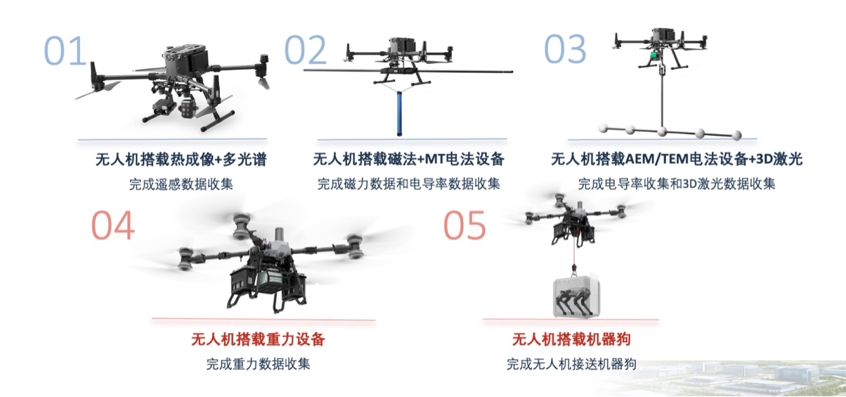
Next, a swarm of drones appears like nimble birds. They are equipped with advanced sensors such as thermal imagers, magnetometers, and lidars, scanning through mountains and valleys. Multidimensional data such as three - dimensional terrain, electromagnetic anomalies, and laser point clouds are intertwined in the air, capturing every bit of information in the vast area. Areas that humans would take months or even longer to survey on foot can be precisely scanned by drones in just a few days.
This not only speeds up exploration but also changes the question of "who has to take risks." In extreme terrains and high - risk areas, more and more tasks are being carried out by drones instead of humans. At the same time, potential geological hazards can be detected earlier, avoiding possible future losses. For enterprises, this is not only an improvement in efficiency but also a more responsible way of working towards lives and the environment.
On - Site Inspection on the Ground: Robot Dogs Take on the "Dangerous Paths" Instead of Humans
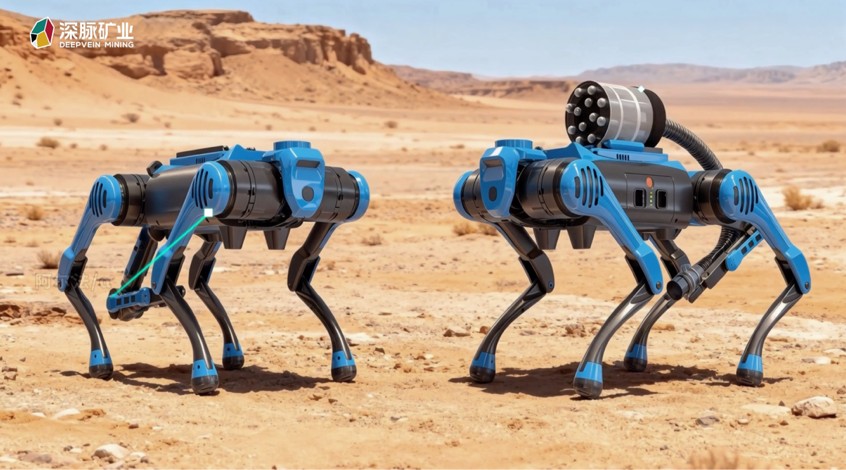
The real breakthrough happens right under our feet. After the satellite has defined the target area and the drones have woven the data net, the innovatively modified robot dogs become the key execution roles. With excellent all - terrain passability, they can autonomously perform two core tasks:
The first is intelligent geological mapping. They can automatically identify rock minerals and mineralization alterations and quickly obtain key geological data.
The second is geochemical sampling. They can drill autonomously, collect samples from target points, and complete the precise collection of 30 - 50 rock or soil samples in a single operation.
The data generated from the operations can further be applied in fields such as environmental assessment and agriculture.
More importantly, many tasks that previously required humans to carry heavy loads up the mountains can now be entrusted to these "tireless and fearless" robot dogs. Behind this is the enterprise's re - prioritization of the safety of front - line workers: protecting people first and then focusing on production.
Near - Surface Drilling: Miniature Drills Bridge the "Last Mile"
After the robot dogs have completed geological mapping and surface sampling, the miniature drills equipped with high - performance motors are responsible for "pushing the view a little further down." Working close to the ground, they can quickly drill holes, take samples in the locked abnormal areas, and conduct small - scale trial mining, using real rock cores and samples to verify the surface and aerial judgments. Their small size and high mobility allow them to operate stably in areas where large - scale drills cannot reach. Through modular design and precise control, they make underground information clearer and more reliable while ensuring safety and environmental protection.
This is a more restrained exploration method. It uses "minimally invasive" drilling to replace large - scale extensive construction, clarifies the situation first, and then makes more prudent decisions regarding the surrounding environment, population, and future planning.
From the sky to the ground and then underground, data from multiple dimensions flow, collide, and corroborate in the same system, finally piecing together a complete geological puzzle. Exploration is no longer a series of fragmented actions but a series of "closed - loop verifications" based on facts and models.
This not only improves the reliability of resource assessment but also provides a more transparent and explainable basis for enterprises when dealing with regulatory authorities, partners, and local communities.
Software - Hardware Integration: Equipping Mineral Exploration with a "Smart Brain"
The hardware endows the system with sensitive "senses" and flexible "limbs," but what truly makes it an organic whole is the "smart brain" - the integrated intelligent operation platform built by Deepvein Mining.
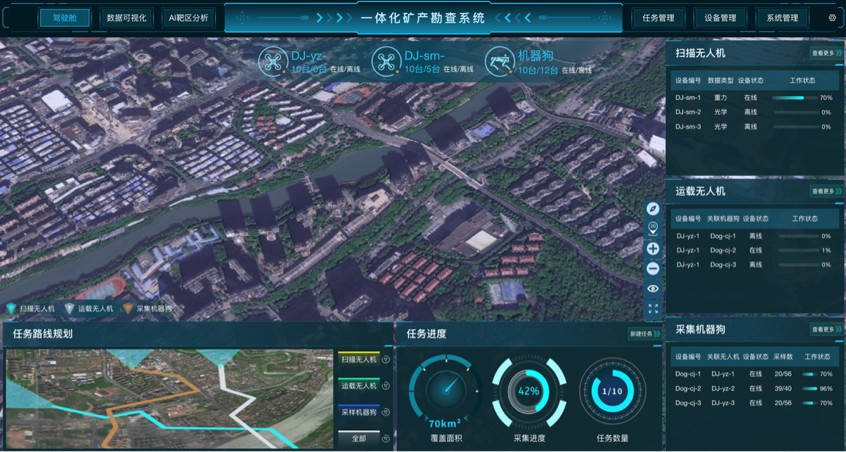
This platform can dynamically receive a vast amount of real - time data from satellites, drones, robot dogs, and miniature drills, and conduct in - depth interpretation and decision - making through AI algorithms and industry - specific large models.
When the abnormal signals from the sky corroborate with the surface mineralization features, the system will automatically arrange for robot dogs to go to the site for precise verification and, if necessary, coordinate with miniature drills for near - surface drilling and sampling verification. From wide - area perception to targeted insight, from surface observation to underground verification, a decision - making closed - loop that requires little human intervention is thus established.
In this process, the valuable experience of veteran geologists is not discarded but digitized and modeled into "knowledge assets" that can be replicated and evolved. The new - generation engineers superimpose AI capabilities on this basis, allowing experience to be continuously tested, corrected, and amplified. Mineral exploration has truly shifted from "relying on experience" to "looking at data."
Industry - University - Research Collaboration: Translating "Cutting - Edge Technologies" into Practical Applications in Mining Areas
Behind these series of innovations lies solid scientific research and engineering collaboration.
The teams from Tsinghua University and the Chinese Academy of Sciences have injected the "underlying genes" of hardware design and core algorithms into the system;
China University of Geosciences (Wuhan) and China University of Mining and Technology have brought in rich accumulations of mining right data and geological expertise;
The product R & D team has gradually transformed these achievements into "mining - area - level equipment" that can withstand wind, dust, and impacts.
When the rigor of academia meets the pragmatism of engineering, when traditional geology meets cutting - edge AI technology, the in - depth integration of industry, university, and research is not just a "sum" in technology but an exploration of an innovative path for large - scale integration and replication in the mining industry.
Conclusion: Towards a New Future of "Robot - Powered Mining": This Is Just the Beginning
Today, the global mining industry stands at a common crossroads: the grade of resources is declining, environmental protection standards are tightening, and safety pressure is increasing. What the industry needs is not just minor adjustments but a complete evolution.
Deepvein Mining's exploration aims to demonstrate the possibility of breaking the deadlock for the industry. Deepvein Mining does not replace humans with cold technology but liberates human hands with intelligent machines, allowing geologists to move from the dangerous front - line to a safe rear and shift from repetitive labor to creative judgment. While improving efficiency and effectiveness, it integrates safety, environmental protection, and community care into every technological upgrade and on - site decision - making.
The release of the "Deepsight Exploration" software - hardware integrated system platform marks a crucial step for Deepvein Mining towards "robot - powered mining." But this is just the beginning. In the future, this system will extend from exploration to the entire industrial chain of mining, ore dressing, and smelting. Relying on the technical path verified in the exploration stage and the accumulated data assets, Deepvein Mining will continuously promote the intelligent upgrade of the entire mining operation process, ultimately achieving cost reduction, efficiency improvement, and safety enhancement across the entire industrial chain.
When robots venture deep into mines and AI algorithms decipher the secrets of the earth, a new era of mining that is "more efficient, more intelligent, safer, and more environmentally friendly" is gradually unfolding before the industry.
Deepvein Mining firmly believes that this is not the end but the prologue of a grander story.