The daily salary of robots, which used to be as high as 10,000 yuan, has been drastically cut.
Robot rental prices have plummeted. Have they dropped to a thousand yuan and gone unnoticed?
Recently, reporters from Science and Technology Innovation Board Daily conducted research and found that the current prices in the robot rental market have significantly declined from the peak of a daily rent of ten thousand yuan at the beginning of the year. The overall decline can be described as a "knee - chopping" drop. The daily rent of basic humanoid robots has dropped to around 2,000 yuan, and the daily rent of quadruped robots has even fallen to a starting point of 500 yuan.
As the robot rental market squeezes out the bubbles and returns to rationality, its long - term value is shifting from being a "performer" in the spotlight to broader real - world scenarios such as production and logistics. The key to achieving this transformation lies in how to technically construct a complete closed - loop of human - like perception, decision - making, and execution.
Robot rental prices have plummeted
The frenzy in the robot rental market began during the Spring Festival in 2025. At that time, the humanoid robots of Unitree Technology performed the yangko dance on the Spring Festival Gala stage. The video views quickly exceeded 100 million, igniting the market enthusiasm.
In a short period, the demand from commercial performances, corporate annual meetings, weddings, etc. exploded, and the robot rental market quickly fell into a state of "one robot is hard to find".
According to the statistics of Hengzhou Chengsi, the global intelligent robot rental revenue scale was about 11.22 billion yuan in 2024. It is expected that the revenue scale will be close to 17.12 billion yuan by 2031, with a compound annual growth rate of 6.1% from 2025 to 2031. Among them, the rental of commercial service robots accounts for 65%, mainly used in scenarios such as commercial performances, scenic area tours, and corporate annual meetings.
At the beginning of this year, according to the investigation by reporters from Science and Technology Innovation Board Daily, the daily rental price of Unitree Technology's robotic dogs (including the Air version and the Pro version) generally ranged from 1,500 yuan to 2,800 yuan. The rent of humanoid robots was even higher, with the maximum "daily salary" reaching up to 10,000 yuan.
However, the market situation took a turn around May this year, and robot rental prices began to decline.
As of December, when reporters from Science and Technology Innovation Board Daily browsed e - commerce and second - hand platforms such as Xiaohongshu, JD.com, and Xianyu, they noticed that unlike at the beginning of the year when the daily rent was generally directly marked at around 10,000 yuan, many merchants now use more attractive display prices to attract customers to inquire, and the actual transaction price needs further communication.
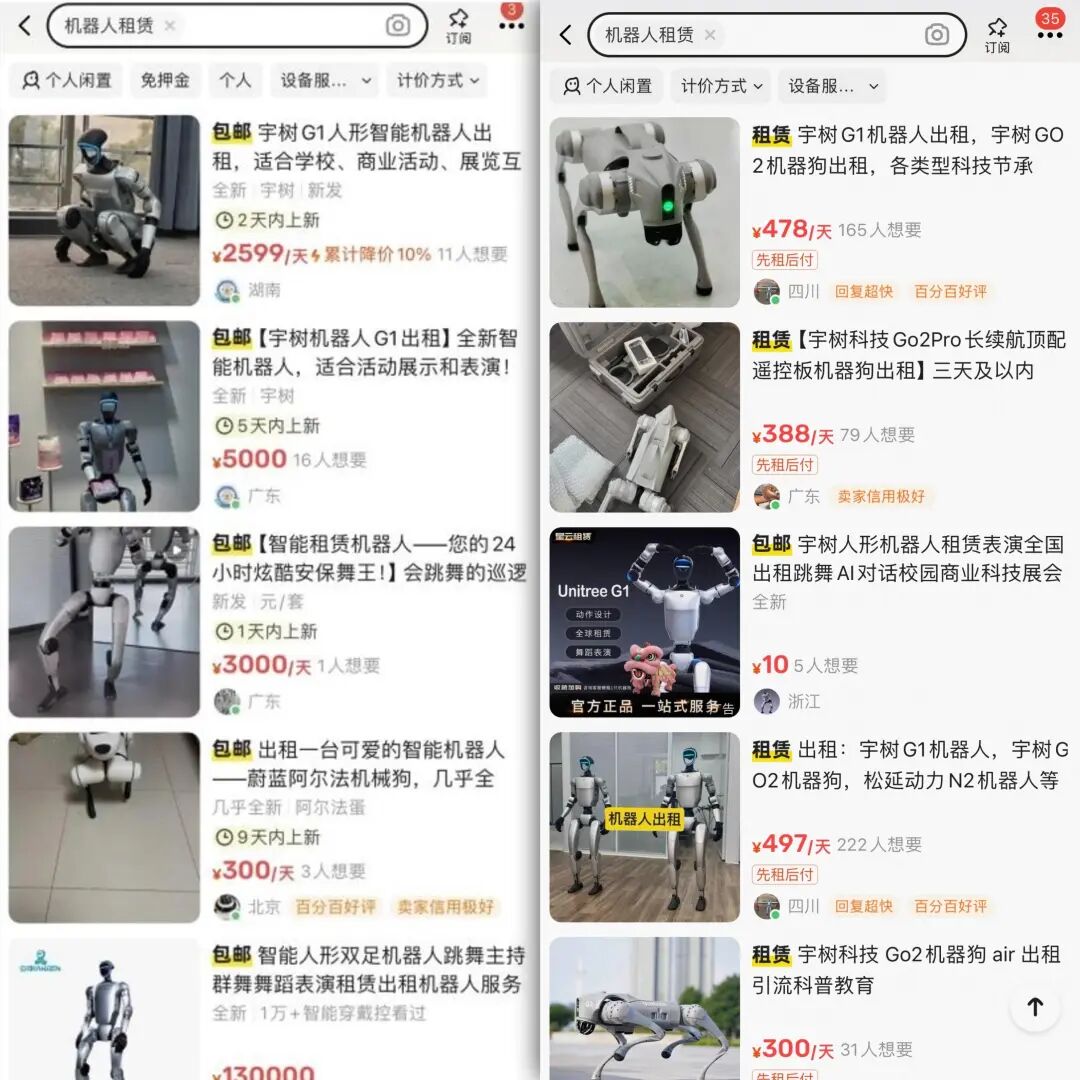
At the beginning of the year, it was easily over 10,000 yuan. At the end of the year, a daily rent of a thousand yuan has become the norm.
According to the quotes provided by multiple rental merchants to the reporters, the current price system in the robot rental market has become more stratified. Among them, the daily rent of basic humanoid robots is about 2,000 yuan. The price of models with dance functions ranges from 3,500 yuan to 4,500 yuan. The daily rent of high - end versions that support intelligent voice dialogue is about 6,500 yuan. In addition, the starting rent of quadruped robots has dropped to 500 yuan per day.
It is not difficult to see that compared with the daily rent of easily over 10,000 yuan at the beginning of the year, the current prices in the robot rental market have significantly declined, and the overall decline can be described as a "knee - chopping" drop.
In addition, a notable trend is that the service model of rental merchants has shifted from a single "equipment rental" to a deeply customized solution of "equipment + operation + content planning". Whether a dedicated operator is provided and whether customized dance or interactive programming is required directly affect the final quote.
For example, a merchant told reporters from Science and Technology Innovation Board Daily that if a robotic dog is paired with a professional operator to provide full - service, the daily rental package price is about 1,500 yuan. If only the equipment is rented and the event organizer operates it by themselves, the price will be reduced to 800 yuan per day.
The popularity of robot rental has rebounded at the end of the year
The significant drop in robot rental prices is significantly influenced by the change in the market supply - demand relationship. On the one hand, as the production capacities of embodied intelligence companies such as Unitree, Zhipu, and Ubtech are rapidly released, and many new players enter the rental field, the market supply has increased significantly in the short term.
On the other hand, the market popularity of robots as a new thing has begun to fade, the public's curiosity has weakened, and customer demand has shifted from early impulse - driven trial to rational evaluation based on actual budgets. The ebb and flow of supply and demand have quickly eliminated the original scarcity premium of the products.
Meanwhile, the lowering of technical thresholds has also simplified robot operation. For example, Zhipu Robotics has launched the "Lingchuang Platform" and the "Lingxin Platform", enabling ordinary users to train robots to perform actions without professional knowledge. This technological progress has greatly simplified the operation process, thereby reducing the originally expensive human programming and debugging costs in rental services.
It is worth noting that it is currently the peak season for year - end events, and the seasonal demand from annual meetings, commercial performances, etc. is being released intensively, injecting new impetus into the robot rental market. Although the overall popularity is still far from reaching the peak at the beginning of the year, the market's inquiry volume and transaction volume are showing a moderate rebound.
"Recently, there have been many concentrated events such as annual meetings, and the market demand has increased significantly." A robot rental merchant revealed to reporters from Science and Technology Innovation Board Daily. "Our orders have been booked until the middle of next month."
The merchant also advised reporters to plan and book in advance: "Basically, it's hard to rent without advance booking. You need to book at least a week in advance."
He said that if you place an order temporarily close to the event date, you may face the situation where the equipment has been fully booked and you need to source from outside. This may not only lead to an increase in rental prices but also may not guarantee the availability of equipment, and professional operators will also be in short supply.
From "performance" to "work", how can embodied intelligence cross the commercialization threshold?
The latest research report released by the Development Research Center of the State Council shows that the market scale of embodied intelligence is expected to reach 400 billion yuan in 2030 and exceed one trillion yuan in 2035.
It should be noted that after the short - term bubbles in the rental market are squeezed out and the industry returns to rationality, the long - term value of robots is not fixed as a "performer" in the spotlight, but lies in whether they can be applied to broader and more essential real - world scenarios such as production workshops, logistics warehouses, and public services.
The transition of robots from stage performances to practical applications is essentially an upgrade from "automation" of executing preset programs to "autonomy" of understanding and adapting to open environments. The key to this leap lies in how to technically construct a complete closed - loop of human - like perception, decision - making, and execution.
"In terms of large - scale commercial use, the technology of humanoid robots still needs further development." Yu Yiran, the managing director of CIC Consulting, also told reporters from Science and Technology Innovation Board Daily.
He believes that since the past focus has been more on the hardware + control segment and the development of the execution module, the "limbs" of humanoid robots have developed relatively maturely, while the "brain" and "cerebellum" currently have a relatively low level of maturity. "However, in the wave of embodied intelligence, humanoid robots need to achieve a perception, decision - making, and execution process similar to that of humans and have generalization ability."
Yu Yiran told reporters from Science and Technology Innovation Board Daily: "The commercial use of robots is currently highly anticipated, mainly because humanoid robots have entered a critical stage of collaboration with large AI models. The commercial use of large models such as GPT has significantly improved the ability of robots to process and analyze data information."
In his view, large models such as GPT can provide robots with simulated complex scenarios and tasks by generating high - quality synthetic data, improving their generalization ability in the real world. At the same time, large models can deeply analyze and process real - world data, extract valuable information from it, and continuously optimize the perception, decision - making, and execution algorithms of robots.
"In the wave of embodied intelligence, the core issue that humanoid robots urgently need to address is how to achieve generalization through a large amount of data training." Yu Yiran said. "Only by achieving sufficient generalization can humanoid robots be commercially applied in multiple scenarios."
According to his analysis, humanoid robots are most likely to be first popularized in industrial, educational research, and retail scenarios. Entering the household scenario still faces challenges in terms of safety, reliability, interaction ability, and cost control. "It may take 10 years or even longer for them to enter households on a large scale."
This article is from the WeChat official account "Caixin AI Daily", author: Li Jiayi. Republished by 36Kr with permission.