"Zhongke Guiji" Completes a New Round of Strategic Financing to Promote Mass Production and Scenario Implementation of Industrial-grade Dexterous Hands + Embodied Large and Small Brains | Exclusive Report by 36Kr
Author | Fu Chong
Editor | Su Jianxun
36Kr learned that Zhongke Siji (Nanjing) Robot Co., Ltd. (hereinafter referred to as "Zhongke Siji") announced the completion of a new round of strategic financing. This round of financing was led by Huakong Fund, jointly invested by Nanjing Venture Capital, Taiya Capital, and Beijing Future Science City Fund.
The financing will be mainly used for the mass production of industrial-grade dexterous hands, the iteration of embodied large and small brain models, and the expansion of industrial application scenarios.
Zhongke Siji was officially established in May 2024. Its business mainly focuses on the full-stack R & D of hardware for humanoid dexterous manipulation of the "upper limbs" of robots, embodied large and small brain models, and system solutions. The company was incubated from the Institute of Automation of the Chinese Academy of Sciences. Since 2018, it has been conducting R & D on cable-driven dexterous hands and their embodied large and small brain model technologies on the platform system of the Chinese Academy of Sciences. It is one of the earliest teams in China focusing on this field.
As the popularity of embodied intelligence and humanoid robot industries climbs, dexterous hands, as key executive components, are moving from the laboratory to real operation scenarios.
"The dexterous hand has gone through the 'Stage 1.0' of competing in degrees of freedom. Now, there is a consensus that a high - quality dexterous hand that can really do work must have a balanced and good performance in terms of load, response speed, durability, and cost to enter the 'Industrial - grade 2.0'." Wang Peng, the founder and CEO of Zhongke Siji, told "Intelligent Emergence".
At this year's World Robot Conference, the company launched the Casia Hand series of dexterous hands, which has formed a product matrix covering four major directions: industrial, service, special, and consumer. Currently, the core components of the products are 100% domestically produced.
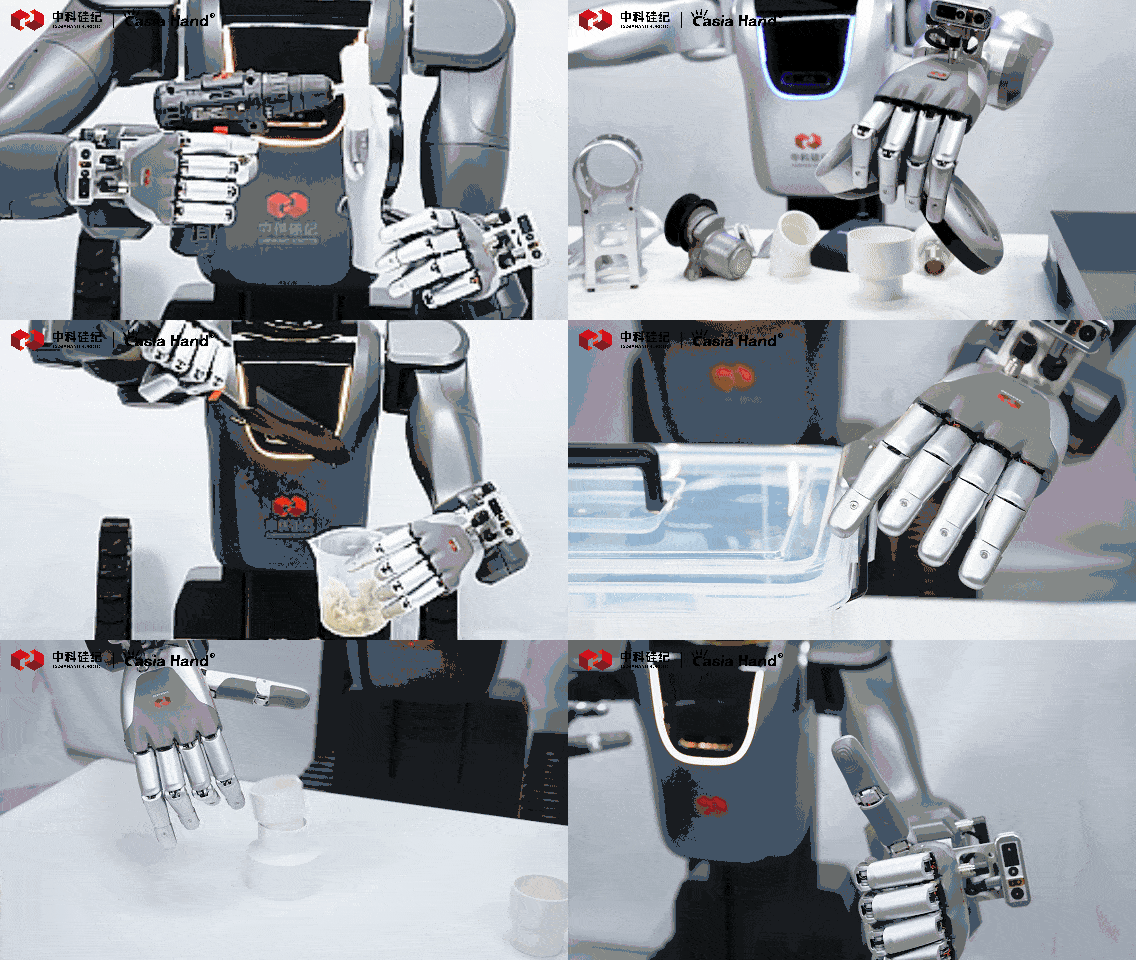
Demo of Zhongke Siji's dexterous hand operation. Photo: Provided by the enterprise
The Casia Hand has a total of four dexterous hand products: a three - finger dexterous hand for household and service robots, which is used to simulate the daily actions of "grasping, pinching, lifting, and placing" objects by human hands; a high - speed hand for industrial scenarios, with a joint angular velocity of up to 720 degrees per second and a service life of over one million times, suitable for high - frequency loading and unloading stations in 3C electronics, logistics, etc.; in special and display scenarios, models optimized for reliability and morphological performance are also provided.
In terms of hardware, to balance degrees of freedom, load, and compliance, the Casia Hand uses a cable - driven solution, and some models use a fusion solution of cable - driven and rigid drive.
However, cable - driven systems generally face problems such as creep, extension, and short service life in engineering applications. Zhongke Siji has improved the wear resistance, fatigue resistance, and long - term accuracy stability of the transmission system by introducing metal alloy cables and cooperating with a redesigned cable path and tension control scheme, and promoted the standardized production of core components for subsequent mass production and maintenance.
At the perception and data collection end, Zhongke Siji has self - developed a high - precision fiber - optic sensing data glove, which can completely capture the multi - joint movement of human hands, be used to control dexterous hands or robotic arms, and collect operation data synchronously.
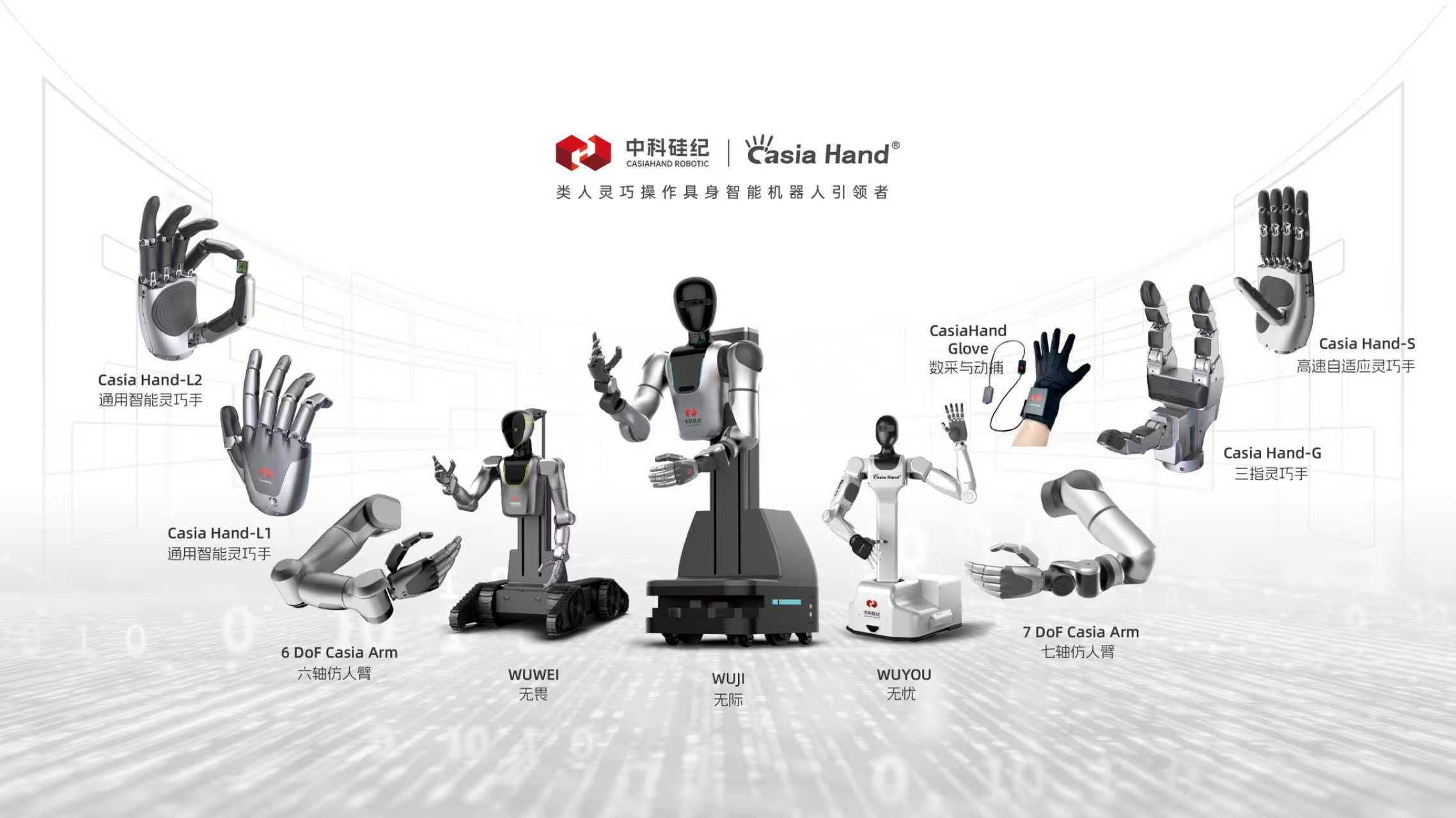
Product matrix of Zhongke Siji. Photo: Provided by the enterprise
Based on the accumulation of embodied large and small brain models by the Institute of Automation of the Chinese Academy of Sciences, Zhongke Siji iterates the dexterous hand and the embodied large and small brain models in a coordinated manner.
The "small brain" part corresponds to the basic control and action library, realizing stable control of each joint of the dexterous hand and calling of common grasping actions. Currently, mainstream dexterous hand companies provide customers with hardware and the above - mentioned basic control software (small brain).
In addition to the small brain, Zhongke Siji also develops and provides customers with a large brain model. This endows the dexterous hand with the ability to understand and reason about tasks, enabling it to independently complete complex operations.
The support of the two types of software, the large and small brains, can serve different types of customers.
One type is industrial integrators and professional equipment manufacturers. By installing dexterous hands on existing robotic arms and collaborative robots, they can improve the system's adaptability to complex workpieces and diverse working conditions. Such customers need dexterous hand suppliers to provide both large and small brain models; the other type is embodied intelligence manufacturers and R & D teams. They are good at large brain model R & D, so they focus more on the access to the small brain action library.
"Many customers still cannot use good dexterous hand hardware effectively after getting it. The delivery of software enables users to achieve rapid deployment in scenarios such as sorting and assembly without collecting data and training models from scratch, and the development cycle can be greatly shortened." Wang Peng said.
Wang Peng, the founder of the enterprise, graduated with a doctorate from the Institute of Automation of the Chinese Academy of Sciences and serves as a researcher and doctoral supervisor. He has visited and conducted cooperative research at the Technical University of Munich in Germany and the University of California, Berkeley in the United States. His team has more than ten years of research on embodied robots for humanoid dexterous manipulation, and their research results have been continuously published in the top journal IEEE Transactions on Robotics.
Investors' comments:
Huakong Fund: The team has more than 10 years of profound technological accumulation from a national - level scientific research institution. It is a team with in - depth integration of "hardware + embodied large and small brain models" and has efficient commercialization capabilities.
Nanjing Venture Capital: As a local enterprise in Nanjing, we look forward to the company's continuous in - depth exploration of core technologies, accelerating the product launch and commercialization process, creating benchmark applications in key scenarios, deeply integrating into Nanjing's "4266" industrial system, and becoming an important force in promoting the high - quality development of the city's future industries.
Taiya Capital: The company's dexterous hands are not only used for research in the scientific research field. We also see their huge potential for application in industrial and household scenarios.
Beijing Future Science City Fund: As a venture capital fund under the Beijing Future Science City Development Group, we focus on the investment layout of high - value links in the entire robot industry chain. The enterprise has both a clear short - term growth strategy and long - term forward - looking vision, reflecting the team's in - depth thinking on business strategy.