JIA Anya of SenseTime: For enterprise AI implementation, business goals and industry understanding are more important than the model itself | WISE2025 King of Business Conference
The business world in 2025 stands at the crossroads of a new - old transformation. Amid the reconstruction of business narratives and the sweeping technological wave, the WISE2025 Business Leaders Summit, with the theme of "The Scenery Here is Uniquely Charming", aims to anchor the definite future of Chinese business in the face of uncertainties. Here, we record the opening of this intellectual feast and capture the voices of those who still forge ahead firmly in the changing situation.
From November 27th to 28th, the 36Kr WISE2025 Business Leaders Summit, hailed as the "annual technology and business trendsetter", was held at the Conduction Space in the 798 Art Zone, Beijing.
This year's WISE is no longer a traditional industry summit but an immersive experience in the form of "technology - themed short dramas". From AI reshaping the boundaries of hardware to embodied intelligence opening the door to the real world; from the globalization of brands in the wave of going overseas to traditional industries equipping with "cyber prosthetics" - what we present is not only trends but also the insights refined from numerous business practices.
In the following content, we will dissect the real logic behind these "exciting dramas" frame by frame and witness the "uniquely charming scenery" of the 2025 business world.
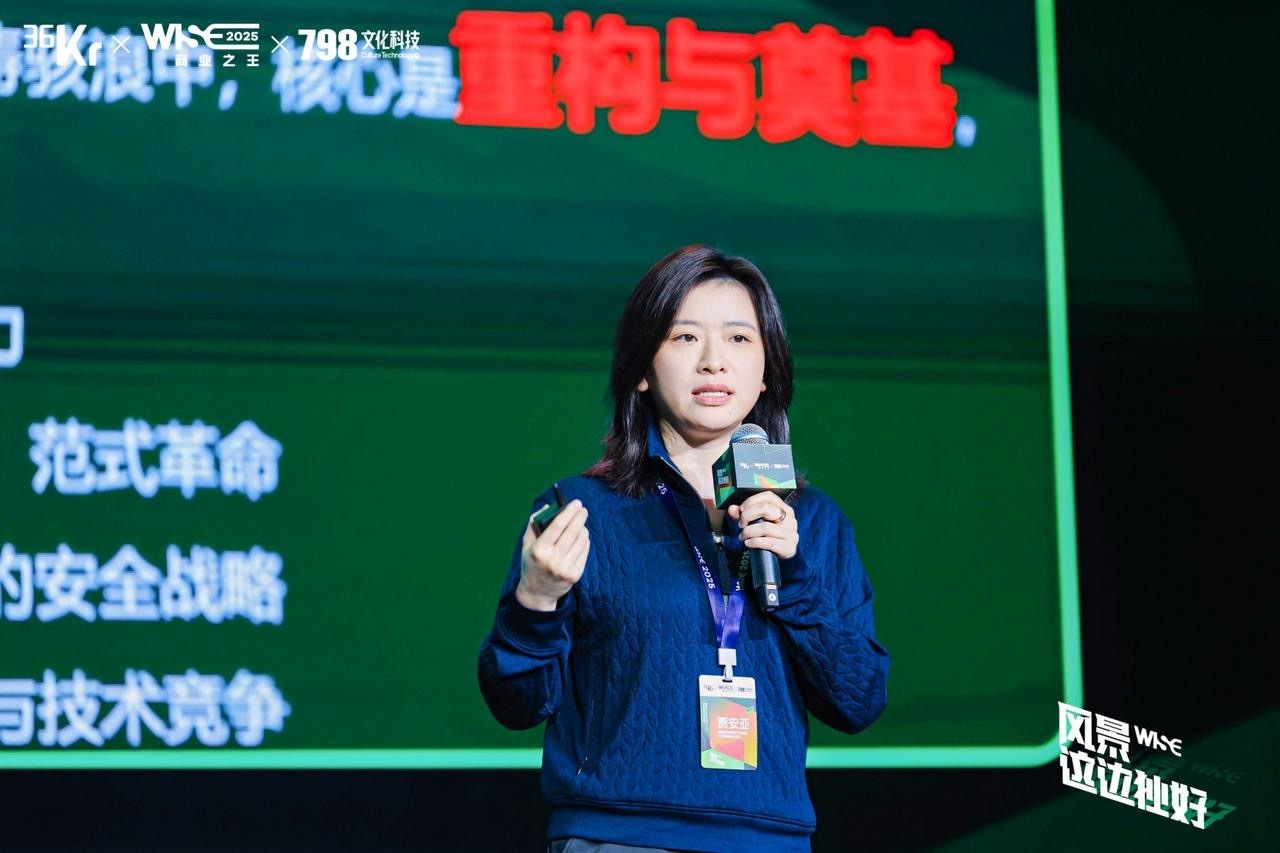
Jia Anya from SenseTime. Photo by 36kr
From the "emergence of intelligence" in 2023 to the accelerated implementation in 2025, the application paradigm of AI is undergoing profound changes.
Jia Anya from SenseTime said in her speech that currently, national policies strongly promote the "Artificial Intelligence +" strategy. Meanwhile, in reality, only a very small number of enterprises have truly realized the value of AI.
She believes that the key breakthrough points for enterprises to implement AI lie in two - dimensional transformations: First, shift from the application model dominated by traditional IT departments to the one driven by the business layer, enabling front - line users to become the decision - makers in technology introduction. Second, adopt a precise scenario selection strategy - avoid fields with extremely low error tolerance such as finance and focus on business links with error - tolerance space and significant incremental value, such as supply chain, human resources, and operations.
With the maturity of multimodal technology and the cost optimization brought by the combination of software and hardware, AI will evolve from a simple productivity tool to a systematic solution that can be deeply integrated into the enterprise data process. During the transformation process, enterprises need not an isolated model but a complete solution that can solve practical business problems end - to - end.
The following is a stenographic record of Jia Anya's speech from SenseTime, edited by 36Kr:
Jia Anya: Thank you for the invitation from the organizer. I'm Jia Anya from SenseTime, mainly responsible for various AI - native products related to productivity.
Before the formal speech, I'd like to share some experiences of this week with you. After the release of Nano Banana and Gemini3 last week, I felt the exciting changes brought by another wave of AI technology emergence.
I personally experienced many new functions, including using NotebookLM to generate PPTs based on Nano Banana. I also saw on Xiaohongshu that many users used it to develop game applications.
I conducted many replication experiments, which were really interesting. I deeply felt the possibilities brought by technological progress to personal applications, which indeed significantly lowered the threshold for application use and design.
I've seen many people say that the future barrier may not be the technological barrier but the creative barrier. Last year, I had many doubts about this statement. After all, the threshold for software R & D is indeed very high.
But now, when I really see the development of front - end applications, games, and mini - programs based on AI, I find that it can indeed save a lot of time, including the process of learning front - end languages. So I recommend you to try it, including many excellent domestic models. Our own models also have many similar application scenarios.
Today, I mainly focus on the application of AI in domestic enterprises. Compared with personal companion and creative applications, enterprise applications are a more serious and demanding topic.
From a policy perspective, the good news is that the country has introduced many excellent policies. You can see the "Artificial Intelligence +" policy, aiming to achieve a coverage rate of over 70% for intelligent terminals and agents by 2027. The importance of this policy can be compared to the "Internet +" policy ten years ago, which promoted the large - scale popularization of the Internet in China and created huge economic and social value. The strong support from the country can promote the implementation and application of AI in enterprises from top to bottom.
We've also seen many changes in the application model. Since the concept of large models emerged at the end of 2022 and the beginning of 2023, the application paradigm of large models has changed significantly in the past two years.
In 2023, many people were still engaged in pre - training, incremental training, fine - tuning, etc. In the first half of this year, people started talking about reinforcement learning, then agents, and now multi - agents. We can see that the AI implementation applications consume less and less computing power but have a higher and higher correlation with scenarios and actual implementation value.
Of course, although the overall trend is changing, we've also seen some challenges and difficulties in implementation. This is a report released by MIT in July, which surveyed the implementation of large models in a large number of American enterprises and found that only 5% of the enterprises saw actual value in their financial statements after implementing large models.
Of course, I think this 5% standard is relatively strict because it's indeed not easy to see specific quantitative value in financial reports. The actual effective application should exceed this figure.
But this also shows that the implementation of large models in enterprises still faces many challenges, including the fact that the deployment ability may be overturned in three months due to the rapid development of technology and needs to be redeployed, and the problem of how to integrate these technologies with the enterprise's own data and processes.
However, there are also some findings that make us AI practitioners quite happy. For example, the success rate of enterprises implementing AI independently is less than one - third of that when external partners help enterprises with implementation.
We've also seen that the success rate of top - down construction in enterprises is not very high, but many employees have spontaneously used various AI tools. So the actual application of AI tools in enterprises exceeds the data shown in the report.
On the right is a report released by Gartner in September, mainly analyzing agents. Some of the viewpoints are quite interesting.
The concept of agents is very popular this year, but in fact, many so - called agents are not real agents in the true sense. They are just low - code, RPA from the past, or simply large models with simple business - layer encapsulation and called agents.
In our view, the concept of agents is not important. What matters is how to combine enterprise needs, various technologies, and applications to help enterprises achieve business goals.
After seeing these surveys, on the one hand, we know that there are still huge unmet needs in the enterprise sector. On the other hand, we also see that the efficiency of the supply side in meeting the large number of enterprise needs is not perfect enough, which brings huge business opportunities for the implementation of AI in enterprises in the next few years.
In the past two years, we've also explored with many enterprises. We're quite happy that in 2023, we mainly cooperated with leading enterprises for implementation. Now, after forming standardized products and solutions, more small and medium - sized enterprises, schools, hospitals, and other institutions are applying based on our general solutions.
Based on our observations, there are several important findings. First, there are significant paradigm differences between the implementation of AI applications and traditional informatization.
Traditional informatization is mostly dominated by the enterprise's CTO and IT departments. After the construction is completed, it's handed over to the business department for use. But now we can see that the implementation of AI applications that truly bring measurable value to enterprises is actually driven by the business layer - the business layer uses our tools first. If they think it's good, then the enterprise introduces it for implementation. This model well fills the gap between the IT department and the business department in terms of demand understanding and implementation.
The second important observation is the key role of scenario selection.
We once cooperated with a leading financial institution. They hoped that the first application scenario would be the finance department. We have a flagship product called Office Raccoon, which mainly provides functions such as AI data analysis, document intelligence, and PPT generation.
At that time, I advised the customer not to choose the finance department as the first - launch scenario. Why? Because the finance department has extremely high requirements for data accuracy and the data complexity is also very high.
Through practice, we found that good AI implementation scenarios for enterprises need to have two characteristics: First, they have error tolerance. Second, they bring high incremental value to users. Financial personnel themselves have strong data - processing capabilities, and reports cannot have errors. But currently, AI cannot guarantee 100% accuracy, so this is not the best scenario.
On the contrary, fields such as the enterprise supply chain, purchase - sales - inventory, human resources, and operations have a large number of data elements but lack enough data scientists for business analysis. These are actually excellent scenarios for enterprise implementation, where incremental effects can be seen immediately.
After implementing in such high - quality scenarios, enterprises can be promoted to further expand their AI construction more quickly.
Another important view is that the implementation of AI in enterprises is not just about purchasing one or two products but a systematic project. Especially for large enterprises, it needs to create in - depth value for enterprises from multiple levels.
We can simply divide the value of AI in enterprises into three categories: First, personal value, which is relatively clear, mainly about personal efficiency improvement, whether it's writing copywriting, writing code, or data analysis. But within an enterprise, the overall operational efficiency depends not only on personal efficiency but also on the overall enterprise management efficiency and the collaboration efficiency between and within teams.
Therefore, we hope that in the long run, AI can not only improve personal efficiency but also enhance team communication efficiency, lower the collaboration threshold, and improve efficiency at the overall management level. Of course, this needs to be verified with the development of AI, especially the improvement of enterprise management efficiency.
This also conforms to the five - layer evolution theory of AI mentioned by Sam Altman (CEO of OpenAI). When it reaches the fourth and fifth layers, true enterprise - level intelligence will emerge.
We can see that the more it is oriented towards personal applications, the easier it is to have relatively standard products and solutions. When it comes to enterprise management, it is more personalized and requires more customization for different industries and individual enterprises.
In the first half of this year, domestic open - source models were very popular. Many enterprises started to independently deploy open - source models. But they encountered a problem: After purchasing NVIDIA or domestic chips and deploying various large models, why can't they be used? Because for enterprises, what they need is a solution that can solve business problems end - to - end, not just a simple model.
Breaking it down, enterprises need to combine large models with enterprise data, processes, business flows, etc. The model itself can be a language model, multimodal, text - to - image, text - to - video, etc. But understanding the enterprise's business goals and the industry is a more important part of enterprise implementation.
At the technical level, we increasingly realize the importance of multimodality. SenseTime introduces more multimodal collaborative training methods during the model training stage and introduces necessary capabilities required by agents such as sandboxes and planning during the reinforcement learning stage to improve the accuracy of the model in solving enterprise business problems. This is very important.
Why is enterprise implementation more demanding than personal implementation? Because individuals are not as sensitive to accuracy, while enterprise AI is directly related to the enterprise's final results, and the accuracy requirement is very high.
We can see that enterprise data elements are very diverse, including not only text but also pictures, databases, and various structured and unstructured data. When applying in enterprises, we need to consider how to combine the multimodal capabilities of the model to achieve complex input, integrated analysis, and result output.
Let's focus on Office Raccoon. We provide AI - native data analysis, text processing, and PPT generation solutions for enterprise - level and individual users. AI has brought significant changes to productivity tools.
In the past, we had Windows and Office suites, which were mainly based on the informatization foundation and were tool - based applications for documents. Later, there were mobile Internet and cloud - based collaborative tools. Now, with AI, we can transform the traditional productivity paradigm oriented towards files into a productivity paradigm oriented towards tasks. By processing different files and background information, we can more actively solve practical problems end - to - end for user tasks. This is the transformation process from productivity tools to productivity assistants.
This is also the evolution path of Office Raccoon. When it was released in January 2024, it was the first data agent in China. Later, more AI capabilities were integrated. By the upcoming 3.0 version this year, in fact, Raccoon is a brand - new upgraded AI office system, which is very different from traditional office systems.
Regarding specific functions, since accuracy is very important, why did we develop the first data analysis agent in China? Because through model training and reinforcement learning, in data analysis tasks, the actual implementation accuracy in enterprises will exceed 95%, and in many vertical data analysis tasks, it can even reach 100%. This is the accuracy that is truly usable on the enterprise side.
If the accuracy is only 80% - 90%, a large number of users will generate a lot of error information when using it. So ensuring the accuracy of the model in application scenarios is crucial.
The second important function is the Task Planning Agent. We found that if the goal is clear, the problem is relatively easy to solve. But when facing complex problems, there is often a lack of sufficient information input and a clear goal. We need to use the AI - guided method to help users better understand the goal, conduct in - depth research, and provide ideas for solving the problem.
By combining these two methods, we can not only well meet the clear goal requirements of enterprises but also help senior enterprise managers solve complex tasks.
Our ultimate goal is to transform from AI productivity tools into AI productivity.
Finally, I'd like to add that I've recently experienced many new hardware forms, including the NVIDIA DGX Spark (AI supercomputer) I got yesterday. It's very interesting.
Cost is an important factor in enterprise implementation. In the past, people thought that the computing power cost was very high. But now, with the development of technology, whether it's inference acceleration, model architecture optimization, or hardware optimization, we have many excellent low - cost hardware options in actual enterprise implementation.
So in the future, the development of AI will not only solve enterprise problems from the software side but also meet everyone's needs at a lower cost through the combination of software and hardware.
Thank you!