Can Doubao make it happen for AI to take over mobile phones?
The pace at which large Internet companies are entering the AI terminal market is faster and more aggressive than expected.
Following Alibaba's launch of the Quark AI glasses, ByteDance recently released the "Doubao Mobile Assistant Technical Preview Version". The first batch of engineering prototypes were custom - made in cooperation with ZTE. The model is Nubia M153, priced at 3,499 yuan, and it is currently sold out on the official website.
After the news was released, ZTE's A - shares (000063.SZ) once hit the daily limit, and its H - shares rose by more than 10%. Meanwhile, due to the small sales volume of the engineering prototypes, the price of this phone on the second - hand trading platform has been marked up by 700 to 1,500 yuan.
Currently, almost all mobile phones promote themselves with "AI" as a selling point. Mobile phone manufacturers basically adopt the technical route of accessing large - model APIs and self - developing end - side models, providing applications in the AIGC category such as AI photo retouching and writing.
Radical players like Honor simulate clicks by invoking the "Accessibility Mode" of the Android system, allowing AI to replace users in operating some apps, such as ordering coffee.
Different from the above development routes, ByteDance has carried out in - depth cooperation with ZTE, integrating the Doubao large model and Agent into the operating system, and "taking over" the phone in some scenarios to achieve automated operations. This in - depth binding model of "leading large model + mobile phone hardware" is the first of its kind in the market and has attracted high attention from the industry and consumers.
AI Deeply Takes Over the Mobile Phone
The mobile phone voice assistant emerged in the early days of smartphone development. The well - known one is Apple's Siri, which was launched as a new feature of the iPhone 4s in 2011. At that time, since AI technology had not yet boomed, the functions of the voice assistant were relatively limited, only capable of simple operations such as checking the weather, setting an alarm, or opening an app, and did not fundamentally change the user experience of using the phone.
With the birth of GPT in 2022, AIGC technology has gradually become popular. Supported by multi - modal large models, mobile phone assistants have gradually shifted from the "App" form to the "Agent" form. Simply put, they can replace humans in operating the phone and completing complex instructions. The Doubao Mobile Assistant is a product based on this logic.
In the video, the staff demonstrated in various ways how to use the Doubao Mobile Assistant to "take over" the phone, such as full - managed shopping price comparison, placing an order, and payment. Except for sensitive links such as payment that require manual completion by the user, other operations can be achieved by invoking the GUI Agent (simulated click).
In the more advanced "Mobile Phone Operation Pro Mode", Doubao can not only simulate clicks but also invoke various tools. It also supports context memory, which can reduce the frequency of asking users for information and greatly improve the fluency.

The staff demonstrated a very complex operation: Go to Paris next month, mark the Parisian restaurants collected on social media on the map, check which museum has an exhibition on the day after arrival, book a ticket for 10 a.m. on a travel platform, and organize the relevant information into the memo.
In the process of handling this task, the Doubao Mobile Assistant successively opened multiple applications such as Xiaohongshu, WeChat, Dianping, and the map, read the relevant data, and successfully completed the map marking. Then, by invoking the "PersonalContext_Search" (personal context search) tool, it analyzed the type of museum the user likes, then queried the exhibition dates and completed the ticket booking on the travel platform, taking a total of 8 minutes and 4 seconds. During this period, the user only needed to intervene when confirming key information and payment information, and other steps were automated, which was very convenient.
In addition, some users who bought this phone shared their usage experiences on social media, including self - taking and retouching photos, ordering takeaways, and price - comparison shopping. The Doubao Mobile Assistant can complete these tasks relatively smoothly. Of course, since it is still in the testing stage, some tasks may take a long time and require multiple user interventions, which are expected to be continuously optimized with software updates.
Doubao said that it will maintain an update frequency of about once every two weeks (excluding holidays) from the date of release until the first quarter of 2026.
Three Days after Launch, Users' WeChat Accounts Showed "Abnormal Login"
Different from traditional voice assistants, AI assistants need to read and invoke a large amount of data from users and third - party apps to better understand the context. Therefore, data security and compliance are crucial and can easily cause disputes.
On December 3, the third day after the launch of the Doubao Mobile Assistant, some users' WeChat accounts were logged out. According to a report in the First Financial Daily, users received a WeChat prompt saying "Your WeChat login environment is abnormal. For the security of your account, please log in again on another device." It is reported that after the user tried to change the WeChat account, the account was logged out again.
In addition, if a user tries to operate WeChat through the Doubao Mobile Assistant, a message will appear saying "The operation of the Doubao Mobile Assistant on the phone is a laboratory function and does not currently support the operation of WeChat."
A relevant person from WeChat responded: "There is no special action. It may be that the existing security risk control measures have been triggered." Referring to the Tencent WeChat Software License and Service Agreement, it clearly prohibits "logging in or using this software and service through third - party software, plugins, add - ons, or systems not developed or authorized by Tencent, or performing automated operations, or creating, publishing, and spreading such tools and methods." If violated, Tencent has the right to restrict account functions or even ban the account.
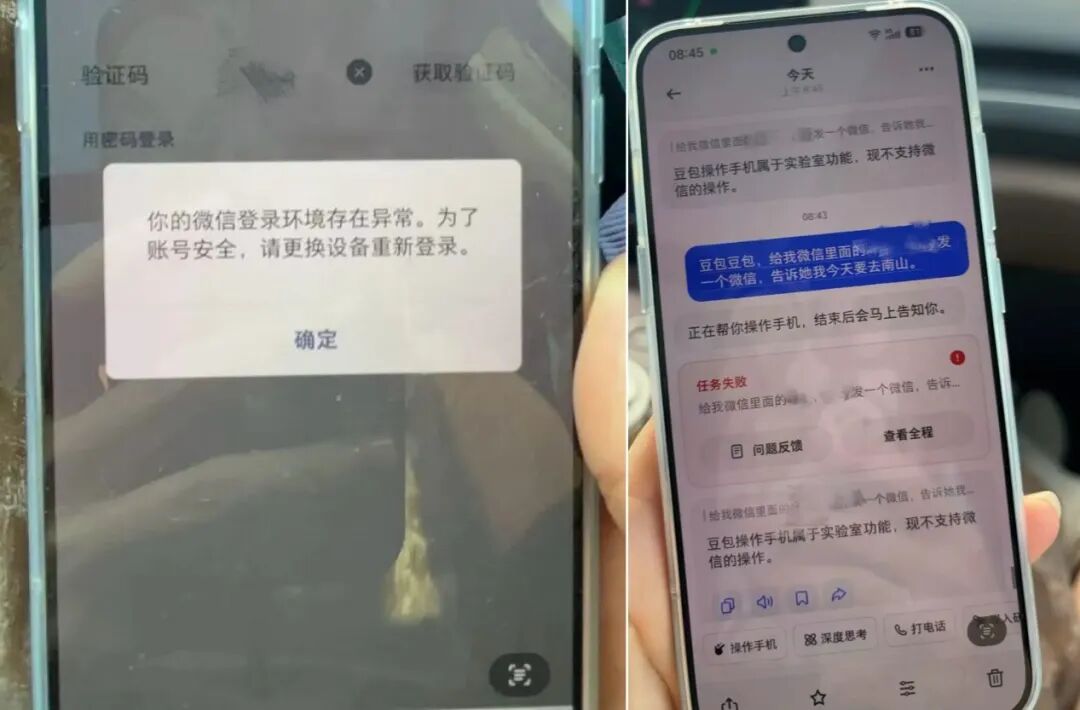
After the incident fermented, the Doubao Mobile Assistant issued an announcement on the evening of the 3rd, stating that the banned WeChat accounts were being unblocked one by one. It also emphasized that the Doubao Mobile Assistant does not engage in any hacking behavior. It needs user authorization to obtain the INJECT_EVENTS permission (Android system - level permission), and the cloud will not store any user screen content, and the relevant content will not enter the model training process.
Li Liang, the vice - president of the Douyin Group, spoke out on Weibo: "I believe that as long as it is user - permitted, there is no behavior of infringing on privacy. The Doubao Mobile Assistant can only complete the task of operating the phone after obtaining user authorization. All the uses of permissions are clearly disclosed in the Privacy and Security White Paper on the official website, and there are no such behaviors as 'invasion' and 'exceeding authority' as some rumors claim."
As for whether the Doubao Mobile Assistant needs to obtain the authorization of the corresponding app operators when reading and processing the relevant app data, and what kind of norms and principles should be followed in data collection and use? As of press time, ZTE has not responded to an interview request from Wall Street Tech Eye.
In the Doubao Mobile Assistant White Paper publicly announced on the official website of the Doubao Mobile Assistant, the information security capabilities and technical measures of the Doubao Mobile Assistant are introduced in four chapters. It promises to collect and use cloud and end - side data in a limited and reasonable manner, and implement security encryption, desensitization, isolation and other protection measures for sensitive data. However, it does not clearly list which specific authorizations from third - party apps it has obtained.

This small incident has exposed the current dilemma of third - party app invocation faced by AI assistants. Industry insiders point out that although regulations such as the Regulations on the Management of Network Data Security have made corresponding regulations on automated tools and AIGC - generated data, due to the large number of entities involved in the data circulation of AI phones (assistants), the responsibility attribution at each link cannot be clearly defined. From the perspective of third - party app manufacturers, simply obtaining user authorization does not mean that AI phones (assistants) can manage their apps or invoke data, as it may involve trade secrets.
On the positive side, the industry is actively promoting the establishment of relevant standards. On December 2, the Cloud Computing Standards and Open - Source Promotion Committee, in conjunction with the China Academy of Information and Communications Technology, released the Security Guidelines for Dual Authorization of End - Cloud Collaborative Intelligent Agent Interaction, which clearly states that an intelligent agent must obtain both application authorization and user authorization to legally access third - party applications.
The Knocking Stone for AI Giants, a New Opportunity for Mobile Phone Manufacturers
Although the Doubao Mobile Assistant is still in the technical preview stage, it has clearly attracted great attention and has increased the exposure of ZTE phones to a certain extent, which is a win - win situation. Undoubtedly, the market expansion demands of ByteDance and mobile phone manufacturers have contributed to this cooperation.
For ByteDance, hardware is a missing piece in its strategic layout. In recent years, ByteDance has acquired assets such as Pico, Smartisan, and Oladance, obtaining the hardware design capabilities for phones, earphones, and VR headsets. However, it has not yet formed a product pattern of "ace app + self - developed hardware". After the monthly active user number of Doubao exceeded 150 million, AI - native applications have clearly become a breakthrough point.
At present, Doubao has clearly stated that "there is no plan to develop self - developed phones, and it is in talks with multiple manufacturers about cooperation on the Doubao Mobile Assistant". However, another Doubao hardware product, the Ola Friend earphone on its official website, is self - developed and comes from the Oladance brand it acquired, indicating that ByteDance still pays attention to the AI hardware market but has adopted a relatively cautious development approach.
In fact, in the early days of smartphone development, large Internet companies such as Facebook, Alibaba, and Tencent have all dabbled in customizing OS (or UI) and launched mobile phone hardware through cooperation with mobile phone manufacturers. However, due to lack of competitiveness, they failed to enter the mainstream market. Examples include the Alibaba Cloud phone and the HiQQ phone.
The hardware complex of large Internet companies actually stems from the logic of "combining software and hardware". The late Apple founder Steve Jobs once said that "Apple is a software company", and its core competitiveness comes from the combination of self - developed OS and hardware. The Mac and iPhone are products born under this logic, bringing great success to Apple.
If OS was the dominant force in the old era, then AI is the hope of the new era. Wu Yongming, the CEO of Alibaba, boldly predicted in a speech that large models will be the next - generation operating system, and AI Cloud will be the next - generation computer. This also explains why large Internet companies are flocking to the AI hardware market, whether through self - development or cooperation.
In addition, in the context of the declining mobile phone market year by year, AI has become a new growth driver and has attracted the attention of mobile phone manufacturers. Large - model training requires heavy asset investment, and not all enterprises can afford it. For second - tier brands like ZTE, cooperating with leading large models is undoubtedly the most cost - effective way.
However, whether the "Doubao model" can become the mainstream in the market remains to be seen. On the one hand, large mobile phone manufacturers such as Apple and Huawei are relatively cautious in their cooperation with large - model manufacturers. Under the product architecture of their own OS, it is unlikely that they will open core permissions to third - party large models.
In the Android camp, domestic mobile phone manufacturers have a relatively open attitude. According to current information, manufacturers such as OPPO, vivo, and Honor do not have plans to integrate the Doubao Mobile Assistant, but the possibility of future cooperation cannot be ruled out. According to media reports, an insider from a mobile phone manufacturer said that Doubao should release a technical solution next month, and the company is taking a wait - and - see attitude. Currently, there is no cooperation plan, but it is not excluded. "It depends on the matching degree between Doubao's solution and the AI functions we want to develop," the insider emphasized.
This article is from the WeChat public account "Wall Street Tech Eye", author: Leon, editor: cc Sun Congying. Republished by 36Kr with permission.