Elon Musk's brain-computer interface enables mind control of a robotic arm. The demonstrator receives a "kiss of steel," and in theory, it can control everything.
There's new progress in Elon Musk's brain-computer interface project.
In an official Neuralink video, a demonstrator has achieved mind control of a robotic arm.
The robotic arm steadily lifted, then reached towards the demonstrator's mouth and "gave a kiss."
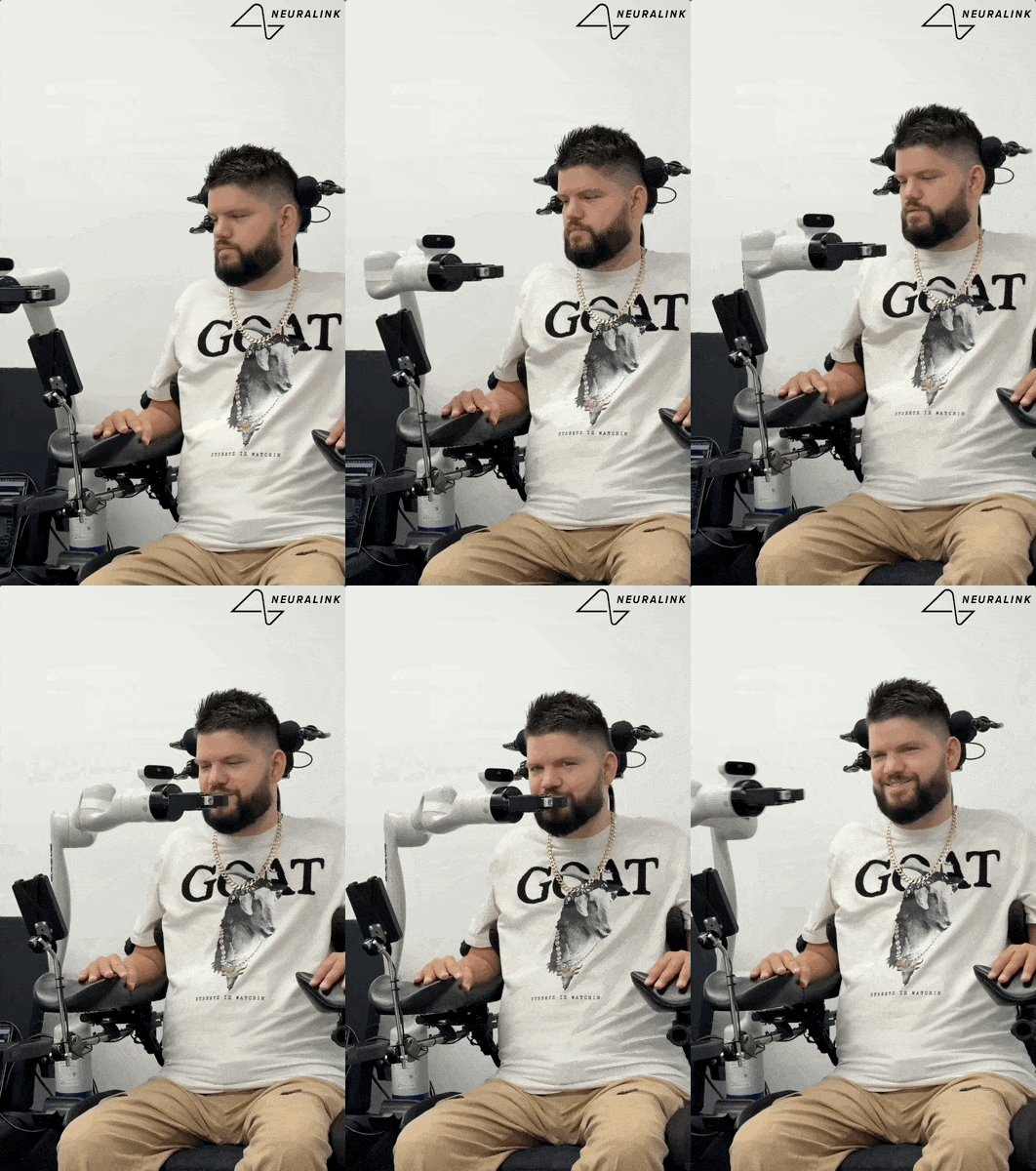
Musk also said that in theory, through a computer or mobile phone, Neuralink will be able to indirectly control everything.
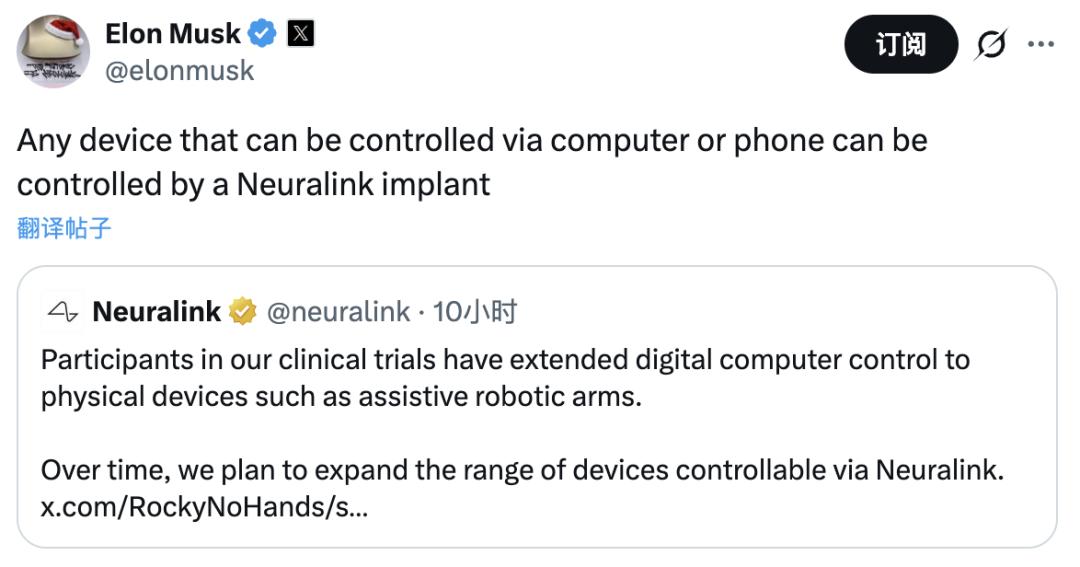
Meanwhile, Neuralink is advancing an upgrade experiment.
The first subject may receive an update
Neuralink's upgrade experiment will adopt a "dual-implant" plan. The first human subject, Noland Arbaugh, is expected to become the first patient to undergo a second surgery.

The plan is to add a second interface at the spinal cord while keeping the existing cranial implant.
The purpose of this architecture is to establish a "digital neural bridge." The chip at the brain end is responsible for decoding movement intentions, and the chip at the spinal cord end is responsible for receiving instructions and directly stimulating limb nerves, thereby bypassing damaged biological pathways and attempting to enable paralyzed patients to regain the ability to walk.
In terms of hardware stability, the technical team has completed a key iteration to address the "electrode wire retraction" problem exposed in the first-generation product.
In response to the situation where the electrode wires became loose and the signal weakened due to an intracranial air gap in the first patient, in the surgeries for the second subject, Alex, and subsequent patients, the team improved the surgical plan by strictly controlling the gap between the implant and the brain surface (Gap Reduction) and optimizing the strategy to prevent brain tissue displacement during the surgery.
These measures effectively eliminated the physical retraction phenomenon and ensured the long-term stability of the signal. The current R & D roadmap shows that the technical focus is shifting from one-way EEG reading to complex "brain - spinal cord" two-way signal bridging.
Musk revealed that in the future, this multi-implant collaborative architecture is not only for medical repair but also plans to significantly increase the information transmission bandwidth through hardware stacking. The ultimate goal is to enable the subject's reaction speed and digital interaction efficiency to exceed the normal level.
Users explore new uses of the brain-computer interface on their own
In addition to the functions set by the official, Neuralink subjects are also actively exploring more uses of the brain-computer interface in daily life.
Brad Smith, the third human subject of Neuralink, is a typical example.
Although he can skillfully control the computer cursor with his mind, he soon realized that the cursor alone could not solve the physical visual field limitation caused by amyotrophic lateral sclerosis.
Specifically, because he couldn't turn his neck, his line of sight was fixed on the computer screen directly in front of him.

Instead of waiting for the medical team to develop a dedicated visual aid, Smith researched online by himself and selected an ordinary conference webcam.
This requirement initially confused the Neuralink team, which focuses on neural signal transmission. But at Smith's insistence, the engineers helped him fix this consumer - grade electronic product on his wheelchair and connected the control system.
Now, Smith only needs to imagine hand movements in his mind to click the control panel on the screen and command the camera to rotate and zoom.
To adapt to his usage habits, the camera manufacturer even specifically adjusted the software parameters so that one mental click from him can make the lens turn three times faster than usual.
Through this self - assembled system, he can finally zoom in to see the wedding photo on the wall and observe the expressions of guests at the dinner table through the screen during family gatherings.

This kind of user - led exploration is not an isolated case in the brain - computer interface circle.
Nathan Copeland, a senior user who has had another brain - computer interface implanted for more than ten years, also said bluntly that the brain - computer interface is just a tool in his toolbox and must be used in conjunction with ordinary devices in daily life.
To control the lights and TV at home, he directly uses the Google Home voice assistant. To play video games, he even asked someone on the forum to help him weld the parts of an arcade joystick and an Xbox controller together to make a special controller suitable for him to operate.
These users don't limit themselves to the role of medical experiment subjects. Instead, by connecting expensive implants with cheap cameras and smart home devices, they have regained the autonomy to observe the world and control their lives.
Neuralink in the past two years
In the two years from 2024 to 2025, Neuralink achieved the first batch of human implants and made substantial progress in multiple technical directions.
In January 2024, Neuralink successfully implanted the brain - computer interface chip N1 into a high - level paraplegic patient for the first time.

The surgery was completed by the R1 robot independently developed by Neuralink. The chip was connected to the motor cortex of the brain through 1024 flexible electrodes. After the surgery, the system could collect neural signals in real - time and transmit them wirelessly to external devices via Bluetooth.
A few weeks later, the patient successfully controlled the computer mouse and operated the typing interface with his mind during a live broadcast, proving that the brain - computer closed - loop system achieved its initial functions in a real human body.
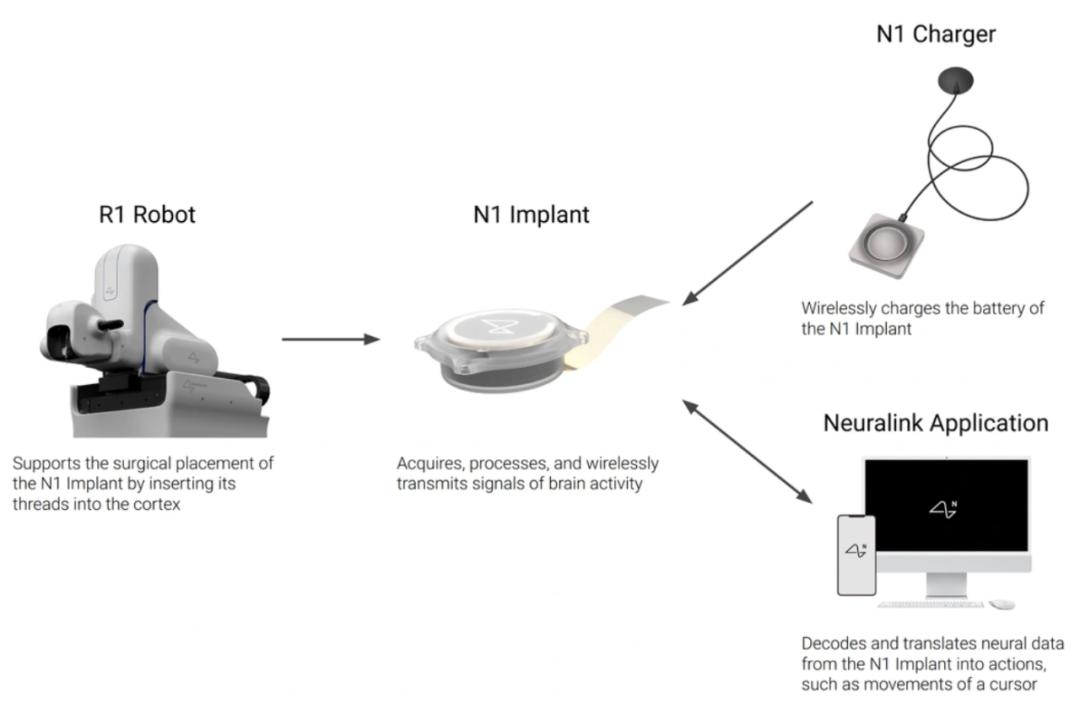
In the following months, Neuralink continuously optimized the signal decoding accuracy, device battery life, and safety, and began to recruit more subjects.
In September 2024, its "Blindsight" project for visual restoration received the "Breakthrough Device" certification from the FDA. The goal is to achieve basic visual perception in blind users by stimulating the visual cortex.
In May this year, its system for assisting language functions also received the same certification. It plans to develop a "brain signal → speech/text" pathway for aphasic patients.
By September this year, Neuralink announced that it had completed implant surgeries for 12 subjects. The cumulative device operation time exceeded 15,000 hours, with no major rejection reactions, and the overall operation was stable.
This marks that Neuralink has completed the transition from single - case verification to multi - case deployment. Meanwhile, the company said that it is preparing for more international clinical trials and has obtained ethical and regulatory approvals in the UK, Canada, and other places.
In the past two years, Neuralink achieved the first human implant of the device, verified the mind - control function, expanded multi - case clinical trials, and obtained multiple FDA certifications, establishing the practical feasibility of its early applications in the field of brain - computer interfaces.
In the next stage, its focus will gradually expand from motor control to more complex neural function fields such as language and vision.
One more thing
Recently, what has attracted more attention about Neuralink is the latest interview revelation from Elon Musk.
Since the interviewer has an Indian - related background, Musk voluntarily mentioned Shivon Zilis and referred to her as his "partner." He said that one of their children has an "Indian" middle name.

Shivon Zilis, 38 years old this year, is an Indian - Canadian and an executive at Neuralink under Musk.
Reference links:
[1]https://x.com/elonmusk/status/1995945912510939622
[2]https://www.teslarati.com/neuralink-first-patient-could-receive-an-upgrade-elon-musk/
[3]https://www.theverge.com/report/829120/neuralink-bci-webcam
This article is from the WeChat official account "QbitAI". Author: Keleixi. Republished by 36Kr with permission.