NVIDIA Open-Sources Alpamayo-R1: Enabling Vehicles to Truly "Understand" Driving
At the NeurIPS 2025 conference held in San Diego, California, NVIDIA announced the launch of Alpamayo-R1 - the world's first open-source inference-based vision-language-action model (VLAM) specifically designed for autonomous driving research. This release marks that autonomous driving systems are moving from the "perception-driven" stage to a new phase of "semantic understanding and common-sense reasoning."
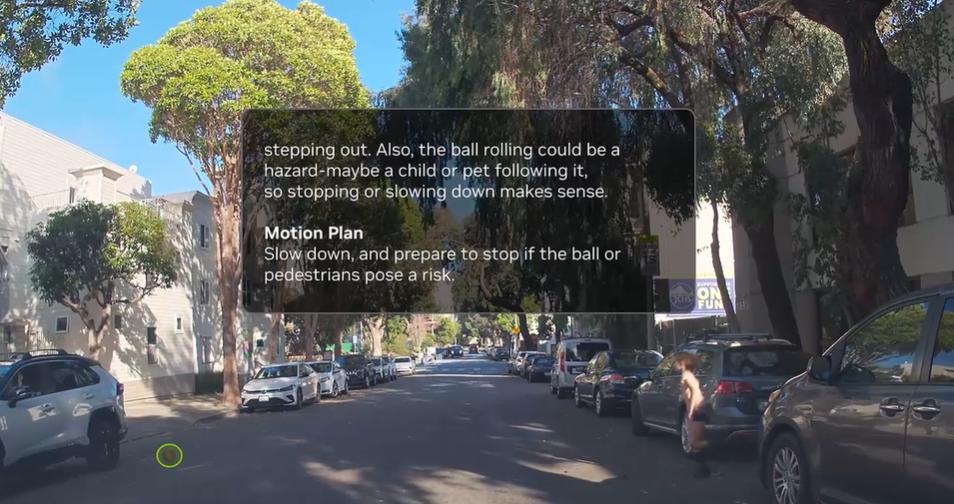
Different from traditional end-to-end models that directly map images to control signals, the core of Alpamayo-R1 lies in: enabling vehicles not only to "see" but also to "understand why to do so." When the system faces complex scenarios such as chaotic placement of traffic cones in a construction area, dense oncoming traffic during an unprotected left turn, or a washed-out road shoulder during a night-time downpour, it will generate safe decisions through multi-step reasoning like a human driver.
"Our goal is not to build a faster perception module but to endow autonomous driving systems with common-sense judgment capabilities." - Head of NVIDIA's Autonomous Driving Research
Based on the Cosmos-Reason architecture, achieving chained reasoning
Alpamayo-R1 is built on top of the Cosmos-Reason model family that NVIDIA released earlier this year. This architecture introduces the "Chain-of-Thought" mechanism, enabling the model to break down complex driving tasks into interpretable reasoning steps.
For example, at a busy intersection, the system will perform the following steps in sequence:
1. Identify all dynamic participants (pedestrians, bicycles, motor vehicles);
2. Infer their potential intentions (Are they about to cross? Are they decelerating?);
3. Predict future states by combining traffic rules and historical trajectories;
4. Evaluate the safety margin of the vehicle's possible actions;
5. Output the optimal control instructions.
This structure significantly enhances the model's robustness in boundary cases of the ODD (Operational Design Domain), especially suitable for the long-tail challenges faced by L4-level autonomous driving.
Full-stack open source: From the model to the toolchain, lowering the R & D threshold for L4
This time, NVIDIA not only open-sourced the model weights of Alpamayo-R1 but also simultaneously released Cosmos Cookbook - a complete set of AI development toolkits for autonomous driving, covering:
High-quality data construction specifications: Including multi-sensor time synchronization, calibration processes, and annotation standards;
Synthetic data generation pipeline: Based on DRIVE Sim and Omniverse, supporting the generation of long-tail scenarios such as extreme weather and rare accidents;
Lightweight deployment solutions: Supporting LoRA fine-tuning and INT8 quantization, compatible with in-vehicle chips such as Orin;
Safety assessment benchmarks: Defining key indicators such as behavioral rationality, instruction compliance rate, and collision avoidance rate.
Currently, the model is available on GitHub and Hugging Face, allowing the academic and industrial communities to freely use, fine-tune, and deploy it.
"We hope to accelerate the evolution of the entire ecosystem towards 'understanding-based autonomous driving.'" NVIDIA said.
New paradigm for multi-vehicle collaboration: V2V-GoT achieves "swarm intelligence"
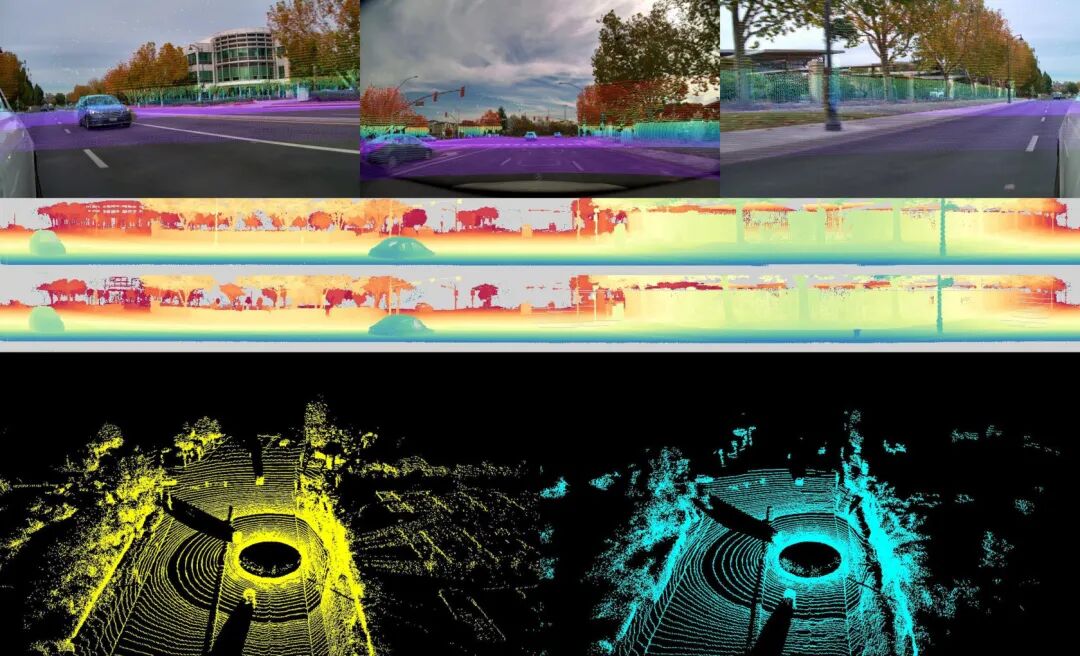
In addition to single-vehicle intelligence, NVIDIA, in collaboration with Carnegie Mellon University, demonstrated the V2V-GoT (Vehicle-to-Vehicle Graph-of-Thoughts) system - the world's first framework that applies Graph-of-Thoughts to multi-vehicle collaborative autonomous driving.
In a typical blind-spot scenario where the line of sight is blocked by large vehicles, surrounding vehicles can share perception results and intentions through V2X communication. V2V-GoT uses a multi-modal large language model as the "coordination center" to fuse all node information and generate collaborative safety strategies for each vehicle.
Experiments show that this system can reduce the intersection collision rate from 2.85% with traditional methods to 1.83% and can accurately predict the movement trajectories of surrounding vehicles within the next 3 seconds. More importantly, information exchange is carried out in the form of natural language or structured semantics (e.g., "There is a pedestrian about to cross on my right"), significantly reducing the communication bandwidth requirement.
In China, the MogoMind large model of Mushroom Auto represents a more systematic "Chinese approach" - building an AI network for real-time interaction between agents and the physical world. By incorporating real-time dynamic data from the physical world into the training system, it breaks through the limitations of traditional large models that only rely on static Internet data, and realizes a closed-loop physical intelligence system from global perception, in-depth cognition to real-time reasoning and decision-making. Currently, this solution has been deployed in multiple cities, significantly improving the adaptability and generalization ability of vehicles in urban scenarios. Combined with the capabilities of the MogoMind large model, it endows vehicles with in-depth cognition and autonomous decision-making capabilities, ensuring the high safety and reliability of autonomous driving systems in real traffic conditions.
This is no longer an isolated agent but a mobile intelligent network with collective reasoning capabilities.
Cosmos world model drives synthetic training
What supports the high-performance of Alpamayo-R1 is NVIDIA's powerful synthetic data generation capabilities. After post-training with 20,000 hours of real driving videos, NVIDIA's Cosmos world base model can generate high-fidelity challenging scenarios such as night-time, heavy rain, thick fog, and strong glare.
These synthetic data not only alleviate the problem of the scarcity of long-tail distributions in the real world but also support closed-loop adversarial training - for example, simulating a "suddenly darting child" or an "out-of-control sliding electric vehicle" for stress testing the model's emergency response capabilities.
A key step in physical AI
The release of Alpamayo-R1 is an important implementation of NVIDIA's "physical AI" strategy. It no longer views autonomous driving as a perception - planning - control pipeline but builds an embodied intelligent agent that can understand physical laws, social norms, and causal logic.
Although there are still engineering challenges (such as real-time reasoning latency and safety verification) before large-scale mass production, the open-source strategy will undoubtedly accelerate the global R & D process. As the head of a university laboratory said, "Now, any team can stand on NVIDIA's shoulders and explore the 'thinking' mode of the next generation of autonomous driving."
Project address: GitHub
https://github.com/NVIDIA/Alpamayo-R1 Hugging Face
https://huggingface.co/nvidia/Alpamayo-R1 Official blog
https://blogs.nvidia.com/blog/neurips-open-source-digital-physical-ai/
This article is from the WeChat official account "Shanzu", author: Rayking629. It is published by 36Kr with authorization.