Li Auto, Seize Opportunities Amid Challenges in 2026
Though it's arduous to sift through thousands of loads of sand, gold can only be obtained after all the wild sand is blown away.
——"Langtaosha: Don't Say Slander Is as Deep as Waves" by Liu Yuxi of the Tang Dynasty
The turning point from an "excellent student" to a "student in adversity."
There was a time when Li Auto was recognized as an "excellent student" among China's new car - making forces. Relying on its precise positioning of "family users" and a unique extended - range technology route, it entered the market with the Li ONE and quickly rose with three "cloned" models in the L series. Its record of 11 consecutive quarters of profitability made it a benchmark in the industry. However, the market never believes in eternal myths. In 2025, Li Auto is facing the most severe challenge since its establishment.
The extended - range advantage that once built its moat is facing a fierce impact of homogeneous competition due to the low technical threshold. The pioneer model MEGA in its highly anticipated pure - electric transformation failed due to controversies over its appearance. Finally, all the problems broke out in the financial report of the third quarter of 2025: the revenue dropped significantly, the company suffered a net loss, and the record of continuous profitability was broken. All this indicates that Li Auto has reached a crossroads in its development, and a profound strategic adjustment is urgently needed. How can Li Auto break the deadlock and survive in this industry elimination race?
Performance under pressure: Key data reflects operational difficulties
Numbers are the most intuitive language. The operational status of Li Auto in 2025 is first reflected in the "change of face" of a series of key data.
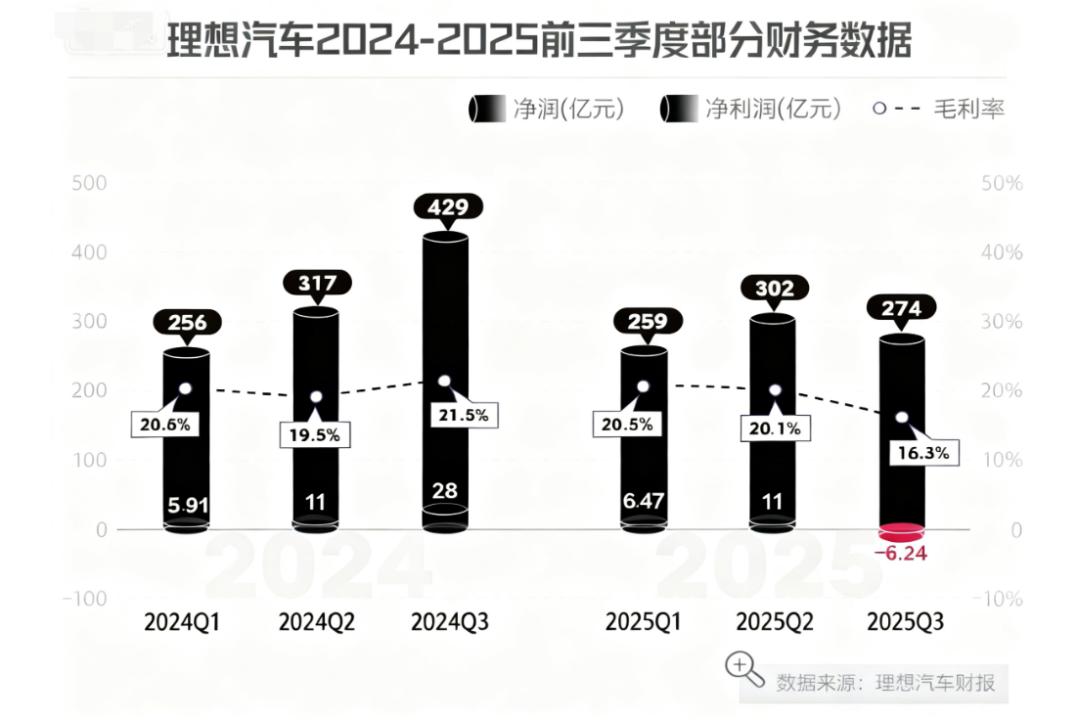
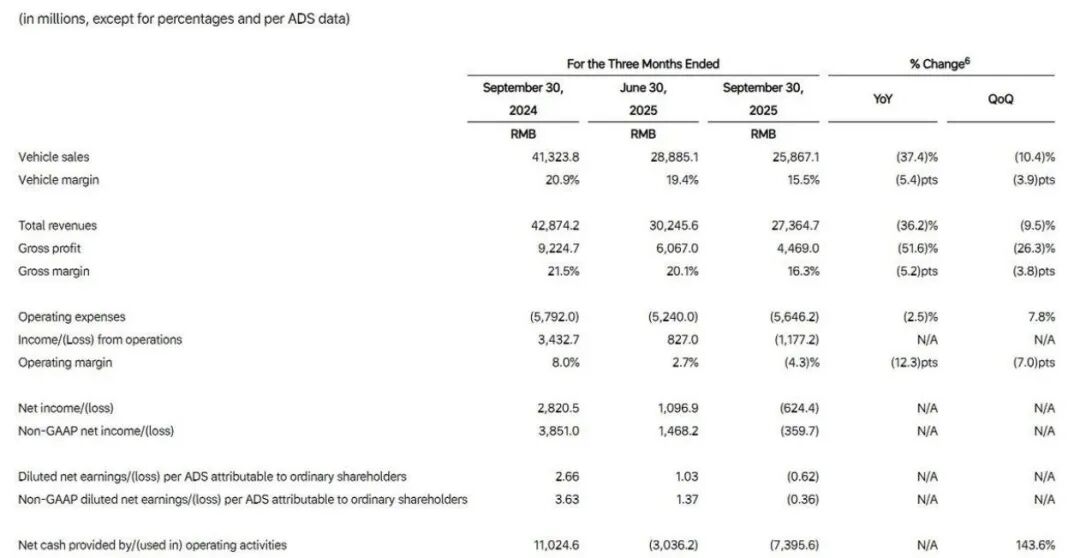
The financial performance is flashing red. According to the financial report of Li Auto for the third quarter of 2025, the company's current revenue was 27.4 billion yuan, a significant year - on - year decrease of 36.2%. More notably, the company had a net loss of 624 million yuan, which ended its previous record of 11 consecutive quarters of profitability, triggering widespread concerns in the market and among investors.
As a key indicator to measure the core profitability of a vehicle enterprise, the vehicle gross profit margin also declined from 20.9% to 15.5%. Li Auto officially explained in the financial report that this was mainly affected by the recall of some models. If this impact is excluded, the vehicle gross profit margin is about 19.8%. Nevertheless, this figure still shows significant pressure on profitability compared with its historical peak.
The sales growth has suddenly stalled. Delivery volume is the lifeline of new car - making forces. The delivery data of Li Auto in Q3 2025 shows that it only delivered 93,200 new cars this quarter, a year - on - year plunge of 39%. The cliff - like decline in sales forced Li Auto to lower its annual sales target twice this year. According to a report from Changjiang Business Daily, its annual sales target has been gradually lowered from 700,000 at the beginning of the year to 640,000. It is worth noting that according to the 21st Century Business Herald, while Li Auto lowered its overall target, it raised the sales target of its pure - electric vehicles from 50,000 to 120,000. This subtly reflects the company's urgent adjustment of its business focus.
Its market position is being challenged. The once - established pattern of "NIO, XPeng, and Li Auto" has long been broken, and Li Auto has lost its throne as the sales champion among new car - making forces. This shows that Li Auto is facing a fierce siege from latecomers using the "low - price, high - configuration" strategy in its traditional extended - range advantage field, and its market share is being rapidly eroded.
Root causes of the crisis: Systemic risks under the combination of internal and external difficulties
Li Auto's current predicament is not a problem that has emerged overnight but the result of the superposition and resonance of multiple internal and external factors.
External competition: The moat has become a red ocean, surrounded by strong enemies
The extended - range technology, which was the starting point of Li Auto's success, has quickly become the focus of many brands' pursuit and even homogeneous competition due to its relatively low technical threshold. Brands such as Leapmotor, ARCFOX, XPeng, and Xiaomi have achieved a "dimensionality - reduction strike" on Li Auto with higher cost - effectiveness and more flexible configuration strategies. In the pure - electric track where Li Auto is determined to transform, the pattern has already solidified.
Tesla firmly occupies the core position in the global new - energy vehicle market with its strong brand effect and self - developed technology ecosystem. It maintains leading advantages in multiple key areas such as sales rankings, technical standards, and industrial ecosystems.
NIO has built extremely high competitive barriers through its unique battery - swapping system and user community.
XPeng has built a technical moat with "full - stack self - developed intelligence + efficient energy - replenishment ecosystem." In addition, the XPeng Super Extended - Range X9 has been launched, directly targeting Li Auto's core area.
Xiaomi Auto, relying on its 600 million user base, AIoT ecological resources, and its accumulation in the consumer electronics field, has opened up a new competitive path with "ecological reconstruction + cost control" and built a unique "cross - border integration" barrier. In addition, the Xiaomi Extended - Range SUV YU9 is expected to be launched in 2026.
As a "latecomer" in the pure - electric field and a pioneer in extended - range technology, Li Auto is facing a tough battle on both fronts.
Moreover, in the first half of this year, the market share of extended - range vehicles in the domestic new - energy vehicle market has dropped from 10.7% in 2024 to 9.8%. Since June, the sales volume of extended - range vehicles at the domestic terminal has been declining year - on - year for five consecutive months.
Product strategy: Shortage of new products and internal competition
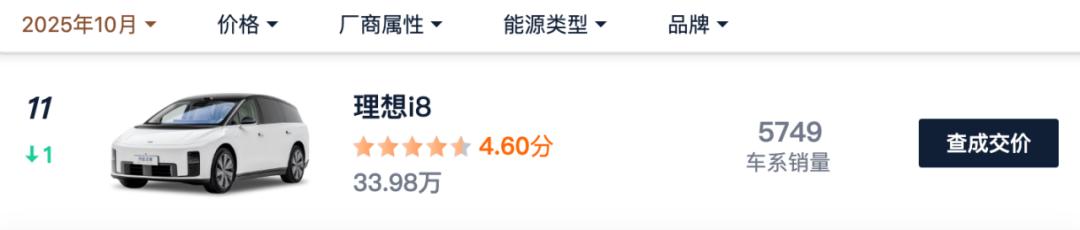
Currently, Li Auto has three pure - electric models: MEGA, i8, and i6. The first pure - electric flagship model MEGA in 2025 caused great controversy in the market due to its advanced "high - speed - rail - style" appearance design and failed to replicate its success in the extended - range market. The delivery of the pure - electric SUV i8, which is regarded as the key to high - volume sales, also far fell short of expectations.
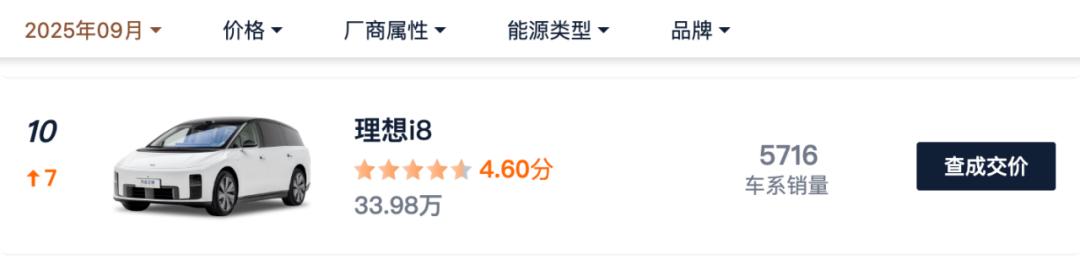
According to the sales statistics of AutoHome in October 2025, the average monthly delivery volume of the i8 in September and October was only about 5,700, which can only be described as mediocre. In addition, the long - criticized "cloned" family design has begun to cause consumers' aesthetic fatigue. More problematically, after the launch of the lower - priced pure - electric sedan i6, it quickly became popular. Although it achieved nearly 50,000 large orders in 48 hours, it had an "internal squeezing" effect on the higher - positioned i8 and the original extended - range L series, resulting in internal competition within the product matrix and failing to form a synergy.
Internal management: Big - company disease and over - dependence on the supply chain
With the rapid expansion of the company's scale, the "professional manager" management model and the PBC (Personal Business Commitment) performance system introduced by Li Auto have recently been criticized for their poor adaptability to the company's original entrepreneurial culture, resulting in a longer decision - making chain and lower efficiency.
At the just - held Q3 2025 earnings conference, Li Xiang denied the attempt to transform into a "professional manager" governance system in the past three years. He believes that this model does not fit the current unstable market environment and Li Auto's actual situation, and even said that his performance in the past few years was the "worst self."
Therefore, Li Auto announced that it will fully return to the startup company model starting from the fourth quarter of this year.
On the supply - chain level, over - dependence on a single supplier also brings risks. The production progress of some i6 models was affected by the supply fluctuations of core components, causing Li Auto to miss some opportunities in the pure - electric market.
The result of the transformation will determine survival
From the perspective of the industry development law, the new - energy vehicle market is shifting from high - speed growth to high - quality competition. It is not uncommon for enterprises to have periodic losses during the technology iteration period.
As Li Xiang said at the earnings conference call: "The third quarter of 2025 is the first quarter of Li Auto's second decade. We have faced multiple challenges such as the product cycle, supply chain, and public opinion, but these will all become the stepping stones for transformation." In this transformation that determines success or failure, production capacity, cost control, and management model have become the biggest variables in the implementation of Li Auto's strategic transformation.
When the vehicle business is under pressure, the only thing that has increased against the trend in the financial report is R & D investment. According to the Q3 financial report released by Li Auto, the annual R & D expenses are expected to be 12 billion yuan, of which more than 6 billion yuan will be invested in the field of artificial intelligence throughout the year. That is, more than 50% of the R & D funds are expected to be invested in the fields of intelligent driving and large AI models.
In addition, on December 2nd, according to a report from Houchangcun, Li Auto announced a strategic cooperation with Zeiss and released a smart glasses product. Whether this technological investment can be converted into commercial value, form a popular feature that users can strongly perceive, and effectively boost sales remains uncertain. The current gross profit margin of 16.3% is unable to support long - term R & D consumption, and the capital market's patience with AI stories usually does not exceed two earnings cycles.
Moreover, in this fierce competitive environment where the big fish eat the small fish and the small fish eat the shrimp, during the critical window period of its transformation, competitors will not sit idle. The price pressure from Tesla, the cost - effectiveness offensive from XPeng, and the technological siege from the Huawei - affiliated companies will all continue.
Summary
In 2025, it was Li Auto's "coming - of - age ceremony." It was forced to leave its comfort zone and enter a more complex and cruel arena. The core of its strategic transformation is to try to hold on to its extended - range market share while striving for a breakthrough in the pure - electric track. Through organizational change, vertical integration of the supply chain, and leadership in AI technology, it aims to rebuild the company's core competitiveness. This is a race against time. Whether Li Auto can cross the cycle and return to the growth track through this profound self - innovation depends not only on the firmness of its strategic implementation but also on its adherence to and evolution of the brand's original intention of "creating a mobile home." In the deep - water area of transformation, only the brave with vision, courage, and extreme efficiency can reach the other shore.
Finally: Can the Wuling Xingguang 730 change its car logo?
Reference materials:
"Li Auto's Q3 Revenue Reached 27.4 Billion Yuan" - Beijing News
"The 'Disciples of Li Auto' Overturned Li Auto" - Phoenix Finance
"Both Revenue and Profit Declined, and the Pure - Electric Product Quality Control Faced Controversy. Is Li Auto's Status Among the 'Big Three' at Risk?" - Blue Whale News
"The Pattern of New Car - Making Forces Has Changed: Leapmotor Continues to Lead, and the Second - Tier Brands Are Accelerating to Break Through" - 21st Century Business Network
This article is from the WeChat official account "Houchangcun". Author: Houchangcun. Republished by 36Kr with permission.