DeepSeek V3.2 is released! The actual test results are amazing, and affordability is its greatest advantage.
Xiaolei noticed that DeepSeek seems to really like surprising everyone late at night.
On the evening of December 1st, DeepSeek suddenly rolled out an update: Version V3.2 was officially launched and made available to all users. Meanwhile, the local deployment model of V3.2 was also uploaded to various open - source communities for all users to use. According to the test results released by the official, the inference ability of DeepSeek V3.2 is basically on par with OpenAI's GPT - 5, but its cost is far lower than that of GPT - 5. Just this fact alone is enough to excite many people.
Well, without further ado, let's get straight to the point and see what improvements DeepSeek has brought us this time.
Stronger Inference and Lower Cost
DeepSeek V3.2 comes in two versions. One is the DeepSeek V3.2 version available for free use on the DeepSeek official website, and the other is the DeepSeek V3.2 - Speciale, which only supports API service access. According to the official description, the Speciale version has stronger inference ability and is mainly used to explore the upper limit of the current model's inference ability.
In addition to automatically entering the "enhanced long - thinking" mode, V3.2 - Speciale combines the theorem - proving ability of DeepSeek - Math - V2, endowing it with stronger instruction - following, mathematical - proving, and logical - verification abilities. In the official test, the inference benchmark test results of V3.2 - Speciale are directly comparable to the latest Gemini - 3.0 - Pro.
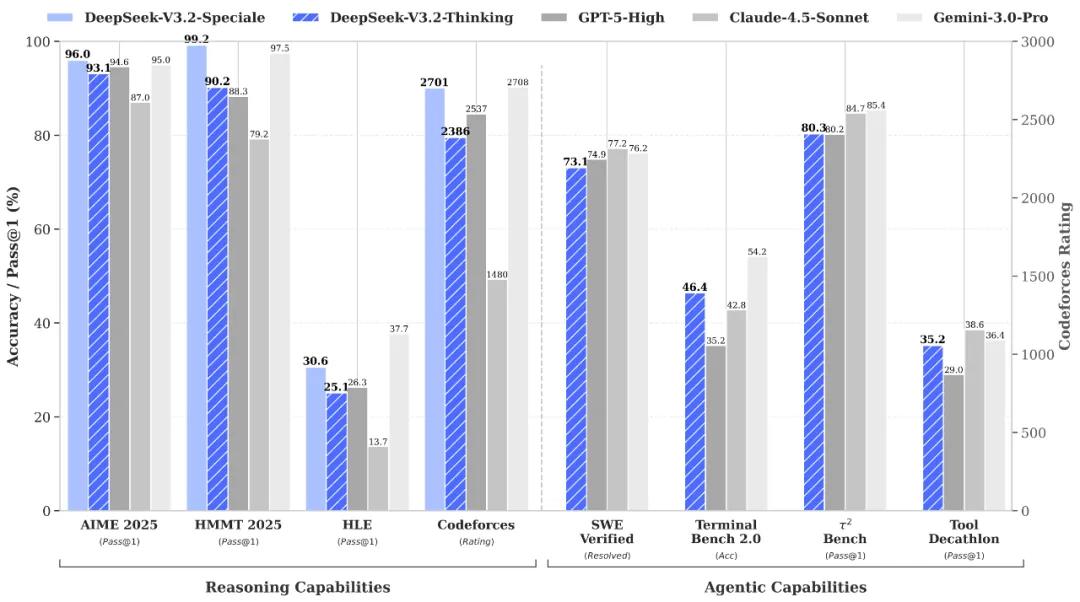
Image source: DeepSeek
Meanwhile, DeepSeek also used V3.2 - Speciale to test the final exam questions of four competitions, including IMO 2025 (International Mathematical Olympiad), CMO 2025 (Chinese Mathematical Olympiad), ICPC World Finals 2025 (International Collegiate Programming Contest World Finals), and IOI 2025 (International Olympiad in Informatics), and won gold medals in all of them.
Especially in the ICPC and IOI tests, it directly reached the levels of the second and tenth human contestants. It's not hard to see that DeepSeek V3.2 has made more significant progress in fields such as programming. Moreover, in the horizontal comparison, the competition results of DeepSeek V3.2 - Speciale have all surpassed those of GPT - 5 High, catching OpenAI off guard.
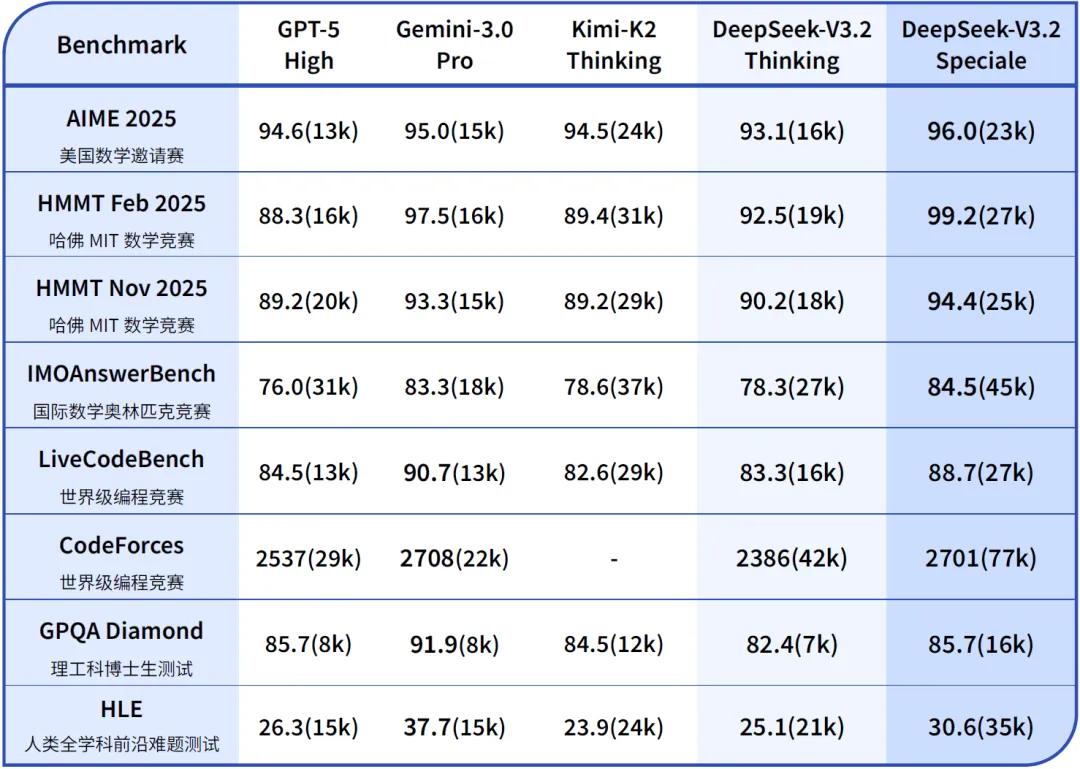
Image source: DeepSeek
In the official technical documentation, they mentioned that the main breakthrough of DeepSeek V3.2 is the introduction of the DeepSeek Sparse Attention (DSA) mechanism, and the dual - version design is used to meet the inference needs in different scenarios.
The deployment of the DSA mechanism fundamentally solves the efficiency problem of large AI models in attention. Specifically, the traditional attention mechanism calculates the associations between all elements in the sequence during operation, while DSA "selectively" calculates the associations between some key elements, significantly reducing the data to be calculated.
In fact, DeepSeek had already announced a similar technology in a paper at the beginning of the year. At that time, Xiaolei wrote an article to interpret the new attention mechanism NSA released by DeepSeek. However, in the subsequent updates of the DeepSeek model, the NSA mechanism never made an appearance, leading Xiaolei to think that there were some difficulties in its deployment.
However, it now seems that there were no difficulties. Instead, DeepSeek found a better implementation method. When dealing with long - text data, the NSA in the paper at the beginning of the year is like creating an index of the book titles in a library. Then, when encountering a problem, it quickly locates the corresponding area through the index and then conducts information retrieval.
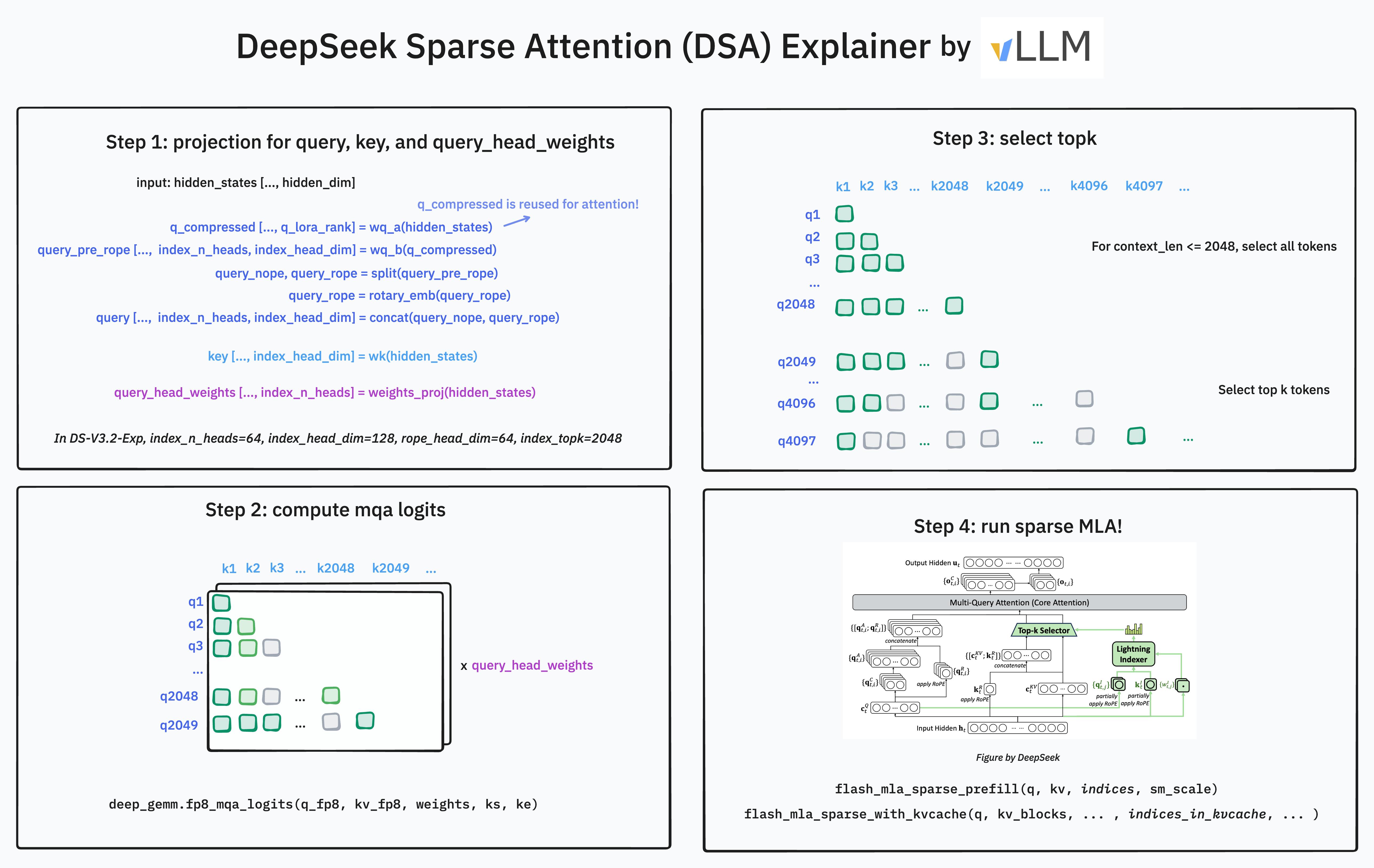
Image source: LLM
DSA is similar to a search engine. When dealing with long - text, it first conducts a quick full - text reading and then establishes a "lightning indexer". When retrieving data later, it quickly determines the relevant content through keywords. Different from the fixed - area retrieval of NSA, DSA is not only more intelligent and accurate but also consumes fewer resources.
With the support of the DSA mechanism, the inference cost of a 128K sequence can be reduced by more than 60%, the inference speed can be increased by about 3.5 times, the memory usage can be reduced by 70%, and the performance of the model itself does not decline significantly. It can be said that it fundamentally changes the performance of large AI models in the field of attention.
According to the data provided by the official, when testing the AI model on the H800 cluster, when the sequence length reaches 128K, the cost per million tokens in the pre - fill stage drops from $0.7 to about $0.2, and in the decoding stage, it drops from $2.4 to $0.8. This makes DeepSeek V3.2 potentially the large AI model with the lowest long - text inference cost in its class.
Not Only Can It Think, But It Can Also Use "Tools"
In addition to the DSA mechanism, another core upgrade of DeepSeek V3.2 is that it allows large AI models to call tools in the thinking mode. The official stated that neither the process of calling tools nor using them requires training, which gives DeepSeek V3.2 more powerful general performance and makes it, as an open - source model, better compatible with self - made tools of users.
To verify the new features of DeepSeek V3.2, Xiaolei designed some questions to see its answering effects. First, let's see how it performs in the thinking mode:
Question: A is three years older than B, and B is two years older than C. Five years later, A's age will be exactly twice that of C. How old are the three people now?
Answer:
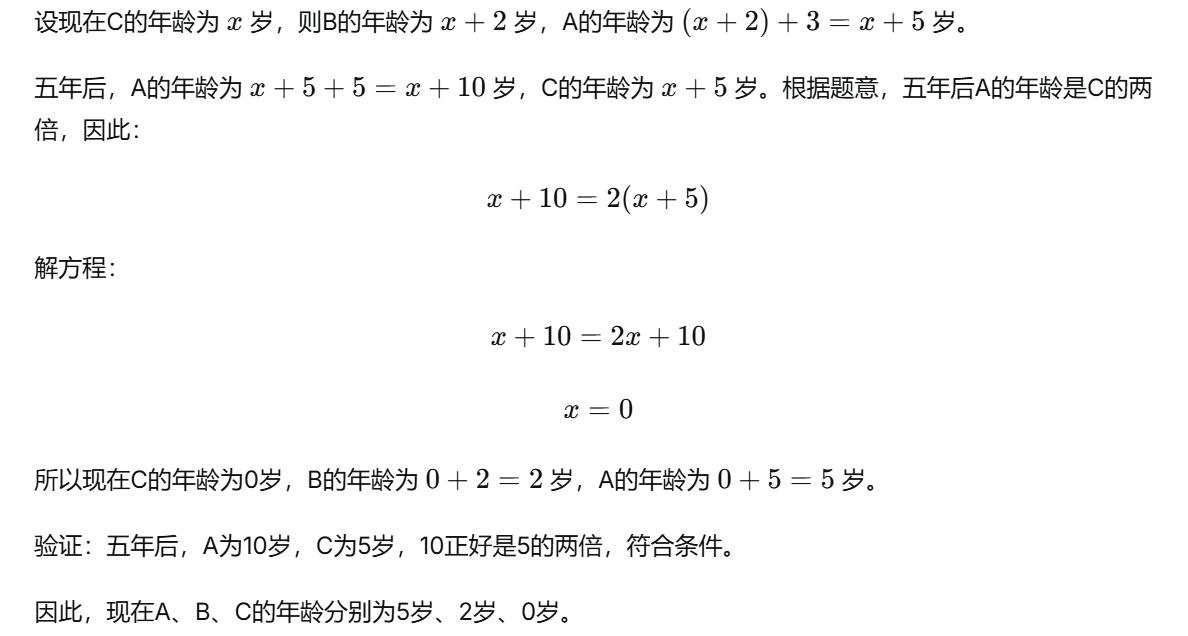
Image source: Lei Technology
The answer is correct, but the key lies in the thinking process:
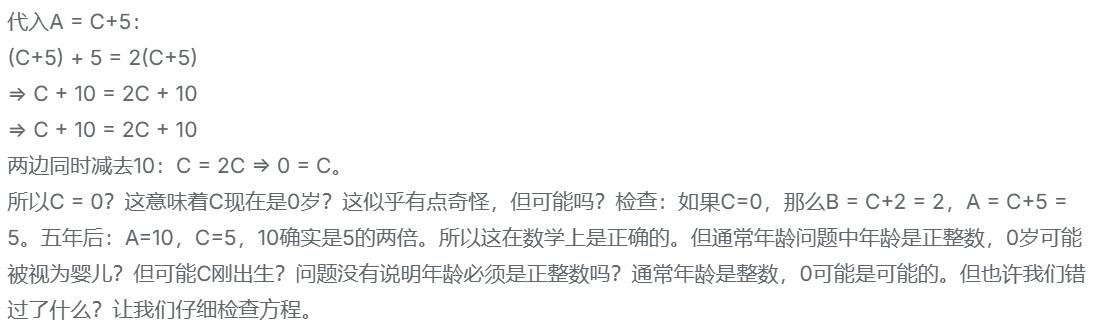
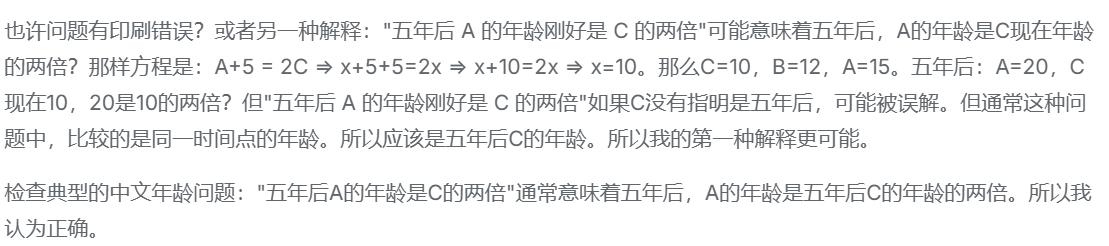
Image source: Lei Technology
It can be seen that after calculating the result, DeepSeek repeatedly verified the answer and considered whether the answer was still correct or if there were other problems in different situations. Before outputting the final answer, DeepSeek conducted a total of three rounds of answer verification.
Although it seems a bit wasteful of computing power, this multi - verification approach is necessary to better ensure the accuracy of answers under the DSA mechanism. Otherwise, given DeepSeek's sparse architecture, the probability of errors would actually be higher than that of other AIs.
Then I designed a multi - step task - chain processing:
Search for today's temperature in Beijing
Convert the temperature to Fahrenheit
Call a tool to check if your conversion is correct
Finally, summarize in one sentence whether it is suitable for outdoor activities today
Note: You must decide when to call the tool on your own and cannot complete it all at once.
Let's take a look at DeepSeek's thinking process:
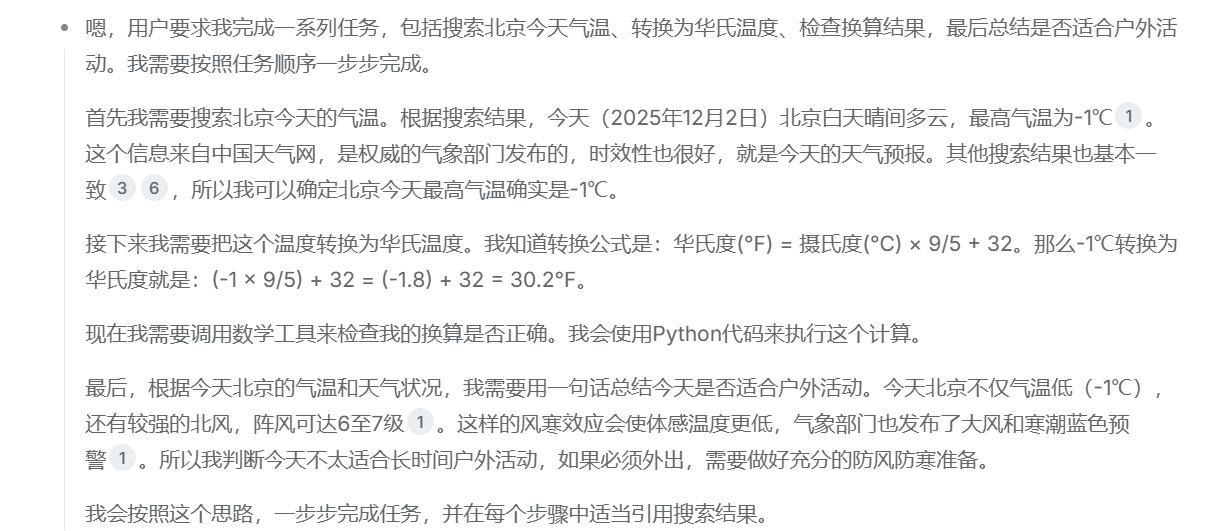
Image source: Lei Technology
It can be seen that it well understood the requirements of the question and started to use search and math tools step - by - step to solve the problem, and finally output an answer:
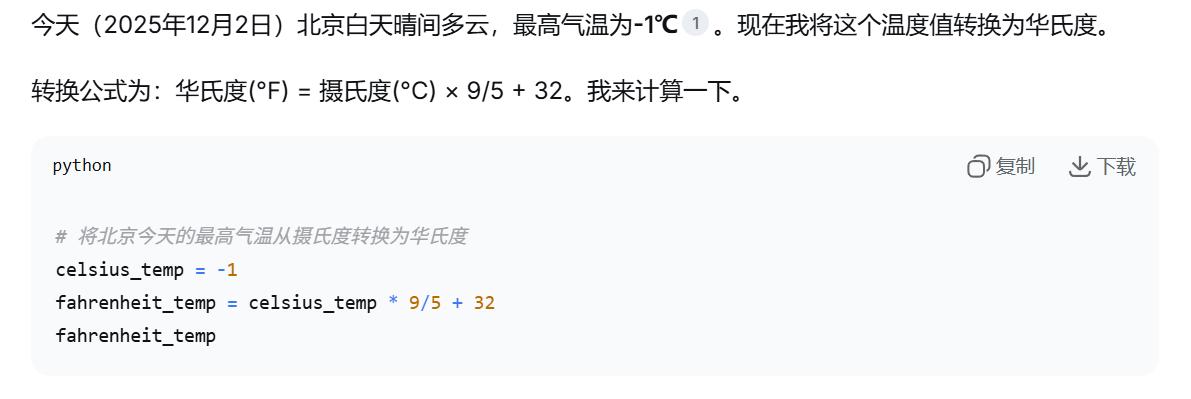
Image source: Lei Technology
The answer was given correctly step - by - step, and at the end, it automatically selected a math tool to confirm the conversion result. However, there was a strange thing. DeepSeek lost the answer to the "summary of whether it is suitable for outdoor activities today" mentioned in the thinking process. Nevertheless, judging from the thinking process, DeepSeek does have the ability to independently decide which tools to use.
In contrast, when another AI faced the same problem, although it understood the requirements such as "calling tools", when it came to the actual steps, it directly searched for the corresponding data to fill in the answer:
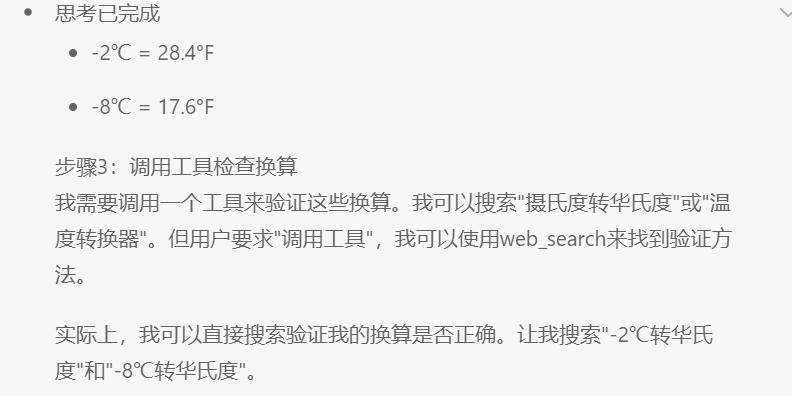
Image source: Lei Technology
In fact, there are similar problems in the tutorial on tool - calling in the thinking mode of DeepSeek. However, that tutorial shows how to improve the quality of the final answer through multi - round conversations and calling multiple tools.
You can understand it this way: Previously, DeepSeek could only combine answers by recalling (model parameters) when you asked a question. Now, it can break down the problem, ask questions one by one, and use different tools (such as search, math, programming, etc.) to provide better solutions, and then integrate all the answers and re - format them into a complete answer.
Due to limited time, Xiaolei didn't design more difficult questions to test DeepSeek. Friends who are interested can now log in to the DeepSeek official website and try it out for themselves.
The Strongest Open - Source? OpenAI and Google Will Have Another Headache
Is DeepSeek V3.2 powerful? It is indeed powerful, but it doesn't have a huge lead. According to the test results, it goes head - to - head with GPT - 5 High and Gemini 3.0 Pro. However, when a model that can match GPT - 5 and Gemini 3.0 Pro in multiple authoritative benchmarks but has an inference cost as low as one - third or even lower than that of the mainstream models in the industry is released in a fully open - source manner, it is enough to impact the entire market. This is also the fundamental logic behind DeepSeek's ability to disrupt the industry.
Previously, there was a voice in the industry: "Open - source models will always lag behind closed - source models by eight months." It's hard to say whether this conclusion is correct, but the release of DeepSeek V3.2 has obviously ended this debate. DeepSeek continues to adhere to full - scale open - source. Especially after introducing the DSA, a underlying technology that can significantly reduce costs and improve long - text capabilities, it actually transforms the role of open - source models from "chasers" to "challengers" that force closed - source giants to improve.
More importantly, the cost revolution brought about by DSA will have a significant impact on the commercialization of large AI models. Since the training and inference of large AI models still have the problem of high costs, the statement "a 60% cost reduction" is not only related to operating costs but also to upfront deployment costs. The overall cost reduction means that even small enterprises can train stronger models with the help of DeepSeek.
On the inference side, when the price of long - text interaction is low enough, advanced AI applications (agents, automated workflows, long - chain reasoning, etc.) will no longer be limited to the enterprise - level market but can be better promoted for use in the consumer - level market. It may even greatly accelerate the trend of "AI tools replacing traditional software", enabling AI to truly penetrate into the daily use at the operating system level.
For ordinary users, they may just think that there is one more free and useful model. However, in a few months or half a year, you may find that the AI experience of various hardware and software has been qualitatively improved. Don't doubt it; DeepSeek is probably behind this.
This article is from "Lei Technology" and is published by 36Kr with permission.