The differentiation of sectors is intensifying, and the most powerful wave of artificial intelligence will hit in 2026.
When the iteration speed of algorithm models surpasses the imagination boundaries of the industry, and when AI evolves from a tool behind the screen to an "actor" permeating the real world, 2026 will become a crucial watershed in the development of artificial intelligence.
It's no longer about the piecemeal "AI +" approach. Instead, it's about the native reconstruction of the underlying logic of the system by AI. It's no longer confined to the generation and understanding within the digital world; instead, physical AI bridges the virtual and real worlds to form a closed - loop of actions. It's no longer the solitary battle of single - modality; instead, multi - modality technology integrates everything. Moreover, the world model enables AI to move from "data response" to "law prediction."
This transformation concerning the technical architecture, application forms, and cognitive levels has already arrived. Who will become the most powerful force reshaping industries and defining the future?
AI Native Triggers a Revolution at the Bottom of System Applications
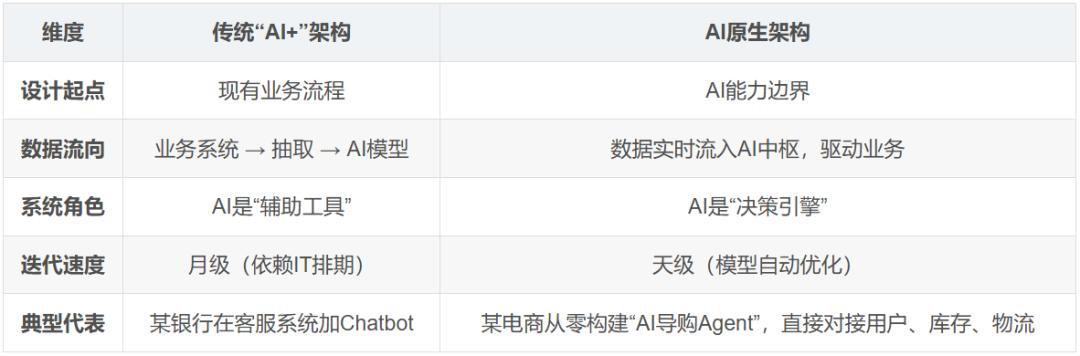
If "AI +" means "patching" or "plugging in" AI functions on existing systems, then AI native means taking AI as the underlying logic and the core of capabilities in system design. This system is designed and grows for AI, driving a comprehensive reshaping from the technical architecture, business processes, organizational roles to the way of value creation.
This transformation is not simply about the superposition of functions. Instead, it's about reconstructing the development paradigm with generative AI at the core, making intelligence a native attribute of applications rather than an additional capability. Moving from "AI +" to "AI native" is becoming a crucial direction for the future development of AI.
A genuine AI native system or application usually has the following three prominent features:
First, it is based on natural language interaction. Users interact with the backend through a language interaction interface, with little or no need to interact with the backend through a graphical interface. Eventually, it presents a mixed interaction form of GUI (Graphical User Interface) and LUI (Language User Interface), enabling users to move from limited input to unlimited input. It not only provides high - frequency and fixed functions but also has the ability to understand and process low - frequency and customized requirements.
Second, it has the ability of autonomous learning and adaptation. In the process of human - machine interaction, it can integrate, understand, remember, and adapt to multi - modality data and conduct self - learning. It can make more accurate and personalized adjustments to the output results according to changes in context, task environment, and interaction objects.
Third, it has the ability to complete tasks autonomously. It can execute precise tasks based on large language models and knowledge bases, achieving an end - to - end closed - loop, integrating the entire process from task acquisition to task completion.

Currently, the development platform of AI native has formed a clear trend. Low - code/no - code tools allow ordinary people to create their own AI tools without programming, giving rise to a large number of "one - person company" models. Tech giants such as Microsoft and ByteDance are deeply embedding AI agents into office suites, achieving an end - to - end closed - loop of "email summarization - schedule planning - task execution."
The development of AI native applications requires the productization of various tool applications, such as the Hub platform for deploying and managing large models, productized automatic fine - tuning tools for large models, high - precision and low - cost knowledge graph generation and management tools, and integrated development environments for efficient Agent programming. The prerequisite for the large - scale popularization of AI native applications to solve various problems is to have a complete system of tools and frameworks, rather than self - developing the entire process in every scenario. As the saying goes, "Good tools are prerequisite to the successful execution of a job." The accumulation of productized tools and frameworks will be a key success factor for the rapid popularization of AI native applications.
The implementation value is particularly prominent in the office scenario. AI native email tools can automatically recognize meeting invitations and synchronize them to the schedule, and intelligently generate meeting plans. Design - related applications can generate multiple versions of plans in real - time based on user sketches and match market data. This "demand - to - result" model can reduce the repetitive work time of knowledge workers by more than 40%.
AI native is the most certain incremental market on the To C side in 2026. Its core competitiveness lies not in the technology itself but in the reconstruction of user habits. When AI changes from "needing to be summoned" to "providing active services," a new ecological barrier is formed.
The technical architecture, tool products, and methodologies of AI native applications will continue to evolve in the next 1 - 2 years, accumulating quantitative change factors. Eventually, they will reach a mature and reusable scale, after which AI native applications will explode. In the short term, "AI native applications" and "traditional applications + AI" will still coexist.
Physical AI Fully Penetrates the Real World
In 2026, AI will no longer be confined to the screen. Instead, it will penetrate into scenarios such as cities, factories, hospitals, and families in the form of physical entities. This is the core of physical AI - connecting the digital world and the physical environment through embedded intelligence, achieving a leap from "perception" to "action."
The development of AI has gone through three distinct stages:
Initially, there was Perceptual AI, which could understand images, text, and sounds. The representative technologies of this stage were computer vision and speech recognition.
Then came Generative AI, which could create text, images, and sounds, represented by ChatGPT, DALL - E, etc.
Now, we are entering the era of Physical AI, where AI can not only understand the world but also reason, plan, and act like a human being.
The technical foundation of physical AI is built on three key components: the world model, the physical simulation engine, and the embodied intelligence controller.
The world model is the cognitive core of physical AI. Different from traditional language models or image models, it needs to build a complete understanding of the three - dimensional space, including the geometric shapes, material properties, motion states, and interrelationships of objects. This is usually achieved through methods such as Neural Radiance Fields (NeRF), 3D Gaussian Splatting, or Voxel Grids for spatial representation. The model needs to learn the implicit representation of physical laws, such as parameters like gravitational acceleration, friction coefficient, and elastic modulus, and be able to predict the future physical evolution based on the current state.
The physical simulation engine is responsible for real - time calculation of physical interactions. This is not simply about preset rules but a dynamic calculation system based on partial differential equation solvers. It needs to handle complex physical phenomena such as rigid - body dynamics, fluid mechanics, and soft - body deformation. The system needs to complete complex physical calculations within milliseconds while ensuring sufficient accuracy to support accurate decision - making.
The embodied intelligence controller is the bridge connecting virtual reasoning and physical execution. It receives the prediction results from the world model and the calculation output from the physical simulation and generates specific control instructions. Technically, it is usually based on algorithms such as Model Predictive Control (MPC) or Deep Reinforcement Learning (DRL). The controller needs to handle high - dimensional state spaces and action spaces while considering the physical limitations, delays, and noises of actuators.

There are mainly two reasons why physical AI has become the mainstream trend.
On the one hand, the demand for physical interaction drives the development of physical AI. With the rapid popularization of intelligent devices such as robots and unmanned systems in industries like manufacturing, healthcare, and logistics, users have put forward higher requirements for their intelligence levels. This not only includes visual recognition and semantic understanding but also requires stable, generalizable, and transferable perception, understanding, and execution capabilities in real - world environments to handle unstructured, changeable, and complex physical scenarios.
On the other hand, the evolution of AI technology will also accelerate the empowerment of physical entities. From visual perception models to decision - making control algorithms, from large - scale pre - trained models to reinforcement learning frameworks, AI is injecting stronger autonomous learning and task execution capabilities into systems such as robots and autonomous driving.
Especially in the field of robotics, technological progress is giving rise to new application scenarios. IDC predicts that by 2026, there will be breakthroughs in AI models, vision systems, and edge computing. The number of application scenarios that robots can achieve will triple, and they will be widely deployed in multiple fields such as manufacturing, logistics, healthcare, and services, promoting the full - scale intelligentization of physical systems.
Multi - Modality Will Become a Fundamental Ability of AI
With the rapid development of AI technology, single - modality AI models can no longer meet the complex requirements of the real world. In 2025, Multimodal Large Models (MLLMs) became the backbone driving the intelligent upgrading of industries and the digital transformation of society with their powerful cross - modality understanding and reasoning abilities.
Multimodal large models can not only process multiple data types such as text, images, audio, video, and 3D models simultaneously but also achieve in - depth integration and reasoning of information, greatly expanding the application boundaries of AI.
The ability system of multimodal large models is mainly built around two core aspects: "cross - modality understanding" and "cross - modality generation."
In terms of cross - modality understanding, its core capabilities are reflected in three levels:
First, it has excellent semantic matching ability, which can determine whether the semantic information of different modalities such as text and pictures, audio and text records is consistent. It plays a significant role in content retrieval and information verification.
Second, it has the ability of structured parsing in the document intelligence scenario. It can not only recognize characters but also accurately parse content such as tables, layouts, and mixed text - image arrangements in complex scenarios, understanding the deep - level structure and semantics of documents.
Third, it has the ability to deeply interpret multimodal content, such as analyzing charts with text descriptions, associating video actions with synchronized sounds, and interpreting the emotional tendencies of social media content with text and images.
Cross - modality generation is even more remarkable. Generating content in one modality based on another modality has become a reality. In addition to the common image - to - text conversion, it also includes text - to - image, audio - to - text, text - to - audio, video - to - text summary, etc., greatly expanding the boundaries of content creation.
Moreover, multimodal large models also demonstrate advanced cognitive abilities such as multimodal thinking chains and multimodal context learning. This means that the models can imitate the human reasoning process and solve problems by gradually analyzing multimodal information, laying the foundation for building an AI system closer to human cognitive patterns.
Current large language models and spliced multimodal large models have inherent limitations in simulating the human thinking process. The native multimodal technology route that connects multimodal data from the beginning of training and realizes end - to - end input and output provides new possibilities for multimodal development.
Based on this, aligning data from modalities such as vision, audio, and 3D during the training phase to achieve multimodal unity and building native multimodal large models has become an important direction for the evolution of multimodal large models.
The so - called "native" means that the model embeds multiple modalities such as images, voices, texts, and even videos into the same shared vector representation space at the underlying design level, enabling natural alignment and seamless switching between different modalities without the need for text transfer, so as to achieve more efficient and consistent understanding and generation.
In 2026, multimodal large models will reshape all industries at an unprecedented speed. Their technological breakthroughs are reflected in multiple dimensions such as cross - modality understanding, data fusion, reasoning optimization, training resource management, data security, and ethical compliance. Although there are still challenges in aspects such as spatial reasoning, data alignment, and model generalization, these problems are being gradually overcome through innovative means such as automated annotation, model compression, and middleware scheduling.
Currently, multimodal large models have shown great value in fields such as cultural relic protection, security, intelligent driving, content creation, industrial quality inspection, and government services, moving from the experimental exploration stage to being application - oriented. For example, Sora 2 has achieved breakthroughs in video and audio generation, such as physical realism, shot control, and sound synchronization. Nano Banana Pro has made great progress in image generation and editing, supporting multi - image fusion, 4K output, logical consistency, and multi - language text rendering.
In the new year, with technological innovation and the deepening of industry applications, multimodal large models will become the core engine in the era of the digital economy, driving society towards a more intelligent, efficient, and sustainable future.
The World Model Triggers a New Round of Growth in AI
From OpenAI's Sora (text→video world simulation) to DeepMind's Genie (interactive world generation), from Meta's V - JEPA 2 (visual self - supervised world model) to Tesla's exploration of implicit world awareness in its autonomous driving system, these cases all indicate that the world model is becoming a key fulcrum for AI to enter the real world.
The world model enables AI to shift from being "data - driven" to being "law - driven." By building a virtual world model to simulate physical rules and achieving forward - looking decision - making, this will be the most disruptive and challenging field in 2026.
There is no standard definition for the world model. This concept originates from cognitive science and robotics, emphasizing that an AI system needs to have an intuitive understanding of the physical world, rather than simply processing discrete symbols or data.
The value of the world model lies in its "generalization ability" - the ability to transfer the cognition of known scenarios to unknown scenarios. For example, on an unseen rural road, based on the understanding of physical laws, a vehicle can still drive safely.
Companies such as Tesla and Google are actively researching the world model. By inputting image sequences and prompts, they can generate virtual scenarios that conform to physical laws for model training and simulation testing, forming an infinite closed - loop of "data - model - simulation."
The industry generally believes that the world model is a generative AI model that can simulate the real - world environment and generate videos and predict future states based on input data such as text, images, videos, and movements. It integrates various semantic information, such as vision, hearing, and language, and uses machine learning, deep learning, and other mathematical models to understand and predict phenomena, behaviors, and causal relationships in the real world.
Simply put, the world model is like the "internal understanding" and "mental simulation" of the real world by an AI system. It can not only process input data but also estimate states that are not directly perceived and predict changes in future states.
The core goal of this model is to enable an AI system to build an internal simulation and understanding of the external physical environment like a human being. In this way, AI can simulate and predict the consequences of different actions in its "mind" and make effective plans and decisions.
For example, an autonomous driving system with a world model can predict that if the vehicle speed is too fast on a slippery road, the braking distance may increase. Therefore, it can slow down in advance to avoid danger. This ability comes from the internal simulation of physical laws (such as friction and inertia) by AI, rather than simply memorizing the rule "slow down on a slippery road."
