Searching for the "ChatGPT Moment": Who Can Define Embodied Intelligence? | 36Kr WISE2025 King of Business Conference
From November 27th to 28th, the 36Kr WISE2025 King of Business Conference, known as the "annual technology and business trendsetter," was held at the Conduction Space in the 798 Art District in Beijing.
This year's WISE is no longer a traditional industry summit but an immersive experience centered around "technology-infused short dramas." From AI reshaping the boundaries of hardware to embodied intelligence opening the door to the real world; from brand globalization in the wave of going global to traditional industries getting a "cyber prosthetic" – what we're presenting is not just trends but the insights honed through numerous business practices.
In the following content, we'll dissect the real logic behind these "exciting dramas" frame by frame and explore the unique business "landscape" of 2025.
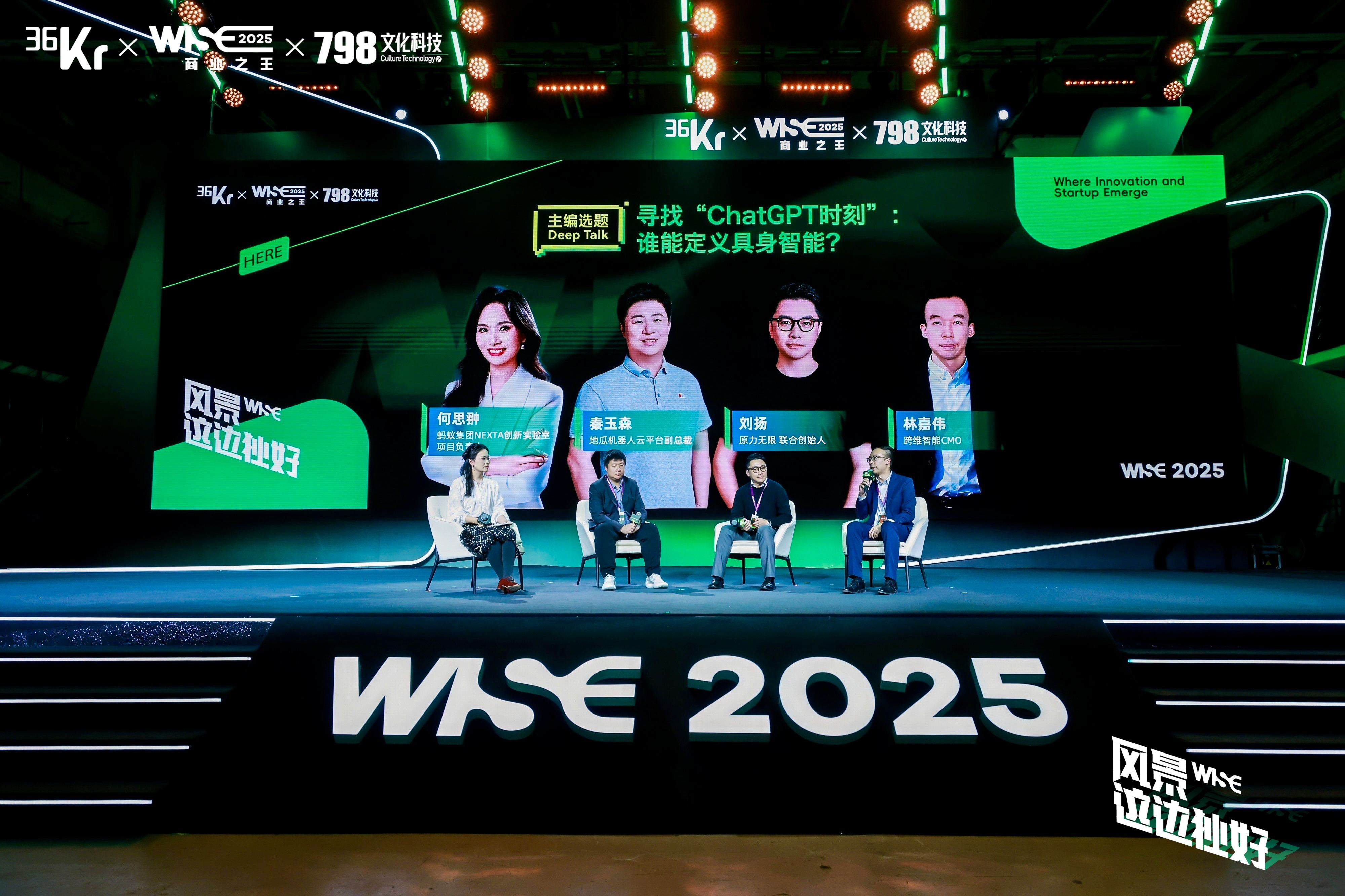
Searching for the "ChatGPT Moment": Who Can Define Embodied Intelligence? Roundtable
The following is the content of the roundtable dialogue, edited by 36Kr:
He Sichong | Project Leader of NEXTA Innovation Lab at Ant Group (Host)
Qin Yusen | Vice President of Sweet Potato Robot Cloud Platform
Liu Yang | Co-founder of Yuanli Unlimited
Lin Jiawei | CMO of Transdimensional Intelligence
Host (Jiawei): Dear friends, next, let's welcome the host of this Deep Talk session, Ms. He Sichong, the project leader of NEXTA Innovation Lab at Ant Group. At the same time, let's welcome Mr. Qin Yusen, the vice president of Sweet Potato Robot Cloud Platform, Mr. Liu Yang, the co-founder of Yuanli Unlimited, and Mr. Lin Jiawei, the CMO of Transdimensional Intelligence. Let's give them a round of applause and invite them to the stage to share their insights!
He Sichong: Good afternoon, everyone! Welcome to this roundtable. I'm He Sichong, the host of this roundtable, from NEXTA Innovation Lab at Ant Group. Just now, we listened to the previous sharing, including the short dramas. I think what's most exciting about AI in 2025 is not just the technological breakthroughs themselves but that AI may truly enter all sectors of our real world. In particular, the concept and industry of embodied intelligence can be said to be the hottest, most topical, and sexiest niche area in 2025. Standing at this crucial juncture, we see that embodied intelligence is transforming from a simple execution tool into an intelligent partner capable of perceiving the environment and making autonomous decisions. Therefore, we're very honored to invite three guests in the field of embodied intelligence, who are rewriting the rules of their respective industries with AI. Let me introduce the three guests first.
First, let's welcome Mr. Qin Yusen, the vice president of Sweet Potato Robot Cloud Platform. Please say hello to everyone, Mr. Qin.
Qin Yusen: Hello, everyone. I'm Qin Yusen, the vice president of Sweet Potato Robot Cloud Platform.
He Sichong: Mr. Liu Yang, the co-founder of Yuanli Unlimited.
Liu Yang: Hello, everyone. I'm Liu Yang from Yuanli Unlimited.
He Sichong: And Mr. Lin Jiawei, the CMO of Transdimensional Intelligence.
Lin Jiawei: Hello, everyone. I'm Lin Jiawei from Transdimensional Intelligence.
He Sichong: Welcome, three guests, to our roundtable.
Before we start, I'd like to invite each guest to briefly introduce themselves and their companies and industries. Let's start with Mr. Qin.
Qin Yusen: I mainly work at Sweet Potato Robot, a company that provides infrastructure for the robot industry. I'm in charge of the entire cloud platform-related business, which includes software development starting from the moment we get the chip and providing the development tools and infrastructure needed throughout the process of turning a robot into a complete product. Thank you all!
Liu Yang: Yuanli Unlimited has been established for several years. We mainly focus on the integration of embodied robots, including wheeled and humanoid robots. We spend most of our energy on the robot and its brain.
Lin Jiawei: I'm Lin Jiawei from Transdimensional Intelligence. I've been deeply involved in Huawei, robot unicorns, and listed companies in the past. Now, Transdimensional Intelligence is a startup team focusing on embodied intelligence, including humanoid robots. Our founder is a tenured professor at the Chinese University of Hong Kong. Currently, our focus is similar to Mr. Liu's in some aspects. We're also working on the embodied brain, developing pure vision sensors, and creating general humanoid robot products.
Thank you!
He Sichong: Okay, I'd like to invite each of you to share whether your company or institution has launched any significant products or solutions in the past year, as we've witnessed the rapid progress of embodied intelligence.
Qin Yusen: Last week, Sweet Potato released a product called RDK Agent, Robot Development Kit Agent, in Shenzhen. This is the industry's first Agent that can run across different devices. That is, the Agent running on your computer can be transferred to an embedded platform for automated programming and operation. This is our first product that enables cross-device automated development. Its function is to relieve algorithm engineers from understanding the complex details of embedded systems and allow those more accustomed to developing on PCs to master the development work on the artificial intelligence brain of embedded platforms more proficiently. This was a remarkable achievement for us last year.
Liu Yang: In 2025, we released our first humanoid robot product, called AstroDroid AD - 01. In fact, behind this visible product, we've also independently developed a lot, including an embodied brain with our own embodied model called Hyper VLA. At the end of this year or the beginning of next year, we'll announce more breakthroughs in our AI infrastructure construction, including changes on the data side. Of course, we're also good users of Sweet Potato's services, and we've also had a lot of hardware cooperation with Transdimensional Intelligence.
In the past year, I think the changes have been quite significant. I believe the industry has changed more in the past year than in the previous few years. In this process, we value more the application side. Just as Mr. Zheng from Guangyuan mentioned, as a startup, we need to show our value through differentiation, which is what we'll focus on in the coming year.
Lin Jiawei: This year, we also released our first robot body. In the past, we mainly focused on the brain and the "eyes" of the robot. This year, we launched our second - generation general humanoid robot. Fortunately, in October, it participated in the Global Women's Summit proposed by the General Secretary and provided self - service coffee for Professor Peng and political leaders from various countries. This robot has also gained experience in serving the public in many coffee - related and other business scenarios and is gradually being deployed in large quantities.
I think this year, AI has brought significant changes, especially for the embodied humanoid robot industry. Robots are gradually transitioning from simple performance - based demonstrations or providing emotional value to attempting and implementing after - sales and business services, which will help the public better understand and experience the development of this industry and technology.
He Sichong: I can tell that all of you have been very busy this year and achieved fruitful results.
I'd also like to ask each of you to talk about what you think is the biggest variable that AI development has brought to our industry this year, especially considering some important milestones in large - model development, such as the progress of inference models and the application of end - to - end models. How will these important technological variables affect your product R & D and business implementation?
Qin Yusen: This year, Sweet Potato participated in many hackathons. As a development platform, we observed that in the past, most developers faced a complex development task involving hardware, software, and model algorithms in the robot field, and few could handle the entire chain. However, in this year's hackathons, 100% of the teams were assisted by large models. Even some small teams with limited skills in the whole chain showed a trend of becoming all - around. In today's situation, many small startup teams with technical capabilities, empowered by large models, also showed no weaknesses in business, PR, and event planning. As for individual developers with advantages in certain aspects, technology is no longer their weakness, and they can at least deliver a satisfactory result. That is, in the era of large models, large models have greatly compensated for people's previous weaknesses, making anyone a potential super - individual as long as they have a long enough strength.
He Sichong: Yes, the emergence of super - individuals and one - person companies is highly anticipated.
Liu Yang: I've really felt the changes in AI this year. For us, it can be divided into two aspects. Internally, in the past, people mainly heard about AI and large models in some specific applications. But this year, there's a very obvious change. Every employee in the company, regardless of their job type, whether technical or non - technical, has gradually developed a habit of using AI. This habit has become ingrained. In our company, we have an internal sharing session every two weeks. You'll find that the way people use AI has changed from following instructions from third - parties to exploring and innovating on their own. For example, in the past, it was mainly about text and some multi - modal applications, but now people are mixing different types of work and applications in practice. Especially our product managers, who used to just talk about concepts like "AI - based," are now really using AI ideas in their work.
On the other hand, in terms of our business and technology, as well as from the perspective of our customers, in the past, the focus of AI was mainly on large language models (LLMs). But this year, we've noticed a very important change. AI is gradually moving towards a more intelligent path from a rule - based approach. Our embodied intelligence products are also shifting from using general models to exploring new directions.
I also talked with Mr. Lin privately. We both believe that the future lies in the world model. We think that the development of embodied intelligence still has certain bottlenecks in the current direction, and there will be significant changes in the understanding of intelligence in the future.
Lin Jiawei: Continuing from what Mr. Liu said, I have a personal feeling. When we released our first - generation prototype in January this year and posted a product release video, many of our followers left comments saying, "Is this an animation?" I'll take it as a compliment to our marketing work and technology. This also shows a significant change that AI has brought to the general public. Now, it's really possible to create realistic content through AI.
Looking at our company's technology, as Mr. Liu mentioned, when it comes to generating skills or implementing new scenario tasks, we used to collect a large amount of data from real machines, which was quite labor - intensive as it required deploying many robot bodies and a large number of engineers. For example, when I joined the company last year, a state - owned institution asked us to develop a robot to perform the task of unscrewing bottle caps. For a child, this is a simple task, but for a robot, after a large amount of data collection and model training, it can only achieve a success rate of about 60% - 70% for a specific brand of green bottle. Once the conditions change, such as changing to a red bottle, the robot may not be able to complete the task. So, there is indeed a bottleneck. Our Professor Jia and the R & D team proposed using a new technological paradigm called the generative world model and efficiency law this year. We hope to use more synthetic data as the basis for training and combine it with a small amount of real - machine data to continuously improve the robot's skills and implementation capabilities, enabling more scenarios to benefit from our advanced technology.
He Sichong: Okay, all of you have mentioned the changes brought about by technology, which have led to progress in both our individual work and the development of robots. Now, let's take a broader view. What types of industries and scenarios do you think are the most likely to generate large - scale value from AI at present?
Qin Yusen: This is a good question. We think that industries currently limited by productivity or slow knowledge transfer will experience high growth rates. I can't directly point out which industries they are, but I can give two examples that everyone can understand. In 1990, there was a very good job called telephone operator, whose function was the same as the routers we have at home today. Five years later, in 1995, there were two special occupations in provincial departments called typists because when microcomputers first entered China, no one could type. Today, there are no typists anymore, and I believe no one here can't type. So, the industries that can use AI to enable more people to access things that were previously out of reach have great potential, although we haven't clearly identified them yet. This is my open - ended answer.
He Sichong: Yes, we're all looking forward to seeing these industries emerge.
Liu Yang: Mr. Lin brought up a good topic. Let me look at it from a different perspective. The host mentioned an important term, "large - scale influence." To achieve scale, it's crucial that the technology serves the public and a wide range of scenarios. Under this premise, currently, there are two issues we have to face. First, in terms of the current state of AI technology, there is still a lot of room for improvement. We still have a long way to go to achieve true AGI (Artificial General Intelligence). Although people may be optimistic, the process from AI imitating humans to approaching, equaling, and surpassing humans will be quite long, depending on our definition and expectations of it. Second, if we're talking about achieving large - scale development at this stage, I think it's important that the technology is applied in emerging scenarios that are more easily accepted. This is based on the products our company has launched. When we launched a product the year before last, although the industry had been developing for a long time, it took time for people to accept the impact of AI on the industry and the changes in products. This time is not only about understanding the product but also about getting used to it and considering safety and other aspects. In summary, from the perspective of scale, we should consider the maturity of the technology itself. And in terms of the industry, it should be relatively new in the AI environment and likely to undergo significant changes in the short term.
Lin Jiawei: I think it's in line with the current national direction, such as AI + artificial intelligence or new economic models. There are different opportunities in business services and intelligent manufacturing. However, for these two different models, due to different user experiences and the process of implementation or commercialization, our choices may vary. For example, we may not necessarily put bipedal humanoid robots in factories to screw screws when there are already professional machines for that. But if the humanoid robot can do more than just screwing screws, it's worth considering. In business services, we can better achieve human - machine collaboration with the help of large language models, which is a bit different from the previous generation of robot companies. As we can see, the delivery robots in hotels are already very mature. When we need something, they can deliver it quickly. But a few years ago, the process was quite bumpy. It takes time for users to put forward requirements and accept such scenarios. These are all potential directions.
He Sichong: Okay, thank you all for sharing your macro - level insights. Now, let's have a more detailed discussion. Let's start with Mr. Qin. I know that Sweet Potato Robot has a very clear positioning to be the "Intel" of the robot era and provide industry infrastructure to serve many players in the industry, as mentioned by the other guests. However, the robot industry is currently in a diverse state, with different forms such as humanoid, non - humanoid, legged, and wheeled robots. When the hardware form has not yet converged, what's Sweet Potato's strategy for creating a general underlying system?
Qin Yusen: In addition to developing a general underlying system, we also want to accelerate the R & D progress. Another meaning of infrastructure is to prevent everyone in the robot industry from reinventing the wheel. After the emergence of TensorFlow, the previous generation of computer vision technology developed rapidly because the implementation of public accounts was no longer a bottleneck. Before the development of large models, PyTorch became a general R & D component and infrastructure in the industry, which made it easier for people to apply the Transformer model in engineering. Our logic at Sweet Potato is to package the difficult and time - consuming tasks into useful tools, so that companies can save manpower and time and avoid making the same mistakes. We hope to clear the obstacles in advance so that more entrepreneurs can focus their energy and resources on their areas of expertise. This way, those with unique business ideas can emerge quickly, and the whole society can enjoy the convenience and benefits brought by technological progress. And as engineers, we hope to make our own lives better too.
He Sichong: Sweet Potato sounds very visionary and is also committed to serving engineers.
Now, I'd like to ask Mr. Liu. As mentioned by the guests, the demos of robots are quite amazing, and people hope these demos and videos can quickly become a reality. Some people say that the second half of the AI era is the era of embodied intelligence. I wonder if you agree that the key sign of AI entering the second half is its ability to interact with the real physical world and solve practical problems. In the practice of Yuan