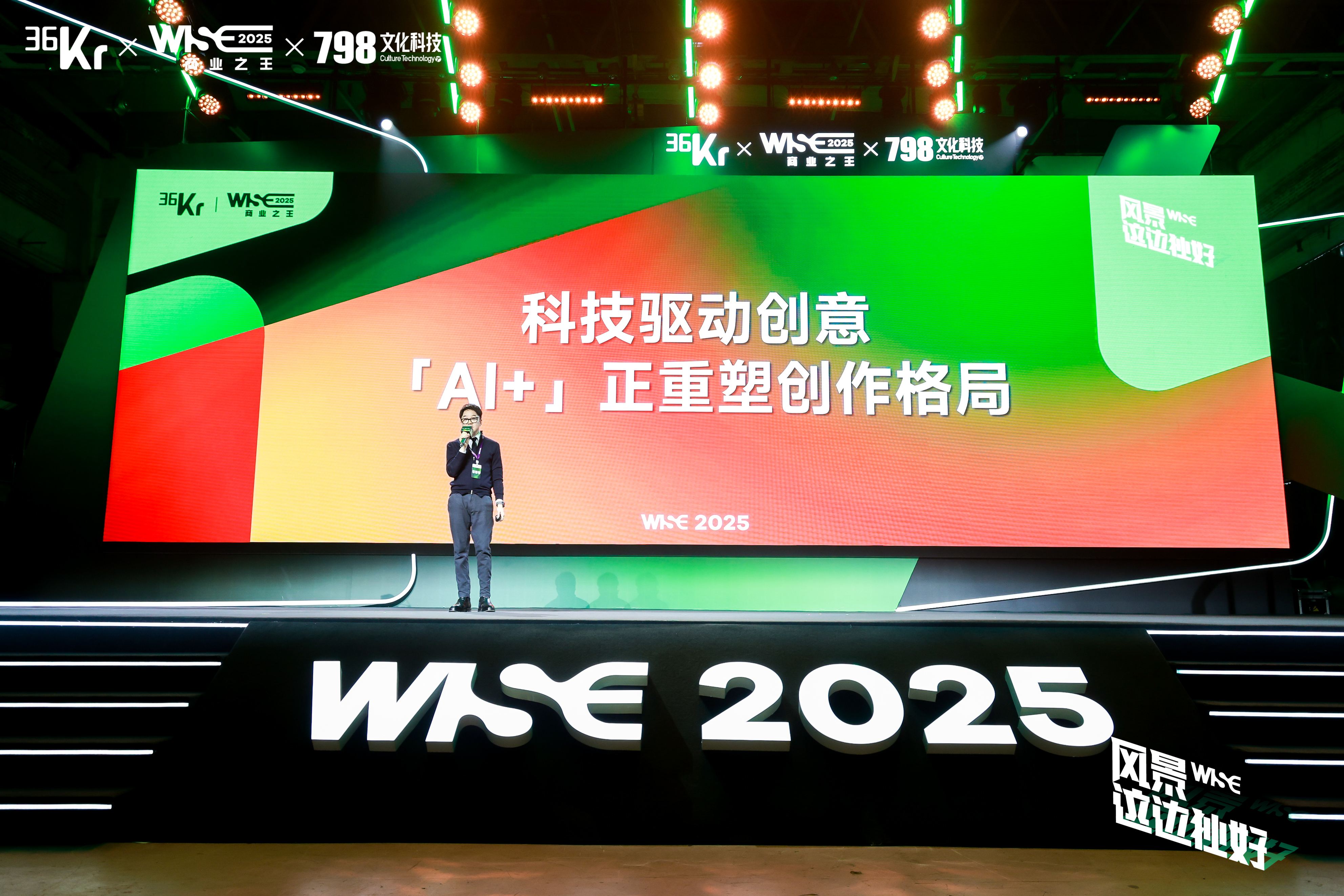
Chen Xiaoguang, Deputy General Manager of Digital Domain in China: Technology Drives Creativity, and "AI+" is Reshaping the Creative Landscape | WISE2025 King of Business
In 2025, the business world stands at a crossroads of transformation. Amid the reconstruction of business narratives and the sweeping technological wave, the WISE2025 Business Leaders Conference, themed "The Scenery Here is Uniquely Charming," aims to anchor the certain future of Chinese business in an uncertain world. Here, we record the opening chapter of this intellectual feast and capture the voices of those who remain steadfast in the face of change.
From November 27th to 28th, the 36Kr WISE2025 Business Leaders Conference, hailed as the "annual technology and business trendsetter," was held at the Conduction Space in the 798 Art District in Beijing.
This year, WISE is no longer a traditional industry summit but an immersive experience in the form of "tech-infused short dramas." From AI reshaping the boundaries of hardware to embodied intelligence opening the door to the real world; from the globalization of brands in the wave of going overseas to traditional industries equipping with "cyber prosthetics" - what we present is not just trends but the insights gained from numerous business practices.
In the following content, we will dissect the real logic behind these "thrilling dramas" frame by frame and explore the "uniquely charming scenery" of business in 2025.
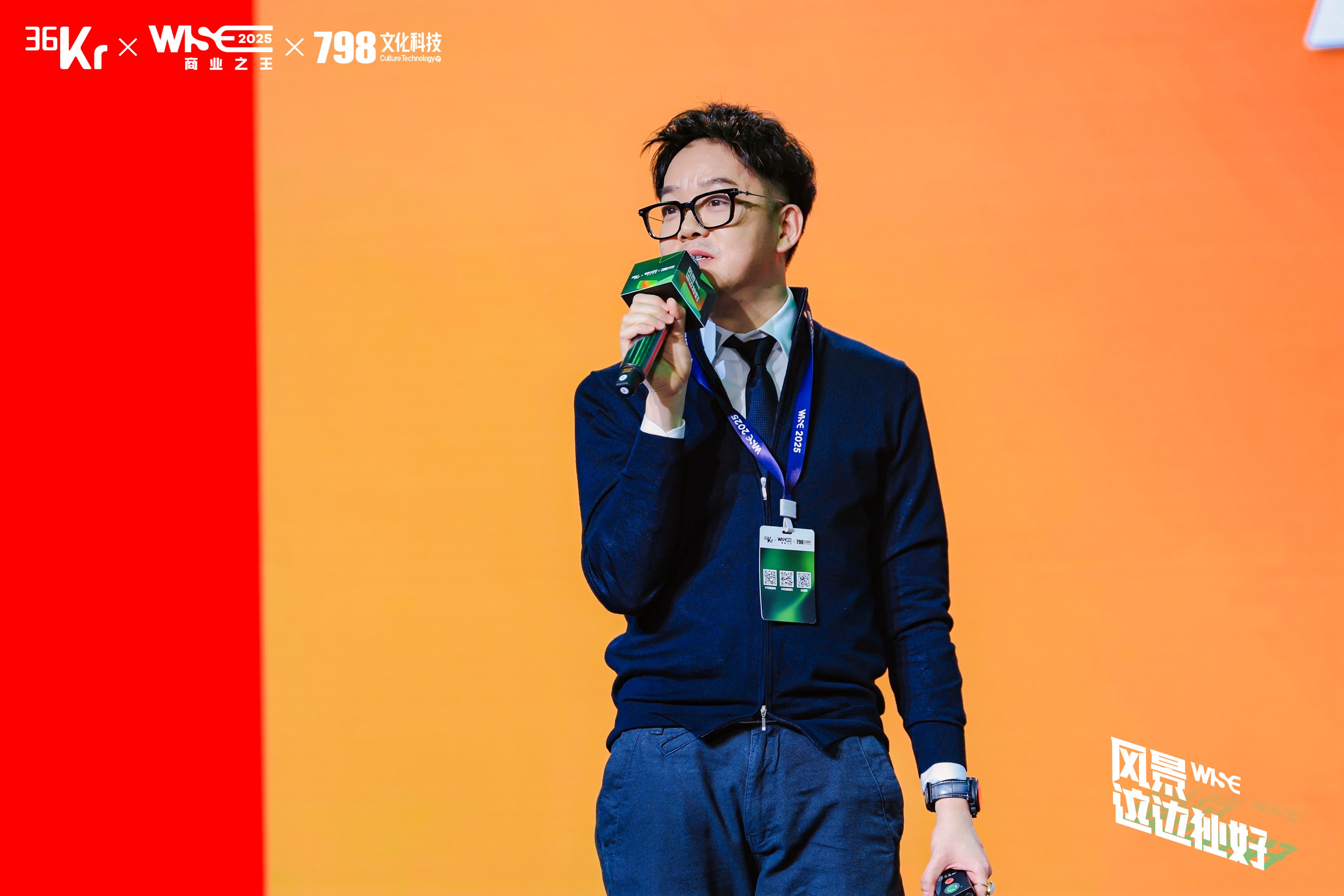
Chen Xiaoguang, Deputy General Manager of Digital Domain's China Region
The following is the edited transcript of the speech by Chen Xiaoguang, Deputy General Manager of Digital Domain's China Region:
Hello, everyone! I'm Chen Xiaoguang from Digital Domain. Thank you very much for the opportunity to talk to you about AI and the changes it has brought to us.
The opening video, "Forging Dawn," is a gift from our team to the conference. Thanks to 36Kr for giving us this opportunity.
Today, I'd like to share briefly that AI is revolutionizing our production process and visual process generation.
Let me introduce myself first. You may not be familiar with Digital Domain, but we've accomplished several significant feats.
First, our founder, James Cameron, created the first true visual - effects movie, "Titanic." It was a remarkable achievement that integrated movie visual effects into the global arena.
Second, over the past 30 years, we've created many classic movie characters and works. In the eyes of us filmmakers, characters like Iron Man and Spider - Man are virtual humans. So, when the concept of "virtual humans" emerged a couple of years ago, it wasn't new to us because they are characters and IPs. In this process, we used our movie - making technology to breathe life into these characters.
Next, I'd like to share what we've been working on so far.
First, we've created movie art.
Second, in 2016, when we entered the Chinese mainland market, we did two more things. First, we created a virtual human named "Teresa Teng." Second, this is our business map. You can see that we have branches in Beijing, Shanghai, and Hollywood.
Currently, our business in the Chinese mainland mainly focuses on three dimensions:
The first dimension is movies, TV shows, and short dramas;
The second dimension is virtual humans;
The third dimension is the application of artificial intelligence.
Thanks to these accumulations, we created the world's first immersive VR advertising short film. These resources and content give us enough visual sense to implement AI in the future.
Among them, I wonder if you've seen a movie called "The Curious Case of Benjamin Button." In 2008, for the first time, we applied artificial intelligence or virtual - human technology to a character, making him transform from an 80 - year - old to an infant.
This is not makeup technology but virtual - human technology. That's why we won the Academy Award for Best Visual Effects that year.
The artificial intelligence we're talking about today is powerful enough to disrupt our production process. So, how should we proceed?
In May last year, we made an advertisement using AI - generated methods for the first time. We used a cloned voice for the dubbing, and all its visual elements were generated by AI.
In this process, we created a production platform. The logic of this platform is that you only need to upload two or three pictures to generate the short films and videos you want. But its function goes beyond that. Its main function is to integrate into an ecosystem, allowing everyone to generate their desired short - video content through this platform.
In the field of AI, we're good at something called "card - drawing." In the process of card - drawing, we have our own logic, which is how to make AI meet our creative needs and the conditions for video generation.
Second, we replicate these good card - drawing results into the production process, creating works like a well - made hamburger.
Third, we connect the creative ideas to the production end.
So, apart from creating "hamburger - like" works, what else can we do?
The traditional production process is a long chain, starting from IP development, planning, investment, to production. Just the production stage alone has six or seven steps, including model asset generation and lighting rendering output, and it takes a long time.
The advent of artificial intelligence has significantly streamlined the production process, from creativity to imaging and then to distribution. With the one - stop platform I mentioned earlier, imaging can be completed.
In July last year, we received a very important task: to cooperate with Alibaba Cloud to create a global promotional video for the Paris Olympics.
We only had one and a half months. Replicating the concept of the Colosseum was really challenging. So, we decided to use AI to improve the production efficiency and quality.
We used text - to - image generation to create a large number of extras and gave them dynamic life through technology. We combined the traditional workflow with the AI workflow to achieve excellent results.
In this process, there's a step called keying. AI technology allows you to complete keying in just 5 to 10 minutes. More importantly, we designed the characters through light and shadow and iPhone - based motion capture.
Imagine that in the future, real actors and visual characters can be entirely generated by AI. Using our ion - emission technology, which has won 10 Academy Awards, we can combine these characters in various ways. Originally, this technology was used to calculate the parabolic path of a falling object. When applied to character generation, it can create various combinations to meet the needs of randomness and diversity. That is, with 10 original characters, we can generate more than 100 different characters, achieving a quantitative upgrade. So, in the future, virtual - human characters will dominate.
After an advertisement is made, how can we make it have the artistic aesthetics and visual appeal of a movie?
In this process, AI shows its imagination. It helps us generate scripts, storyboards, and even the entire creative concept.
AI tells us that 30 years ago, it was the era of mobile phones like Nokia, and now it's the era of large - screen devices. AI also predicts that in the next decade, the following areas will be visually presented: First, 5G networks or even cognitive networks will be our tools. Second, multi - video, non - video, and no - video formats are possible. Not only visual images but also characters and dubbing will be completed by artificial intelligence.
AI tells us that in the future, we can learn through AI, interact with AI, and it even emphasizes AI education. Traditionally, ion or so - called emission technology used models and modules. Now, we can improve the expressiveness in just a few minutes of generation.
Ten years from now, autonomous driving and intelligent driving will also be our focus. Future technology also gives us another imagination, the era without screens. So, AI provides us with a good outline and vision.
The logic of movie - making is the most challenging, especially when it comes to characters. If you're in the AI - related industry, you may have noticed that while we can solve the problems of consistency in the subject and environment, how can we ensure the consistency of human characters? Let me show you a case.
Last year, we officially established a full - process AI production system for movies. We told a story using a car. First, we used a large - scale model to ensure the consistency of the car's appearance. Then, we created three character models for visual representation in the story.
Whether it's the AI "hamburger" or the one - stop platform solution, we found that we still need an important element: real people.
Previously, from directors and creators to producers, in the future, we need interdisciplinary talents. So, this year, together with educational institutions such as the Shanghai Film Academy of Shanghai University and Anhui Institute of Information Technology, we've taken the first step in reforming AI education and training, bringing real possibilities to everyone through our one - stop platform.
Second, we've also realized that on the human level, AI has changed the traditional way. Whether you're in the industry or not, as long as you have a dream, you can use AI to create.
The students we trained completed some good creative works in less than two months.
The field of AI visual generation can not only meet the needs of posters and scenes but also solve a fundamental problem. When the environment doesn't allow shooting, or when some conditions are hard to meet, or when shooting is affected by natural or harsh environments, AI can provide great assistance. For example, it can place a vehicle on a mountain.
Relying on the logic of AI, our recent attempt is "comic dramas."
In terms of sound, language, and performance, AI has completely replaced the traditional way of making comic dramas. These comic - drama works were completed by our trained students in just two and a half months. Before that, these students only knew some AI tools like Doubao. So, in the future, we can imagine that AI can provide excellent assistance in comic dramas, short dramas, and movies.
Finally, we've always said that Digital Domain is not a movie company but a technology company. Eight out of our 10 Academy Awards are related to technological innovation. We believe that through our platform and users, we can connect the upstream, mid - stream, and downstream of the film - making industry.
The first industrial revolution was the steam - powered era, when technology changed our way of life. The second was the electrical era, and the third was the energy era.
The last one is the fourth industrial revolution, represented by artificial intelligence. Its logic is simple: excellent communication capabilities, that is, the power of the Internet, combined with impeccable renewable resources. And AI is precisely such a high - quality renewable resource that can help form an ecosystem. Digital Domain has mastered this technology and is ready to cooperate with you.