Dropped out of high school and broke into OpenAI: Rejected Vibe Coding and self-studied with ChatGPT to make a comeback as a research scientist on the Sora team
Read code line by line and reject "Vibe Coding". Learn mathematics, diffusion models, etc. in reverse with the help of ChatGPT. This OpenAI research scientist who participated in Sora has successfully implemented the video generation architecture in the most unconventional way.
In OpenAI's Sora team, there is such a research scientist who is very "un - Silicon Valley": he dropped out of high school, has no academic degree, no competition background, and is not a Vibe Coder who writes code relying on AI.
He is from a small town in Sweden and left school before graduating from high school. At that time, he couldn't even understand Andrew Ng's machine learning courses and struggled with calculus. However, by painstakingly studying the diffusion model code line by line and using ChatGPT to make up for his lack of mathematics and ML knowledge in reverse, he managed to break into San Francisco and join the Sora video model team, doing research work that usually requires a doctorate.
His method is very "wild", but it is extremely replicable: project - driven + AI recursive knowledge - filling + the hard work of reading code line by line.
Therefore, this article is not about "the comeback of a dropout", but about analyzing how ordinary people can upgrade themselves to the doctoral - level ability with the help of AI in the era of large models.
PS: We do not advocate dropping out of school. In the past, Silicon Valley was keen on glorifying the "dropout myth". However, the social connections, resources, and vision that a university can provide actually have extremely high substitution costs. Gabriel himself also admits that not having a diploma is still a limitation in some situations. He just chose to "force his way through" in a more extreme way. But if you are in college, in a safe and resource - rich environment, and start using Gabriel's learning method, your growth rate is likely to be 100 times, or even 1000 times faster than the traditional path.
The following content is a Chinese transcript of a podcast interview by Cel Wen, the founder of Extraordinary.com. The guest is Gabriel Petersson, a high - school dropout from Sweden and currently a research scientist at OpenAI.
1 The First Entrepreneurship: Knocking on Doors One by One to Sell Solutions with Recommendation Systems and A/B Testing Scripts
Host: Today's guest is Gabriel Petersson, a former high - school dropout from Sweden, and now an AI research scientist at OpenAI, a member of the company behind ChatGPT. Gabriel's story is very appealing.
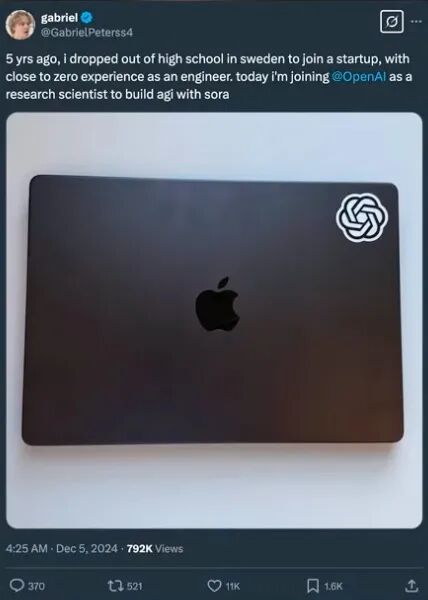
I saw a tweet you posted: "Five years ago, I dropped out of high school in Sweden with almost no engineering experience and joined a startup. Today, I've joined OpenAI as a research scientist, building AGI with the Sora team." How did you do it?
Gabriel: It's a long story. I've actually been thinking about AI since I read Superintelligence and Life 3.0. I really liked those two books, and coincidentally, the authors are both Swedes. So I thought, there must be something in it.
But at that time, I always thought I wasn't smart enough. I checked a little about AI - related content and couldn't code. I always felt that there were a lot of very smart people out there, and I couldn't compete with them at all. Finally, I decided to become an engineer and worked as an "engineer employee" in a startup for several years.
Host: Why did you drop out of school? In your hometown and the environment you grew up in, don't people usually go to school as normal? Where did you get the courage to leave?
Gabriel: To be honest, I didn't really "make up my mind". It was more like things pushed me to that point. One day, my cousin called me and said he had just met a very smart person who had an idea of using AI to build a recommendation system. He asked us to immediately build this thing and sell it to customers. That person was doing research in Singapore at that time. My cousin said, "We have to start right away. Come to Stockholm quickly."
I told him, "Dude, I have a huge party tonight."
He said, "No, come now."
So I directly bought the next bus ticket to Stockholm. After I went there, I never went back to school.
Host: What happened after you went to that startup?
Gabriel: Our idea at that time was to build a product recommendation system for e - commerce. The problem was that none of us knew anything about "entrepreneurship". We didn't know how to acquire customers or how to sell.
At first, I sent cold emails, and almost no one replied. Later, I started making phone calls one by one. Sometimes the conversations went well, but after all, I was just an 18 - year - old kid with no technical background, so it was hard for people to really trust me.
Later, I simply went door - to - door to promote our product.
I would crawl the customer's website in advance, train a new recommendation model, and then print out a large A3 picture comparing their original recommendation results with the ones we generated. The left side was what they were currently using, and the right side was ours.
I made more than a hundred copies, put them in folders, and knocked on the doors of companies one by one, saying, "Could you call the e - commerce director or the CEO for me?"
When they saw the comparison chart, their first reaction was always shock: "Did you do all these? How did you do it?" The next question was: "Then how can we launch it?"
At this time, I would say, "No problem. We're ready today and can launch it directly." I always carried a script with me, which could be directly pasted into their website's browser console to replace the original recommendation results with ours. The script also integrated A/B testing to compare the profits brought by both sides. Many times, I could get them to switch to our solution on the spot during the first meeting - it sounds crazy, but it really worked.
Of course, this also led to big problems later: we didn't consider scalability and maintainability at all. We just wanted to acquire customers first. The whole team was a group of 17 - and 18 - year - old dropouts, just charging forward with brute force.
Host: Did you do all these offline in Stockholm?
Gabriel: Yes, we were all there. I lived in my cousin's student apartment. It was a very small place. It was called a "dormitory", but actually it was just a small room separated from an ordinary apartment, and only students were eligible to live there. When submitting materials, we even had to pretend that he was still in college. I slept on the sofa cushions I picked up in the public area for a whole year. The room was small and dirty, but that was our co - working space.
Host: Most people would choose to go back to school after experiencing these, but you didn't. What made you persevere?
Gabriel: My perception of reality has always been distorted. At that time, I was 100% sure that I would become a billionaire. Seriously, I had no doubts at all. I was convinced that we were working on "the next big thing", and nothing else mattered. So I worked desperately, stayed up all night many times, ran around Stockholm for sales, and tried all kinds of crazy ways to acquire customers.
2 The Fastest Way to Learn Is Not to Finish the Basics First, but to Be Forced by Real Projects
Host: You couldn't code at the beginning. So how did you learn?
Gabriel: It was mainly out of necessity because we had to do various integrations for customers. At first, my cousin taught me Java, and we wrote a very bad turn - based "Pokémon" game together. Later, I took a Python course on Udemy and made another equally bad game. I also tried to take Andrew Ng's machine learning course, but I couldn't understand it at all and just thought I was too stupid.
I really started learning after starting the business because you have to do those things: write crawlers, build recommendation systems, set up A/B testing, and do various integrations. Once you have a real problem in front of you, learning becomes much easier.
You will search on Stack Overflow. If you get stuck, you will ask your friends around. With real work pressure, you are forced to learn things. For me, I can hardly learn anything without pressure.
Host: If you were to give advice to another high - school dropout, what would you say?
Gabriel: I'm very lucky. I grew up in a small town in Sweden called Vaggeryd, and I didn't know any engineers around me. When I first saw a programmer in high school, I was so excited that I asked him if he could make websites.
In a place where there are no engineers and no entrepreneurial culture, it's natural to think that all these things are very far away from you. In San Francisco, people think that starting a business is a normal option, largely because everyone around them is talking about these things.
I was able to break out because I joined that startup, which gave me the opportunity to have real "hands - on experience". This was the most important learning experience for me. If others want to take a similar path, I would advise them to enter the market as soon as possible, solve real problems as soon as possible, and truly be responsible for the results.
Now with ChatGPT, you don't even need to know a lot of technology at the beginning. You just need to prove that you can ask questions, put forward requirements, and are willing to do things yourself, with strong initiative. You can completely say: I don't know the technical details now, but I'll ask ChatGPT, and I can get any knowledge I need from there.
Knowledge itself is no longer a scarce resource.
Host: In the past, you had to take courses and read textbooks to pave the way. Now you can directly ask AI with your questions.
Gabriel: Yes. The fastest way for humans to learn is actually top - down: start with a real task and then dig deeper. Whenever you don't understand a certain part, learn that part on the spot.
However, schools can't teach in this way on a large scale because it requires teachers to constantly judge "what you should learn next". So the education system generally chooses the bottom - up approach: start with the basics such as mathematics, linear algebra, and matrices, and build up layer by layer. This method is suitable for large - scale teaching, but the learning efficiency is very low.
Now with ChatGPT, this situation has changed. Universities no longer monopolize the access to "basic knowledge". I even find it hard to take seriously those universities whose curriculum doesn't include large - model - related content in the basic part. This kind of thing should be introduced at a very young age.
Many people say that learning in this way "can never truly understand the essence of the problem", but that's not the case. You can start from a task and learn recursively, and still understand it deeply.
For example, if I want to learn machine learning, I'll first ask ChatGPT: What project should I do? Let it help me design a project plan and start from there. Then, I'll ask it to write a complete machine - learning code. There will definitely be bugs, so I'll start by fixing them and gradually get the program running. When the program can run, I'll focus on a small detail and continue to ask: "What exactly is this part doing? Can you explain it in a more intuitive way? Why can this module enable the model to learn?"
It will first give an explanation and then mention that matrix multiplication and linear algebra are used here. Then I'll continue to ask: "How do these things work in essence? What's the underlying mathematical intuition? Can you draw some schematic diagrams to help me build an intuition for this machine - learning module?"
Learning in this way is actually starting from the "upper - level task" and gradually filling in all the necessary basics, rather than struggling at the most basic level for many years. This change will fundamentally change the way of education.
Host: In school, what aspects of AI are not taught at all or are taught incorrectly?
Gabriel: First of all, the overall perception of AI in school is already wrong. As soon as ChatGPT came out, students' first reaction was: "Great, there's something that can help me do all my homework." They only saw this aspect. To be honest, if I were a student at that time, I might have thought the same way.
Teachers' first reaction was: "Oh no, everyone will use AI to cheat on their homework. We have to ban it immediately. AI is a bad thing." Thus, a self - reinforcing cycle was formed: in students' eyes, AI equals a cheating tool; in teachers' eyes, AI equals a source of cheating. In this environment, almost no one has the opportunity to naturally develop an intuition that AI can be used for "learning". This habit won't appear out of thin air.
Now, there is a somewhat encouraging change. Occasionally, when I talk to my friends who are studying at universities in Sweden, they will say: "I found that I can use ChatGPT to help me with quizzes. I'll throw in all the past exam questions, let it summarize the core concepts behind these questions, or let it generate 10 similar new questions. In this way, I can really understand what they are trying to teach."
A small number of students are starting to figure it out. But overall, teachers still strongly reject AI, which doesn't make sense. If teachers are willing to change the narrative from "AI will make you cheat" to "I'll teach you how to use AI to learn efficiently", the situation will be completely different.
Students who want to cheat will always find a way, whether there is AI or not. If no one tells them that "AI can actually be used for learning", they will naturally only regard it as a tool to finish their homework.
To be honest, I also tried to cheat when I was a student (laughs). It's just that no one ever told me that such tools could be used for real learning.
3 Learning Mathematics and Diffusion Models by Self - Study with AI, and Making His Way into OpenAI's Sora Team
Host: So, now you can learn almost any topic just with the help of ChatGPT. First, ask it: "If I want to learn this, what prerequisite knowledge do I need to understand?" It will give you a long list. Then you start from one of the items on the list and dig deeper. For example, when I was learning video models, I first grasped the "diffusion model" part and kept asking how it worked.
Next, you keep asking questions step by step: I don't understand this part, what does this symbol mean, why is this structure designed like this, and how is the mathematics here derived. Through this process of continuous questioning and correction, you can really understand the whole thing.
I've read many of your posts on X. It seems that you keep using AI to do this "re - explanation" until you really understand it thoroughly. This is a bit like the Feynman learning method: the best way to learn is to explain the concept to others. Now, "others" can be AI. When you were learning the diffusion model, you didn't even know what a gradient was at first, and it would also teach you calculus and linear algebra. When you think you've got it, you can explain your understanding to the model and let it check: "This is my understanding of this concept. Is it correct?" This can both correct your understanding and fill in the details you missed.
Gabriel: I call this whole process "recursive knowledge - filling". If I have to summarize it in one word, the most crucial ability is: knowing where you don't understand. You can imagine that when you're learning an AI model or a certain field, you need to be able to keenly sense: "Wait, I actually don't really understand this part." This is not something you're born with; it needs to be deliberately trained. You have to keep asking yourself: Do I really understand?
This is the first signal. The second signal is that when you keep asking questions and digging deeper, there will be a moment when you suddenly have an "Ah, so that