NVIDIA enters the arena and joins hands with surgical robot companies to challenge Da Vinci.
Recently, the surgical robot industry has witnessed a "cooperation boom with NVIDIA", and currently, more than eight surgical robot companies have announced partnerships with NVIDIA.
For example, the endoluminal robot company EndoQuest Robotics plans to integrate NVIDIA's IGX Thor platform into its next - generation surgical robot system; CMR Surgical in the UK announced that it has become one of the world's first companies to adopt the NVIDIA IGX Thor platform. It is understood that IGX Thor is NVIDIA's newly launched top - tier physical AI and robotics platform, with an artificial intelligence computing power of 5581 FP4 TFLOPS and a 400GbE network connection capacity. It represents a comprehensive leap in computing power efficiency and perception ability compared to the previous - generation platform.
In addition, surgical robot companies such as Johnson & Johnson, XCath, Asensus, Moon Surgical, Virtual Incision, Neptune Surgical, and Stereotaxis have all reached cooperation agreements with NVIDIA.
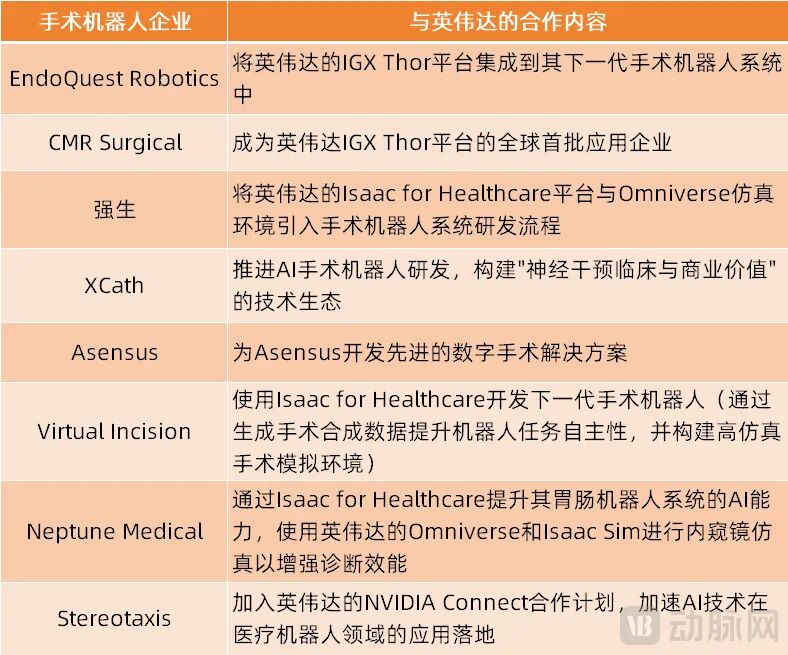
Judging from the cooperation content, the successive partnerships between these surgical robot companies and NVIDIA are mainly for intelligent innovation and robotic automation transformation. In these two aspects, domestic companies have long made arrangements.
In terms of intelligence, surgical robots launched by domestic companies such as MicroPort Robotics, Jinfeng Medical, Tianzhihang, and Ruilong Surgical are all equipped with intelligent functions such as image reconstruction, intelligent navigation, surgical planning, and auxiliary decision - making.
In terms of robotic surgical automation, domestic innovative companies have gone further than their overseas counterparts. For example, Geray Technology recently demonstrated the "Newton" intelligent endoscopic minimally invasive robotic surgical solution at the 17th COA Academic Conference and completed its first public full - automation demonstration. Currently, the automation level of its surgical robot is approaching the L4+ level. It is expected that high - order autonomous robots will be able to independently complete more core surgical steps, reducing the reliance on doctors' experience and eliminating human errors.
Meanwhile, Aopeng Medical pioneered the Aopeng Embodied Intelligent Robotic Automatic Surgical Platform "FARS" agent. Previously, Aopeng Medical used the first - generation interventional surgical robot equipped with the "FARS" agent to successfully conduct an automated interventional surgical animal experiment at an animal experimental research center. The entire operation was independently completed by the "FARS" agent, including wire manipulation, catheter delivery, and stent release. During the operation, multi - modal imaging (DSA - CT fusion) was used to achieve sub - millimeter - level operation accuracy, attempting to challenge the ultimate goal of "autonomous driving" in interventional intelligence.
In the vertical field of robot - assisted vascular intervention in the domestic academic community, the team of Professor Qi Peng from Tongji University, together with the clinical team of Academician Ge Junbo from Zhongshan Hospital Affiliated to Fudan University, and in collaboration with top research forces from Siemens Healthineers, the Chinese University of Hong Kong, and other parties, jointly explored the autonomous operation path of vascular interventional surgical robots driven by embodied intelligence based on simulation learning. Currently, the team has completed preliminary technical demonstrations at the top international robotics conferences ICRA and IROS: by training the "digital twin" control model in a virtual environment and migrating it to the physical robot system, in an experimental environment simulating the human vascular structure, high - precision navigation and instrument manipulation tasks were achieved. For the first time in the high - risk and high - precision scenario of vascular intervention, the feasibility of the "simulation → physical" technical path was verified, providing key directions and methodological bases for subsequent system optimization, algorithm robustness improvement, and real - environment adaptation. These latest achievements based on virtual simulation training and computing power support are further optimized in the cooperation with NVIDIA, deeply integrating the simulation system, AI training framework, and real - time execution engine to break through intelligent surgical operations supported by flexible simulation of human organs and real - time computing.
Facing the collective partnerships between surgical robot companies and research institutions with NVIDIA, we need to think about: Can these surgical robots supported by NVIDIA compete with the market - monopolizing Da Vinci? Can domestic surgical robots, which are already leading in terms of intelligence and automation, gain a foothold in the future? What difficulties still exist in realizing future intelligent and automated surgical robots?
01 Is computing power the foundation for future innovation in surgical robots?
In the past, the intelligence of surgical robots mainly relied on algorithms. However, with the growth of data volume, the increase of intelligent functions, and the improvement of clinical requirements, surgical robot companies can no longer simply rely on algorithms to meet the needs but require more computing power support.
As a globally leading provider of AI computing solutions, NVIDIA has an absolute advantage in computing power solutions. This is also one of the reasons why surgical robot companies have successively cooperated with it.
Currently, the computing power requirements of surgical robots are mainly reflected in three aspects: real - time environmental perception, data processing, and the fusion and analysis of multi - modal data. Specifically, in terms of corresponding functions, it can be analyzed from the pre - operative, intra - operative, and post - operative stages.
Firstly, pre - operative: Data processing, including data acquisition, three - dimensional reconstruction of imaging data, automatic delineation of medical images, calculation of lesion volume, and surgical approach planning, all requires a certain amount of computing power support. These functions have almost become the basic and essential functions of surgical robots.
Take the Newton surgical robot independently developed by Geray Technology as an example. Its "Newton 3D" is the world's first all - electric 8 - axis/integrated intra - operative mobile imaging system, which can achieve ultra - high - definition scanning of 0.16mm and low - dose real - time registration. It can also automatically generate personalized surgical plans based on the patient's anatomical structure through the intelligent planning module. Functions such as three - dimensional reconstruction, data transmission, and intelligent surgical planning all require computing power support.
Secondly, intra - operative: Functions such as real - time intra - operative navigation, auxiliary decision - making, robotic arm control, and multi - modal data fusion all require powerful computing power support. Compared with the pre - operative stage, the intelligent solutions during the operation have higher requirements for real - time performance. For example, during surgical assistance, the surgical robot needs to simultaneously complete multiple tasks such as surgical field image segmentation, instrument trajectory tracking, and patient vital signs analysis. Any delay may affect the surgical operation and even the safety of the operation.
At the same time, during the operation, the surgical robot also needs to fuse and process in real - time multi - modal data such as real - time tracking data of surgical instruments, force feedback data, X - ray data, endoscopic data, system response data, and other imaging data to ensure the accuracy and safety of the surgical robot.
Thirdly, post - operative: Functions include post - operative evaluation, quantification of operation standards, and assessment of complications. For example, Intuitive Surgical plans to rely on the newly launched Da Vinci 5 surgical robot to quantitatively decompose the operation into multiple key steps, conduct a correlation analysis by combining the surgical type, objectively quantify the surgical workflow, and the actual clinical effects of patients, so as to obtain relatively important objective indicators and establish the basic standards for surgical robots.
Intuitive Surgical also attempts to combine these objective indicators with past case data to predict the treatment effect of current patients, and then provide more valuable suggestions during the operation, allowing doctors to combine these suggestions with the current patient's situation to choose a better surgical method. All these data analysis functions require a certain amount of computing power support.
Generally speaking, the intelligence of surgical robots must be based on computing power, and each of its intelligent functions requires different levels of computing power support. Among them, basic perception functions such as sensor data collection, data transmission, and data processing only require medium - level computing power, but these functions have higher requirements for real - time performance; auxiliary decision - making functions such as surgical planning and navigation positioning require higher - level computing power, and these functions need to be completed within a very short time, with relatively concentrated computing power (less used at other times). Enterprises need to balance the cost and computing power security; while intelligent decision - making functions such as automated surgical operations require ultra - high - level computing power support.
In addition, different levels of computing power also have an impact on the performance of surgical robots. Powerful computing power can improve the response speed of surgical robots, reduce the delay in each link, and make their operations smoother; it can also enhance the control accuracy and reliability of surgical robots, ensuring high - precision operations and surgical safety; powerful computing power also contributes to the exploration of automated robotic surgeries.
Of course, powerful computing power means higher costs. Enterprises cannot simply stack computing power but need to consider the balance point among clinical requirements, product performance, and costs.
02 Can these surgical robots supported by NVIDIA compete with the Da Vinci?
Although surgical robot companies have successively partnered with NVIDIA, the depth and direction of the cooperation vary. These differentiated layouts are the characteristic innovations of each company.
Firstly, innovation in terms of intelligence. Both EndoQuest Robotics and CMR Surgical plan to integrate NVIDIA's IGX Thor platform into their surgical robots.
It is understood that NVIDIA's IGX Thor platform is specifically designed for "physical AI" and robotics scenarios, with powerful computing power and high - speed interconnection capabilities. It can support low - latency multi - modal perception and real - time control. Compared with the previous - generation platform IGX Orin, the AI computing power of this platform on the integrated GPU has increased by 8 times, the computing power on the independent GPU has increased by 2.5 times, and its connection performance has also doubled. It can run multiple large AI models on the surgical robot side.
Therefore, EndoQuest Robotics will use NVIDIA's computing power and technology to achieve low - latency sensor processing and 3D visualization, precise and time - synchronized motion control, and secure cloud connection; it will also use NVIDIA's technology platform to integrate and deploy more AI functions on its surgical robot.
CMR Surgical, on the other hand, uses the 250 - 600 TOPS computing power provided by the NVIDIA IGX Thor platform to enhance the intelligent performance of its Versius surgical robot. The Versius surgical robot is the world's first multi - port soft - tissue general robot approved by the FDA, capable of performing complex surgical procedures on the lungs, thymus, esophagus, and other parts.
Compared with the past, the real - time AI blood vessel recognition ability of the Versius surgical robot supported by the IGX Thor platform has increased by 3 times, and the delay control is as low as 10 milliseconds. With the support of this platform, Versius can maintain a positioning accuracy of 0.3 millimeters and for the first time, achieve non - contact vein placement and automatic catheter insertion.
In addition, surgical robot companies such as Moon Surgical, Neptune Medical, and Asensus Surgical have also increased and innovated their intelligent functions through other computing power platforms or solutions provided by NVIDIA. For example, the artificial intelligence application ScoPilot developed by Moon Surgical based on NVIDIA's Holoscan real - time perception platform has been running on its Maestro surgical robot. This intelligent function can empower surgeons with the ability to control three instruments with two mechanical arms and provide a stable, continuously optimized, and safe surgical field, significantly improving the efficiency of the operating room...
Secondly, innovation in terms of automation. Robotic surgical automation is another important direction explored by innovative companies. For example, the surgical robot company Virtual Incision plans to use NVIDIA's Isaac for Healthcare (a developer framework for AI healthcare robots) to develop the next - generation surgical robot - by generating synthetic surgical data to enhance the robot's task autonomy.
In fact, not only overseas companies, but also many domestic innovative companies have achieved certain results in the field of surgical robot automation. For example, in the field of hair transplantation robots, the second - generation Fazhixing hair transplantation robot developed by Bangce Medical has made breakthroughs in intelligent planning, hair flow recognition, automatic extraction, and punching. Compared with overseas robots that focus on local assistance such as hair follicle recognition, the Fazhixing hair transplantation robot has moved towards "automated execution + intelligent decision - making".
In the field of laparoscopic surgical robots dominated by Intuitive Surgical, domestic innovative companies have also explored automated operations of surgical robots. In August 2025, Kangnuositen, in cooperation with the multidisciplinary research team of the Chinese University of Hong Kong, achieved the world's first clinical - scenario - based autonomous surgical verification and published the paper in the top robotics journal "Science Robotics". This operation was carried out on a live animal (a live pig). Throughout the operation, relying only on the endoscopic visual feedback of the surgical robot and driven by the algorithm, the approved Kangnuositen Sentire laparoscopic surgical robot independently performed three endoscopic surgical operations: gauze grasping, vascular clamping, and soft - tissue traction. The results showed that without human intervention, the Sentire laparoscopic surgical robot could accurately and efficiently complete autonomous operations, with the success rates of the three tasks reaching 83%, 77%, and 67% respectively.
In addition, domestic innovative companies such as Aopeng Medical and Geray Technology, which were mentioned earlier, have also made progress in robotic automated surgeries. Automation is an important development direction in the field of surgical robots in the future, and robotic automated surgeries require surgical robots to have higher real - time perception and intelligent decision - making abilities. All these require surgical robots to have higher computing power support. In this regard, it is expected that NVIDIA will play a more crucial role in the future innovation of surgical robots. Domestic innovative companies such as Aopeng Medical and Geray Technology are also continuously paying attention to the various solutions launched by NVIDIA.
It is worth mentioning that compared with many challengers, the newly launched Da Vinci 5 surgical robot by Intuitive Surgical also has a variety of intelligent functions, and its computing power has increased by 10,000 times compared with the previous - generation product. Based on the significant increase in computing power, the Da Vinci 5 surgical robot integrates a variety of new systems and intelligent functions. However, Intuitive Surgical has made few arrangements in the field of automated surgeries. This may be an opportunity for later - comers to overtake on a curve.
Finally, NVIDIA has deeply involved in the R & D process of surgical robots. In October 2025, Johnson & Johnson announced a cooperation with NVIDIA, introducing NVIDIA's Isaac for Healthcare platform (a developer framework for AI healthcare robots) into the R & D process of its surgical robot system.
It is reported that the Isaac platform is a complete technology stack for robot development, covering high - precision simulation, digital twin, AI model training, and inference capabilities. The core technologies include the Omniverse high - fidelity simulation platform, the Cosmos world basic model, and multi - modal capabilities. Through this platform, Johnson & Johnson can use a virtual environment similar to the real world to design, verify, and optimize surgical robots during the development stage, such as developing and testing functions such as force feedback response, intra - operative navigation algorithms, spatial path optimization, and abnormal situation handling in advance in the virtual environment.
In the past, developing a surgical robot required a large number of laboratory experiments and animal experiments, which was very costly. With the Isaac platform, it is possible to test and optimize the surgical path in a virtual environment similar to the real world, reducing the cost of physical trial - and - error. This means that in the future, the R & D of surgical robots will not only rely on physical hardware but can be tested and developed in advance in a virtual environment. This will significantly shorten the R & D cycle of surgical robots, reduce R & D costs, and accelerate the commercialization process. This platform can also be used in the training process to help doctors adapt to and master surgical robots earlier.
Previously, NVIDIA collaborated with researchers from universities such as the University of Toronto, the University of California, Berkeley, the Swiss Federal Institute of Technology in Zurich, and the Georgia Institute of Technology to launch the ORBIT - Surgical simulation surgical robot training framework to enhance the skills of surgical teams and reduce the cognitive load of surgeons. ORBIT - Surgical introduced more than ten benchmark tasks for surgical training, including picking up a piece of gauze with one hand, inserting a shunt tube into a blood vessel, holding a suture needle to a specific position, passing the needle from one mechanical arm to another, and passing a threaded needle through a ring - shaped rod.
In 2024, the ORBIT - Surgical research team demonstrated at the ICRA Robotics Conference how to transfer the digital twin from simulation training to a physical robot in a laboratory environment. This demonstration confirmed that researchers can train surgical robots in a virtual environment and transfer them to physical robots after optimization to a certain extent. This method can significantly reduce R & D costs and shorten the R & D cycle.
Generally speaking, technologies such as simulation platforms and digital twins have great advantages in the R & D of surgical robots. Against this background, it is expected that NVIDIA will occupy an important position in the future innovation of surgical robots, especially as surgical robots gradually move from hardware innovation to a new stage driven by software and computing power, accelerating the development towards intelligence and automation.
However, although the goal is clear, the path is tortuous. Intelligence and automation are recognized as the future directions, but it is very difficult to achieve these two technologies. For example, surgical robots require a large amount of accurate data, but there is a problem of data silos; there are regulatory and ethical issues in robotic automated surgeries in the clinical field, which require the support of regulatory authorities; in terms of the industrial ecosystem, it is also necessary to improve the industrial chain, supply chain, payment system, and other aspects. These difficulties need to be solved one by one by innovative