Can intelligent cooking machines invade the kitchen and "eliminate" a group of chefs?
Stir-frying robots vs. chefs: Who will dominate?
Nine years ago, Lee Sedol, the international Go world champion, was defeated by the artificial intelligence AlphaGo with a score of 1:4. A year later, Ke Jie, the world's number one Go player, lost three consecutive games and became the loser to the upgraded Alpha Master.
Today, as stir-frying robots are accelerating their penetration into the catering industry, will the chef community face a similar situation? To what extent can the dishes produced by stir-frying robots reach? Will chefs be eliminated by stir-frying robots?
Recently, Hongchu Network talked to many catering industry insiders and some chefs and found that the answer is not as simple as "one wins and the other loses".
Fast speed and stable output: Stir-frying robots have a chance
After closely observing a batch of stir-frying robot equipment, the most profound feeling of Hongchu Network is that: Fast speed and stable output are the remarkable advantages of stir-frying robots.
Input instructions, heat the pan, add ingredients... A few minutes later, the spicy chicken, braised chicken chunks, and stir-fried shrimps in "Bifengtang" style, steaming with heat and aroma, can be quickly served on plates.
Take the "First China Guangzhou Robot Chef Competition" (hereinafter referred to as the "Robot Chef Competition") held not long ago as an example. The competition regulations state that the "Future Chef Group" is required to present characteristic and innovative dishes within 20 minutes, while the "Stir-frying Robot Group" only has 5 minutes.
But in fact, excluding the time for preparing ingredients, Most stir-frying robots only take about 3 minutes to cook a dish.
Stir-frying robot manufacturers such as Shanghai Changshan Intelligent Technology Co., Ltd. have also developed different versions of stir-frying machines. For example, the quick-frying version of the stir-frying machine is more suitable for fast-food restaurants and canteens where small portions of food are served frequently. The canteen version can meet the centralized meal output needs of schools, factories, etc., and can complete large-pot cooking within 5 - 7 minutes.
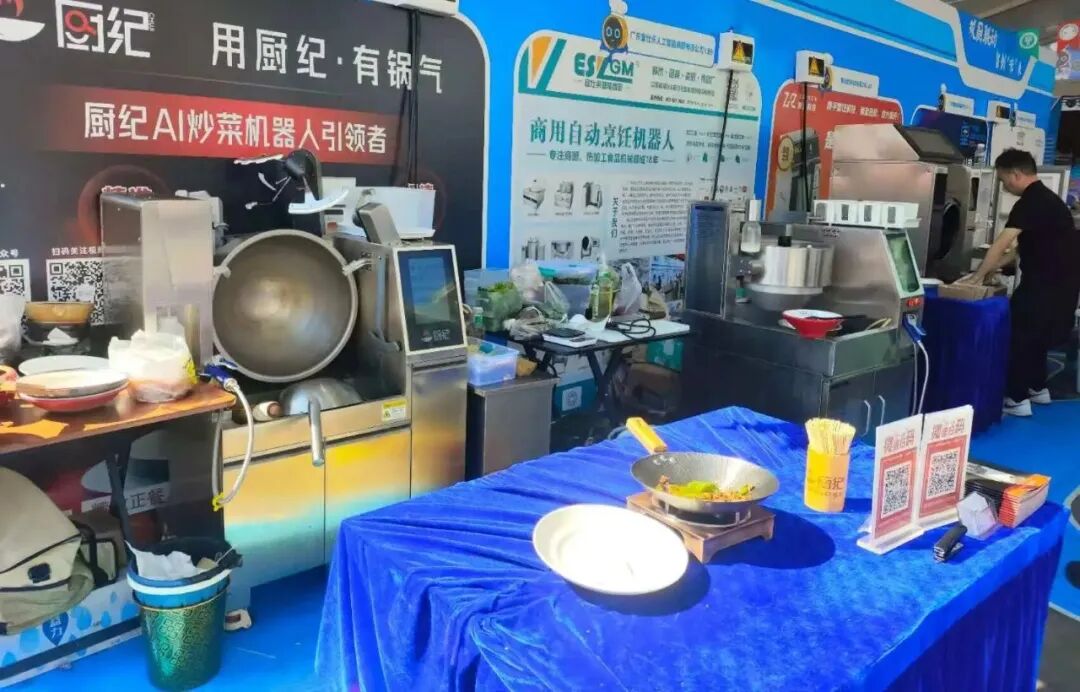
△Photo source: Taken by Hongchu Network
Since the birth of the first stir-frying robot in 2012, this invention has been continuously upgraded, from automatic stir-frying by robotic arms to the integration of AI algorithms, sensor control, and cloud collaboration. At present, stir-frying robots of different brands have basically achieved functions such as precise ingredient feeding, heat control, and automatic stir-frying.
The market is also willing to pay. According to public information, 140,000 stir-frying robots were sold in the Chinese market in 2024, a year-on-year increase of 54.4%, and the online sales reached 290 million yuan.
The "World Stir-frying Robot Industry Development Report" (hereinafter referred to as the "Report") released by the China National Food Industry Association shows that the market scale of stir-frying robots in China reached 3.17 billion yuan in 2024. By 2025, the market scale is expected to exceed 3.7 billion yuan, and it will continue to show a high-growth trend in the following years.
The "Report" also predicts that by 2028, the penetration rate of stir-frying robots will be the highest in group meals and fast food, reaching about 50%. Next are Hunan cuisine and Sichuan cuisine, with a penetration rate of about 35% - 45%, while the penetration rates of Cantonese cuisine, Zhejiang cuisine, Shandong cuisine, and snacks are relatively low.
In reality, it can also be seen that the application of stir-frying robots is mainly concentrated in fast-food scenarios such as community canteens, group meals, and service areas. For example, chain catering brands such as Laoxiangji and Xiaocaiyuan have deployed automated equipment, and enterprise canteens such as Foxconn have also introduced stir-frying machines to improve meal supply efficiency.
Not "stealing jobs", but "a great assistant"
It can be predicted that in the future, the intelligence level of the catering industry will be higher and higher, and more and more restaurants may accept and use stir-frying robots.
In this situation, how should chefs respond?
At the Robot Chef Competition, Chen Zhixiong, the president of the Zhongshan Food Industry Association, straightforwardly commented on the dish "Pine Nut Fish Taking the First Place": "From the dish design, color control to heat control, everything is handled very meticulously." Obviously, the "dedication" of chefs still has competitiveness in the man-machine confrontation.
Chef Liu Zijian also shared his views with Hongchu Network. "Sometimes, there must be friction to generate sparks. We learn the standardized output of robots, and robots can also take our chefs' manual work as the direction for future optimization."
In his opinion, the standardization of stir-frying robots is both an advantage and a disadvantage. The advantage lies in the high output efficiency of basic dishes with single operations such as stir-frying, frying, and deep-frying, but the program design is not so flexible. "If it goes to a restaurant or a big hotel, (the robot) can only handle a certain link. For example, it is quite difficult to complete the 'oil-bubbling' technique in Cantonese cuisine, unless the robotic arm has reached the level of a human hand."
During the communication, Hongchu Network also learned that another identity of Liu Zijian is the person in charge of the Cooking and Nutrition Department of Guangzhou High-Tech Medical and Food Technician School. As a teacher, he highly encourages students to compete with stir-frying robots more often. He will also find an opportunity to introduce some equipment to the school for integrated development.
Facing the AI wave represented by stir-frying robots, he believes that this is a tool, not a relationship of elimination and replacement. In other words, the "AI content" of the new generation of chefs is increasing. "We will guide students to apply AI, not rely on it. For example, if a dish has been designed, then use AI to help me check if there are any unreasonable nutritional combinations or taste conflicts."
Taking his creative dish "Mushroom-flavored Hundred-flower Air Roll" as an example, Liu Zijian first discussed the envisioned flavor with AI, and then completed the dish by integrating design and basic skills. In his opinion, stir-frying robots cannot replace the creativity of chefs for the time being.
Creativity is rare, and master chefs are even rarer. Qiu Kehong, the executive vice-chairman of the Famous Chef Professional Committee of the China Cuisine Association and the global promotion ambassador of Sichuan cuisine culture, once told Hongchu Network that "When robots come, master chefs become more useful. It still depends on master chefs to truly make good use of robots." He called on chefs to cross over to the food industry and provide R & D guidance and application guidance in SOP (Standard Operating Procedure).
In fact, looking back at the rise of stir-frying robots, the reason why they have caused a stir is not only the innovation of the ancient profession of chefs by AI, but also the real and objective problem of a large shortage of chefs. Taking Sichuan cuisine as an example, the average age of Sichuan chefs is now 43 years old, and those born in the 1990s only account for one-tenth.
A survey by the China Cuisine Association shows that 78% of catering enterprises face a labor shortage of more than 30% during the peak season, the recruitment cycle is as long as 15 - 20 days, and the labor cost has increased by 40%. The data of the National Bureau of Statistics also shows that the annual average turnover rate of employees in the catering industry in 2024 was as high as 65%, and the training cost of new employees accounted for 40% of the total recruitment cost. It is estimated that by 2025, the shortage of chef talents will reach 3 million people.
As the backbone chefs gradually get old and there is a generational gap in the chef team, the most anxious ones are the catering bosses. This is also the main reason why a large number of restaurants are interested in stir-frying robots.
Still a long way from application to popularization
However, it is still quite difficult for stir-frying robots to be widely popularized.
In the description of some stir-frying robot manufacturers, a stir-frying machine costs 60,000 yuan. Calculated based on an 8-year service life, the monthly cost is only 625 yuan. The implication is that buying a stir-frying robot is much more cost-effective than hiring a chef. But in actual application, it's not that easy to calculate this account.
Boss Liao, who runs group meals in an industrial park, found after leading his chef team to conduct multiple inspections that it is not very realistic to completely replace chefs with stir-frying robots.
First of all, the current layout of the back kitchen is still designed for manual stir-frying. Even if a small number of dishes can be replaced by stir-frying robots, dozens of dishes need to be served a day. However, there are conflicts in the workflow when the "manual + machine" two modes operate simultaneously.
Secondly, stir-frying robots need to be debugged by the store employees themselves and cannot be used right after purchase. "This machine claims to be able to produce 12 catties of dishes at a time, but the average customer spending in our restaurant is a bit higher. Maybe the best quality is produced when it makes 6 catties. The chefs need to test 'how much is the most appropriate'."
Not only the amount of ingredients needs to be controlled, but each step of each dish also needs to be split into a "manual + machine" cooperation and cannot be entirely entrusted to the stir-frying robot.
Taking the simplest scrambled eggs with tomatoes as an example, "If the robot is asked to fry everything, the speed is too slow. We will specially prepare a pan beside it to fry more than a dozen catties of eggs at a time, and then let the robot stir-fry." In the actual application of stir-frying machines, robot manufacturers and users are still exploring.
In Boss Liao's current restaurant, stir-frying robots can only replace 20% of the manual labor. "Only when it reaches 35% can it form a positive cycle. Otherwise, the input and output of the machine are not proportional." According to his observation, most catering bosses around him are taking a wait-and-see attitude.
In addition, a catering industry insider told Hongchu Network that there are still too few national service points for stir-frying robots at present, which is also an important reason hindering their wide application. "If the machine breaks down, can a brand-new one be brought over for replacement within half an hour and the broken one be taken for repair? Coffee machines can do this now, but stir-frying machines can't."
Conclusion
In the view of Hongchu Network, the arrival of stir-frying robots will not streamline the chef team, but adjust the role of chefs and provide a new development path.
After all, at present, stir-frying robots cannot think. They cannot, like large language models such as OpenAI and DeepSeek, summarize rules through "learning ability" and have "continuously improving cooking skills". And this gap is exactly the new opportunity for chefs in the AI era.
On the one hand, the processes such as cutting vegetables, cutting meat, and chopping ribs are replaced by machines, so chefs are liberated from rough processing and have more energy to invest in initiative work such as dish design and taste R & D;
On the other hand, chefs are the bond between machines and dishes, helping stir-frying robots to be integrated into the restaurant's management system. This requires more comprehensive abilities such as cost management and operational efficiency. In other words, the industry may need some all-round chefs in the future.
This article is from the WeChat official account "Hongchu Network". Author: Hongchu Editorial Department. Republished by 36Kr with permission.