"Skill Gomoku" is sweeping across the entire internet, and the AI hit songs are invading your ears.

Five-in-a-Row with Skills
Music with AI

Initially, no one used the term "traditional five-in-a-row" to refer to the game until the one with "earth-shattering power" emerged.
"Traditional five-in-a-row is just about connecting five pieces in a line. How boring! But five-in-a-row with skills adds skills to the traditional game. It's so much fun and explosive! Five-in-a-row with skills, earth-shattering; five-in-a-row with skills, earth-moving; five-in-a-row with skills, earth-shattering; five-in-a-row with skills, time-traveling!"
This absurd comedic line from Happy Wonderful Night 2, paired with a catchy melody, suddenly took over the entire internet. Open Douyin and you'll hear the brainwashing BGM of "Five-in-a-Row with Skills". Scroll through your WeChat Moments and you'll see adapted lyrics. Search on Baidu and you'll find five-in-a-row games made with the same adapted tune. Even Zhang Yixing danced to this five-in-a-row song at his concert in the Bird's Nest.
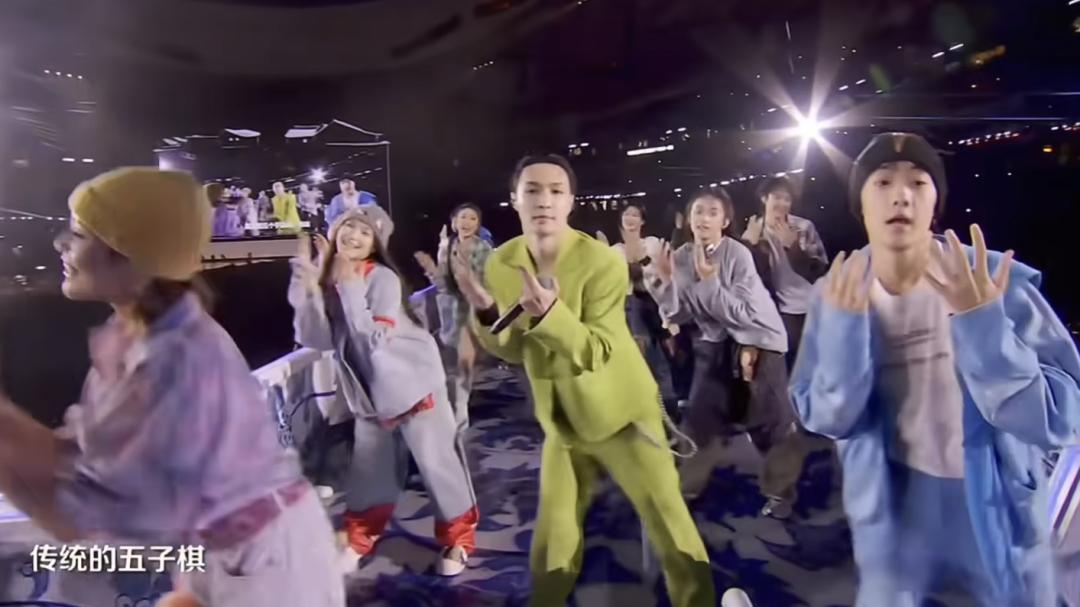
● Screenshot of Zhang Yixing's Bird's Nest concert live stream on Douyin
No one can really say what's so good about this melody, but no one can escape its "mental pollution". What's even more interesting is that when netizens dug into the creation background of this popular music, they found the most exciting secret in the music industry this year: Half of this year's viral hit songs may have AI genes. Yes, Zhang Xingchao said that Five-in-a-Row with Skills "was just an attempt at AI composition after a little drunkenness". It's rumored that he used Suno, but he hasn't confirmed it, so we don't know for sure.

● Screenshot of Zhang Xingchao's Weibo post
You've probably already heard songs written by AI without even realizing it. Now, social media platforms are flooded with all kinds of AI songs, including not only songs like Five-in-a-Row with Skills created by AI, but also voice-replaced songs like the AI version of Deng Lijun and Sun Yanzi's Tearful Bridge. All these phenomena indicate that AI is breaking down the barriers to music creation or cover singing into pieces. In the past, to make a demo, you had to rent a recording studio and hire musicians, and just recording the vocals could cost thousands of yuan. Now, with Suno's "Add Vocals" function, a bathroom a cappella clip can be directly turned into a professional performance.
There are already a large number of AI music creation platforms on the market.
Suno - the AI music creation tool rumored to be used by Zhang Xingchao to create Five-in-a-Row with Skills - its latest V5 version can achieve studio-level sound quality, with more detailed sound, capable of showing vibratos, whispers, and delicate emotional layers, and less distortion;
Udio, created by a former Google DeepMind research team, supports style transfer. It can instantly adapt country music into various styles like electronic music, making it suitable for mass-producing short video soundtracks;
There's also AIVA, an early pioneer founded in 2016. It builds mathematical models by analyzing the melody, rhythm, and harmonic structure of composers like Mozart and Beethoven, and combines artificial neural networks with genetic algorithms to generate music. Its generated music works have been adopted by international companies such as NVIDIA, Globant, TED, and Vodafone. In March this year, it received strategic investment from NetEase to expand into the Chinese market.
Domestic platforms better meet the needs of the Chinese market. They include ByteDance's Sponge Music, Kunlun Wanwei's SkyMusic, Qwan Tech's Tianpu Music, and Tunee, which is comparable to Suno. These platforms can complete the entire process from demand decomposition, plan formulation to music creation based on users' vague requirements, and finally generate music works that meet users' needs.
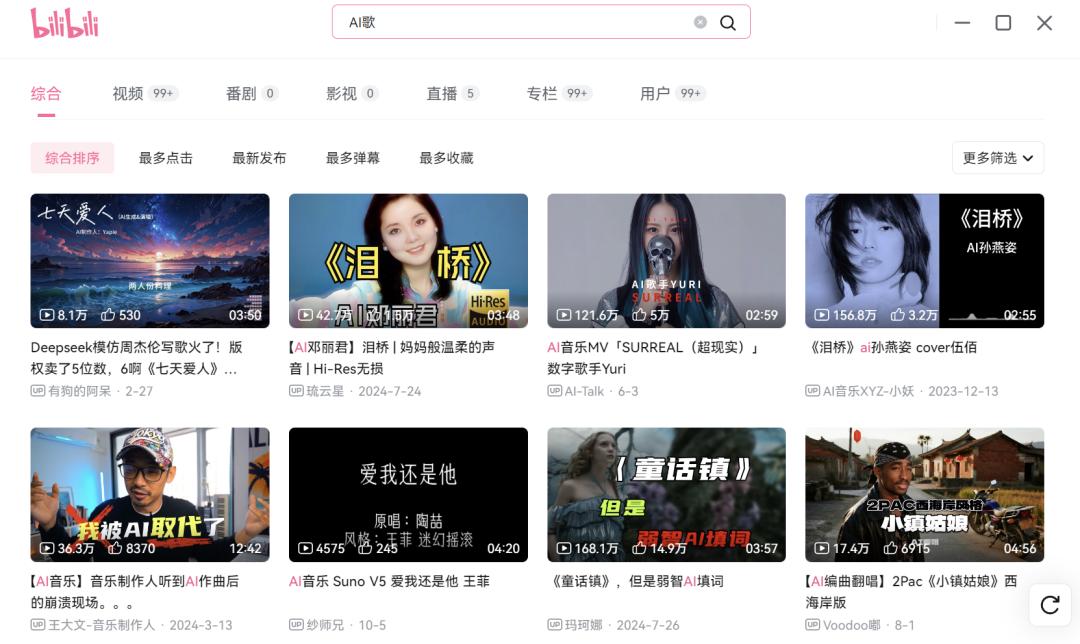
● Search results for "AI songs" on Bilibili
With the help of AI, new opportunities have emerged for ordinary people who are not professional musicians.
In February, a song called Seven-Day Lover suddenly appeared on NetEase Cloud Music's rising chart. One line in the song, "You said iced Americano is too bitter and you want to add a spoonful of my compromise", was jokingly said by netizens that even Fang Wenshan would have to step aside.
Actually, these lyrics came from an instruction given by Yang Ping, a financial self-media blogger, to DeepSeek. This programmer, who doesn't even have basic music theory knowledge, simply input a prompt: "Imitate Jay Chou's early love song style and construct a seven-day emotional narrative. The chorus should be memorable." Then DeepSeek gave him a complete set of lyrics. Yang Ping used MakeBestMusic (a professional AI music creation platform that can compose music, separate audio tracks, and mix sounds) and spent 3 hours completing the songwriting and composition of Seven-Day Lover. Later, he sold the song's copyright to a technology company and earned 50,000 yuan.
Tasting the sweetness, Yang Ping summarized netizens' comments on Seven-Day Lover and quickly launched Eight-Day Lover. Many netizens who also saw the business opportunity and wanted to ride on this wave of popularity followed suit and released Nine-Day Lover, Ten-Day Lover, Eleven-Day Lover, Twelve-Day Lover, and even Thirteen-Day Lover. However, these assembly-line works never achieved the same level of popularity as Seven-Day Lover and all sank into obscurity.
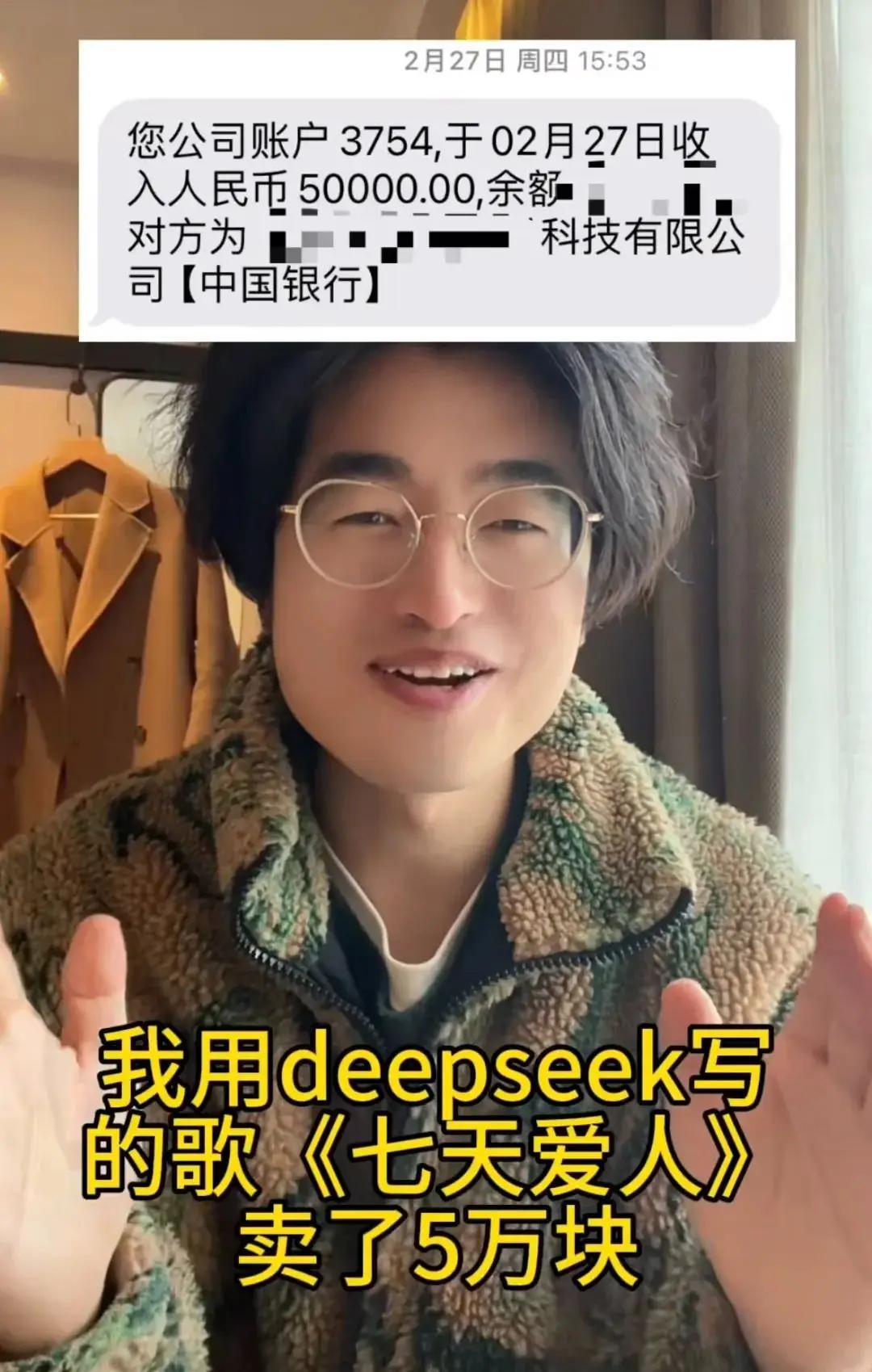
● Screenshot of @Yapie Programmer Brother (Yang Ping)'s Douyin video
The popularity of Seven-Day Lover turned AI music into a sub - field of Yang Ping's self - media. In addition to being known as "the programmer who lost 320,000 yuan in A - shares on the hot search in 4 days" in his personal profile, he added another title, "the pioneer of songwriting with DeepSeek on the hot search", and completely shifted to the AI music track. He launched a collection of AI songwriting tutorials, covering everything from prompt design to platform review, with a total online playback volume of over 25 million. Then he registered the domain name "ai6666.com" and integrated websites of tools for lyric writing, composition, and audio track separation into a one - stop service, which was jokingly called "the godfather of Chinese AI music" by his fans.
AI - created songs often have some common features. For example, the chorus segments are repetitive and the melodies are simple. Lines like "Iced Americano is too bitter" in Seven-Day Lover and "Earth - shattering" in Five-in-a-Row with Skills are very suitable for short, fast - paced short - video dissemination. An inspiration that pops up in the morning can be published in the afternoon.
However, the controversies behind the popularity of these songs are even more ear - piercing than the songs themselves. After Seven-Day Lover became popular, Yang Ping not only received reports from some musicians, being questioned as engaging in unfair competition, but also received five inquiry letters from the music association.
Although Suno claims to provide full - platform authorization and DeepSeek says the copyright belongs to the prompt creator, and relevant lawyers also say that Yang Ping's approach "should be regarded as co - creation between humans and machines, and technological innovation itself does not constitute unfair competition", the skeptical voices still keep coming.
Now, Yang Ping's domain name "ai6666.com" is no longer available. The public's enthusiasm for it has greatly diminished, and Yang Ping has shifted to a new field, "low - altitude economy entrepreneurship".
After all, the essence of music has never been about how to make it, but why to sing it. Just like the popularity of "Five - in - a - Row with Skills", it's not because the melody is so brain - washing. It catches the young people's mood of "going crazy together" and resonates with everyone. As Yang Ping said, "AI can turn vague inspirations into concrete forms", but the most important thing is the momentary feeling when we recall something one day after experiencing all kinds of things.

Written by | Ma Yujian
Edited by | Ba Rui
Cover image source | Screenshot from the first episode of Happy Wonderful Night Season 2



What kind of AI music do you think will become popular?



This article is from the WeChat official account "Future Human Laboratory". The author is Ma Yujian. It is published by 36Kr with authorization.