I used AI to create a hobo to deceive my dad, and as a result, he called in the special police.
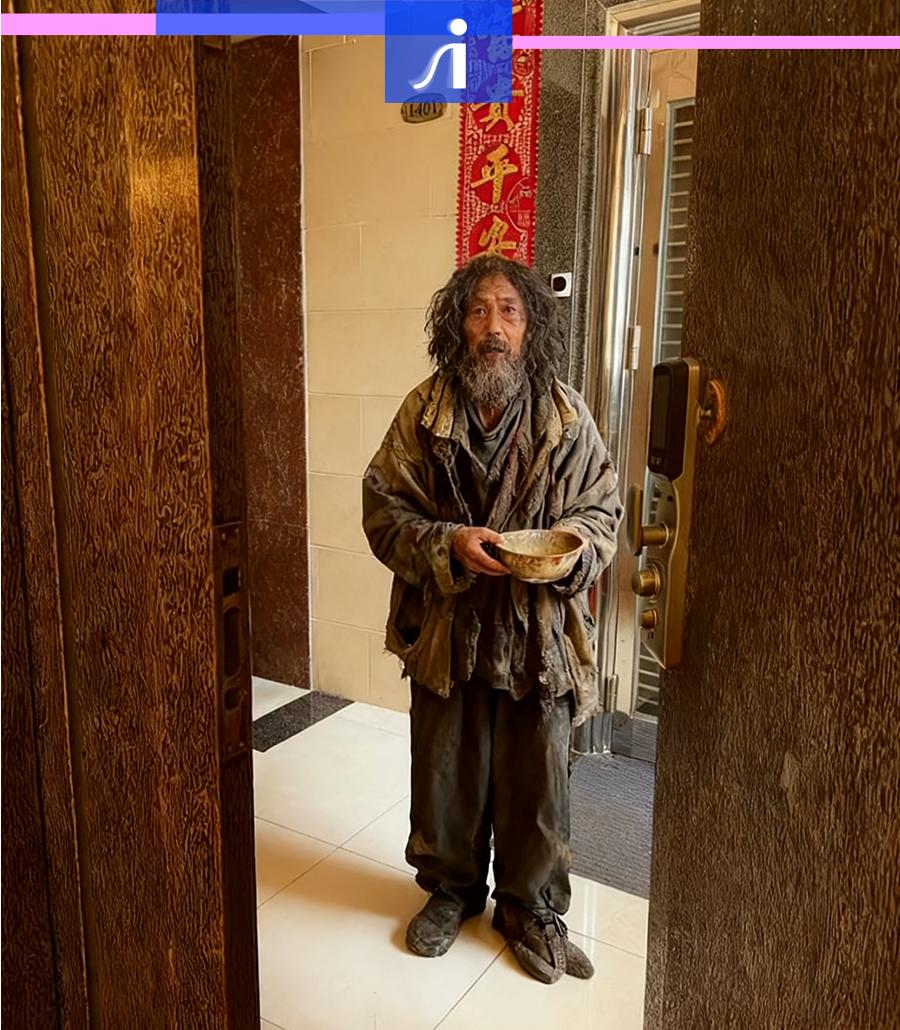
Consider the consequences before playing a prank


A homeless man enters the house
"Dad, there's a homeless man at the door saying he knows you."
Joe sent his father, who was at work, a picture of a bearded strange man standing at the door. His father said he didn't know this man. "What does he want?"
"He said you two went to school together. I invited him in." After that, Joe sent his father a series of pictures of this seemingly homeless stranger rummaging through the fridge, brushing his teeth with his father's toothbrush, and even sleeping in his father's bed..."
His father's calls came in one after another like a barrage, but Joe didn't intend to answer. His father on the other end was obviously extremely anxious. "Answer my call quickly! I don't know him!"
In this video made by recording the text message exchanges, it shows that within just 3 minutes, Joe's father had called him 21 times and even threatened to call the police.
After that, Joe posted this record on TikTok, and the video quickly went viral. It has now reached nearly 920,000 views.
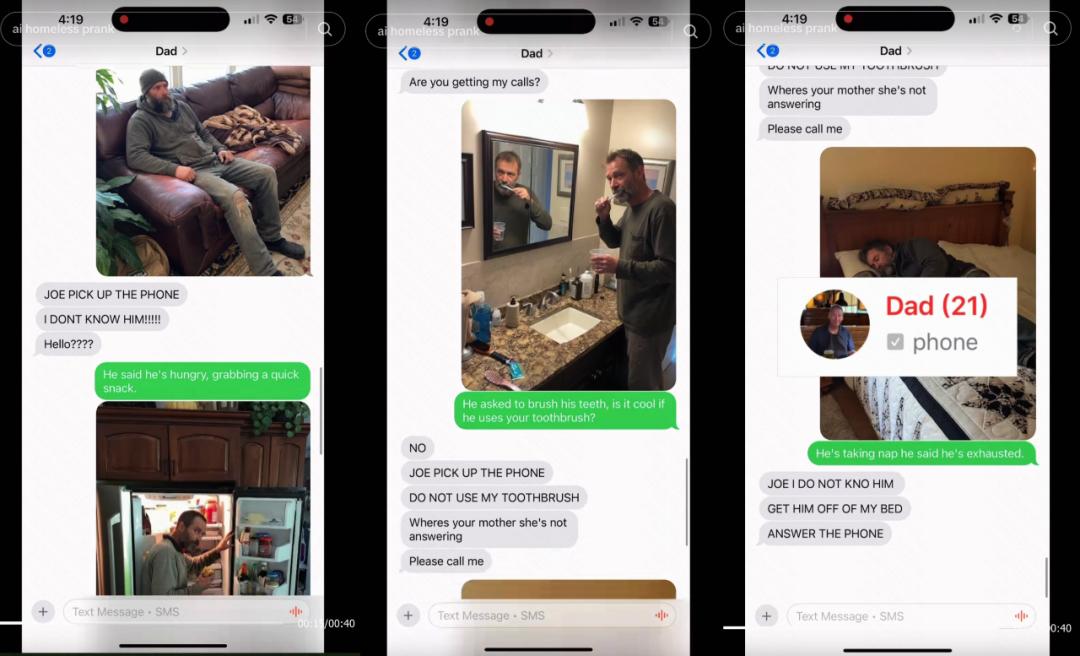
● Video by TikTok user mmmjoemele
Since this October, a wave of pranks called "AI homeless man enters the house" has quickly spread on social media platforms like TikTok.
The video of the chat record screen recording uploaded by Joe at the beginning is one of the earliest such videos. Most of the creators are teenagers. They use AI image - generating tools like Snapchat and Nano banana to create pictures of a homeless man in the house, then send them to their family members, and record their panicked reactions in text messages by screen - recording. After that, they upload the videos to social media. These posts always easily attract a large amount of traffic and attention. In the comment section, apart from a few worried remarks, most are things like "It's so realistic, haha" and "How did you do that?"
As of now, there are more than 1,600 related videos under the #homelessmanprank hashtag on TikTok, and the views of each video often reach millions.

● #homelessmanprank
This trend then spread to other social platforms such as Snapchat and Instagram. Even in Chinese communities like Douyin and Xiaohongshu in China, similar reposted and imitated videos began to appear. AI - related pranks are spreading from overseas to local areas.

"Harmless prank"
Initially, netizens regarded this as a harmless prank. However, the premise of it being harmless is that no one gets really hurt.
But when the prank continued to escalate and family members called the police, things started to change.
According to a report from The Verge, the problem changed from "funny" to "dangerous" when parents actually called the police. When the police receive a report of a "home invasion", especially when it involves children, it will be classified as a high - priority event, and a large - scale police force may be mobilized. Commander Andy McKinney of the Round Rock Police Department said in an interview with NBC that such pranks could even "trigger the dispatch of a SWAT team".
Meanwhile, this trend was also introduced to Chinese social media and "localized".

● Screenshot of a Douyin search
Searching for "AI homeless man" on Douyin, you can see a large number of spoof videos made with AI tools like Doubao. "Because I was bored and used AI to create a homeless man to prank my parents/grandparents/roommates..." has become a traffic - attracting formula.
A imitated video titled "When I tricked my dad with an AI homeless man to see his reaction" #prank parents" has received more than 400,000 likes. In the video, there is also a screen - recording of a chat between a father and son. The 28 - year - old son sent a WeChat message to his dad saying, "There's a man at our door saying he's your distant cousin." Then he sent a picture of a homeless man standing at the door.

● Screenshot of a Douyin video
The father immediately sent a voice message saying, "I don't have a distant cousin. Ask him to leave right away!" Then the son sent several pictures of the homeless man, following the same pattern as the TikTok videos. Finally, the father rushed home in a hurry with a broom in his hand, shouting, "Where is he!" Seeing that there was no homeless man in the house except his son, the son quickly explained, "I'm just joking with you." The father ran towards his son with the broom in his hand, and the video ended with the son's laughter and pleas for mercy.
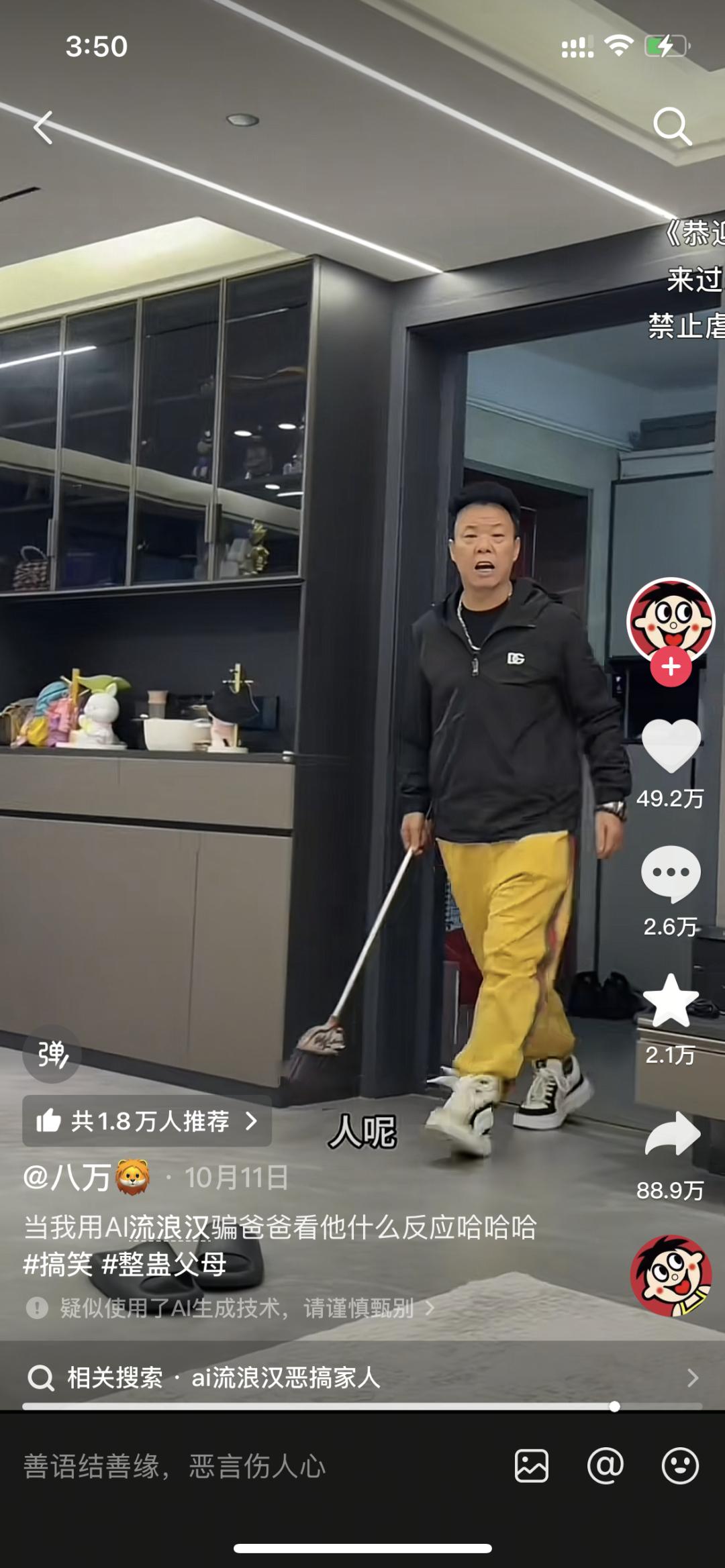
● Screenshot of a Douyin video
Netizens in the comment section laughed out loud and shared pictures of "AI homeless men" they generated in various places in the house. After the laughter, some netizens also expressed doubts and concerns.
One netizen commented, "The development speed of AI scares me a bit. I feel like I'll be tricked by bad guys using AI when I'm old." This comment received nearly 9,000 likes.
Someone posted a screenshot and said, "Last night, when I saw the message my child sent, I really called the police and even made a long - distance call to 110. When I found out it was fake, I quickly called 110 again to explain the situation, but it was too late. The local police had already dispatched, and four or five police cars went there. Finally, I kept receiving calls from the police and kept apologizing. The police gave my child a good talking - to. This damned AI material."

● Screenshot of the comment section of a Douyin video

A series of troubles caused by the abuse of AI - generated content
Recently, there have been endless troubles caused by AI - generated content. For example, Deloitte was just sentenced last week to compensate the Australian government.
Deloitte, a consulting giant, was found to have included false references and fictional court judgments in a A$440,000 evaluation report written for the Australian government. After being pointed out by scholars from the University of Sydney, Deloitte admitted that it had used generative AI tools such as Azure and OpenAI GPT - 4o during the writing process and had updated the report, removing the false content.
Even earlier, in July, a male law student at the University of Hong Kong used AI software to create more than 700 indecent photos of 20 to 30 women (including his university classmates, senior schoolmates, friends, primary school classmates, and middle - school teachers) without their consent. The school's way of dealing with it, which was to issue a warning letter to the student involved and ask him to apologize to the affected classmates, was questioned.
In the same month, The Guardian reported that the number of child pornographic materials generated by artificial intelligence had reached an unprecedented level. According to the latest survey results of the Internet Watch Foundation (IWF), the number of child sexual abuse videos made by artificial intelligence had increased by 400%. Only in the first half of 2025, 1,286 videos were verified, while there were only 2 in the same period last year. The amount of online synthetic abuse materials increased sharply.
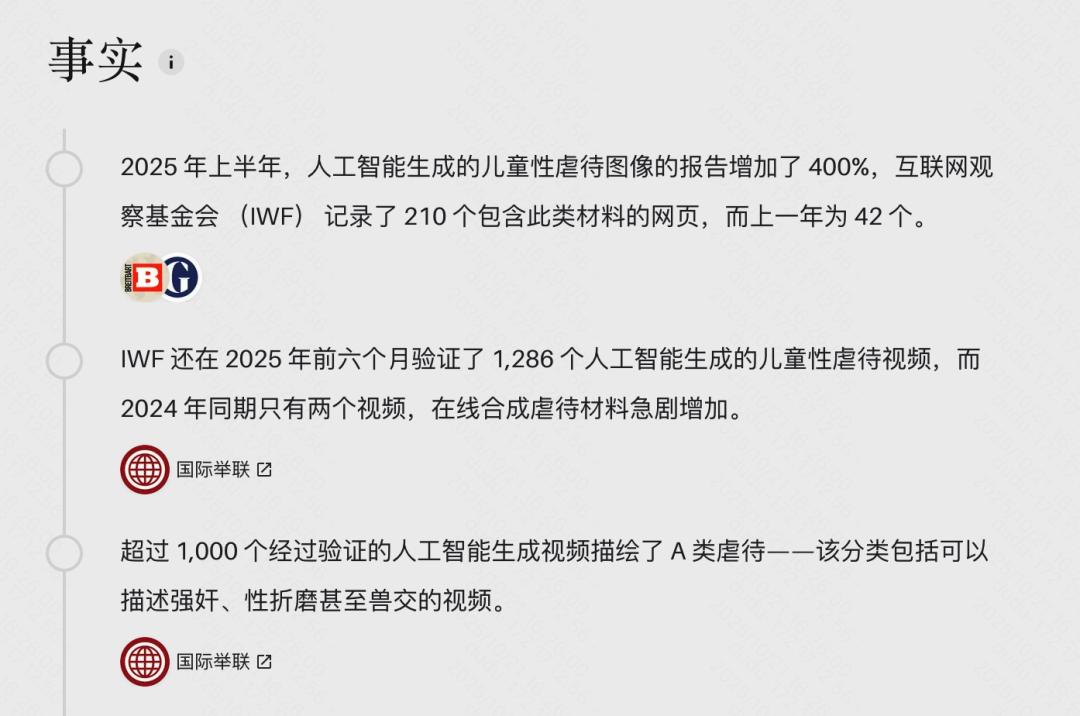
● Related report
Since the beginning of this year, the China Internet Joint Rumor - refuting Platform has issued several announcements, pointing out that the phenomenon of "using AI to spread rumors and disrupt public order" has become more and more serious. From fabricating fires, forging remarks of celebrities to tampering with news pictures, AI has become a "universal tool" for creating false images. The Internet and Information Office then launched a special rectification campaign, requiring that the source of AI - generated content must be clearly marked and holding malicious users accountable.
In the United States, where this trend first started, the statement from the Salem Police Department in Massachusetts was more straightforward: "This kind of prank dehumanizes the homeless, causes pain and panic to the pranked people, and wastes police resources. The police who are asked to respond don't know it's a prank and will treat the call as an actual ongoing burglary, thus creating a potentially dangerous situation. Consider the consequences before playing a prank."

Written by | Du Xueying
Edited by | Ba Rui
Cover image source | AI - generated by a Douyin user

