Android and ChromeOS to Merge, Google's New System Exposed. Netizens: Fuchsia Failed Miserably Back Then. Is This Time Reliable?
According to foreign media Android Authority, Google is developing a brand - new desktop operating system codenamed Aluminium OS. The purpose of this system is to integrate Android and ChromeOS into a single desktop platform, which means Google intends to gradually replace ChromeOS with Android and reshuffle its desktop product strategy.
This move is also considered by the outside world to be similar to Huawei's HarmonyOS in terms of ecosystem, and it has also triggered memories and discussions about Google's former Fuchsia system.
Putting Android on the PC is not Google's first attempt
It's worth noting that Android is ubiquitous in mobile phones, tablets, TVs, in - vehicle systems, and even XR devices, but it has almost zero influence on traditional laptops or desktops, as that's the territory of ChromeOS.
However, in terms of market share, ChromeOS lags far behind Windows and macOS and even ranks behind Linux.
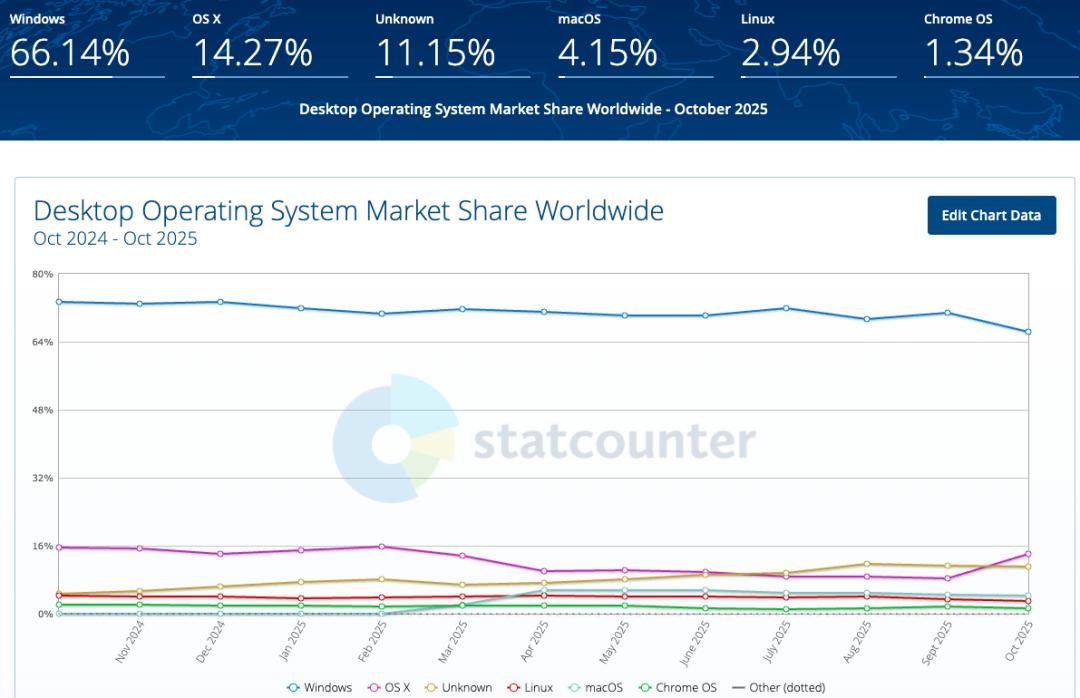
Obviously, Google has been dissatisfied with this situation for a long time.
As early as 2016, there were reports that Google was secretly developing a new operating system called Fuchsia. Different from Chrome OS and Android, which are based on the Linux kernel, Fuchsia is developed based on the new Zircon micro - kernel and is mainly written in C and C++. Importantly, its design goal is not to replace operating systems like Android and ChromeOS but to run on all platforms, including smartphones, PCs, smart devices, and the Internet of Things, realizing the vision of "one system for all".
This yet - to - be - released system was highly anticipated, but the reality disappointed the outside world. After years of rumors and disclosures, the priority of Fuchsia within Google gradually declined, and it has almost disappeared from the public eye.
However, this failure did not make Google abandon the idea of "connecting all hardware with one system". The difference is that this time it is adopting a more prudent strategy and choosing to advance step by step.
A year ago, foreign media reported that Google hoped Android would become a unified desktop OS to better compete with the iPad and make more efficient use of development resources.

However, there wasn't much news after that. Until July 2025, a Google executive revealed that the company planned to merge ChromeOS and Android into a single platform. Then, at the Qualcomm Snapdragon Summit in September, Google officially announced the introduction of Android into the PC market. The company said it is collaborating with Qualcomm to leverage the latest advancements in the field of artificial intelligence to build a new platform that integrates mobile and desktop computing.
New system Aluminium OS is exposed
Recently, as time passed, a Telegram leaker named Frost Core shared a Google job posting, revealing Google's progress on the new system.
The position in this job posting is named "Senior Product Manager, Android, Laptop and Tablets", which clearly mentions the development of the Android - based Aluminium operating system.
It has to be said that this name has a "Google style", just like Chromium OS. They are all named after metals, seemingly implying that Android is its foundation.
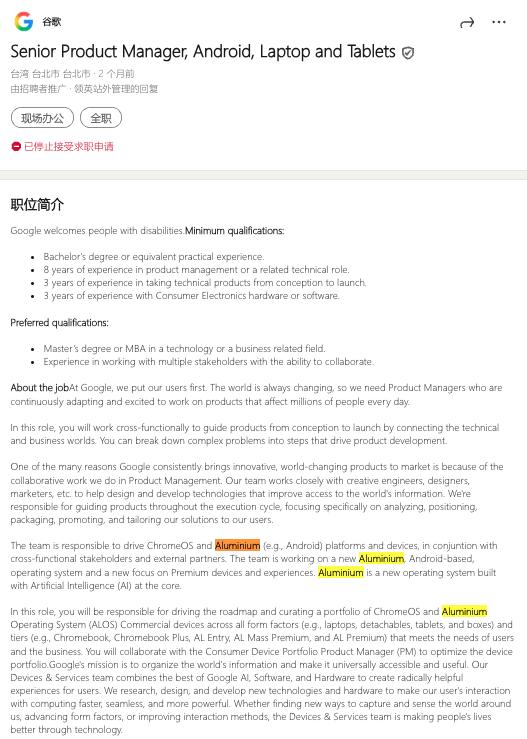
Notably, Aluminium OS is not simply a port of the Android system to PCs. Google emphasized in the job posting that this system is "built with artificial intelligence (AI) at the core". In other words, AI will be deeply integrated into this operating system. Considering Google's existing Gemini large - model and Assistant, the new system is likely to fully utilize these AI capabilities in the future, bringing a more intelligent and efficient experience to PCs.
In response, Rick Osterloh, the senior vice - president of Google's Devices and Services, recently introduced the company's plan to bring the AI technology stack to PCs: "This is how we further leverage the results of our full - stack AI collaboration - bringing the Gemini model, the Assistant, and all our applications and developer ecosystems to the PC field. I believe this will also enable Android to serve all users across all computing forms."
Hardware roadmap: Cover all levels, not just entry - level machines
Many people are worried that such an Android desktop system will, like the existing Chromebooks, only target the entry - level market. In fact, the plan for Aluminium OS is quite ambitious. The job posting clearly mentions multiple device categories: laptops, detachable devices, tablets, and even "small boxes" (similar to mini - PCs). It also reveals different "AL" (Aluminium) tiers: AL Entry, AL Mass Premium, AL Premium. That is to say, Google intends to deploy this OS across both low - end and high - end markets.
Meanwhile, this position will also be responsible for the overall roadmap of "ChromeOS and Aluminium OS (i.e., Android) platforms and devices", which means the two lines will coexist for some time in the future. But the key is that this role is also responsible for formulating the "transition strategy from ChromeOS to Aluminium at Google", suggesting that Aluminium OS will eventually replace ChromeOS.
This transition obviously won't happen overnight. The job posting mentions that this transition will probably require a multi - pronged approach:
Support for old devices: Existing ChromeOS devices that cannot be migrated to Aluminium OS are expected to continue receiving updates until the end of their life cycles. This means Google will need to maintain the old ChromiumOS codebase for several years to come.
Optional migration: Instead of a mandatory switch, Google may offer an optional upgrade path for sufficiently powerful hardware devices. The company is currently testing Aluminium OS on development boards equipped with MediaTek Kompanio 520 and 12th - generation Intel Alder Lake processors, which means some Chromebook models using these chips in the market may be eligible for an upgrade. However, migrating an entire operating system on existing hardware is an extremely difficult project that requires extremely rigorous execution.
There have already been records of Aluminium OS devices in bug reports. Of course, there will also be brand - new PCs pre - installed with Aluminium OS hitting the market.

Here is the job posting:
At Google, we always put users at the center. The world is constantly changing, so we need product managers who can continuously adapt and are willing to build products that impact millions of users and are used every day.
In this position, you will collaborate across teams, bridging technology and business to guide products from conception to launch. You need to be able to break down complex problems into clear steps to drive product development.
Google's ability to continuously launch innovative and world - changing products largely comes from the collaboration of the product management team. We work closely with engineers, designers, marketing teams, etc., to jointly design and develop technologies that improve the way people access information. We are responsible for guiding product advancement throughout the entire execution cycle, with particular attention to analysis, positioning, packaging, and promotion, and ensuring that our solutions truly meet user needs.
This team is responsible for driving the development of ChromeOS and Aluminium (e.g., Android - based) platforms and devices and collaborating with various cross - functional teams and external partners. The team is building a brand - new Android - based Aluminium operating system, with a focus on high - end devices and experiences. Aluminium is a new operating system built with artificial intelligence (AI) at the core.
In this role, you will be responsible for formulating the roadmap and managing the commercial device portfolio of ChromeOS and Aluminium operating system (ALOS) across all form factors (such as laptops, detachable devices, tablets, and box - type hosts) and all product tiers (such as Chromebook, Chromebook Plus, AL Entry, AL Mass Premium, and AL Premium) to ensure they meet user and business needs. You will also work with product managers (PMs) of the consumer device portfolio to optimize the entire device product line.
Google's mission is to organize the world's information and make it universally accessible and useful. Our Devices and Services team combines Google's strengths in AI, software, and hardware to create truly helpful experiences for users. We research, design, and develop new technologies and hardware to make users' interactions with computing devices faster, smoother, and more powerful. Whether it's finding new ways to perceive the surrounding world, driving innovation in device form factors, or improving interaction methods, the Devices and Services team is using technology to make people's lives better.
Will ChromeOS disappear?
So, will ChromeOS disappear because of this? In fact, even if Google eventually replaces ChromeOS's technical foundation with Android, it may not be willing to abandon the ChromeOS brand name. Although ChromeOS has a lower market share than Windows or macOS, it has a very high brand recognition in the education and enterprise markets.
The job posting doesn't reveal the future naming method, but bug reports discovered by Frost Core suggest that Google may retain the ChromeOS brand. Engineers internally refer to the existing platforms as "ChromeOS Classic" and "non - Aluminium ChromeOS", implying that the new Android - based ChromeOS may directly inherit the name "ChromeOS".
Another possibility is that Google will introduce the new name "Android Desktop" to align with its vision of making Android a unified brand. However, "Android Desktop" may also just be an internal term used to distinguish device forms. Since these names currently only appear in bug reports, the final market - oriented naming is still undetermined.
When will Android PCs be released?
Currently, Google is actively promoting the development of this platform. Bug reports show that the company is testing a new build based on Android 16. Google has confirmed that the project will be launched in 2026, but it's still unclear whether it will be in the first or second half of the year. Based on the current pace, the first public version is likely to be based on Android 17, which is to be released in 2025.
However, netizens on Hacker News have been having heated discussions about this move.

Some people think that the desktop version of Android can be an alternative to Linux, as it has a mature application ecosystem and high security. Others criticize Google for forcibly launching a new system just to increase software revenue. Some users are worried about scalability and system freedom, especially on ARM - architecture devices, where they may not be able to change the system as freely as on x86 devices.
Overall, Aluminium OS represents a major bet by Google in the PC field. It's not only a technical integration but also a strategic adjustment: using Android's flexibility and powerful AI capabilities to enter the traditional computer market in a more unified and intelligent way. If successful, this system may reshape the Chromebook ecosystem and open up a new battlefield for Google in the mid - to - high - end PC market.
Source:
https://www.androidauthority.com/aluminium-os-android-for-pcs-3619092/
https://news.ycombinator.com/item?id=46037591
This article is from the WeChat official account "CSDN", compiled by Tu Min and published by 36Kr with authorization.