Send AI to space and build a fully domestic space supercomputer: "CAS Space Computing" completes angel round financing of tens of millions of yuan | Exclusive report from 36Kr
Text | Liu Jingqiong
Editor | A Zhi
Cover Source | Provided by the enterprise
36Kr learned that Beijing Zhongke Tiantian Technology Co., Ltd. (hereinafter referred to as "Zhongke Tiantian"), a provider of space-based intelligent computing and application systems, announced the completion of a multi-million-yuan angel round of financing. This round of financing was jointly led by Gewuzhizhi Private Equity Fund and Shanghai Future Industry Fund, with participation from Plum Ventures and Miracle Plus. The funds raised will be used for the research and development of core technologies for space-based computing and the pre-engineering preparation for the first satellite.
Zhongke Tiantian was established in June 2024 and focuses on breaking through the core technologies of "supercomputing in space" and "AI for Space". It conducts the design, research and development, and industrial ecological services of space intelligent computing software and hardware systems, intelligent application services, and experimental training systems.
The founder is currently a doctor from the Institute of Computing Technology of the Chinese Academy of Sciences and the leader in the field of space-based computing. He also serves as the deputy secretary-general of the Fault-Tolerant Computing Special Committee of CCF and has been deeply involved in the design and demonstration, standard design, and equipment development of multiple satellite Internet systems in China. The core members of Zhongke Tiantian come from the Institute of Computing Technology of the Chinese Academy of Sciences, the aerospace department, Huawei, Zhejiang University, and Zhijiang Laboratory, etc., and have a complete technical link from the underlying computing architecture to space-level system engineering.
The founder introduced that Zhongke Tiantian's product system includes the Aurora series of on-board intelligent machines, supporting module card sets, the Aurora OS operating system, and the Aurora operator library. Multiple versions of the Aurora series of on-board intelligent machines have been launched. The Aurora 1000 series has been verified in orbit for more than 1000 days through multiple satellites; the Aurora 2000 series using the VPX architecture has completed research and development and is waiting for in-orbit verification; the Aurora 5000 series will be equipped with a domestic full-size GPU with performance comparable to that of NVIDIA's H100 and is planned to be verified in orbit next year.
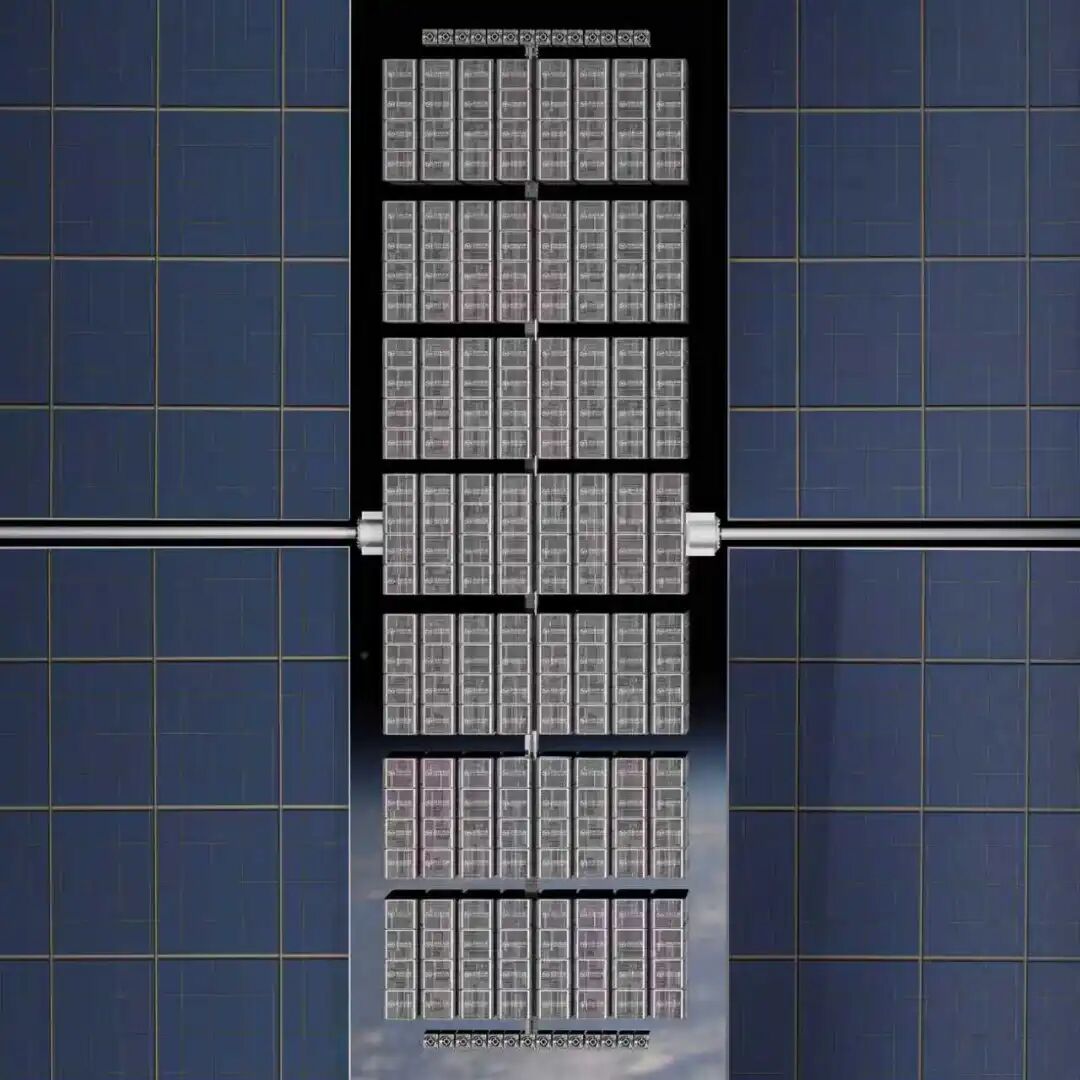
Zhongke Tiantian's "Tianyuan Plan" to build a space supercomputing center

Breaking through the key technologies of space supercomputing, "leading the industry by more than two years in overall progress"
At the beginning of November this year, the Starcloud-1 satellite equipped with NVIDIA's H100 GPU was launched into space by SpaceX. Some media reported that this was the first attempt by humans to deploy the payload of an AI data center in space. If the verification is successful, the supply side of AI computing power will expand from the ground to space, and the computing power competition among major countries will also continue from the ground to space.
In fact, China started exploring "supercomputing in space" earlier.
It is reported that as early as 2019, the Tiantian team led by the founder started a project to explore how to apply AI chips in space. In 2022, the team launched the Aurora 1000 on-board intelligent machine equipped with a domestic high-performance AI chip into space. It has been operating stably in orbit for more than 1000 days, successfully verifying the possibility of a high-performance AI computing system in space.
On this basis, to promote the breakthrough of the key technology of "space supercomputing collaborative computing", the Tiantian team developed the Aurora 1000-3 in 2023 and completed the in-orbit collaborative verification experiment of three machines, taking the lead in exploring the in-orbit collaborative computing architecture of multiple nodes. In 2024, Zhongke Tiantian further launched the Aurora 1000 Smart Eye and completed the in-orbit inference of the space-based large model in it.
Currently, Zhongke Tiantian is promoting the research and development of a new generation of space supercomputing products - the Aurora 5000 on-board intelligent machine. The Aurora 5000 uses a full-size GPU computing architecture and has key features such as multiple backups, high reliability, and high performance. It uses a fluid cooling method on the on-board equipment and supports the parallel computing and stable operation of more than 10 AI accelerator cards. According to the team's plan, the Aurora 5000 will be verified in orbit next year.
To truly move towards "space supercomputing", the founder believes that it is necessary to build a multi-card cluster with a full-size GPU as the core node. The difficulty is far more than just putting the GPU into orbit. The core challenges include at least two dimensions: one is space-level fault tolerance - to maintain stable operation in extreme environments such as strong radiation, thermal cycling, and micro-vibration; the other is the heat dissipation ability of high-heat-flux density devices - because space is a vacuum environment without air convection, traditional heat dissipation methods are difficult to implement in orbit.
"These two abilities require both long-term in-orbit data accumulation and interdisciplinary system engineering design, which are thresholds that ordinary teams are difficult to cross. From the Aurora 1000 to the Aurora 5000, Zhongke Tiantian has formed a team with 'actual flight experience + engineering ability', which is one of our core competitiveness." The founder added.
It is reported that Zhongke Tiantian currently leads the industry by more than two years in overall progress. " Now many companies are hyping up the concept of space-based computing, and their actual technical route is based on embedded systems with non-full-size GPUs, which Zhongke Tiantian achieved in 2022. Recently, it was reported that the Starcloud satellite is equipped with NVIDIA GPUs and can run large models such as Google Gemini in orbit, but this ability was verified by Zhongke Tiantian through the Aurora 1000 Smart Eye in 2024."

Two business segments to achieve short-term commercial revenue, and long-term layout of the space-based supercomputing system through the "Tiantian Plan"
In terms of business planning, in the short term, Zhongke Tiantian hopes to achieve commercial revenue through two business segments: hardware and algorithms.
On the hardware side, it mainly sells on-board intelligent machines and also sells module card sets. Currently, Zhongke Tiantian's customers cover leading constellation companies, satellite companies, and rocket companies. Depending on the difficulty of the products, the delivery cycle ranges from a few weeks to a year, which is faster than the industry average.
On the algorithm side, Zhongke Tiantian mainly sells the Aurora OS and the Aurora operator library in the early stage. After the software is open-sourced, it will attract developers to join the Aurora software ecosystem and cooperate with satellite manufacturers to develop satellite application APPs to obtain revenue.
Considering the gradual maturity of the technology of multiple generations of on-board intelligent machines and the continuous accumulation of in-orbit verification nodes, Zhongke Tiantian launched the "Tiantian Plan" this year with the goal of achieving the in-orbit deployment of a space-based ten-thousand-card-level supercomputing and data center. It will form a new computing infrastructure that breaks through the bottlenecks of ground energy consumption, power supply, space, and network delay and will be gradually built by 2030.
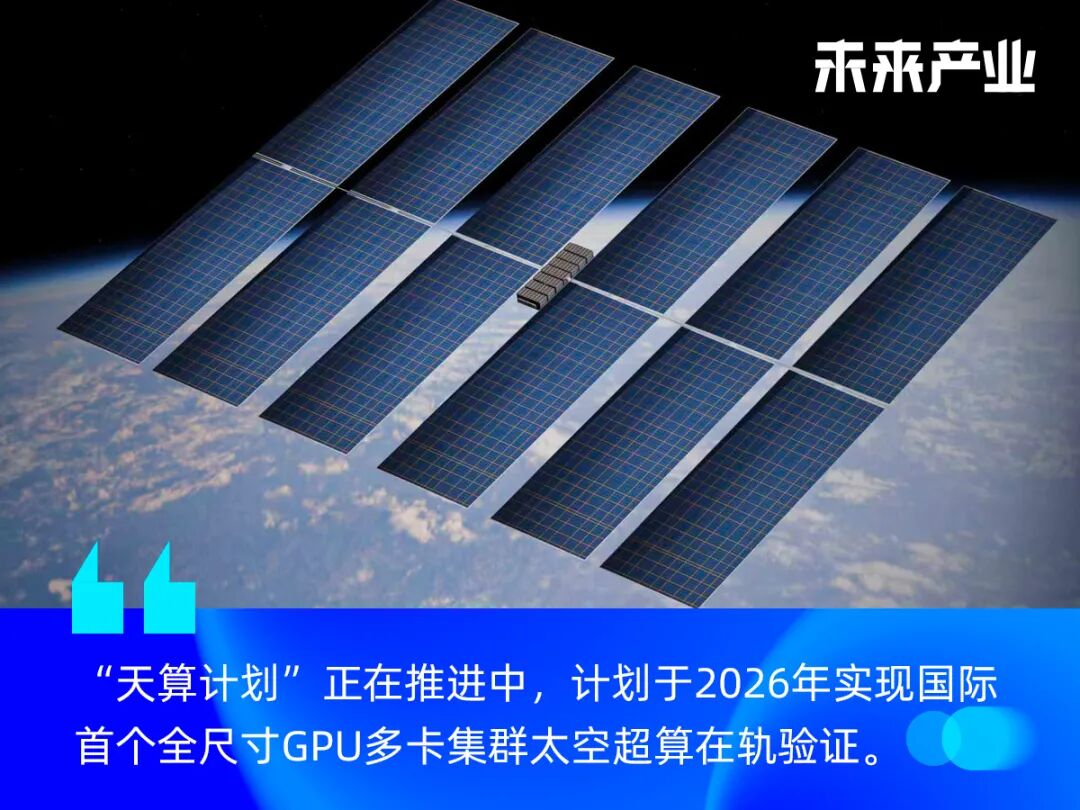
According to the plan, the "Tiantian Plan" will use a centralized high-efficiency supercomputing architecture and build a complete space-based supercomputing system through three core modules: the energy module, the computing power module, and the communication module. Zhongke Tiantian will build an energy module composed of a 1-square-kilometer solar cell array, providing more than 100 MW of clean energy. The ten-thousand-card-level computing power module based on domestic GPUs will achieve an intelligent computing power output of 10 Eops, supporting modular assembly, in-orbit replacement, and continuous upgrading; the communication module will be composed of hundreds of 100 Gbit-level laser communication devices, with a total communication capacity of up to 10 Tbps.
In the long run, the "Tiantian Plan" is expected to bring greater and continuous benefits to Zhongke Tiantian.
The Zhongke Tiantian team predicts that around 2030, with the successive completion of major satellite constellations and the "Tiantian Plan", a new era of the "space application store" will come. By then, the space-based supercomputing system, on-board intelligent computing hardware, core chips, and software platforms led by Zhongke Tiantian will all see a concentrated explosion.
Introduction to the investors
Shanghai Future Industry Fund: The Shanghai Future Industry Fund focuses on disruptive innovation, interdisciplinary innovation, and cutting-edge platform technologies. It makes early-stage investments in future industries such as future information, future energy, future health, future space, future manufacturing, and future materials. Among them, space-based computing is a key cutting-edge technology in the fields of future space and future information. The fund invests in and incubates the aerospace information industry ecosystem around breaking through the computing power bottleneck.
Plum Ventures said: We have been deeply involved in the commercial space track for many years. We clearly recognize that the large number of satellites in orbit has led to a rapid increase in space data, and there is an urgent need to build space computing power infrastructure. Zhongke Tiantian is one of the first practitioners in China to focus on space-based computing. It has taken the lead in completing a highly available fault-tolerant computing technology system with cross-layer collaboration from chips to the whole machine, operating system, cloud platform, and algorithms, with deep technical accumulation and sufficient in-orbit verification of products. We are very optimistic about the Zhongke Tiantian team and look forward to the team breaking through in space supercomputing and becoming a leader in the satellite computing power and space supercomputing industries.