Digua Robotics Launches One-Stop Cloud Development Platform, Enabling Robot Application Development and Deployment with a Single Sentence | Frontline Report
Author | Huang Nan
Editor | Yuan Silai
Recently, at the DDC 2025 Sweet Potato Robot Developers Conference, Sweet Potato Robot announced a comprehensive upgrade of its full - link development infrastructure and launched the S600, a high - computing - power robot development platform for embodied intelligence. The platform is expected to be officially released in the first quarter of 2026.
Meanwhile, the company launched a "one - stop development platform" integrating a data closed - loop system, an embodied intelligence training ground, and Agent development services on - site. Through the combination of hardware and software and the end - cloud integrated architecture, it accelerates the application and implementation of robots.
As the application scenarios of robots continue to expand, a single hardware or software solution has difficulty meeting the task requirements in complex environments. Due to the increasing complexity of tasks and the evolution of algorithm models, the contradiction between the computing power bottleneck on the end - side and the real - time requirements has become increasingly prominent. The flexibility of cloud resources can complement the limitations of end - side computing power, making end - cloud collaboration an inevitable choice for achieving robot intelligence.
The intensification of market competition has also made development efficiency a key factor. The collaborative design of hardware and software and the end - cloud integrated architecture can not only improve system performance but also significantly shorten the overall cycle from R & D to deployment.
To address the dual challenges of computing power deployment and development efficiency in robot development, Sweet Potato Robot has built a full - link development system covering the end and the cloud. On the end - side, based on the continuously optimized BPU computing architecture, the company has established two major product series, Sunrize and RDK, to meet different computing power requirements and maintains stable iterations. On the cloud - side, Sweet Potato Robot provides a one - stop development platform, combined with hundreds of directly deployable robot intelligent algorithms, to help developers and enterprises more efficiently build competitive intelligent robot solutions in the market.
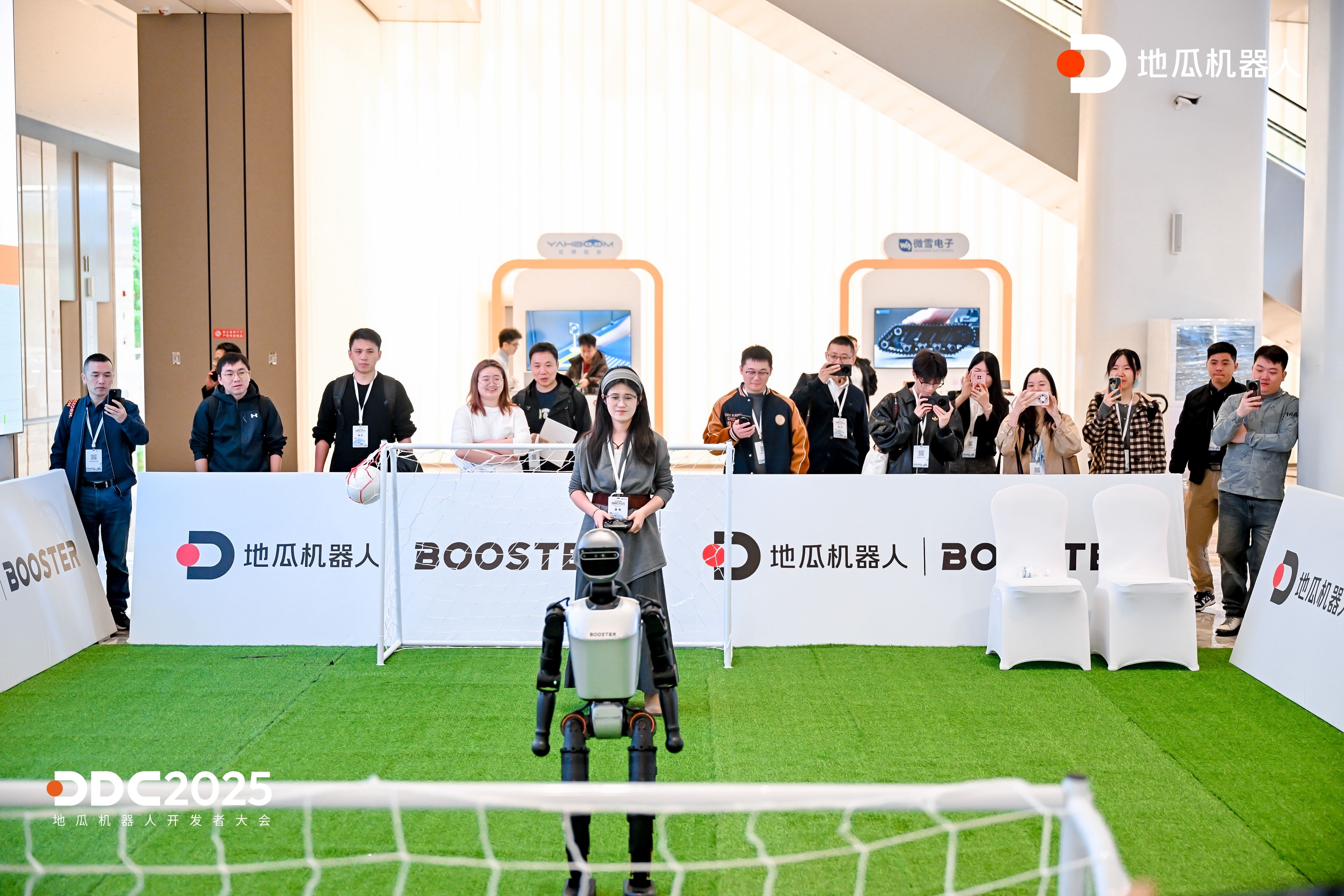
The scene of the DDC 2025 Sweet Potato Robot Developers Conference
The one - stop development platform launched this time adopts a combination of hardware and software and an end - cloud integrated architecture, providing three core services: The data closed - loop system realizes the autonomous evolution of the system through the trinity of "model - simulation - hardware"; the embodied intelligence training ground provides full - link support for all - scenario tasks; the Agent development service supports the development and deployment of robot applications through a single - sentence instruction, significantly improving development efficiency.
Meanwhile, the latest high - computing - power development platform S600 for embodied intelligent robots of Sweet Potato Robot was also displayed on - site. It adopts a big - and - small - brain architecture, with a computing power of 560 TOPS*(INT8) and supports the deployment of large models such as VLA and VLM on the end - side. When running models such as Pi0 and Qwen2.5 - VL - 7B, its performance is more than 2.2 times that of mainstream platforms, meeting the decision - making needs in complex scenarios.
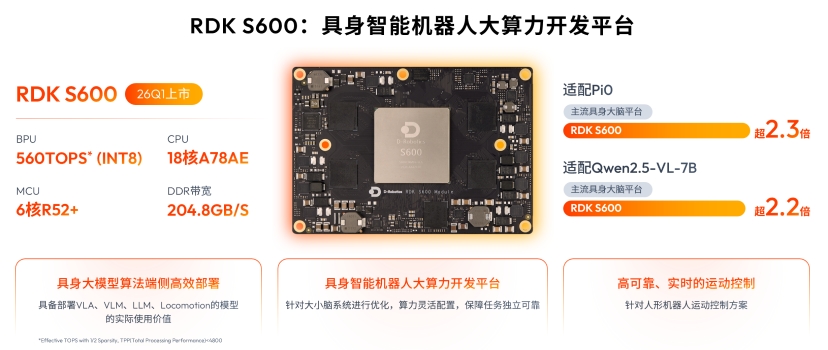
560 TOPS*(INT8), *Effective TOPS with 1/2 Sparsity, TPP(Total Processing Performance)<4800
Wang Cong, the CEO of Sweet Potato Robot, pointed out in an interview with 36Kr and other media that Sweet Potato Robot clearly does not aim to provide "ready - to - use" complete solutions. Instead, it focuses on extracting the core common points of different scenarios and refining them into standardized technical components. For example, binocular vision technology is widely used in various products such as floor - sweeping robots, lawn mowers, drones, and embodied quadruped robots. By prioritizing the solution and iteration of technical pain points and building standardized modules, it can adapt to the needs of various products. In the field of embodied intelligence, the motion control algorithm developed by the company can quickly adapt to different motion scenarios and has high universality.
"For the needs of the R & D end, we transform common links such as data collection, annotation, generation, simulation, and testing into a standardized toolbox. This logic is similar to the design concept of PPT software. We do not interfere with users' personalized creation, but we hope to support diverse needs through perfect basic tools. By highly abstracting the common R & D links of multiple scenarios, we can provide underlying capabilities for ecological partners." Wang Cong said.
Specifically in the application implementation stage, Sweet Potato Robot focuses on three major directions: mass - produced robot products, emerging robot applications, and future general - purpose embodied intelligent robots.
36Kr learned that Sweet Potato Robot has now established cooperation with more than 60 upstream and downstream enterprises in the industrial chain, helping companies such as Yunjing develop the Xiaoyao 002 floor - sweeping robot, promoting the application of AI binocular perception technology in the field of floor - sweeping robots, enabling Insta360 to launch the world's first panoramic drone, the Yingling Antigravity A1, and jointly releasing an intelligent companion robot dog with Vita Power. In the past year, the company's product shipments increased by 180% year - on - year, and the number of customers increased by 200%.