Domestic electric vehicles flock to Hong Kong. Is Tesla in trouble again?
After a two-year hiatus, the TVB anniversary drama "News Queen 2" has once again become a phenomenal hit Hong Kong drama at the end of the year. Since its premiere on November 5th, relevant topics have swept across major social platforms, and the popularity has remained high.
Beyond the authentic "news palace intrigue," viewers munching on sunflower seeds have also discovered a new element: "Do Hong Kong women drive domestic electric vehicles now?"
That's right. In the past, Hong Kong dramas often featured a showcase of luxury cars. However, in "News Queen 2," what catches the eye is not the commonly seen Mercedes-Benz, BMW, or Ferrari on the streets of Victoria Harbour, but domestic electric vehicles that are more familiar to mainland viewers - including GAC Aion, known as the "king of ride-hailing cars," the newly emerging GAC Hyper, MG of SAIC, and so on.
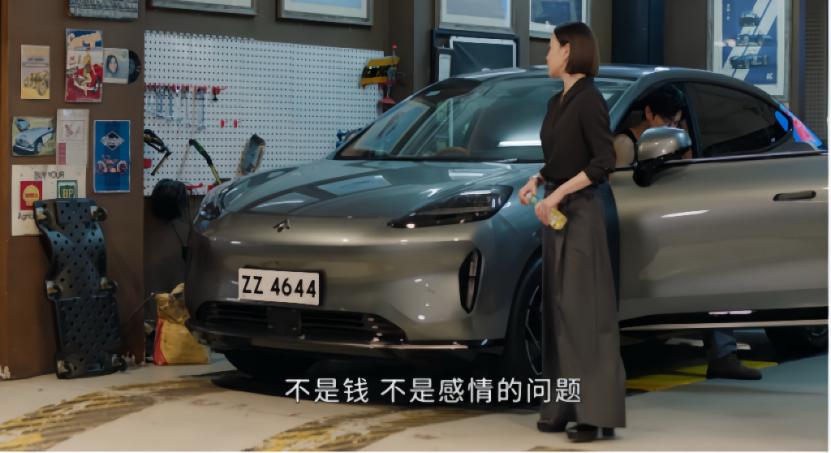
In "News Queen 2," the car driven by "Sister Man," Wen Huixin (played by Charmaine Sheh), is a GAC Hyper. (Photo/ "News Queen 2")
Some mainland viewers shared screenshots of the drama on social media, stating that it "seemed a bit unreal." However, they soon received an explanation from Hong Kong netizens: "The plot in the drama is already a true reflection of what's happening in Hong Kong now."
This is indeed true. One month before the premiere of "News Queen 2," Hong Kong billionaire Joseph Lau publicly acquired the newly launched Zeekr 9X, which instantly became a hot topic in the media. Apart from celebrities and wealthy businessmen, when strolling on the streets of Hong Kong today, new energy vehicles with domestic self-owned brand logos can be seen speeding by from time to time.
Hong Kong, which has no automotive industry, has seen the most mainstream car brands in the past few decades come from Japan, South Korea, and Europe. Tesla, the first electric vehicle brand to enter Hong Kong, has taken the lead in the past few years.
As the saying goes, fortune changes like the revolving of a wheel. Hong Kong's electric vehicle penetration rate in the first half of this year has led the whole country.
If Tesla ignited Hong Kong people's enthusiasm for electric vehicles with the first spark, then the influx of mainland electric vehicles into Hong Kong has injected more diverse vitality into this market, rewritten the market environment where Tesla dominated alone, and also broken the outside world's stereotyped impression of cars in Hong Kong.
Of course, the Hong Kong market is still very different from the mainland. The annual car sales volume is only about 40,000, but the competition is extremely fierce. Selling cars successfully is just the first step in establishing a foothold in Victoria Harbour.
Domestic Electric Vehicles Flock to Hong Kong
The "breakout" of domestic electric vehicles in Hong Kong is not just limited to social media. The latest data from the Hong Kong Transport Department reveals that BYD, with 936 registered electric private cars, has replaced Tesla as the best-selling electric vehicle brand in Hong Kong in September.
In the first half of the year, BYD already ranked first with 4,902 registered electric private cars, leading Tesla, which ranked second, by more than 1,000 vehicles. According to the current trend, BYD may become the best-selling electric vehicle brand in Hong Kong in 2025.
This is obviously an interesting phenomenon. After all, before this, Tesla had always been the "king" in the Hong Kong electric vehicle market. At its peak, one out of every two electric vehicles sold in Hong Kong was a Tesla. In 2016, Tesla founder and CEO Elon Musk even said at an entrepreneurship forum hosted by the Hong Kong Special Administrative Region Government that Hong Kong had one of the highest per capita ownership rates of Teslas in the world and was "a model for the development of electric vehicles in world cities."
Tesla's absolute position in Hong Kong is long gone, but the latter part of Musk's evaluation remains an indisputable fact. Official data from the Hong Kong Transport Department shows that the number of registered electric private cars in Hong Kong reached 18,356 in the first half of 2025, with a penetration rate as high as 68.6%, ranking among the top in the world.
If the Hong Kong electric vehicle market were just a battle between BYD and Tesla, it would be rather boring. Also in the new car registration data for the first half of 2025, Zeekr, the favorite of Joseph Lau and Aaron Kwok, rushed into the top 4 following BMW; XPeng's score of 770 vehicles is also something to be proud of. XPeng, which has emerged from the shadow of sluggish growth this year, has regarded Hong Kong as a springboard for globalization after entering the market for a year and a half.
This year, new models such as Changan Deepal, SAIC IM, Dongfeng eπ, and Geely Galaxy have successively entered the Hong Kong market, making the product line of electric private cars more diverse. At the same time, pure electric vehicles with "domestic bloodlines" produced by joint-venture brands in the mainland have also landed in Hong Kong, such as Toyota, a Japanese brand highly trusted by Hong Kong people.
On October 16th this year, the all-electric SUV bZ3X produced by GAC Toyota "reversely" landed in Hong Kong, which was regarded by the automotive circle as a "dragon crossing the river" move - before this, no joint-venture brand had ever exported self-developed models from the mainland to the Hong Kong market.
Even taxis are turning to domestic electric vehicles. In July this year, the Hong Kong Transport Department announced that it would issue licenses to five new taxi fleets that can provide ride-hailing services. The models they use are not the classic Toyota Crown Comfort, but domestic MPV models such as SAIC Maxus MIFA 7 and GAC Trumpchi E9. Aion, known as the "king of ride-hailing cars," is also on the list.
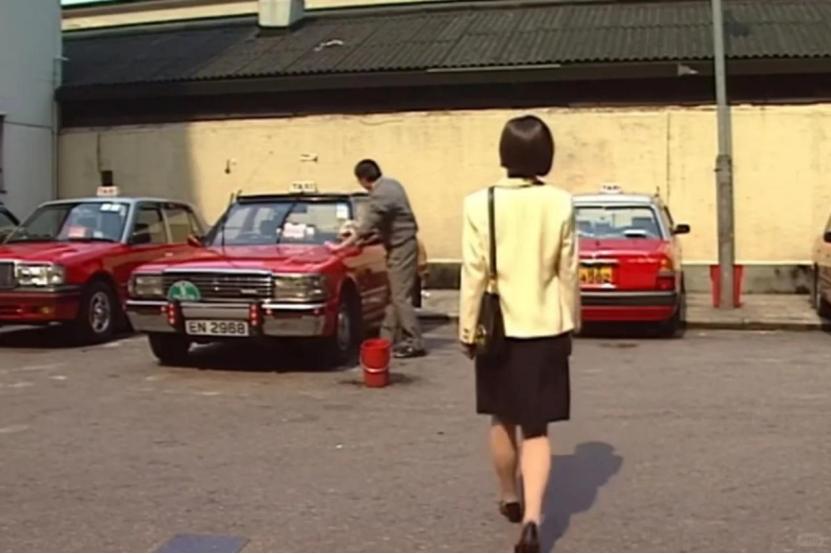
The Toyota Crown Comfort was once the most classic street car in Hong Kong. (Photo/ "Those Were the Days")
Domestic electric vehicle brands, which were often looked down upon in the past, are now on an equal footing with established traditional car brands. The Hong Kong automotive market is quickly catching up with the times. On social media, some Hong Kong people have shared their experiences of taking their families to test-drive domestic MPVs, exclaiming that the comprehensive performance exceeded their expectations: "It has completely changed my view of domestic cars."
Hong Kong People Have Experienced the Joy That Fuel Cars Can't Provide
You might think this is a sign of "consumption downgrade." After all, the trend of Hong Kong people traveling north to the mainland for consumption has been increasing in the past two years, and more and more Hong Kong people have tasted the joy of cost-effectiveness.
This naturally includes cars. In a report in Hong Kong's Wen Wei Po in July this year, the reasons why domestic electric vehicles have won the hearts of Hong Kong people were analyzed as follows: In addition to having a complete industrial chain and high-quality after-sales service, domestic brands also have a cost-effective product positioning. Features such as electric massage seats, intelligent cockpits, and genuine leather interiors, which are only available in high-end overseas luxury cars, are standard in all domestic luxury cars, and the price is only 30% - 50% of the former.
This kind of amazing cost-effective joy is also reflected in driving itself.
In Hong Kong, where land is extremely valuable, the number of private cars has long been maintained at a relatively low level. Whether driving a fuel car or an electric car has always been a luxury, and the cost of driving a fuel car is much higher than that of an electric car.

In Hong Kong, whether driving a fuel car or an electric car is a luxury. (Photo/ "Street Knight 2: Illegal Racing")
According to the current laws in Hong Kong, car owners need to pay a first registration tax when purchasing a new car, and the tax amount is directly related to the car's selling price. The more expensive the car, the higher the tax. However, in order to promote electric vehicles, the Hong Kong Special Administrative Region Government announced a significant discount on the first registration tax for electric vehicles. In 2018, it launched a more generous "one-for-one" replacement program to encourage fuel car owners to scrap their old cars and replace them with new electric vehicles.
In addition, car owners also need to pay an annual license fee. The license fee for fuel cars is calculated based on the engine capacity, with a minimum annual fee of HK$5,000; in contrast, the license fee for electric vehicles is calculated based on the output power, and the annual fee is 1/5 cheaper than that of fuel cars.
If we also consider energy replenishment and parking, the cost of owning a fuel car is even more like burning money.
The fact is that the fuel price in Hong Kong has long been among the highest in the world. Gas stations only provide 98-octane standard unleaded gasoline ("golden oil") and premium unleaded gasoline ("platinum oil"), and the price per liter has long been maintained in the range of HK$27 - 30, about three times that of the mainland. In contrast, there are many public charging piles on the streets of Hong Kong, and the electricity price is much cheaper than the fuel price. Many parking lots also provide dedicated charging spaces, and parking and charging can even offset the parking fee.
Generally speaking, when a fuel car parks in a parking lot, the starting hourly charge is mostly between HK$20 - 35, and in some places, the hourly parking fee can be as high as HK$80, with no upper limit.
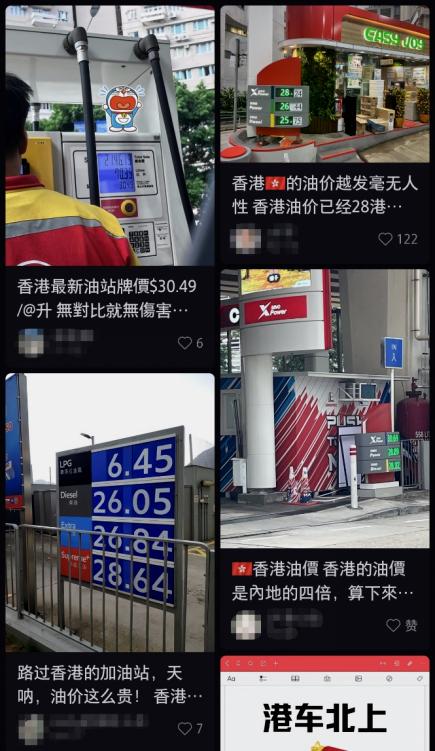
On social media, many people are shocked by the fuel price in Hong Kong, and there are often questions like "Why not drive an electric car?" under these posts. (Photo/ Screenshot from Xiaohongshu)
Hong Kong is a small place, and it only takes half a day to drive around the whole territory. Coupled with the warm climate in Hong Kong, there is no obvious seasonal difference in the range of electric vehicles here. Given the high cost of owning a fuel car, it's not surprising that Hong Kong people are turning their attention to electric vehicles - especially the highly cost-effective domestic electric vehicles.
Moreover, Hong Kong's special policies are also helping to promote the popularity of electric vehicles. "There is a regulation in Hong Kong that when the Observatory has not issued a high-temperature warning, fuel cars are not allowed to turn on the air conditioner while waiting by the roadside, but electric vehicles don't have this problem," someone said on social media.
Establish a Foothold in Hong Kong, Then Look to the Global Market
Different from the fierce competition in the mainland electric vehicle market, the Hong Kong electric vehicle market is still a blue ocean at present. However, compared with the mainland market, domestic pure electric vehicles are not cheap in Hong Kong.
Taking BYD, the best-selling brand, as an example, the official starting price of the all-electric SUV Yuan PLUS (known as ATTO 3 overseas) in Hong Kong is HK$238,000. If the "one-for-one" program is not applied, the price will exceed HK$300,000 after including taxes, which can buy a decent luxury car on the mainland. The cute and compact entry-level pure electric car Dolphin also has a starting price of HK$179,800 in Hong Kong, and the actual price without the "one-for-one" program also exceeds HK$200,000.
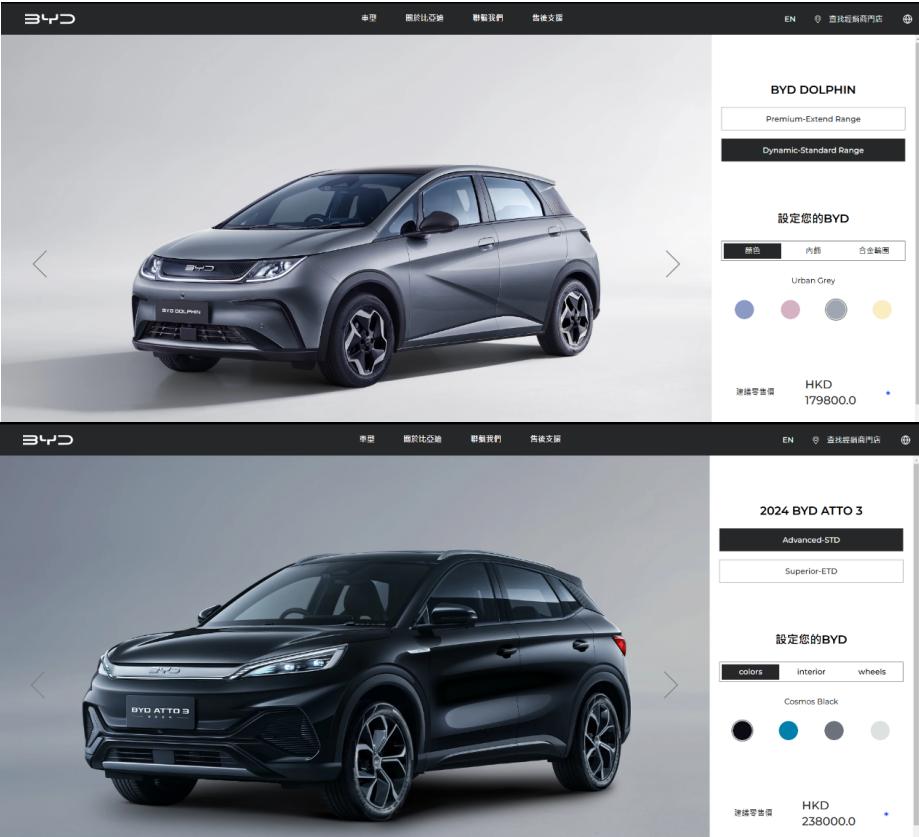
The Dolphin, which can be bought for only a few tens of thousands of yuan on the mainland, has a starting price of about HK$180,000 in Hong Kong. The price of the Yuan PLUS is also much higher than that on the mainland. (Photo/ Screenshot from BYD Hong Kong official website)
This means that electric vehicles are undoubtedly more attractive to existing fuel car owners than young people who don't have a car. A report in a financial magazine in 2024 revealed that most of the Hong Kong people who buy BYD cars are middle-aged people in their 40s and 50s.
Not to mention that there are not many young people in Hong Kong who can afford to buy a new car.
The "Women and Men in Hong Kong - Key Statistics (2025 Edition)" released by the Census and Statistics Department of the Hong Kong Special Administrative Region Government on August 29th this year shows that the median monthly income of employed women and men in 2024 was HK$17,000 and HK$24,000 respectively. A statistical report released by HSBC in 2022 showed that based on the consumption data of all users, the spending power of customers aged 45 - 54 in Hong Kong was the highest among all age groups, with an average monthly expenditure of HK$83,000, while the average monthly expenditure of young people aged 23 - 27 was about HK$27,000.
Looking through social media, there are very few Hong Kong people who can truly claim to be wealthy. In other words, it's obvious that Hong Kong young people can't afford to buy a BYD with their own savings alone.
However, it cannot be denied that Hong Kong people have recognized the capabilities of domestic electric vehicles. More precisely, domestic electric vehicles in Hong Kong have completed the transformation from "market occupation" to "mental occupation," changing the perception of Hong Kong consumers with the attitude of "same price, same quality, better experience."
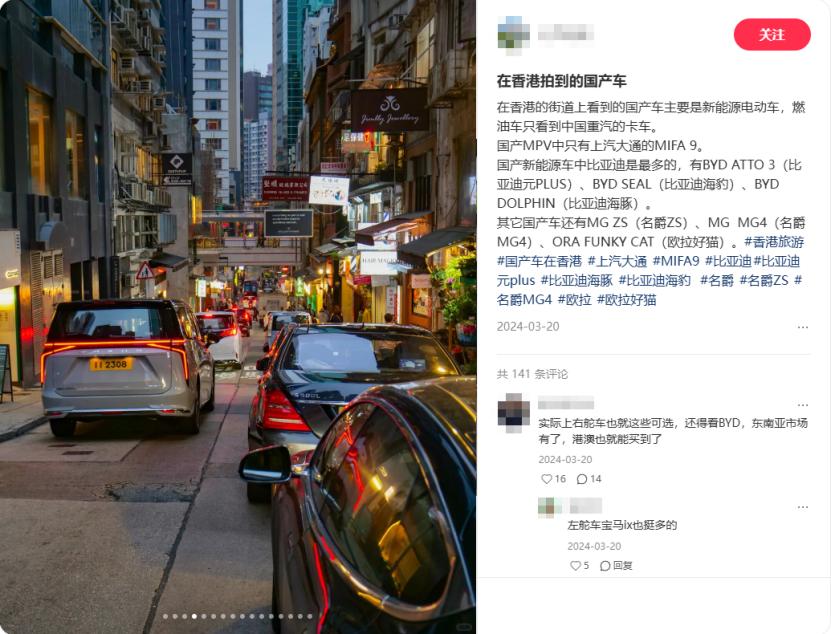
Domestic electric vehicles in Hong Kong have completed the transformation from "market occupation" to "mental occupation." (Photo/ Screenshot from Xiaohongshu)
However, the entry of domestic electric vehicles into Hong Kong is obviously not just about selling cars. After all, the shrewd players in the automotive circle know that the Hong Kong market is small, the taxes are high, and the operating costs are expensive. Pursuing market sales in a place with an annual car sales volume of only about 40,000 is not only a losing proposition