Former Baidu executives start a business and grow into a unicorn in a year and a half.
Just two years after leaving Baidu, two former senior executives joined hands to create a unicorn.
On November 20th, the AI search engine Genspark (affiliated with Mainfunc Inc., hereinafter referred to as: Genspark) located in Palo Alto, California, USA, completed a $275 million Series B financing, with a post - investment valuation of $1.25 billion.
The founder & CEO of this company is Jing Kun, the former vice president of Baidu Group and the CEO of Xiaodu Technology. Before joining Baidu, he served as the chief R & D director at Microsoft, responsible for the R & D of Microsoft Bing Search in the Asian market, and is also the inventor and creator of Microsoft Xiaoice; Zhu Kaihua, the co - founder of Genspark, once served as the director architect at Google, the chief architect of the intelligent assistant at Baidu Group, and the CTO of Xiaodu.
Jing Kun and Zhu Kaihua joined Baidu around 2013 and worked together for 11 years. Since 2020, they have served as the CEO and CTO of Xiaodu Technology, which was valued at $5.5 billion, respectively, until they left in 2023.
With their backgrounds as senior executives from large companies, the top - level configuration of "CEO + CTO", and the wave of large - model technology, Genspark raised $60 million in the seed round, with a valuation of $260 million. Subsequently, along with development milestones such as exceeding 2 million monthly active users and launching the new platform Genspark AI Workspace, Jing Kun's new company completed a total of three rounds of financing in one and a half years, with a total financing amount of approximately $435 million.
The birth of this AI search unicorn is both natural and inevitable.
Two former Baidu executives join hands in entrepreneurship, targeting "AI search"
Both Jing Kun and Zhu Kaihua have rich search experience.
During his nearly 10 - year tenure at Microsoft, Jing Kun was responsible for the R & D of Bing Search in the Asian market. Zhu Kaihua pioneered AI - driven search ranking technology at Google in 2011. After they joined Baidu around 2013, their work related to "search" did not stop.
Take Jing Kun as an example. After joining Baidu, he worked as the general product architect in the large - scale search department, responsible for the overall product planning, innovation, and implementation of Baidu's large - scale search. Jing Kun led the team to innovate the overall search experience boldly, providing equal and convenient search services for hundreds of millions of users. At the same time, he and the team pioneered innovative search interaction methods such as voice search, image search, and conversational search.
Since 2023, with the application of generative AI technology in the search field, the results of users' search content have changed from the previous fuzzy keyword feedback to precise conversational feedback, greatly improving users' search efficiency and the value of content results. Search giants such as Google, Baidu, and 360 have all upgraded their searches to AI searches, and the results are remarkable.
Take Google as an example. This year, a major update to Google Search attracted industry attention - the launch of the AI Mode, which completely changed the traditional search interaction logic of "keywords + clicking links" and upgraded it to a new experience of "continuous conversation + demand understanding". As of October 2025, this mode has covered more than 200 countries/regions and supports more than 35 languages. Data shows that the length of users' questions in the AI mode is three times that in traditional search.
The report from Coherent Market Insights shows that the global artificial intelligence search engine market size is expected to reach $43.63 billion in 2025 and grow to $108.88 billion in 2032, with a compound annual growth rate of up to 14% from 2025 to 2032.
From this, we can infer that Jing Kun and Zhu Kaihua's departure from Baidu around October 2023 was not "sudden" but the result of careful consideration. As expected, Jing Kun's startup company targeted "AI search" as soon as it emerged, which is described by the outside world as an attempt to recreate a "Baidu".
After only half a year of preparation, Jing Kun and Zhu Kaihua launched the Beta version of Genspark in June 2024, initially positioned as an AI Agent engine. As a new web form, Genspark has changed the way users interact with online information. It uses various large models to process tasks, including open - source models such as Meta's LLaMA and OpenAI's GPT series models.
Along with the product launch, Genspark completed a $60 million seed - round financing, led by Singaporean fund Lanchi Ventures and supported by other global angel investors. The company's valuation was $260 million.
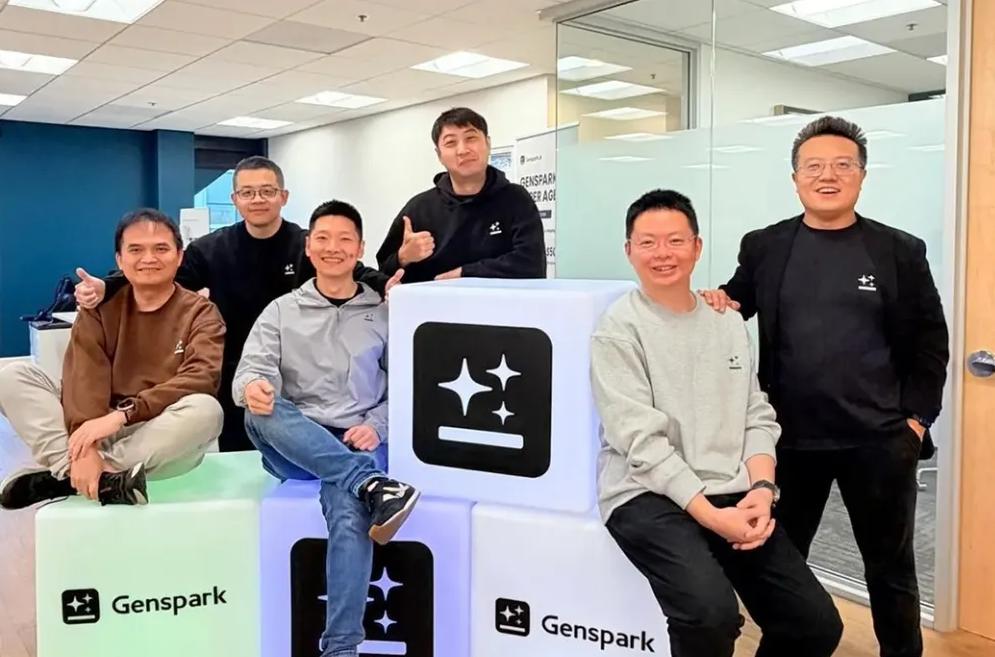
Source: Genspark
The latest news shows that the co - founder and COO of Genspark, Sang Wen, whom Jing Kun and Zhu Kaihua invited as a startup partner, holds a Ph.D. from MIT. He previously founded and successfully exited the enterprise SaaS company Smarking, which was supported by Y Combinator and Khosla Ventures.
Genspark said in its official introduction that it is this gene for building large - scale AI systems that enables Genspark to establish an industry - leading quality evaluation system, ensuring that the results delivered by its intelligent agents have a high degree of completion - users usually only need one instruction to obtain high - quality delivery results.
More than $400 million in three rounds of financing in one and a half years, and the annualized revenue exceeded $50 million five months after launch
In the past two years, the focus of AI competition has gone beyond model capabilities or smarter chatbots. The key is to deliver immediate and meaningful work results for users. Jing Kun and Zhu Kaihua timely shifted their focus to the direction of general intelligent agents.
Just one month after quietly completing a $100 million Series A financing in March this year, which increased the valuation to 3.852 billion yuan, Genspark officially launched Genspark Super Agent, which integrates functions such as in - depth research and multi - modal generation. It outperformed competitors such as Manus and OpenAI in all three different levels of the GAIA benchmark test.
According to the introduction, Genspark Super Agent adopts a multi - agent mixture (Mixture - of - Agents) system architecture, integrating eight differentiated large - language models and more than 80 tool sets, and supporting the autonomous invocation of tools such as Python interpreters, slide makers, and video generators to handle complex tasks.
Nine days after its launch, Genspark Super Agent achieved an annualized revenue of $10 million, and reached an ARR of $36 million in 45 days. In July this year, the product was even selected for the list of the world's top 100 AI applications. Within only five months of the product's launch, the annualized revenue exceeded $50 million, making it one of the fastest - growing companies in the AI industry.
These achievements naturally deserve heavy investment from institutional investors. Therefore, in the Series B financing on November 20th, Genspark was led by top Silicon Valley venture capital firm Emergence Capital Partners. Other leading global technology investors included SBI Investment, LG Technology Ventures, Pavilion Capital, Uphonest Capital. All existing investors, including Lanchi Ventures, the largest investor in the first round, also continued to increase their investment in this round.

Source: Tianyancha
The latest official introduction states that Genspark is committed to reshaping the working methods of more than one billion knowledge workers globally. Its core is to make AI intelligent agents become users' all - around collaborators, transforming business intentions into complete delivery results: from board reports, in - depth financial models, and business documents to full - stack web applications, mobile programs, and even video games. This product is specifically designed for knowledge workers who define directions rather than just execute tasks.
In short, what Genspark does is not just an efficiency tool, but a reconstruction of the essence of knowledge work - it systematically reconstructs the essence of knowledge work by integrating multiple models, intelligent agents, and tools.
At the Microsoft Ignite conference held on November 19th, Genspark even announced its participation in the Microsoft Agent 365 ecosystem. This interface connection is an important signal in the history of AI Agent development: AI is truly entering the core productivity platforms of hundreds of millions of knowledge workers globally from independent "chat windows".
Jing Kun said, "We hope to deeply integrate Genspark into the Microsoft ecosystem. In the future, knowledge workers can directly call on Genspark's capabilities to solve problems without leaving their familiar Microsoft 365 interface."
Along with the official announcement of the Series B financing on November 21st, Genspark also simultaneously launched a new platform, Genspark AI Workspace. This platform goes beyond the simple AI - assisted mode that requires step - by - step guidance and achieves true end - to - end automation, putting daily work in "autopilot" mode.
"There are more than one billion knowledge workers globally, and they spend a lot of time on transactional tasks every day: drafting emails, organizing meeting minutes, making slides, analyzing data, and writing reports. AI chatbots have brought conversational capabilities, but they have not eliminated the work itself. People are still constantly inputting instructions, switching tools, and modifying outputs - this is not a transformation; it is just transactional busyness with AI assistance!"
Jing Kun said, "Genspark has completely changed this mode. Our platform allows knowledge workers to focus on strategy and decision - making, while autonomous agents are responsible for execution. You just need to set the goal, and we will deliver the completed work. This is a fundamental change in the working methods of one billion people - from managing tasks to driving results. In the AI era, Genspark is your one - stop platform for automatic work completion."
This article is from the WeChat official account "Lieyun Selection". Author: Wang Fei. Republished by 36Kr with permission.