As the influenza peak approaches, who is buying flu medicine at 200 yuan per box?
"I've caught it."
One morning in mid - November, A Liang, a white - collar worker in Shanghai, woke up feeling a tightness in her throat and general weakness. By noon, she began to faintly feel the signs of a fever, which was "completely different from the recent cold she had just recovered from". A Liang immediately realized that she had probably contracted the flu.
In the winter of 2025, the flu season started nearly a month earlier. At a press conference on November 10th, the National Disease Control and Prevention Administration stated that the overall flu activity in the country was "on the rise", and the peak of the flu this autumn and winter might occur from mid - to late December to early January next year.
On the public level, the demand for flu medications has skyrocketed. Data provided by Meituan Pharmacy shows that since November, the overall order volume of specific drugs for influenza A and B has more than doubled. Especially in northern cities such as Harbin, Hohhot, and Taiyuan, the order volume has increased by more than 150%.
In terms of product categories, both "classic old drugs" and innovative drugs have shown significant growth. For example, the order volume of Oseltamivir Phosphate Granules on Meituan Pharmacy has increased by more than 85% overall, and the growth of Baloxavir Marboxil has exceeded 110%. In addition, since this year, with the intensive approval of several domestic flu drugs with new mechanisms, consumers have more choices, and the flu drug market, which was previously "dominated" by Oseltamivir, has become lively again.
Some securities firms have even directly stated that 2025 is the "Year of Domestic New Flu Drugs".
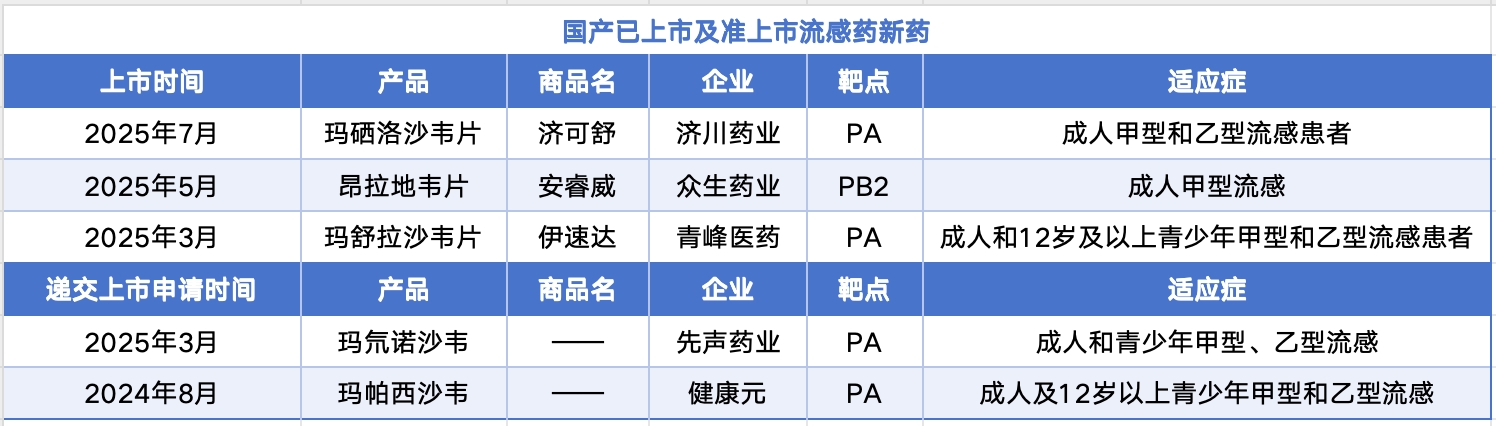
Data sourced from public information
Compared with Oseltamivir, which needs to be taken for several consecutive days, the core selling points of this batch of flu drugs are "only need to take once for the entire course of the illness" and shortening the duration of flu symptoms. However, their prices are generally nearly 10 times higher than that of Oseltamivir, and when they were just launched and their brand recognition was not yet established, they entered a situation of intense competition among similar products.
Specific Flu Drugs
Start to Compete on "One - Time Dose for the Entire Course"
The flu is one of the most common respiratory infectious diseases, with an annual incidence of up to 100 million people in China. At the same time, since the structure and infection mechanism of the flu virus are relatively clear and the product development ideas are well - defined, the flu drug market has supported a multi - billion - yuan market with strong certainty. Excluding various cold medications and other products, the market for specific flu drugs alone has reached over one billion yuan.
This is the major premise for pharmaceutical companies to flock to the flu drug track and continuously conduct product iteration and research.
Looking back in time, in the early years, many people actually couldn't tell the difference between a cold and the flu. They often used cold medications such as Ganmaoling and Kangtai to treat the flu, and even when having symptoms like a fever, they "wanted to use antibiotics or get an injection".
"With the increasing popularization of knowledge in recent years, more and more people understand the difference between the two and know that the flu may lead to serious consequences, such as pneumonia and white lung. When it comes to using specific drugs, patients are also more likely to be convinced." said Li Dongzeng, the chief physician of the Department of Respiratory and Infectious Diseases at Beijing You'an Hospital Affiliated to Capital Medical University.
Previously, when the mainstream research direction of antiviral drugs in the market was mainly to "eliminate" the virus, Oseltamivir provided a new idea: to "trap" the virus in the original cells, preventing them from being released from the host cells to spread the infection until the immune system clears them.
Thanks to its innovative mechanism, Oseltamivir was once regarded as the "first - generation miracle flu drug". In 2023, its sales in the domestic drug terminal market reached 9.8 billion yuan, ranking first among flu drugs.
However, as an old drug that has been on the market for more than 20 years, various dosage forms of Oseltamivir have gradually entered the national centralized procurement system. Along with the decrease in the price and profit of this "old drug", many pharmaceutical companies are actively exploring new specific flu drugs.
On the other hand, Oseltamivir itself has certain limitations. For example, its half - life is only 6 - 10 hours, resulting in a rapid weakening of the drug effect. Usually, it needs to be taken twice a day for 5 consecutive days.
Following the idea of "target upgrade + mechanism optimization", in 2021, Roche took the lead in launching a new - generation antiviral flu drug, Baloxavir Marboxil Tablets (hereinafter referred to as "Xofluza") in China. By inhibiting the PA protein of the virus, it directly blocks the source of its replication, can cover both influenza A and B and drug - resistant strains, and has a half - life of 99.7 hours.
This new - mechanism drug that inhibits the activity of the influenza virus PA protein can stop the virus from being excreted within 48 hours, thereby reducing the risk of infecting others. In addition, since only one dose is needed for the entire course of the flu, patient compliance is better.
Benefiting from this, "Xofluza" was included in the national medical insurance catalog in its first year on the market, resulting in an explosive increase in sales. According to PDB data, in 2023, its sales in the domestic terminal market reached 630 million yuan, achieving nearly an 8 - fold increase.
Domestic enterprises have also been very quick in their layout in this area. Among them, although several enterprises targeting generic drugs of "Xofluza" have obtained production approval, they have not started production due to patent restrictions.
In contrast, domestic new drugs with the same target are progressing faster. Currently, "Yisuda" by Qingfeng Pharmaceutical and "Jikeshu" by Jichuan Pharmaceutical have both been launched; Madanoxavir by Simcere Pharmaceutical and Mapaxavir by Healthmate have also entered the NDA stage and are only one step away from approval.
Last year, the shortage of "Xofluza" during the flu season triggered a wave of drug - buying enthusiasm, promoting the concept of "one - time dosing" among patients and their families. However, due to factors such as a short listing time and high terminal prices, the penetration rate of such products in the total flu drug market is still not very high.
Xie Weibin, the director of the retail market department of Qingfeng Kerui, conducted a small - scale survey this year. The results showed that among those who clearly knew they had the flu, less than 5% of users chose the new - generation PA - target flu drugs. "This means that there is great market growth potential for new PA - target flu drugs."
The Battle between Old and New in the Multi - Billion - Yuan Flu Drug Market
The differences in efficacy lay the foundation for new - generation products to enter the flu drug market. However, whether a new drug can achieve commercial success also needs to consider multiple factors such as pricing and channels.
After several rounds of national centralized procurement, the prices of the three major mainstream dosage forms of Oseltamivir, including dry suspension, capsules, and granules, have dropped to around 20 yuan. For example, in the recent centralized procurement of granules mainly targeting the children's market, the winning bids of Hunan Huize and Chengdu No.1 Pharmaceutical were only 17.88 yuan and 19 yuan respectively.
In contrast, the currently launched PA - target flu drugs are mainly new drugs, with initial prices reaching over 300 yuan. Even after the price reduction by medical insurance, Roche's "Xofluza" is still around 230 yuan. After the recent flu season arrived, "Yisuda" and "Anruiwei" have successively taken the initiative to reduce their prices to less than 200 yuan on e - commerce platforms.
However, the overall value difference between the two types of drugs is still nearly 10 times.
This has also led to distinct regional and group characteristics in the domestic flu drug market. It is understood that in previous years, "Xofluza" had a higher penetration rate in economically more developed coastal areas such as Beijing, Shanghai, and the Yangtze River Delta region, but in most inland provinces, Oseltamivir was still the first choice.
Doctor Li Dongzeng observed that currently, the elderly usually choose Oseltamivir, while the younger generation tends to use the more convenient "Xofluza". However, since this product is not approved for children under 5 years old, this group still needs to use Oseltamivir.
Some enterprise insiders believe that in the next 3 - 5 years, with the promotion of policies such as national medical insurance negotiations and the entry of more pharmaceutical companies, the prices of new - type PA - target flu drugs will further decrease. At that time, the popularization of new - type flu drugs in the mass market may have more highlights.
Before that, pharmaceutical companies may focus on channels and other aspects. For example, similar to "Xofluza" in its time, "Yisuda" and "Anruiwei" both chose to participate in the national medical insurance negotiations in their first year on the market. If they successfully reduce the price and are included, the sales volume increase effect in the hospital channel may be worth looking forward to.
In addition, in terms of product characteristics, flu drugs are "urgent - use drugs", which are naturally compatible with the instant - retail style of e - commerce channels. This is why in the past two years, leading e - commerce platforms have been more comprehensively deploying in the flu product category, and have basically achieved full - process services including home testing, online consultation, and drug delivery.
From a marketing perspective, as prescription drugs, flu drugs cannot be directly advertised like ordinary cold medications. Therefore, they are mainly promoted through academic means. For example, strengthening the training of pharmacy clerks' understanding of flu diseases, and then having them pass on the updated medication methods. It is also understood that AI search engine optimization and doctor - led disease popularization are also promotion methods adopted by flu drug manufacturers.
Ultimately, different from previous competitions in the flu drug market, the core of pharmaceutical companies' current efforts is to build a new prescription and medication habit, transforming the concept of "one - time dosing" from a novel idea into a preferred choice in diagnosis and treatment. This is destined to be a long - term battle centered around user market education. This year's flu season is a crucial starting point for domestic pharmaceutical companies.