Just now, Yann LeCun officially announced his departure to start a business, targeting Advanced Machine Intelligence (AMI).
Just now, Yann LeCun, a Turing Award laureate who is about to leave Meta, announced on social platforms such as Threads and LinkedIn that he has embarked on the next stage of his career: entrepreneurship.
The core of research and development for this new company will be the so - called Advanced Machine Intelligence, or Advanced Machine Intelligence (AMI). He wrote, "The goal of the new company is to drive the next major revolution in AI: to enable systems to understand the physical world, have long - term memory, possess reasoning abilities, and plan complex sequences of actions." In other words, this new company will continue his long - standing research on the "world model."
Interestingly, as an accompanying picture, he also posted a photo of himself with Mark Zuckerberg.
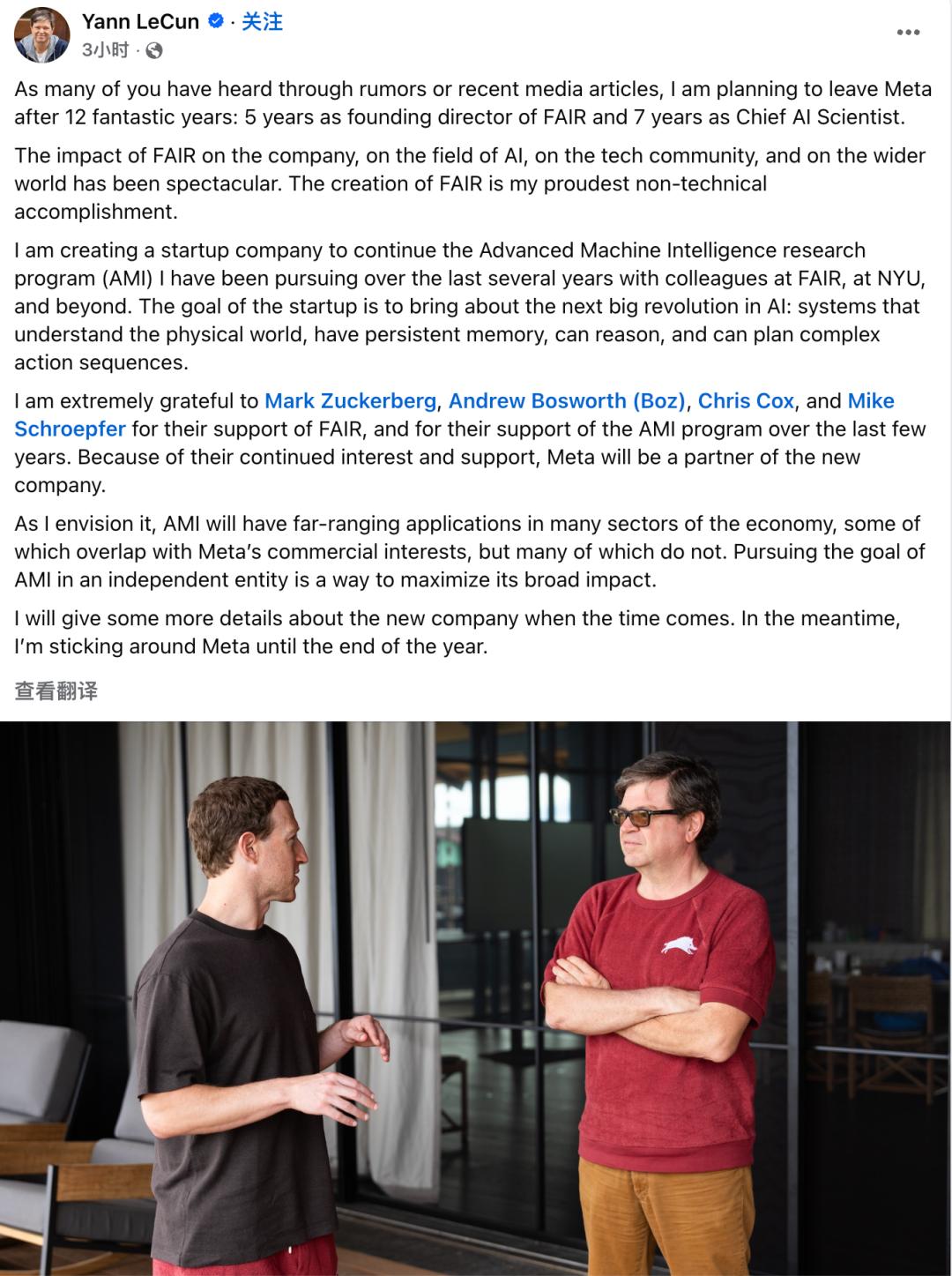
Image source: https://www.linkedin.com/feed/update/urn:li:activity:7397020300451749888/
The full text of Yann LeCun's resignation statement is as follows:
As many of you have learned through rumors or recent media reports, I plan to leave Meta after an amazing 12 years: including 5 years as the founding director of FAIR and 7 years as the Chief AI Scientist.
The impact of FAIR on Meta, the field, the tech community, and the world at large has been profound. Creating FAIR is one of my proudest non - technical achievements.
Currently, I'm in the process of establishing a startup to continue the Advanced Machine Intelligence (AMI) research program that I've been working on with colleagues at FAIR, New York University, and across the broader field for the past several years.
The goal of the new company is to drive the next major revolution in AI: to enable systems to understand the physical world, have long - term memory, possess reasoning abilities, and plan complex sequences of actions.
I'm extremely grateful to Mark Zuckerberg, Andrew Bosworth (CTO), Chris Cox (CPO), and Mike Schroepfer (First Senior Fellow) for their support of FAIR and their backing of the AMI program over the past few years. Thanks to their continued interest and support, Meta will be a partner of the new company.
In my vision, AMI will have widespread applications across many economic sectors. Some of these applications will overlap with Meta's business interests, but there are many more areas where there is no overlap. Therefore, advancing the goals of AMI as an independent entity is the way to maximize its broad - reaching impact.
I'll share more details about this new company at an appropriate time. In the meantime, I'll stay at Meta until the end of this year.
People in the comment section have sent their best wishes to Yann LeCun for his departure and are full of expectations for his future.

Yann LeCun: A 65 - year - old entrepreneur
Yann LeCun (Chinese name: Yang Likun, born on July 8, 1960) is a French - American computer scientist, known as one of the "godfathers of deep learning." He won the Turing Award in 2018 together with Geoffrey Hinton and Yoshua Bengio, and a few days ago, he also received the Queen Elizabeth Prize for Engineering in the UK along with Yoshua Bengio, Bill Dally, Geoffrey Hinton, John Hopfield, Jensen Huang, and Fei - Fei Li.
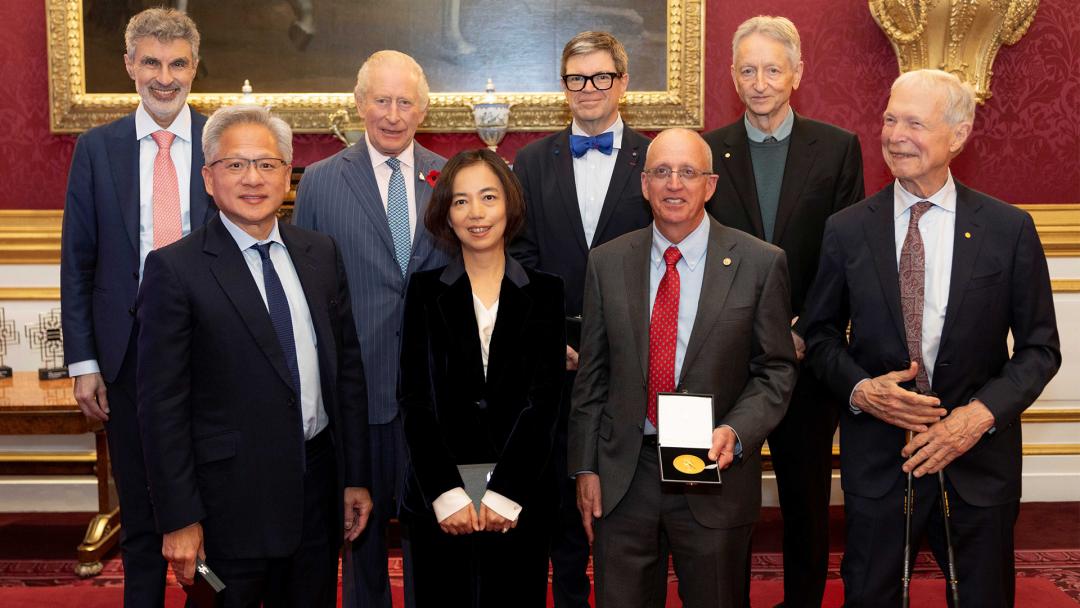
This heavyweight figure has chosen to start a new business at the age of 65, aiming to drive the next major revolution in AMI (Advanced Machine Intelligence). This is undoubtedly one of the most notable events in the AI field.
AT&T Bell Labs and CNN: Laying the foundation
Before joining Meta, most of Yann LeCun's fundamental work was done at AT&T Bell Labs.
Convolutional Neural Networks (CNNs): He developed a biologically inspired image recognition model here: the Convolutional Neural Network (CNN), also known as LeNet. This technology has become the core cornerstone of modern computer vision, image recognition, and optical character recognition (OCR).
Practical applications: The bank check recognition system he helped develop was widely deployed by companies such as NCR in the late 1990s and early 2000s, and it once processed more than 10% of the checks in the United States.
Other contributions: He is also one of the main creators of the DjVu image compression technology.
From "outsider" to "conflicter": The FAIR era
Yann LeCun joined Facebook (later Meta) in 2013 at the personal invitation of Mark Zuckerberg and served as the founding director of FAIR (Facebook AI Research). What made this appointment special was that he insisted on a condition that was out of step with the mainstream in the industry at that time:
The academic freedom model: LeCun insisted that FAIR must adopt an open research model, just like in academia, where papers are published publicly. He believes that the only way to attract and retain the top scholars is to meet their desire for "peer recognition and the advancement of science."
Core assets: Under this model, FAIR has provided Meta with a continuous stream of core technologies, including open - source tools such as PyTorch, and has established its leadership position in the open AI ecosystem through the Llama series of models in the competition of large - scale models.
However, as the AI competition has become increasingly fierce, the "idealistic" environment within Meta has begun to wane.
Changes in the power structure: Mark Zuckerberg spent $14.3 billion to acquire Scale AI and appointed Alexandr Wang to lead the new super - intelligence laboratory, which caused internal turmoil.
Cultural conflict: Meta imposed a new policy of "tightening paper publication" on the FAIR laboratory, and then laid off about 600 AI positions at the end of October 2023, affecting multiple teams.
It was in this environment of "intensified conflict between the old and the new, restricted academic freedom, and chaotic internal culture" that Yann LeCun, a Turing Award laureate, finally revealed his intention to resign. He chose to leave a laboratory that he had built himself and that once enjoyed a high degree of academic freedom. At the age of 65, as an entrepreneur, he continues his grander scientific exploration of the "world model." This is seen as a sign of the ebbing of the "idealism" in the FAIR laboratory.
LeCun's dream of the world model
Yann LeCun is a critic of large - language models (LLMs) and a strong advocate of the world model. He believes that LLMs will never truly understand the physical world. He once said that the physical intuition of modern LLMs is even worse than that of a donkey.
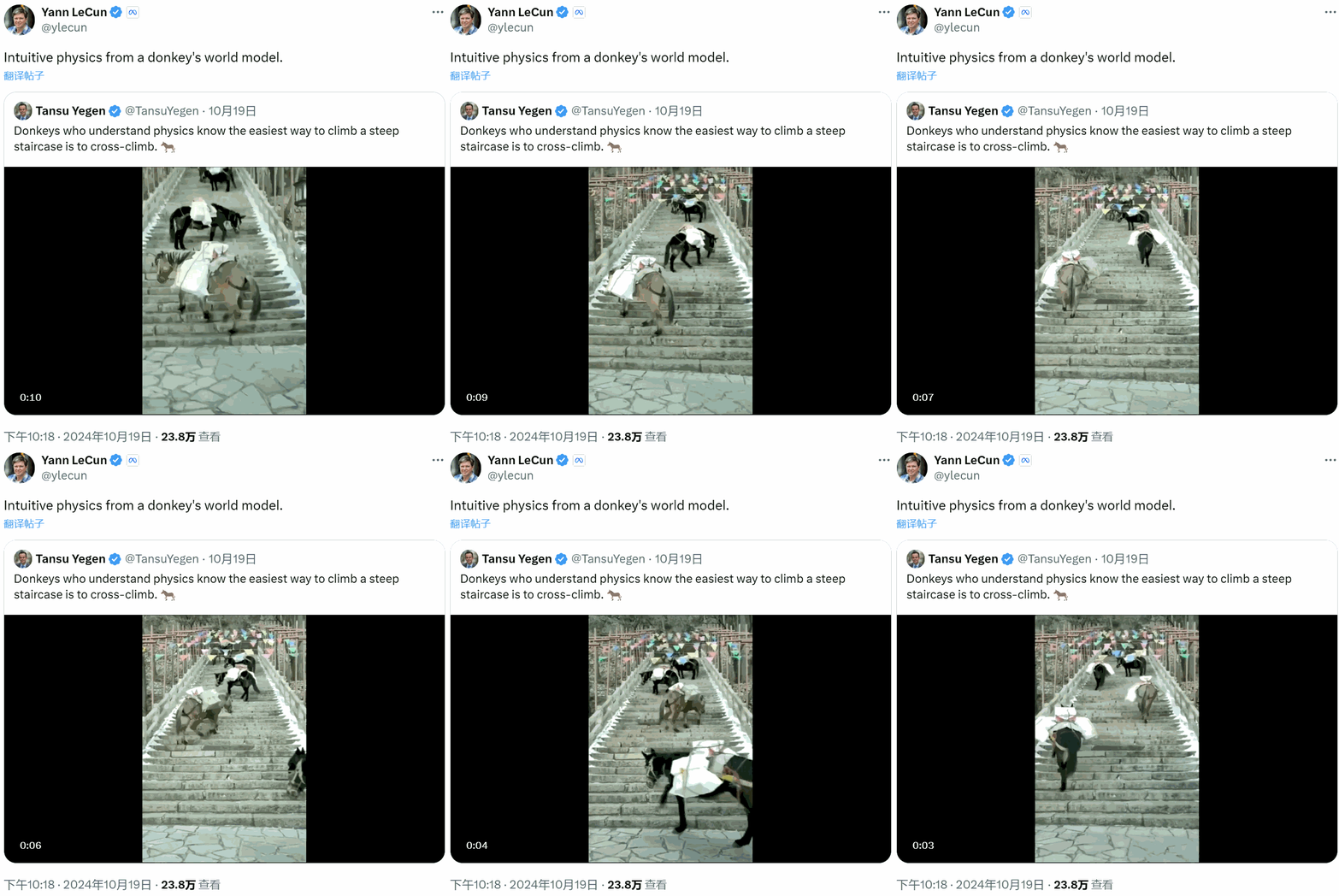
In recent years, Yann LeCun has been promoting the development of the world model research direction and has also demonstrated some very impressive results, such as DINO - world, Navigation World Models, and Cambrian - S.
In June this year, LeCun personally appeared to introduce the differences between the world model and other AI models.
He said that the world model is an abstract digital twin of reality. AI can refer to it to understand the world and predict the consequences of its actions. Different from understanding language, the world model enables machines to understand the physical world and plan action routes to complete tasks without millions of trials because the world model provides a basic understanding of how the world works. AI that can use the world model for reasoning and planning will have a wide - ranging impact. For example, it can be used in assistive technologies for the visually impaired, to provide guidance for complex tasks in mixed reality, to make education more personalized, and even to understand the impact of code on the program state and the external world.
Before leaving Meta, he and his student Randall Balestriero co - authored a paper on LeJEPA and jointly proposed a comprehensive theory about JEPA (Joint Embedding Prediction Architecture). The core idea of JEPA is to learn an organized and operable high - dimensional embedding space by maximizing the consistency between the embeddings of semantically related views (such as different transformations or croppings of an image). LeCun believes that this is a potential solution to realizing the world model.
The "dissatisfaction" of a Turing Award laureate
Yann LeCun's departure and entrepreneurship symbolize the end of an important stage in the history of AI development and the beginning of the next exploration cycle.
As a top talent in academia, he was invited by Zuckerberg to create FAIR, which was known for its openness and freedom. However, against the backdrop of the conflict between the company's strategy and "idealism," this 65 - year - old Turing Award laureate has chosen to leave his comfort zone and become an entrepreneur again.
His entrepreneurship is not a repetition of the old path but is based on a profound understanding of the limitations of existing LLMs. LeCun's goal is very clear: Advanced Machine Intelligence (AMI), that is, the world model he has advocated for many years. From developing CNN at Bell Labs in the early days to lay the foundation for perception, to now being committed to the JEPA theory and realizing the machine's physical intuition and reasoning and planning abilities, LeCun has been pursuing making machines truly understand the world throughout his life.
The departure of Soumith Chintala, the father of PyTorch, and LeCun's entrepreneurship mark the end of an era within Meta AI. But for Yann LeCun, this may just be another assault on a grander and more fundamental scientific problem in his scientific research career. His new company and his dream of the world model will undoubtedly be one of the most anticipated stories in the AI field in the next few years.
Reference links
https://www.facebook.com/search/top?q=yann%20lecun
https://www.linkedin.com/posts/yann - lecun_as - many - of - you - have - heard - through - rumors - activity - 7397020300451749888 - 2lhA/
This article is from the WeChat official account "Almost Human" (ID: almosthuman2014). The author is Almost Human. It is published by 36Kr with authorization.