The first AI hardware company invested by Zhu Xiaohu has completed another round of financing.
The AI glasses, which made a stunning debut at CES in 2025 and set a crowdfunding record of nearly $4 million, have once again won the favor of capital.
The startup behind it, Gyges Labs, officially announced that it completed a Pre-A+ round of financing in October. The investors are Granite Asia and Bright Capital.
Previously, Gyges Labs completed a Pre-A financing round in November 2024, with an amount in the tens of millions of RMB. It was led by Jinshajiang Venture Capital, founded by Zhu Xiaohu, and the investors included Chen Hao, the founder of AfterShokz.
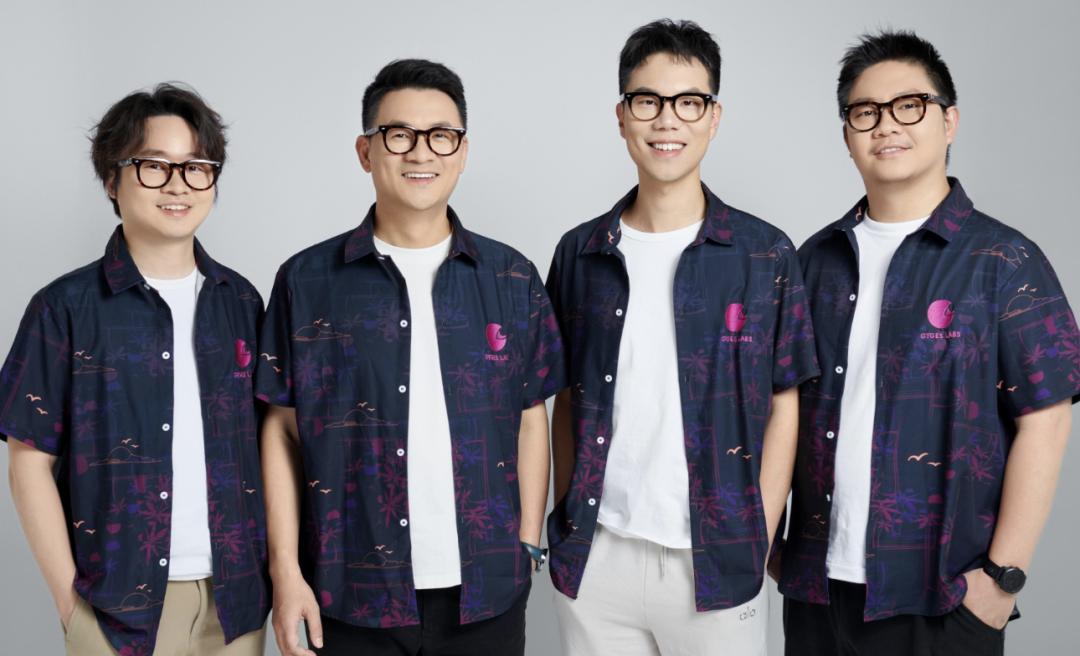
Its CEO is Dr. Jia Jieyang from Stanford University, who has held core R & D positions in several Silicon Valley startups. The core members of the team include Lu Zheng, the CTO who participated in the R & D of Apple Vision Pro, Deng Xudong, the COO with more than a decade of experience in consumer electronics products, and Dr. Qi Siyuan, who once worked at Google in the field of AI.
△
In the current situation where the AI hardware track is becoming increasingly crowded and there are numerous exploration directions, Gyges Labs' ability to obtain capital support is closely related to its unique product entry point.
When everyone believes that the battlefield for AI wearables is an arms race for "comprehensive" functions, Deng Xudong, the co-founder of Gyges Labs, demonstrated a completely different path at a sharing session.
During the more than one - hour sharing, he repeatedly mentioned a word - "restraint".
AI glasses should first be glasses
"Anyway, what we are making is first and foremost a pair of glasses."
Deng Xudong emphasized that the core concept of Gyges Labs is "Glass First", which means that their glasses should first be suitable for daily wear.

This coincides with the concept put forward by Lei Jun when releasing Xiaomi AI glasses.
Smart glasses on the market, whether those pursuing a large - screen audio - visual experience or those featuring a shooting function, have all made compromises to some extent on the essential attributes of glasses - they are too heavy, too obtrusive, and too "smart" to truly integrate into daily life.
Deng Xudong pointed out that wearing glasses like a portable large screen to a meeting is not socially acceptable. Even for photo - taking glasses like Ray - Ban, the flashing indicator light will make others wary, thinking "Don't take my photo."
The goal of Gyges Labs is to create a product that can be worn every day without anyone noticing it is a smart pair of glasses.
To achieve this goal, Gyges Labs presented their core self - developed technology - DigiWindow.
Deng Xudong called it "the world's smallest near - eye display system." He proudly added that the team once hesitated whether to use the word "smallest", but "after several years, no one has made it smaller than us."

Smallness is the first - principle for achieving "Glass First". Because it is small enough, the engineers at Gyges Labs were able to come up with a revolutionary design -
The entire display module is placed at the bridge (nose pad) of the glasses, and the image is directly formed on the retina by directly projecting into the eye.
The advantages brought by this design are interlinked.
First of all, it completely gets rid of the thick side temples of traditional smart glasses, making the appearance infinitely close to ordinary glasses. The total weight of the device is controlled at 35 grams (about 28 grams without lenses), and the power consumption is extremely low, enabling real all - day wear.
Meanwhile, since there is no light leakage or rainbow pattern interference, when the wearer obtains information, people facing them cannot notice at all.
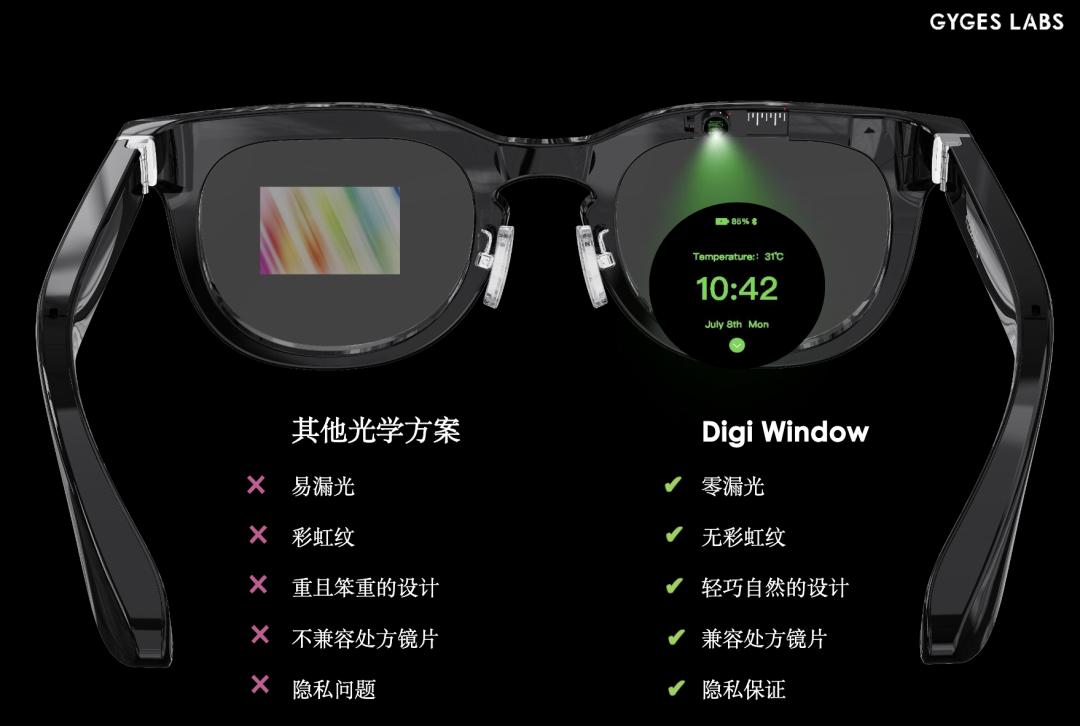
Deng Xudong summarized this as a concept: "Display, but not showy". It is this extreme return to the essence of glasses that has touched the hearts of early users.

Exchange "function subtraction" for "experience addition"
Gyges Labs' extreme pursuit of hardware form is also reflected in the selection of its AI functions. The most obvious manifestation is that Halliday has no camera.
Facing the question of "Will the lack of vision make the AI handicapped?", Deng Xudong frankly admitted that it does lack a dimension of information.
But he immediately presented his thoughts - if you add these functions, the product will become unusable in daily life.
He pointed out that visual collection brings three major problems: battery life, appearance, and privacy. If you really want to continuously collect visual information throughout the day, basically this pair of glasses will be useless, and the battery will be exhausted in two hours.
This is exactly the manifestation of Gyges Labs' "restrained innovation" in terms of functions.
While other manufacturers are pursuing "comprehensiveness", Gyges Labs has made extremely minimalist subtractions, only providing monochromatic and information - prompting functions.
Deng Xudong believes that under the current technology and consumer perception, a comprehensive product may not necessarily achieve commercial success.
"Rather than trying to include all functions at once," Deng Xudong said, "it's better to first do a good job in the AI functions in this dimension based on voice and the perception of surrounding sounds."
What this "subtraction" has exchanged for is the "active AI" that Halliday Glasses can focus on realizing.

When asked what this AI can do, Deng Xudong described several scenarios.
First is real - time translation and meeting minutes. This is a basic function with almost no delay.
Secondly, it can act as an active knowledge supplement. Deng Xudong gave an example:"For instance, during a meeting, when you mention an unfamiliar word, my AI knows I don't understand it and will display its meaning in front of my eyes."
The ingenuity of this design lies in avoiding social embarrassment. Deng Xudong explained it like this:
"I don't need to ask it, because it would be embarrassing to ask my assistant during a chat. We want this AI to integrate into our work and life."
Finally, this AI can even correct "lies" immediately. Deng Xudong imagined: "If you tell me that you just went to Japan, which is a city in Europe, my AI here will say that Japan is not a city in Europe; it is in East Asia."
Moreover, this personal AI assistant is the core of Gyges Labs' layout in AI wearables. In Deng Xudong's view, it will not only run on a pair of glasses in the future.
From AI glasses to "distributed super - humans"
Facing the soul - searching question of "How can startups survive when big companies enter the market?", Deng Xudong's answer is that Gyges Labs does not compete in a single dimension.
He emphasized that Gyges Labs is not an "AI glasses company" but an "AI wearables company", and its core is "AI + wearables".
The ultimate goal of the company is to build the next - generation display, interaction, and computing platform. Deng Xudong believes that this platform is likely not a single device but a distributed system.
He explained the difference between portable and wearable devices - although smartphones are powerful, they are always portable, and their biggest disadvantage is that they take up your hands. Wearable devices, such as glasses and rings, can truly "perceive what I perceive and accompany me 24 hours a day."
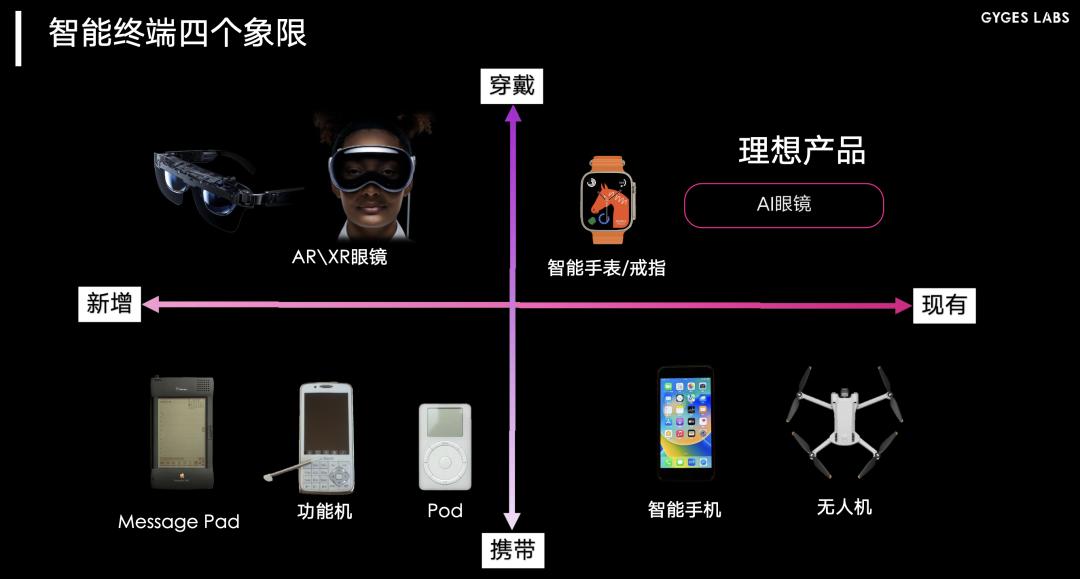
Under this concept, Gyges Labs' layout is clear. Glasses are the first product form, and Deng Xudong revealed that the second product of Gyges Labs will be a smart ring, which is planned to be released at CES in 2026.
Whether it is glasses or a ring, they are all carriers of AI capabilities.
The real vision of Gyges Labs is to "endow AI capabilities to various wearable devices" to fulfill its entrepreneurial original intention.
"Our company is called Gyges Labs," Deng Xudong went back to the origin. "This name comes from a legend in Plato's Republic. There was a young man named Gyges who picked up a ring. After turning it, he found he could become invisible... We want to borrow the meaning of such a ring and hope to create a series of devices to make people more capable and turn everyone into a super - human."
This article is from the WeChat official account "QbitAI". Author: Keleixi. Republished by 36Kr with permission.