The stock price of the silicon photonics company has skyrocketed.
Tower Semiconductor, which almost sold to Intel for $5 billion two years ago, has seen its stock price more than double in just a few months, reaching a 20-year high. As shown in the figure below, in August 2025, Tower's stock price was still hovering around $50, but by November 12th, it soared to $106.42. For a mature semiconductor manufacturer, such a rapid increase is almost unheard of (except for NVIDIA), indicating the high level of market sentiment. More importantly, looking back at the past 20 years from 2005 to 2025, Tower's valuation has long been at a relatively low level, making this surge particularly noticeable in the industry.
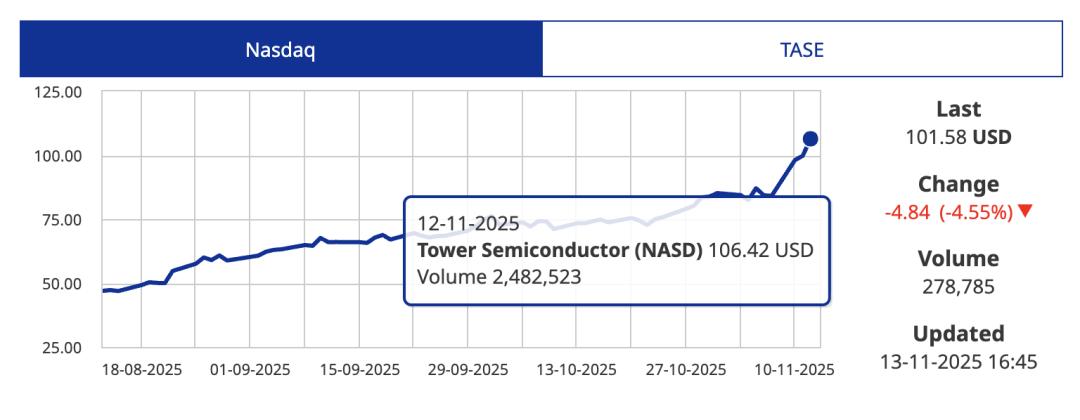
Caption: Tower's stock price trend from August to November 2025
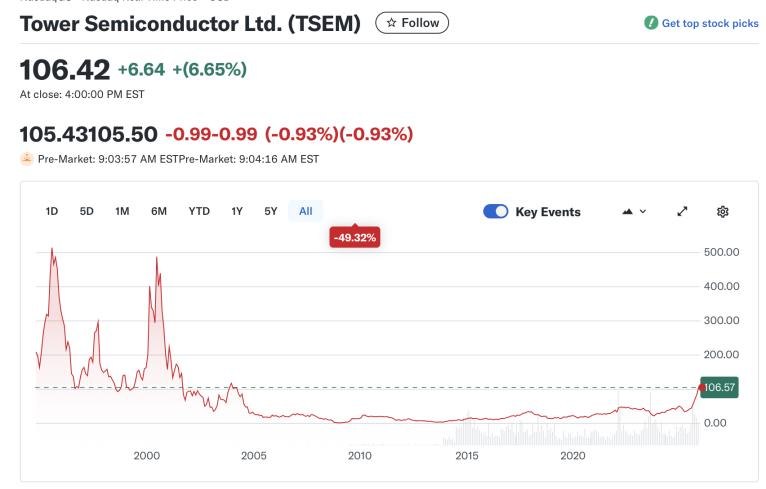
Caption: Tower's stock price situation from the end of 1994 to the present
It may seem like a capital story, but it actually reveals a larger trend: when the computing power demand brought by AI explodes, the high value behind silicon photonics interconnection is being realized.
Why is silicon photonics the only answer?
Before AI, interconnection was not the focus of the industry. CPU bandwidth, server topology, and data exchange scale were all within controllable ranges. Copper wires, PCBs, and materials were sufficient to support the system.
However, when the computing power architecture evolved from single machines to large-scale GPU clusters and expanded from dozens of GPUs to tens of thousands or even millions of nodes, the interconnection system became the first bottleneck of the entire system. Once entering the era of GPU parallel computing, thousands of GPU training, and 100 Tb/s Fabric networks, all parameters increase exponentially: a cluster of 100,000 GPUs may require 500,000 interconnection links, and the devices carrying these links include thousands of servers and switches. If the scale expands to 1 million GPUs, the number of interconnections may exceed 10 million, and the energy consumption of the network alone may approach the 1 GW level. In other words, as the computing power scale increases, the network cost, power consumption, and physical connection complexity increase exponentially, rather than linearly. This is why interconnection technology has moved from the background to the forefront in the AI era.
In the past, the interconnection between servers and between GPUs mainly relied on copper cables. However, as the single-channel rate increased from 56G → 112G → 224G PAM4, the pure copper solution began to encounter unavoidable physical limits:
Significantly reduced reach: As the frequency doubles, the channel loss increases exponentially, making it difficult for on-board, backplane, and cable connections. Heavy equalization will lead to increased power consumption and latency.
Limited bandwidth density: To achieve higher total bandwidth, more wiring, thicker backplanes, and more complex connectors are required, resulting in a significant increase in PCB area and material costs.
EMI/integrity challenges: SI/PI issues such as crosstalk, radiation, and reflection make it increasingly unsustainable to simply add more components.
Therefore, the industry began to realize that high-speed interconnection must shift from electrical to optical.
However, after traditional optical modules entered the market, they quickly encountered growth bottlenecks. Traditional optical modules were born in the "telecom-grade optical communication era" with the goal of long-distance (tens to thousands of kilometers), stable transmission, high unit price, but relatively low volume. Most optical communications occur between computer rooms and between cities. Their characteristics are: most devices are discrete components, optical devices are assembled, the cost structure is heavily weighted towards labor, packaging, and optical alignment, and most lasers use EML (electro-absorption modulated lasers), which are expensive and have limited production capacity. This architecture works well for "inter-city long-distance communication," but problems arise in AI data centers.
In the AI era, a large amount of optical communication occurs between servers, between GPUs, and even inside chip packages (CPO) in the future. That is to say, optical communication has changed from "long-distance transmission" to "short-distance high-density interconnection." This poses new requirements for optical modules: higher bandwidth (400G→800G→1.6T→3.2T), lower power consumption, smaller size, and lower cost (due to the large number of AI servers).
Traditional optical modules struggle to meet these four requirements simultaneously and face three major bottlenecks: First, in terms of cost, 40 - 60% of the cost of traditional optical modules comes from lasers, packaging alignment, and optical component manufacturing. EML lasers are the standard, but they are difficult to manufacture, have high costs, and limited production capacity. Second, in terms of power consumption, as the rate increases, the driver becomes more difficult to operate. In the 200G/lane (1.6T) era, it is difficult to reduce the power consumption of traditional modules. And the energy consumption of data centers is limited, with very tight PUE/POD budgets. Third, there are many devices, complex assembly processes, and it is difficult to scale up production. One AI server may require dozens of 800G/1.6T optical ports. In terms of quantity, the traditional module system simply cannot meet the demand.
Therefore, silicon photonics began to take the stage of history. In fact, silicon photonics is not a new concept, but AI has truly given it the first "industrial-level implementation window." Silicon photonics is a technology that uses CMOS processes to manufacture hundreds of components required for optical communication. It has been used for many years to produce coherent optical modules for metropolitan area networks and long-distance communication.
Different from traditional optical modules, silicon photonics uses common continuous-wave (CW) lasers, which are lower in cost and easier to manufacture. Loi Nguyen, the executive vice president and general manager of Marvell's Cloud Optics, said, "A CW laser is like a light bulb... It just emits a constant beam of light. It is easier to manufacture, can be obtained from multiple sources, and is inexpensive. All the high-speed'magic' for modulating data occurs inside the silicon photonics chip." Silicon photonics devices can also be produced in 200mm and 300mm wafer fabs.
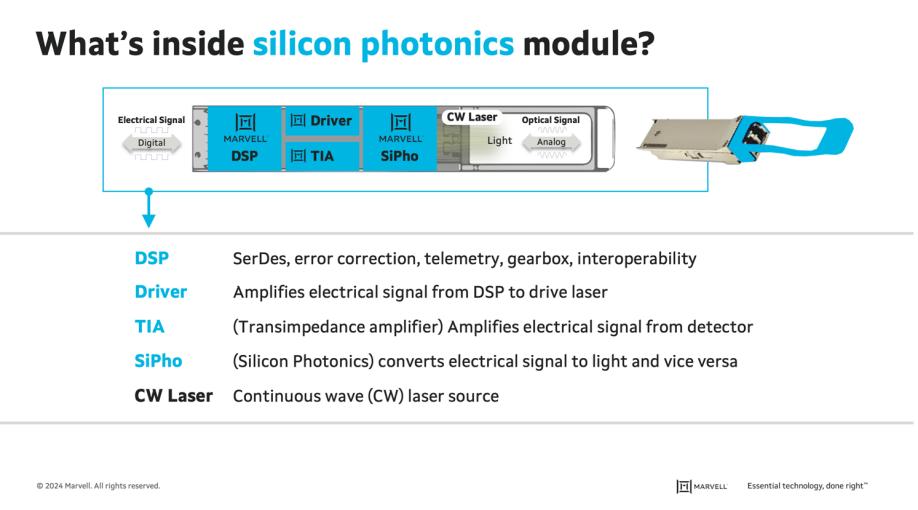
Caption: Internal structure of a silicon photonics module (Source: Marvell)
Why has silicon photonics become crucial at this moment? Marvell gave an example: If a discrete module has eight 200G channels in a single chip, it requires four EML lasers to drive a total rate of 1.6T. With silicon photonics, all functions are integrated, and four channels can share one laser. Therefore, the entire 1.6T module only needs two CW lasers, which are lower in cost and easier to manufacture. Moreover, integrated silicon photonics modules have higher reliability, are easier to scale up, have less supply chain pressure, and have a better cost structure.
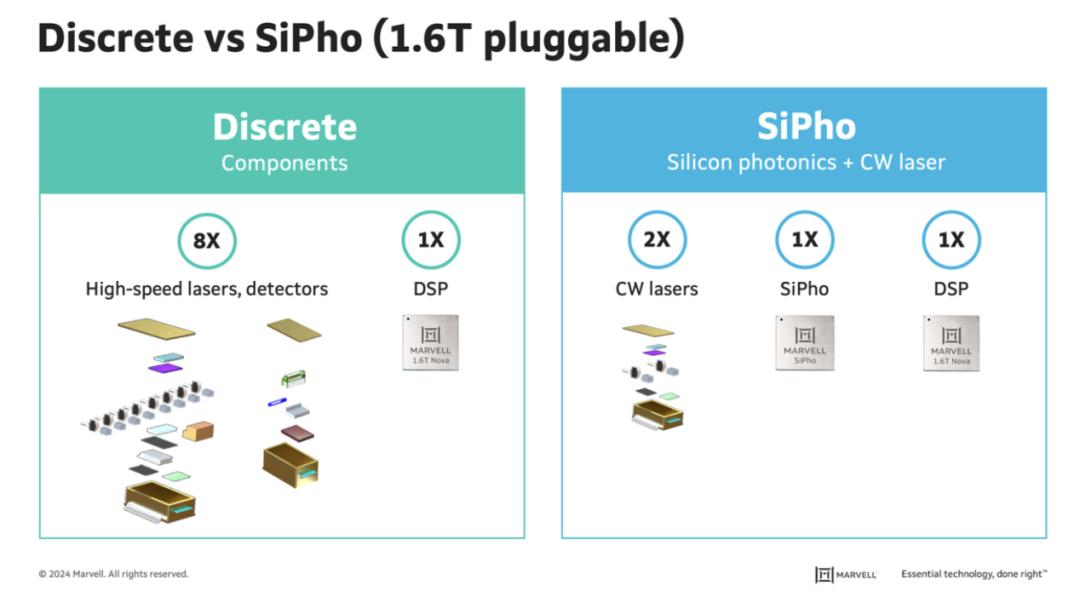
Caption: Comparison between discrete devices and silicon photonics (Source: Marvell)
Therefore, the technological trend is very clear: The physical bottleneck of copper interconnection + the structural limitations of traditional optical modules = the inevitability of silicon photonics. Silicon photonics will be the next-generation computing power infrastructure.
Three steps of silicon photonics interconnection
From the outside to the inside, the industry is undergoing a three-step evolution of silicon photonics:
Step 1: Active cables at the cable level (AOC / AEC). Initially, the industry extended the reach of electrical signals in copper media by adding amplification and equalization circuits at the cable ends. This active cabling extended the lifespan of electrical interconnection by cleaning up the electrical signals before their quality deteriorated, effectively prolonging the life of traditional copper wires.
Step 2: Pluggable optical modules (LPO, QSFP-DD / OSFP / OSFP-XD, etc.). As the rate increased to 400G, 800G, and even 1.6T, copper cables could no longer support the required bandwidth and distance. Therefore, the industry turned to using short-distance optical modules extensively within racks and between cabinets, directly performing "electrical - optical conversion" at the ports of switches and accelerators. For example, linear direct-drive/low-DSP (LPO) modules use "lighter" equalization links in the pluggable era, sacrificing some link tolerance in exchange for lower power consumption and lower latency. This step allowed optical communication to enter the interior of data centers and become the main form of high-bandwidth interconnection at present.
In June 2024, Marvell demonstrated a 6.4T 3D silicon photonics engine: The engine has 32 channels, each capable of achieving a 200G electrical/optical transmission rate. This new architecture integrates hundreds of optical communication functions into a single chip, including integrating the TIA and driver into the same device. As the industry's first product with this integration method, it uses a modular design and can scale from 1.6T to 6.4T or even higher bandwidth levels. Initially, the form is a pluggable optical module, and the number of channels will expand from the current 8 channels per module to 16, 32, or even 64 channels.
Step 3: Optical integration at the package level (CPO / NPO / OBO). The further trend is to move the optical engine to the edge of the chip package or even inside the same package. This significantly reduces the length of electrical traces, power consumption, latency, and thermal penalty. Looking further ahead, there is the silicon photonics SoP (System on Package) / SiPho co-packaging solution - this may be the ultimate mode of AI optical interconnection, allowing optical and electrical signals to naturally couple on the same silicon chip, achieving true "optical computing integration."
From the evolution path, pluggable modules will remain the mainstream in the short term (due to their flexibility and maintainability). In the medium term, linear direct-drive/low-DSP modules will reduce PUE. In the long and medium term, CPO/near-package optics will be implemented in large-scale training/switching platforms, further pushing "optics" to the edge of the chip.
What does this mean for the industrial chain?
From the demand side, optical modules have shifted from "long-distance, low-volume, high-price" to "short-distance, high-volume, high-density." The increase in volume directly drives the growth of both optical module shipments and the production capacity of optical devices/processes. Optical modules have changed from being "sparingly configured for long-distance applications" to being a standard configuration for "each server, each board, and each chip."
From the supply side, chip manufacturers, foundry giants, and interconnection manufacturers have all started to layout silicon photonics technology. For example, in November 2025, Tower announced a new CPO (co-packaged optics) foundry service platform, which is compatible with its SiPho/SiGe PDK and introduces 300 mm wafer bonding and 3D IC multi-technology stacking design flow.
Stock prices rise with silicon photonics
According to LightCounting data, the global optical interconnection market has doubled since 2020 and will approach $20 billion by 2025. It is expected to double again by 2030, with an industry compound annual growth rate (CAGR) of approximately 18%. More interestingly, if we narrow our perspective to the artificial intelligence data center scenario, the growth curve becomes even steeper. LightCounting predicts that the market size of optical modules, LPO, and CPO for AI clusters will exceed $10 billion by 2026, doubling compared to 2024. And as the scale of large model training expands, CPO enters the deployment phase, and silicon photonics accelerates into the mainstream packaging form, this market will further reach a scale of $20 billion by 2030.
The capital market has already sensed this "structural supply-demand reversal." The transmission chain from AI computing power to optical interconnection is as follows: Growth of AI models → Explosion of GPU clusters → Upgrade of internal interconnection → Multiplication of optical module demand → Tight supply of silicon photonics/SiGe production capacity. Therefore, every link in the industrial chain related to silicon photonics is benefiting from AI:
Foundry: Representative manufacturer - Tower
In its latest quarterly earnings report, Tower emphasized the core position of silicon photonics in its business revenue. In the third quarter of 2025, Tower's revenue was $396 million, a 6% increase from the previous quarter. The company expects its revenue in the fourth quarter of 2025 to be $440 million, with a floating range of 5%, reflecting a 14% year-on-year increase and an 11% quarter-on-quarter increase. Russell Ellwanger, the CEO of Tower Semiconductor, said, "We are at the leading position in the industry in the fields of silicon germanium (SiGe) and silicon photonics (SiPho) technologies required for optical modules. Coupled with the strong increase in data center demand, Tower has unprecedented growth potential in both revenue and profit."
The core reason for Tower's doubling of market value is the strong demand for production capacity in the silicon photonics field and the significant increase in market demand. In the key process links of optical modules, Tower has global leading strength in silicon photonics processes and advanced SiGe processes (used for TIA manufacturing), with significant technological advantages. Among them, it can meet the performance requirements of single-wavelength 200G, with an FT cut-off frequency covering 300 - 400GHz, providing core support for the mass production of high-performance optical modules.
In fact, in addition to silicon photonics, advanced silicon germanium (Silicon Germanium) processes required for advanced node DSPs and transimpedance amplifiers are also core support technologies. Photoelectric detection, drive amplification, and transimpedance amplification (TIA) in high-speed optical modules are one of the performance bottlenecks of optical modules. Due to its high-frequency, high-gain, and high-linearity characteristics, the SiGe process has become the preferred choice for driving such devices. The SiGe process can provide a cut-off frequency of up to 300 - 400GHz and is a key amplification technology for high-speed optical links. Tower also pointed out that the combination of silicon germanium technology and silicon photonics is its future growth path.
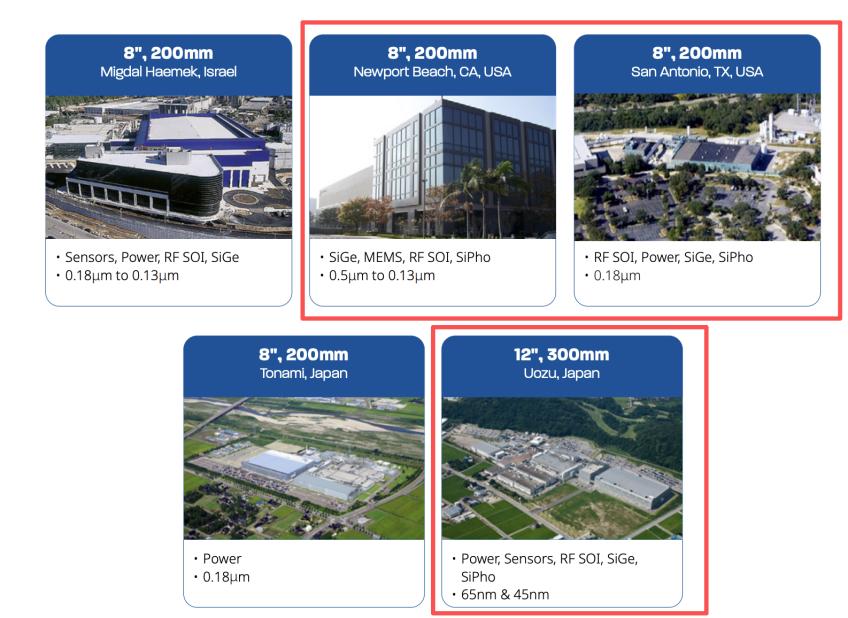
Caption: Tower's wafer fabs capable of providing silicon photonics foundry services (Source: Tower)
In response, Tower is ramping up production. "We are advancing customer certification, continuing to increase investment in Newport Beach Fab 3, and re-planning and adding investment to three other wafer fabs to support a new and rich portfolio of SiPho and SiGe products. The initial release of the new production capacity is already reflected in our record revenue guidance of $440 million for the fourth quarter," Ellwanger further pointed out.
Laser: Coherent
Previously, we talked about the important role of lasers in optical modules. Coherent is a major player in the laser field