The "Big Four" in AR: A Time of Intertwined "Dangers" and Opportunities
From Pessimism to Optimism
Recently, the combination of AI and AR glasses has been gaining more and more attention. First, JBD, which "masters core technologies," received a huge amount of financing. Then, a southern Chinese enterprise in the industry secured the largest single - round financing this year, though the amount is "unknown." The industry is finally warming up, and I sincerely rejoice for all AR startups.
As an independent commentator who has worked in two benchmark companies in the industry, I deeply understand how immature consumer - grade AR is and how difficult it is to put it into practice.
Two years ago, core micro - displays and optical engines accounted for half of the BOM cost. However, the color and brightness could never meet the requirements. The near - eye display optical solutions were complex and far from reaching a consensus, and the mass - production consistency and yield rate were quite poor. With these high costs that had to be borne, the finished terminals only had weak application scenarios and extremely limited screen - expanding and information - prompting functions.
Consumer - grade AR is not real AR. To meet both the "consumer - grade" and "AR" requirements simultaneously, it can only be fake.
As an example, even Apple, with its powerful Video - See Through solution, faces difficulties. No matter how much progress is made in optical modules, sensors, algorithms, and computing power, essentially, humans have to adapt to "observing the world through a camera like looking through a telescope." It seems that we have to wait for Homo sapiens to evolve. The market prospects of Apple Vision Pro in the consumer market are uncertain.
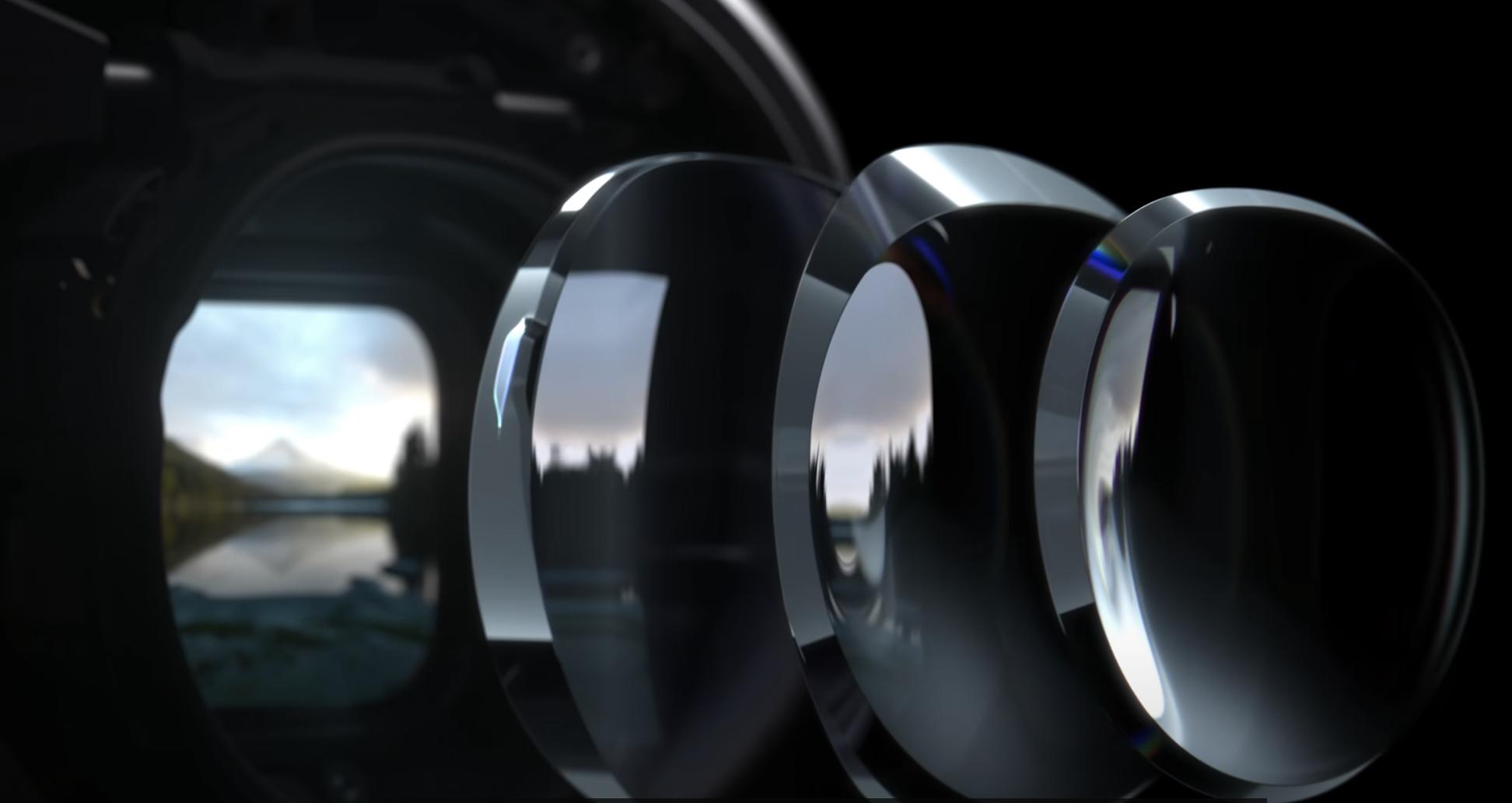
This is the customized optical module of Apple Vision Pro.
For the Optic - See Through solution and even some partially transparent BirdBath solutions, only when they are made into helmets can they achieve complete AR functionality, which means they are only suitable for the B2B market, not the B2C market. What kind of AR can the so - called "Four AR Dragons in China" be if they don't have consumer - grade AR with real virtual - real interaction? Moreover, there are almost no relevant apps, so the products end up gathering dust after purchase. Without repeat purchases and stable device replacements, companies can only keep "chasing new opportunities." Consumer - grade AR represented by the BirdBath solution and the waveguide solution is a very early and niche market. Only by putting on a show and promoting aggressively can companies secure financing to survive.
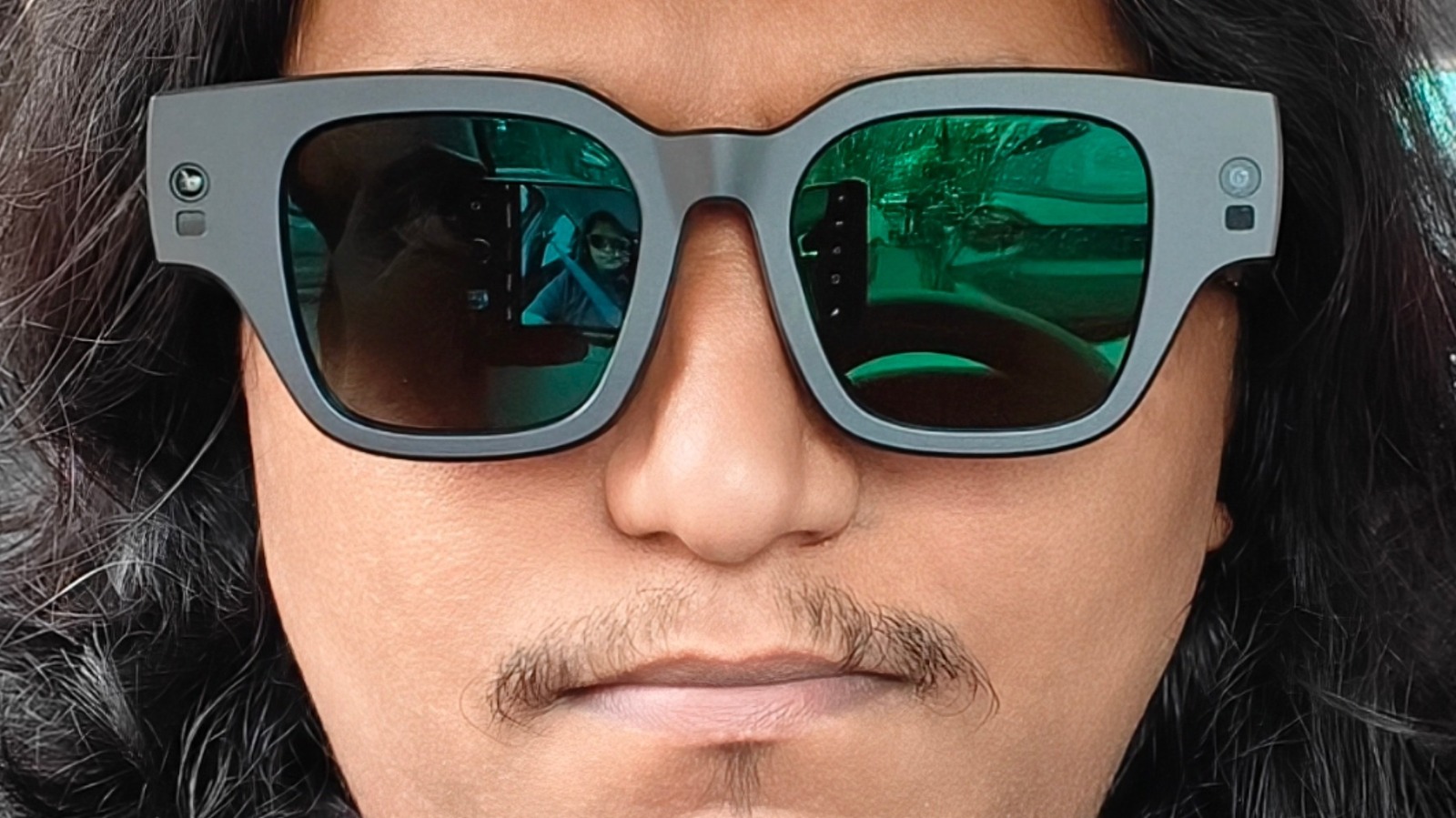
This is the INMO Air 2.
At the end of 2022, ChatGPT - 3.5 became a global phenomenon, triggering a perfect storm in the seemingly unrelated field of consumer - grade AR. The evolution of LLM technology is not only the most crucial variable for the consumer - grade AR category. It has greatly enriched the product combinations, scenarios, and functions that can be explored. In the eyes of many domestic and foreign tech giants, AR glasses with high light transmittance that can be worn daily outdoors are the best hardware paradigm for the implementation of LLM.
Theoretically, by connecting to the API of a cloud - based large - scale model, the glasses can receive, recognize, and generate voice, text, images, and video streams in real - time. They can understand the world at a multi - modal level and know your preferences. As an editor of the well - known overseas tech blog The Verge said: "I feel like Tony Stark (Iron Man), and Gemini (Google's large - scale model) is my J.A.R.V.I.S."
Large language models and generative diffusion models are in a global race. High - order intelligent agents that can perform end - to - end training and parallel calls, and GUI Agents that can recognize "elements" on the screen and execute multi - step tasks based on long - term planning have great potential at the application level. This year, after reinforcement learning, the post - training introduced a new Scaling paradigm with the expansion of the thought chain. Furthermore, world models that can understand the physical reality, predict, and generate 3D content have a huge imagination space. Even a waveguide "useless" glasses with a very narrow green FoV can be transformed into the next - generation consumer electronics of AI + AR.
As a second brain that can be freely accessed, it goes beyond the original concept of a "wearable computer" and can provide real - time visual enhancement of the real world. Theoretically, the scenarios in science - fiction movies will become achievable as large - scale models progress. The GUI Agent that can achieve long - term reasoning and a unified multi - modal information flow processing architecture may give rise to new technical paths, greatly simplifying the positioning, mapping, and rendering processes originally required to implement AR functions. The reasoning computing power is in the cloud, while the sensors and basic human - computer interaction are at the terminal, opening up a lot of innovation space and product freedom.
Technological progress drives the expansion of functions and scenarios, reducing the complexity and cost of achieving a certain function. This is a typical process in which technological innovation creates new product categories and new demands.
The "Four Dragons" Caught between "Dangers" and "Opportunities"
Although they are not like the "Eastern Heretic, Western Poison, Southern Emperor, and Northern Beggar," the "Four Dragons" of consumer - grade AR in China are distributed in the east, west, south, and north. The one in the north received investment from Shanghai and moved to the east, and another one in Shenzhen in the south moved to Chengdu in the west.
Facing the temptation of the next - generation consumer electronics of AI + AR, foreign companies such as Meta, Google, Microsoft, and Apple have been conducting continuous R & D for many years, acquiring key technology companies, and building up a deep patent pool. They are all ready to make a big move when the market takes off.
Meta's Ray - Ban is a stroke of genius. The market boomed just by optimizing the audio and AI to a certain extent. Meta continues to flex its financial muscles. Orion uses silicon carbide as the waveguide substrate, expanding the FoV to 70°. This is unprecedented for a lightweight waveguide glasses. The pupil - expanding layout of the Orion waveguide is fascinating. The three - chip combined - color Micro LED full - color light engine has decent brightness. The key is that the forward light leakage of the lenses is reduced, and the waveguide chips are "visually hidden." Achieving this in an array waveguide is quite remarkable. You can't tell it's an AR glasses when worn in daily life.
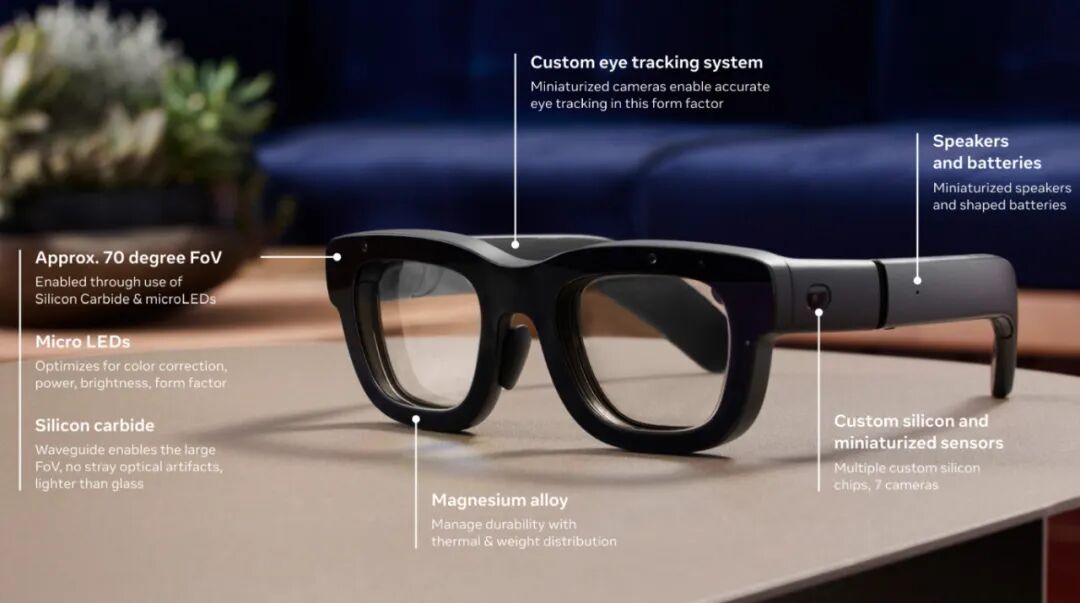
This is a detailed illustration of Meta Orion.
Meta first set a perfect high - end example with Orion, and then Ray - Ban Display continued to make precise improvements in configuration. If we look at it with the expectation of the next Apple, few people notice that Meta's stock price is currently at a low level.
Have the belated media and users noticed that the "iPhone moment" of consumer - grade AR may have already arrived?
In China, ByteDance, Alibaba, Tencent, Baidu, and even Huawei have started to take AI glasses seriously. In addition, there is a well - known company that is good at communicating with enterprises and poaching employees with several times higher salaries. It lurks in the shadows, and is particularly good at quickly gaining momentum by leveraging a much higher brand reputation. Then it uses this momentum to negotiate better prices in the supply chain to achieve extreme cost - performance.
When the tech giants enter the market and there are also some "clean - up" players, a serious market test is not far away for the once - famous "Four AR Dragons." Their stupidity lies in the fact that they may be doing MVP verification for large companies.
The company in Shenzhen in the south is taking a two - pronged approach. The X series uses an RGB three - chip Micro LED combined - color light engine, which is the same as Meta Orion's. However, it was more radical and earlier than Meta, and is paired with a single - chip full - color waveguide display. This is a very high - risk solution that few dare to try. After more than two years of iteration, it is the only company in the industry that has truly mass - produced and sold the product, with a price approaching 10,000 yuan. Although the core components of the light engine come from the supply chain, the efforts made during the mass - production process, including customizing equipment, promoting the implementation of the etching process with application materials companies, and improving the SRG waveguide display layout, are worthy of admiration.
However, the product actions of the BB solution (BirdBath) Air series of the other product line are questionable. Is it really wise to carve a small microphone on such a small temple piece? Due to the space limitation, the area of the microphone diaphragm is small, and the sound quality has a ceiling. Users who emphasize private viewing are more likely to wear a Bluetooth headset. Without actual experience, it's hard to evaluate the improvement brought by the newly added picture - quality chip. It seems more like a gimmick than a real improvement. Introducing more unique and cutting - edge innovation solutions in the lens module, fine - tuning the optical design, and achieving a balance between ergonomics and user experience are more valuable and have a more intuitive effect for users. The so - called increase or decrease of FoV and the size of the virtual screen can only deceive users.
Regarding the company in Hangzhou, although there are some rumors that are hard to verify, Misa is the most Geeky entrepreneur I've ever met. The latest waveguide glasses are still single - green. The one - to - two light engine of the Light Boat can effectively reduce costs. Compared with the previous binocular solution, the difficulty of light collimation and coupling has been significantly reduced. It seems that the waveguide layout has been adjusted later to reduce some forward light leakage. It can be directly attached to myopic lenses, and the company is trying hard to make the glasses look like normal ones.
The other product line, the BirdBath, is quite mediocre. The overall texture of the product is really good, and the appearance and structural design have some unique features for the consumer - grade market. It pays attention to the user experience in some details, and there is nothing wrong with it. However, I think the myopia adjustment function from the supply chain is a bit naive. Most myopic users also have astigmatism, and since the astigmatism cannot be corrected, they still have to clip on a myopic lens.
In my limited interactions, Misa seems to be an upright person with few underhanded tricks. He always values user feedback and tries to balance product iteration, mass - production, and cost. He also saw the limitations of hardware early on and tried to build a system and software development ecosystem, which is very forward - looking.
However, the products are still not "powerful" enough, not radical enough, and not far - reaching enough. The company's approach of using supply - chain solutions has limited "originality." Although it attaches importance to overall industrial design, detail refinement, and system and software ecosystems, it should at least create a "hardware concept machine" to amaze the outside world and expand the company's imagination space. In an industry with high uncertainty and high risks in the future, being a honest person is the biggest risk.
The company in Shanghai has a rather aloof boss. However, they make the best BirdBath glasses. They have been continuously improving the key light engine and supporting modules, and have the deepest technical reserves. Google's decision to cooperate with them for OEM demonstration is not just a marketing stunt. The latest product that impressed me the most is the X - prism. It seems to have borrowed the inspiration from Apple Vision Pro's customized multi - layer Pancake lens - an ultra - thin optical module with an extremely short folding and reflecting optical path. The new product of this Shanghai - based company has an additional folding lens (uncertain), adding an extra layer of refractive optical path, which not only reduces the module thickness but also expands the FoV, and continues to improve the suppression of stray light at the bottom of the lens.
However, this Shanghai - based company only has one product line. In the entire industry, the BB solution is obviously a transitional one, and it's difficult to break through its niche market positioning. Emphasizing the split - type design with the host and display separated and self - developed chips, achieving stable and reliable 3DoF or 6DoF, but the combination of BirdBath + AR is a bit of a deviation from the mainstream. Not pursuing the waveguide solution with flat lenses and high light transmittance means falling behind in the market.
The company in Chengdu is quite bold. The boss seems to have a strong sense of the "jianghu" and high executive ability. Their INMO Air 2 was a pioneer, but their recent products haven't left a deep impression.
The "Four Dragons" are trying different hardware solutions and testing different product routes. In this process, they are running through the supply chain, accumulating mass - production experience, and iterating products based on user feedback. They are taking all the risks themselves.
But in this vast market, the "Four Dragons" are only well - known for now. Can't later - comers copy them pixel by pixel? What is it that others really can't copy?
The cornerstones of this industry are still JBD's Micro LED or SeeYA's multi - layer Micro OLED micro - displays, as well as a series of companies that make light engines, optical modules, and waveguide lenses, and even more fundamental companies in wafer, etching, optical design, and materials. The threshold for customized algorithms DSA or SoC chips, and large - scale models at the edge or cloud side is too high for small - scale startups to reach. You can't build a real moat for your products.
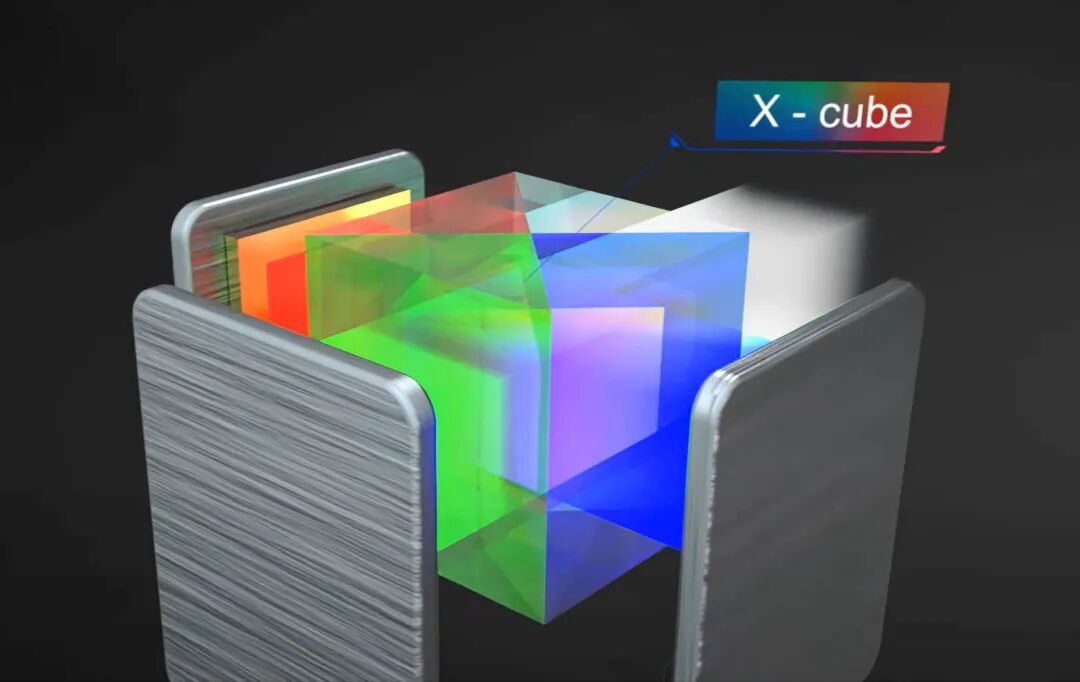
This is the RGB three - color MicroLED micro - display combined - color solution of JBD.
If you have a deep understanding of hardware and have accumulated sufficient design, manufacturing, engineering, and large - scale mass - production know - how, you will better understand how high - level the combination of algorithms, software, systems, and hardware - software integration is.
Did NVIDIA become the world's number one in the AI era by relying on its ultimate GPU architecture design and engineering accumulation? No, it comes from decades of observing algorithms and developing operators at the forefront of scientific research. By using CUDA to drive GPGPU, while the architecture is general enough, the underlying data - flow calculation is highly efficient. It leaves the complex logic control, pipeline scheduling, and corresponding hardware micro - architecture to itself, and leaves more efficient, lower - threshold, and more flexible algorithm development to coders and model developers.
Did Apple dominate the smartphone era by relying on its ultimate product experience and hardware performance? It is through the iOS ecosystem and the continuous expansion of applications that are deeply coupled with its hardware products, making them inseparable. As the shipment volume increased, it gradually started to self - develop SoC, and tried to tackle Micro LED screens, unified memory, and self - developed basebands.
In my humble opinion, whether it is consumer - grade AR or AI glasses, it may gradually become a software business and an ecological competition in the future. Spending a large amount of money on products is not as good as building a system. Focusing on the supply chain and key components is not as good as achieving hardware - software integration. It is better to gradually extend your reach to the core technologies of chips, sensors, and displays in a strategic and rhythmic way.
The essence of entrepreneurship is to find the unmined Product - Market Fit (PMF), and find a mechanism that makes users comfortable and addicted among numerous combinations and carefully designed structures.
After finding the PMF, you also need to prevent later - comers and cross - border giants. Create a unique product experience that cannot be replicated even with their