Beyond SiC? A dark horse emerges in the power device market
In the evolutionary lineage of power semiconductor materials, silicon (Si) has reached its limit, silicon carbide (SiC) is currently in the spotlight, and gallium nitride (GaN) is making inroads in the high-frequency and light-load fields. However, the industry's pursuit of better materials is endless.
At the beginning of November, Patentix Co., Ltd. of Japan announced the world's first successful growth of rutile-type germanium dioxide (r-GeO₂) bulk crystals using the FZ method, with a size of up to 5 millimeters. This tiny crystal has a bandgap as high as 4.68 eV, far exceeding that of silicon carbide (3.3 eV) and gallium nitride (3.4 eV), and theoretically can achieve both p-type and n-type doping.
This breakthrough has once again pushed the ultra-wide bandgap (UWBG) oxide material system to the forefront. With the popularization of electric vehicles (EVs), the increasing energy consumption of AI data centers, the growing demand for carbon reduction and energy conservation, and the trend of miniaturization of on-board power modules, the commercialization of ultra-wide bandgap semiconductors is highly anticipated. Oxides, such as GeO₂ and Ga₂O₃, are being regarded as important candidate materials for the next-generation power semiconductor devices with higher voltage resistance, higher power, and higher efficiency.
Germanium Dioxide: The New Dark Horse in the UWBG Race?
In the field of ultra-wide bandgap (UWBG) semiconductors, in addition to the well-known gallium oxide (Ga₂O₃), germanium dioxide (GeO₂) is rapidly emerging as a competitor for the new generation of power semiconductors.
Germanium dioxide has three main advantages as a power semiconductor: First, it is an ultra-wide bandgap semiconductor with high-power semiconductor potential; second, it is suitable for P-type and N-type doping of conventional GeO₂ MOSFETs; third, it has inexpensive bulk crystals and epitaxial layers.
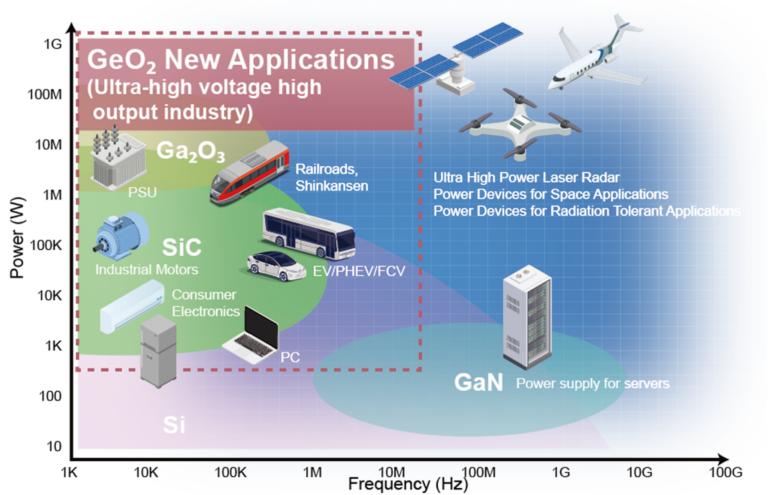
Positioning of Germanium Dioxide (Source: Patentix)
Germanium dioxide (GeO₂) has a total of five crystal structures: rutile-type, α-quartz-type, CaCl₂-type, α-PbO₂-type, and pyrite-type. The breakthrough currently achieved by the Japanese company Patentix is the rutile-type germanium dioxide (r-GeO₂), which has a huge bandgap of 4.6 eV. Theoretical predictions indicate that it has both n-type and p-type conductive properties. Therefore, it is expected to be applied in fields such as the next-generation high-performance normally-off MOSFETs.
Patentix Co., Ltd. is a startup originating from Ritsumeikan University, focusing on the research, development, manufacturing, and sales of the ultra-wide bandgap (UWBG) semiconductor material - germanium dioxide (GeO₂). Since its establishment in December 2022, the company has raised a total of 1.059 billion yen in financing.
In order to maximize the potential of r-GeO₂, it is necessary to achieve high-quality bulk substrates with minimal crystal defects. Previously, the company used the flux method to synthesize bulk crystals, with a maximum size of approximately 15x2.5x5 mm. To realize power semiconductor devices using r-GeO₂, higher-quality and larger-size bulk crystals are essential.
This time, using the r-GeO₂ bulk crystal synthesized by the traditional flux method as the seed crystal, Patentix successfully achieved the world's first growth of r-GeO₂ crystals by the FZ method. As shown in Figure 1, the black part on the left side of the crystal is the growth area by the FZ method, with a size of approximately 5 mm. Although the crystal appears black due to the doping additives, obvious crystal facets can be observed on its side, indicating a high crystal quality.
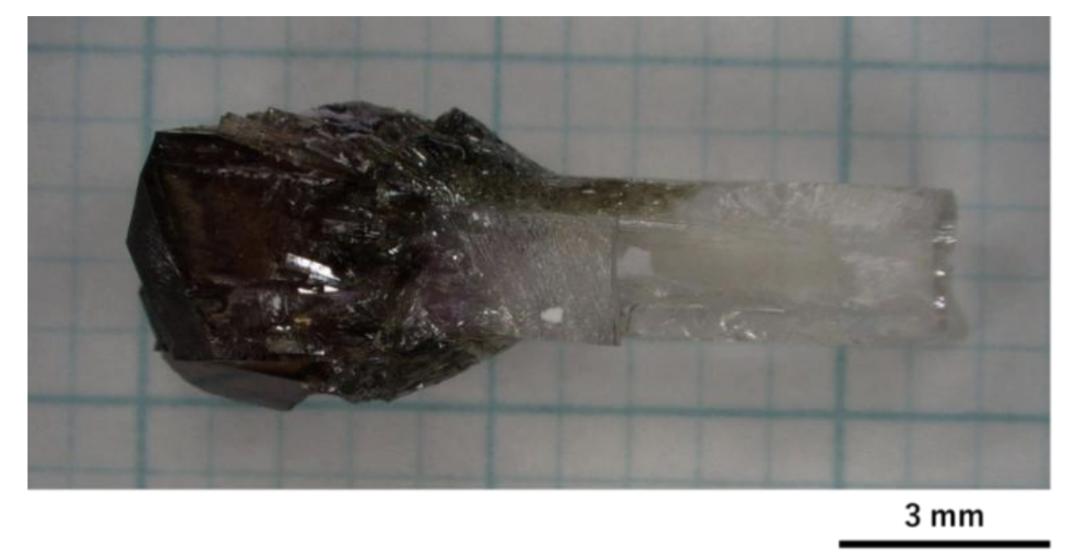
Figure 1: Photo of the r-GeO₂ bulk crystal grown by the FZ method. The black part on the left is the crystal grown by the FZ method, and the white part on the right is the seed crystal synthesized by the flux method. (Source: Patentix)
Analysis of the side crystal facets by X-ray diffraction (XRD) confirmed that they correspond to the (110) crystal plane of r-GeO₂ (see Figure 2). Further XRD testing after grinding the grown part into powder showed the crystal peaks of r-GeO₂; however, the diffraction peaks of trigonal GeO₂ were also detected, indicating that the grown crystal still contains impurity phases different from the rutile type (see Figure 3).
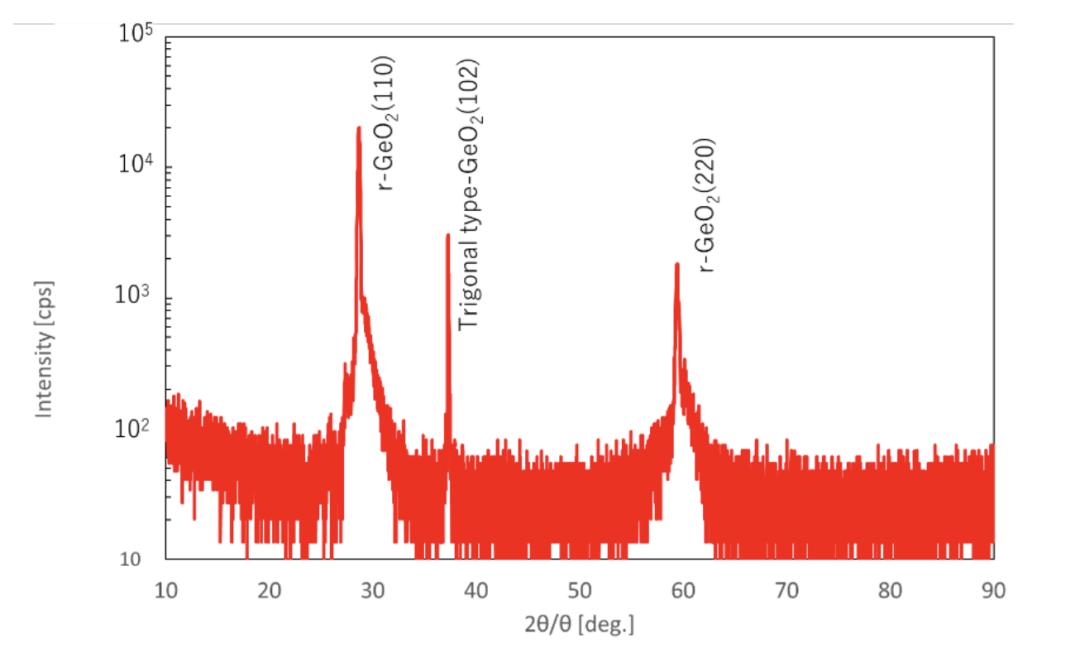
Figure 2: X-ray 2θ/θ diffraction pattern of the side crystal facets of the crystal. (Source: Patentix)
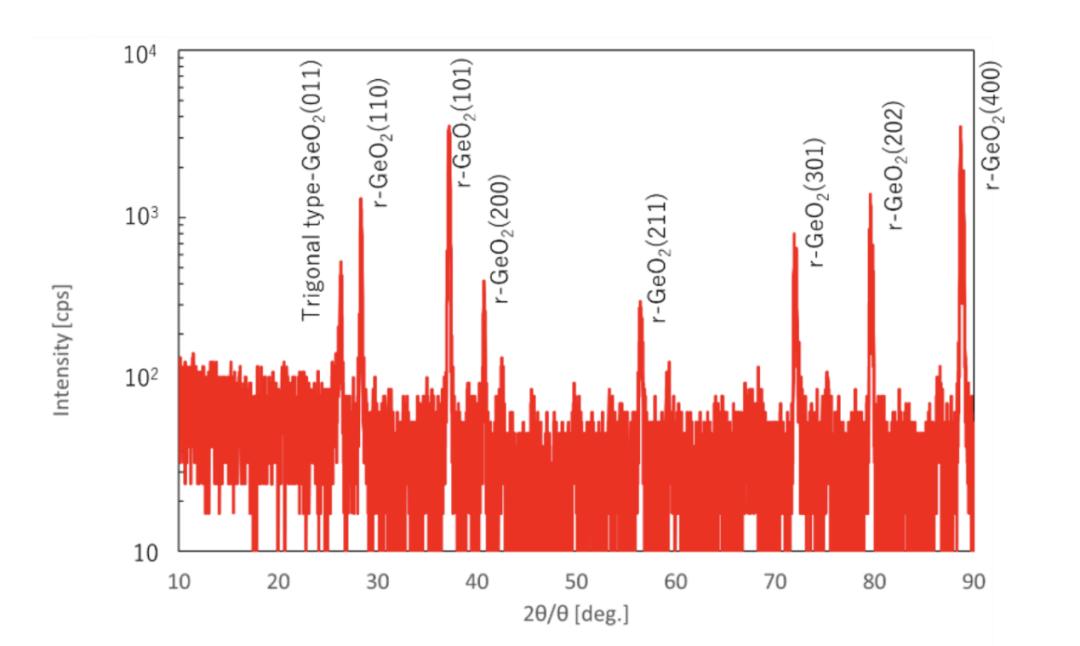
Figure 3: X-ray 2θ/θ diffraction pattern obtained after powdering the crystal. (Source: Patentix)
The company's next goal is to prepare a half-inch r-GeO₂ bulk substrate. In the longer term, it plans to combine the half-inch r-GeO₂ bulk substrate with the Minimal Fab system to develop ultra-high-performance power devices that cannot be achieved with traditional semiconductor materials.
In addition to rutile-type GeO₂, on the other hand, trigonal α-quartz-type GeO₂ has an extremely large bandgap of 6.2 eV and exhibits piezoelectricity. Therefore, it is expected to be used as a HEMT element in the next-generation Schottky barrier diodes and high-capacity, high-speed 7G communications after 6G.
Gallium Oxide, Japan Has Deep Technological Accumulation
Next, let's take a look at gallium oxide (Ga₂O₃), which has been pursued by the industry since a few years ago and is regarded as the most promising material for high-voltage power devices after SiC and GaN. It is an inorganic compound with performance far exceeding that of gallium nitride. Currently, there are up to six known crystal phases, including five stable phases such as α, β, γ, and a transient phase κ - Ga₂O₃. Among them, the β-phase (β - Ga₂O₃) is the most thermodynamically stable and most deeply studied crystal structure, and is also the protagonist of the current industrialization.
The research on β - Ga₂O₃ can be traced back to the cooperation stage between the National Institute for Materials Science (NIMS) in Tsukuba, Japan, and the Leibniz Institute for Crystal Growth in Berlin, Germany. The melting point of this material is as high as 1793°C. At high temperatures, other phases will transform into the β-type, so single crystals can only be obtained by the melt method. Thanks to its excellent thermal stability, β - Ga₂O₃ can be mass-produced by the Czochralski method similar to that of silicon wafers, and can also be grown by the edge-defined film-fed growth (EFG) method and the vertical Bridgman - Stockbarger method, showing significant industrialization potential.
This is in sharp contrast to other wide bandgap semiconductors. Except for silicon carbide (SiC), most emerging wide bandgap semiconductors lack homogeneous substrates and can only be epitaxially grown on heterogeneous materials (silicon, silicon carbide, sapphire), resulting in lattice mismatch and a large number of defects, which affect the device performance. However, Ga₂O₃ can grow self-supported without the problem of lattice mismatch.
In terms of physical properties, the bandgap of β - Ga₂O₃ is about 4.8 eV, and the breakdown electric field reaches 8 MV/cm, far exceeding that of Si (1.1 eV, 0.3 MV/cm), SiC (3.3 eV, 2.5 MV/cm), and GaN (3.4 eV, 3.3 MV/cm); the Baliga figure of merit (BFOM) is about 10 times that of SiC and 4 times that of GaN, enabling lower on-resistance and higher energy efficiency; with a narrow absorption edge (260 nm), the carrier concentration has little impact on the ultraviolet transmittance, showing unique advantages in deep ultraviolet optoelectronic devices (DUV); it also has excellent thermal and chemical stability. Relying on these properties, β - Ga₂O₃ is regarded as an ideal material for future high-voltage power devices and deep ultraviolet optoelectronic applications.
Of course, it is not perfect. The main shortcoming of β - Ga₂O₃ is its low thermal conductivity, which is about one-tenth of that of SiC, and heat tends to accumulate inside the device. How to solve the heat dissipation bottleneck has become a key issue for future industrialization breakthroughs.
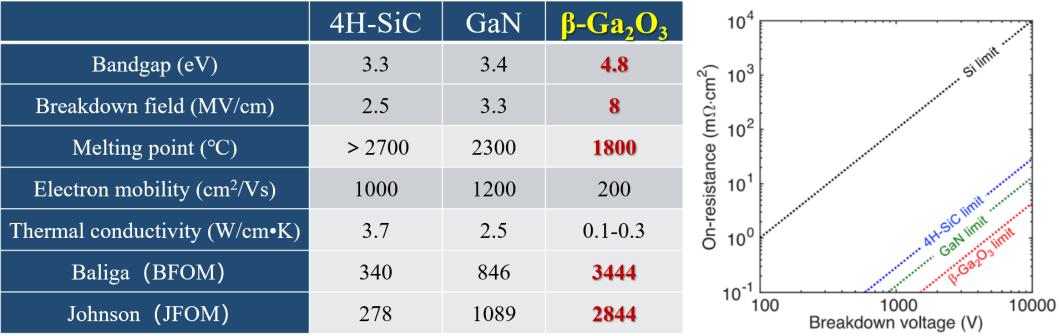
Figure 4: Physical properties and power transistor benchmark diagram of β - Ga₂O₃ (Source: Gallium Ren Semiconductor)
More commendably, gallium oxide can be doped during the epitaxial growth or ion implantation process and is compatible with standard commercial lithography and semiconductor processes. This means that it can reuse the existing wafer manufacturing technology and easily define nanoscale devices. Most wide bandgap materials do not have this advantage, and even GaN does not fully possess it.
Japan has deep accumulation in gallium oxide research. As early as 2012, Professor Masataka Higashiwaki of the National Institute of Information and Communications Technology (NICT) in Tokyo published the world's first single-crystal β - Ga₂O₃ transistor (metal - semiconductor field-effect transistor, MESFET), with a breakdown voltage exceeding 250V. It should be noted that it took nearly twenty years for GaN to reach the same level. This research first verified the great potential of β - Ga₂O₃ in high-voltage power switching devices.
The industrialization successor of this achievement is Novel Crystal Technology (NCT), which was established in 2015.
NCT is committed to the research and development of gallium oxide materials and devices and continuously refreshes the global performance records.
In April 2025, NCT announced the successful development of a vertical structure gallium oxide MOS transistor (β - Ga₂O₃ MOSFET), with a power figure of merit (PFOM) reaching 1.23 GW/cm², setting the current world record for β - Ga₂O₃ field-effect transistors. This indicator is 3.2 times higher than the highest value previously announced by other research institutions. This achievement is expected to greatly promote the development of medium and high-voltage gallium oxide transistors in the range of 0.6 - 10 kV. NCT plans to further improve the terminal structure using p-type heterogeneous semiconductor materials such as NiO to further reduce the electric field concentration at the electrode terminals. The research team's goal is to fully utilize the high breakdown field (6 - 8 MV/cm) potential of β - Ga₂O₃ to develop a new generation of high-voltage power transistors with performance exceeding that of SiC.
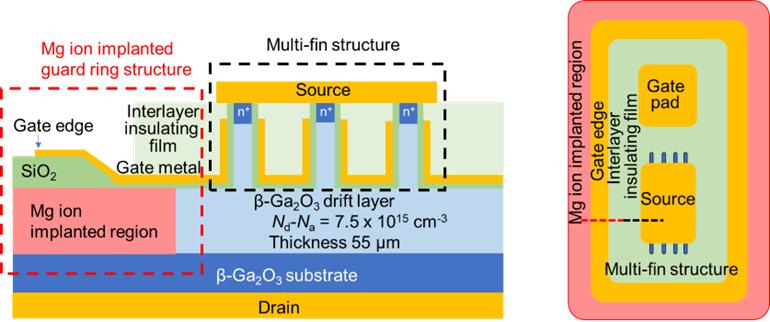
Schematic diagram of the β - Ga₂O₃ MOSFET structure (a) Cross-section (b) Top view (Source: NCT)
On August 1st this year, NCT also announced a strategic cooperation with Kyma Technologies, an American gallium oxide producer with deep accumulation in epitaxial growth technology (especially the HVPE process), to jointly develop the preparation process of 150 mm (6 inches) large-area gallium oxide epitaxial wafers for the research and development and manufacturing of multi-kilovolt power devices.
With more than a decade of research accumulation and material process advantages, the Japanese team has formed a complete technical system in the field of gallium oxide, leading the world in crystal growth, epitaxial technology, and device structure design.
Gallium Oxide: Chinese Manufacturers Lead the 8 - Inch Era
However, the domestic gallium oxide industry is not lagging behind. In the past three years, domestic enterprises have made successive breakthroughs in multiple links such as single-crystal substrates, epitaxial growth, and equipment manufacturing.
In the single-crystal substrate link at the most upstream of the gallium oxide material, the progress of Hangzhou Gallium Ren Semiconductor is particularly remarkable.
In March 2025, the company announced the launch of the world's first 8 - inch β - Ga₂O₃ single crystal, becoming the world's first enterprise to master the growth technology of this size. Gallium Ren uses the casting method independently developed by the team of Professor Yang Deren, an academician of the Chinese Academy of Sciences and from Zhejiang University, which is an innovative melt growth technology with advantages such as high efficiency, low cost, simple process, and strong scalability.
This breakthrough not only breaks the global record for the diameter of gallium oxide single crystals but also marks the company's leapfrog development from 2 inches to 8 inches in just three years, achieving "one generation per year". The 8 - inch β - Ga₂O₃ substrate is fully compatible with the existing 8 - inch silicon production line, which will greatly accelerate the industrialization process. Larger-size substrates also help improve material utilization, reduce costs, and increase manufacturing efficiency. China's first entry into the 8 - inch era of β - Ga₂O₃ has far-reaching strategic significance.
Hangzhou Gallium Ren Semiconductor was established in September 2022 and is located in Xiaoshan District, Hangzhou. Relying on the State Key Laboratory of Silicon Materials of Zhejiang University and the "Zhejiang University - Hangzhou Global Innovation and Technology Center", with Academician Yang Deren of the Chinese Academy of Sciences as the chief consultant, the company has assembled a research and production team with independent innovation capabilities. The company has pioneered a new technology for gallium oxide single-crystal growth, has more than ten international and domestic invention patents, and has broken through the monopoly and blockade of Western countries such as the United States, Germany, and Japan in gallium oxide substrate materials.
In terms of single-crystal substrates, in February 2025, Gallium Ren Semiconductor successfully prepared a 6 - inch beveled gallium oxide β - Ga₂O₃ substrate. The main crystal plane of this substrate is the (100) plane, tilted 4°68 along the [00 - 1] direction, as shown in the figure below.