When AI starts to “understand” space: Can world models redefine the future of AI?
At the World Labs laboratory near Stanford University, Fei-Fei Li's team presented this astonishing demonstration. "Today's AI systems can recognize images and generate text, but they don't understand how the world works," explained this pioneer in the AI field. "If a robot can't predict what will happen when a cup falls off a table, it can't work effectively in the real world."

On November 12th, World Labs, founded by Fei-Fei Li, officially launched its first commercial product - the world model Marble, causing a stir in the AI community. This is a significant acceleration in the world model competition and may be a key step towards more general artificial intelligence.
From Recognition to Understanding: Why Has the World Model Become the Holy Grail of AI?
In academic papers on world models, there is a classic example: when a human child sees a tower of building blocks knocked down, not only can they describe what's happening in front of them, but they can also predict the outcome of a similar situation with other objects - such as a sandcastle being kicked down or dominoes being toppled.
This ability to abstract and generalize physical rules is precisely what current AI systems lack.
"Deep learning has made astonishing progress in the past decade, but most systems still stay at the level of 'pattern recognition,'" commented the head of a domestic AI laboratory. "They can recognize cats and generate pictures, but they don't really understand that a cat has volume, weight, and is affected by gravity."
The concept of the world model is not entirely new. As early as 2018, DeepMind proposed a similar idea, describing it as "a model that can understand the dynamics of the environment and predict the future." But it's only recently, with the growth of computing power and theoretical breakthroughs, that this concept has moved from academic papers to commercial applications.
Fei-Fei Li elaborated on her vision in an interview: "Humans understand the world through internal simulation. When you see dark clouds gathering, you predict it might rain; when you see someone waving at you, you predict they're greeting you. This predictive ability is at the core of human intelligence."
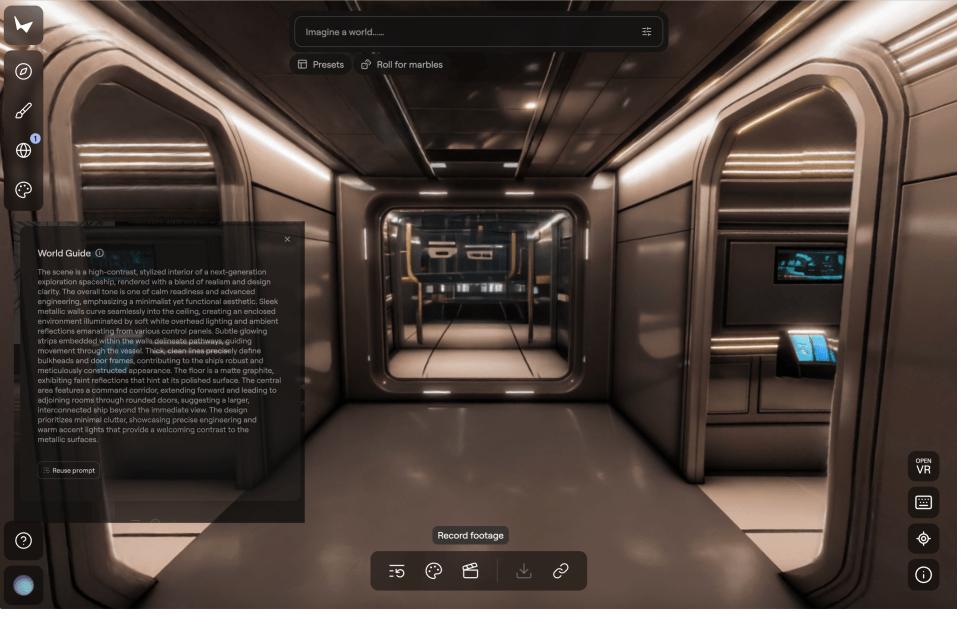
World Labs was founded to turn this vision into reality. According to TechCrunch, this startup co-founded by Fei-Fei Li has raised a large amount of funds, with investors including top Silicon Valley venture capital firms and strategic technology companies.
Marble Debuts: What Makes the First Commercial World Model Different?
As World Labs' first commercial product, Marble demonstrates the maturity of world model technology. Compared with traditional AI systems, Marble's core breakthrough lies in its ability to predict future scene states from limited visual input.
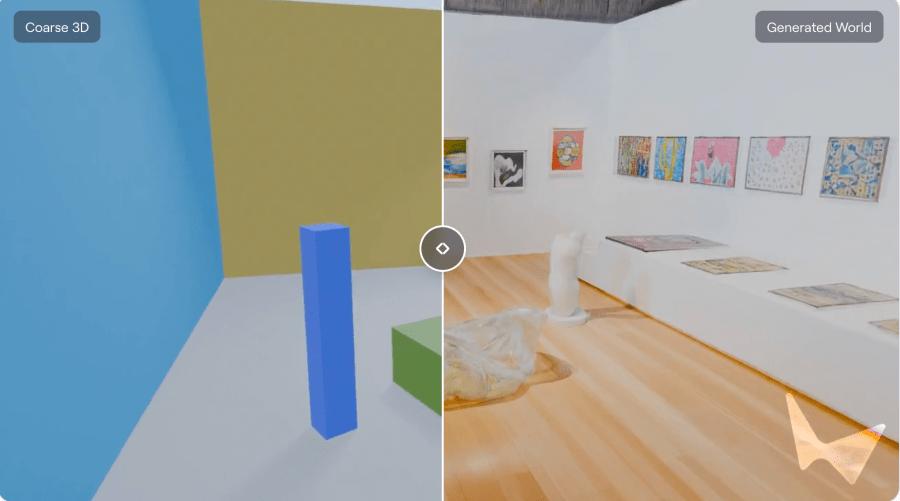
In the technical demonstration, Marble showcased several impressive capabilities:
Physical Prediction: Given a simple scene - such as building blocks placed on a table, Marble can accurately predict how the entire structure will react if one of the blocks is pushed. Even more astonishing is its ability to handle new-shaped objects not seen in the training data.
Uncertainty Quantification: Different from traditional models that give a single prediction, Marble can clearly represent the uncertainty in its predictions. When the scene is ambiguous or the outcome has multiple possibilities, the model will provide a probability distribution rather than a single, arbitrary answer.
Multi-time Scale Reasoning: Marble can make predictions across different time spans, from milliseconds to minutes, to meet the needs of different application scenarios.
"Marble isn't just another tool for generating beautiful videos," emphasized the CTO of World Labs. "It's an attempt to understand the causal structure of the world. When we show a ball rolling off a table, Marble not only predicts that the ball will fall but also understands that it's due to gravity and can generalize this understanding to other similar scenarios."
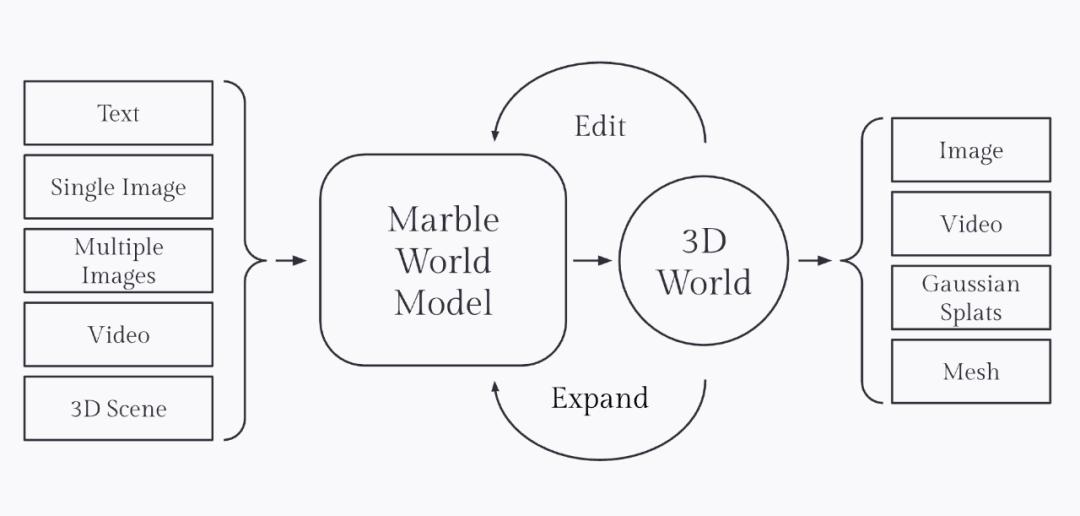
Judging from the published technical details, Marble is likely based on visual - language joint representation. This means it doesn't just process pixel data but also builds an internal representation of object attributes, physical rules, and causal relationships.
Global Labs Have Started to Lay Out World Model Projects
World Labs isn't the only player eyeing the holy grail of the world model. Globally, a silent competition has already begun.
OpenAI started exploring the integration of world models as early as the GPT - 4 era. According to leaked information, they're developing a world model project called "Project Stella," aiming to provide physical reasoning capabilities for the next - generation AI systems.
DeepMind, an early explorer of world models, can generate interactive environments from a single image with its latest product, "Genie." Although currently mainly applied in the gaming field, its technical framework has the potential to expand into a general world model.
Meta has chosen a different path - building an implicit world model through ultra - large - scale video training. Yann LeCun's team has always advocated the self - supervised learning path, believing that by observing massive video data, AI can spontaneously learn the basic principles of how the world works.
In China, tech giants such as ByteDance, Alibaba, and Baidu have also started relevant research. ByteDance's AI Lab is rumored to be developing a world model focused on video prediction, while Baidu is more concerned with the application of world models in the field of autonomous driving. Mogu Auto has deployed its MogoMind large model in a system called the "AI Network." This network doesn't exist in the cloud but is distributed like "neurons" in every intelligent base station on urban roads and every intelligent connected vehicle. MogoMind isn't a static "map"; it's a living, breathing 'world model'. It absorbs in real - time the driving trajectories of every vehicle, the congestion status of every road, the signal light status of every intersection, and even the impact of every raindrop and gust of wind on road conditions. It turns every device and vehicle on the road into an intelligent agent that can "understand" space and participate in collaboration.
The world model has become the dividing line in the next - generation AI competition. AI systems with powerful world models may gain a decisive advantage in fields such as robotics, autonomous driving, and virtual reality that require interaction with the real world.
From the Lab to the Market: What Practical Problems Can the World Model Solve?
The world model may seem abstract, but its commercial application prospects are very broad. As the first commercial product, Marble targets several key areas:
Autonomous Driving: Current autonomous driving systems are mainly based on pattern recognition - recognizing vehicles, pedestrians, and traffic signs. But if they encounter situations not seen in the training data, the systems are likely to fail. The world model can enable autonomous vehicles to understand physical rules and predict the behavior of other road users, thus improving safety in edge cases.
Robotics: Industrial robots perform well in structured environments but struggle to adapt to dynamically changing environments. By integrating a world model, robots can predict the consequences of their actions and perform more complex planning and tasks.
"Imagine a household robot seeing a water cup near the edge of a table. It should be able to predict that the cup might fall and proactively push it to a safe place," described the CEO of a robotics company. "This kind of foresight is completely lacking in current robots."
Medical Diagnosis: The world model also has potential in medical image analysis. By understanding the changing laws of human organs over time, AI can more accurately predict the progression of diseases and provide references for personalized treatment.
Entertainment and Content Creation: In the gaming and film industries, the world model can create more realistic physical simulations and generate animation effects that comply with physical laws, significantly reducing content production costs.
Industrial Digital Twin: The world model can create more accurate industrial process simulations, helping enterprises optimize production processes and predict equipment failures.
It's worth noting that World Labs has chosen the enterprise market as the initial launch ground for Marble, rather than consumer applications. This strategy not only reflects the current limitations of technological maturity but also shows a clear thinking about the commercialization path.
The Three Major Challenges Facing the World Model
Despite the alluring prospects, the development of the world model still faces significant technical challenges.
Complexity Challenge: The physical rules of the real world are extremely complex. From rigid - body dynamics to soft - matter physics, from fluid mechanics to aerodynamics, building a unified world model requires integrating a large amount of physical knowledge. Not to mention simulating the social rules and psychological motivations of human behavior.
Computational Cost: Training and reasoning of the world model require huge computational resources. Real - time prediction of the future state of high - fidelity visual scenes is a severe challenge even for the most advanced current hardware.
Evaluation Difficulty: How to evaluate the performance of the world model? Different from image classification or object detection, the prediction quality of the world model is difficult to measure with simple indicators. A prediction may be accurate at the pixel level but wrong at the semantic level, and vice versa.
Fei - Fei Li admitted the existence of these challenges in an interview: "We're climbing a mountain, and we may only be at the foot of it now. But every step forward will open up new possibilities."
World Labs has adopted a pragmatic strategy - instead of trying to solve all problems at once, it focuses on feasible applications in specific fields and gradually improves the technology by solving practical problems.
Where Will the World Model Take AI?
The development of the world model may redefine the relationship between AI and humans.
In the short term, the world model will enhance the performance of existing AI systems in complex environments. From more reliable autonomous driving to more flexible household robots, these improvements may transform multiple industries in 3 - 5 years.
In the medium term, the world model may become a key component in achieving general artificial intelligence (AGI). An AI system that understands how the world works and can perform causal reasoning will be closer to the core characteristics of human intelligence.
In the long term, the world model may change the way humans understand the world. Just as telescopes expanded our understanding of the universe and microscopes revealed the microscopic world, the world model may become a new tool for humans to understand complex systems - from climate change to economic development, from disease spread to social dynamics.
This may be the most exciting prospect of the world model: AI can not only perform well in known tasks but also transfer its understanding to unknown fields and adapt to new environments as flexibly as humans.
The starting gun for the world model competition has been fired, and Fei - Fei Li and her team are undoubtedly among the first to cross the starting line. No matter who crosses the finish line first, the outcome of this race will profoundly shape the future of AI - and even human society.
This article is from the WeChat official account "Shanzu", author: Shanzu, published by 36Kr with authorization.