So what if he was rejected by Ivy League schools? An 18-year-old genius created a hit AI and earned 200 million yuan a year.
Zach Yadegari, the co-founder of Cal AI, started learning programming at the age of 7. At 16, he sold his first app and earned nearly $100,000. He then co-founded an AI app company with another high school student, which generates an annual revenue of $30 million. After being rejected by Ivy League universities, Yadegari chose to attend the University of Miami. Yadegari believes that more young entrepreneurs will emerge in the AI era, and the most important piece of advice he gives for starting a business is to take action immediately.
At the age of 7, he participated in a programming summer camp and began to develop an interest in programming. Subsequently, he started teaching himself how to make games and apps through internet resources such as Google and YouTube.
At 16, he sold his first app and earned nearly $100,000.
After watching the movie "The Social Network" and learning about Mark Zuckerberg's entrepreneurial story, he teamed up with another high school student to develop an AI app for tracking calories, which generates an annual revenue of $30 million.
This talented young entrepreneur is Zach Yadegari, the co-founder of Cal AI.

Zach Yadegari founded Cal AI in high school.
A netizen named vas in the venture capital circle once tweeted: "To be honest, there are no entrepreneurs under the age of 15."
Yadegari, who saw this tweet, confidently retorted:
"At 13, I had a gaming website that earned me $60,000 a year."
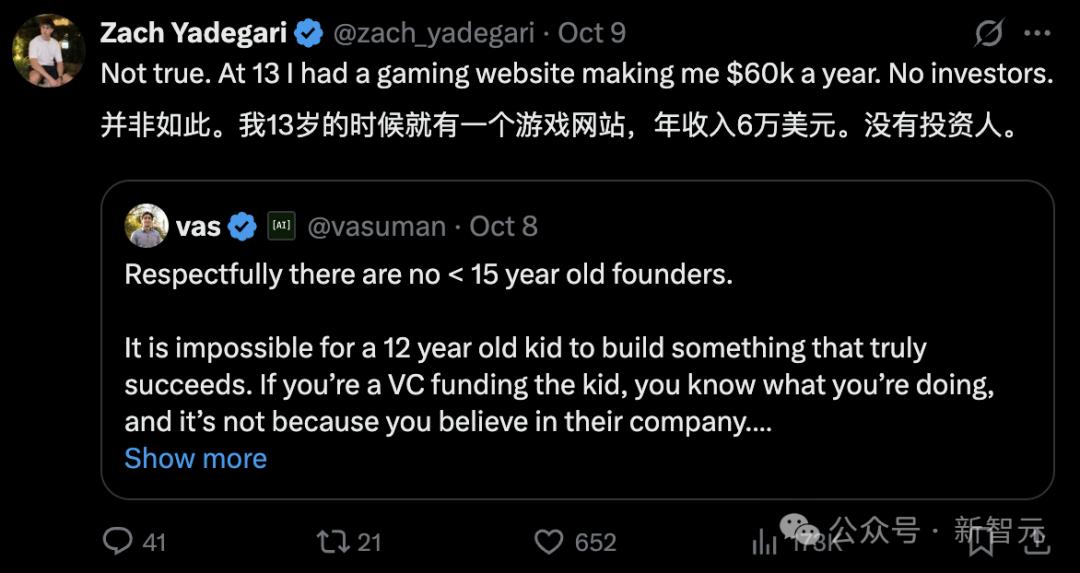
Different from those teenage programmers who grew up with "atmospheric programming", Yadegari claims that he had mastered Python and C# in junior high school and created his first app, a gaming website called "Totally Science", at around 13 years old.
At 16, Yadegari sold Totally Science to another gaming company, FreezeNova, for nearly $100,000. He used this money to co-found Cal AI with several other co-founders.
According to the official website of Cal AI, the app has received nearly 5-star reviews from 5 million users.

Cal AI has a rating of 4.8 on the Apple App Store and 4.6 on Google Play, with over 1 million downloads.


It's not hard to see that this is a very successful AI app.
Track calories with AI and earn $30 million a year
"Track calories with just one photo."
This is the slogan that Cal AI uses on its official website.
Yadegari says that every app or game he develops is to solve problems in his own life.
Cal AI is no exception.
"I was very thin when I was a kid. To gain weight, I started going to the gym, but soon realized that the real key was diet. So, my co-founder and I decided to develop an AI-powered calorie tracking app."
The motivation for starting the business might seem a bit funny. It was to make a good impression on girls.
In the summer of 2023, Yadegari recruited Henry, another co-founder of Cal AI. The two high school students started developing the app from scratch.
During this process, they actively sought guidance from several successful app entrepreneurs, one of whom was Blake Anderson, who later became a new co-founder.
Anderson is a few years older than Yadegari and has previous experience in developing apps with millions of downloads.
A few months after the product was launched, Yadegari, Henry, and others moved to San Francisco to focus on research and development and started building a team from scratch in an unfamiliar city.

The above is a photo of the founding team of Cal AI. Jake Castillo is at the bottom right, Blake Anderson is at the top right, Henry Langmack is at the top left, and Zach Yadegari is at the bottom left.
Yadegari described the division of labor among the founding team members on the X platform:
He has always been the CEO of Cal AI, Henry is the CTO, and he, Henry, and Blake developed the app together. At that time, Blake was developing Umax, so he was part-time responsible for the communication strategy.

They collaborated with some influencers to shoot videos. Under this promotion strategy, the new app achieved an unexpectedly high growth rate.
Yadegari quickly realized the extraordinary opportunity and bet all his "assets" on it. The Cal AI app took off rapidly and has now grown into a company with a 30-person team and an annual revenue of about $30 million.
During this process, Yadegari and the founding team began to realize that the product they developed was not just a short-term hit but could also become a continuously expanding business.
Now, Yadegari often sees people around him showing Cal AI on their phones, which brings him unparalleled pride.
Start learning programming at 7 and become self-taught through YouTube
When Yadegari was 7 years old, his parents sent him to a programming summer camp, which was his first exposure to programming.
Although he didn't learn much during that summer camp, it successfully sparked his interest in programming and opened a new world for him.
Subsequently, Yadegari taught himself through YouTube.
He would spend several hours every day watching videos to learn how others wrote games, then try to replicate them and make modifications. This process benefited him a lot.
A turning point came from the movie "The Social Network".

This movie, based on the story of Mark Zuckerberg founding Facebook (the predecessor of Meta), gave Yadegari the greatest inspiration for starting a business and enabled him to make a major leap from "making games" to "making products".
Perhaps from this moment on, he began to grow from a tech geek into an entrepreneur determined to build successful products.
A natural entrepreneur who is willing to be "delayed" by going to college
Yadegari seems to be a natural entrepreneur.
He thinks he is not a very special child. He has good grades and has his own social life like everyone else.
The only difference is:
After school every day, he would spend several hours working on various projects. Even in class, he often came up with new ideas.
He seems to have an innate interest in starting a business, rather than just passively following the fixed path arranged by parents and society like most children.
When founding Cal AI, Yadegari worked with entrepreneurs in their twenties or thirties all day long, but he always had a "college dream" in his heart.
What would life be like if he went to college?
He felt that deep down he wanted to go to college rather than become a typical Silicon Valley dropout.
Although he had a rich entrepreneurial background, a perfect GPA, and an ACT score of 34 (close to the full score), Yadegari still received rejection letters from more than a dozen well-known schools, including Ivy League universities. Even Stanford University, known as the "entrepreneurial mecca", did not admit him.
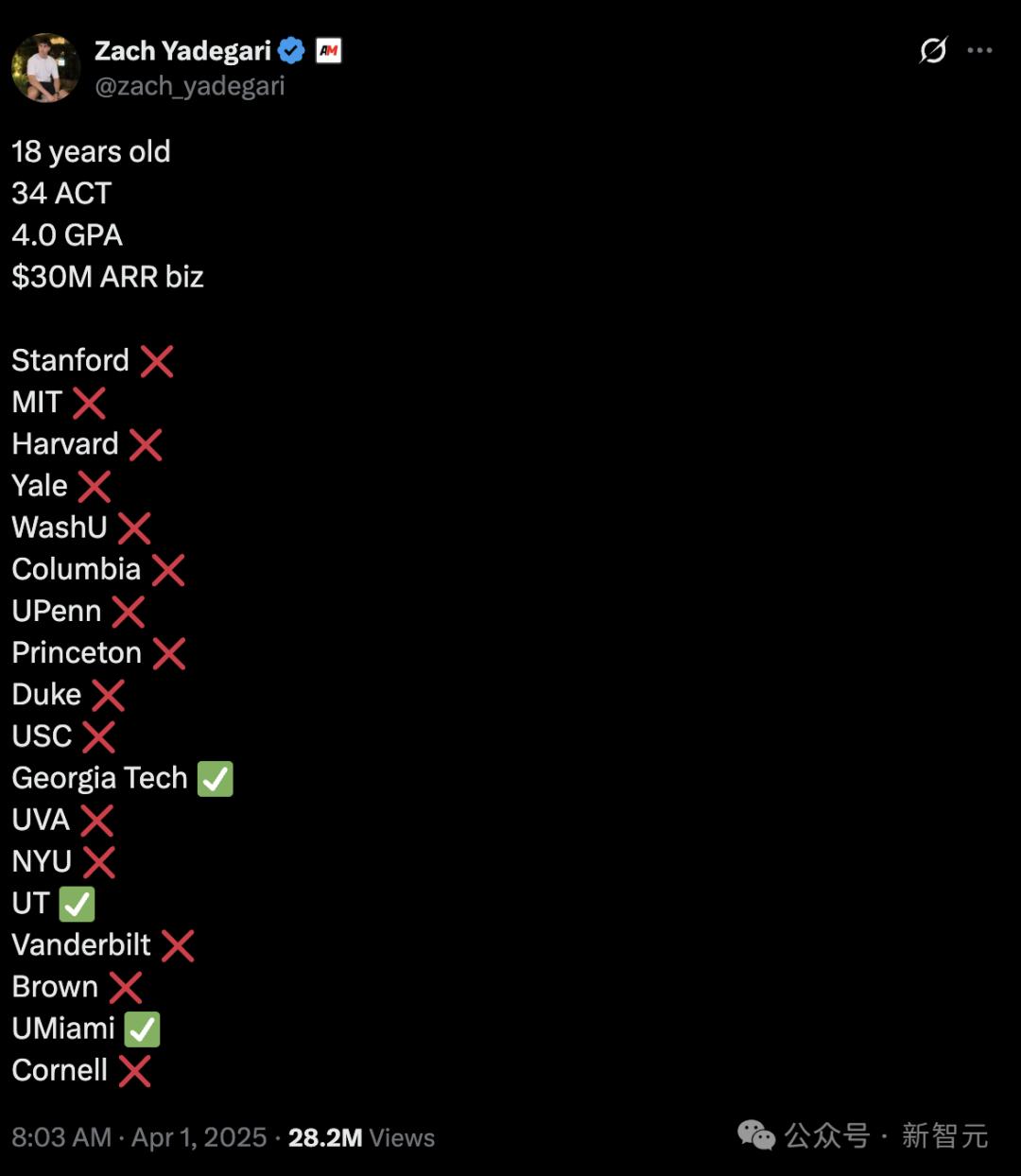
Yadegari's proud entrepreneurial experience was ignored by top universities. Finally, the Georgia Institute of Technology, the University of Miami, and the University of Texas admitted him.
Yadegari chose the University of Miami not for its academic reputation but for its social atmosphere.
If he couldn't get into the academically best university, he would try to go to the university with the best social atmosphere.
From this, we can see Yadegari's personal decision-making style.
Some netizens questioned Yadegari, thinking that going to college was a waste of time, and there are many stories of college students dropping out to start businesses in Silicon Valley.

But Yadegari was straightforward. His main purpose of going to college was to build connections. "It's a temporary trade-off to integrate into the social circle."
In Yadegari's view, socializing takes up the most time in college, and his evaluation of it is "although it's fun, it's not very productive."
Although most people think his approach is not worth it, Yadegari seems to value more the life experience and emotional value that going to college brings him: "I'm having a great time, and I think it's worth it for me... It will be worth it to create memories."
But he also said that he would stop once it became unworthy.
Now is the best time to start a business
After enrolling at the University of Miami, Yadegari still takes care of Cal AI in his spare time but no longer needs to be involved in daily affairs.
He says the company has established a perfect process, and he is mainly responsible for setting the vision and direction.
Now, finding like-minded people has become Yadegari's biggest challenge. Having experienced several entrepreneurial ventures, he is much more mature than his peers.
He is not very willing to talk about courses and would rather talk about real-world problems, solutions, business models, etc., which are often not of interest to people of his age.
Yadegari believes that it is easier to start a business now than ever before.
Not long ago, Altman, the founder and CEO of OpenAI, also expressed a similar view at OpenAI's DevDay:
"I envy today's 20-year-old dropouts because they can create so much now. The opportunities in the AI field are very broad."
Altman dropped out of Stanford University at a similar age to Yadegari to found Loopt and later led Y Combinator and OpenAI.

Sam Altman, the founder and CEO of OpenAI
"The increasingly young entrepreneurs in the news are not a coincidence," Yadegari believes that successful entrepreneurial stories will tend to be about younger people.

"There is no perfect time to start a business. It's just about whether you're willing to take the first step."
Start early and be brave enough to take action. Ignore the noise and don't believe those who say you're too young to succeed. Don't let others plan your life for you!
This is the first rule of entrepreneurship that Yadegari recommends for beginners.
References
https://techcrunch.com/2025/03/16/photo-cal