I, the founder of the AI, have gone to Shenzhen.
This is a rare scene —
On November 6th, a group of AI experts gathered in Nanshan, Shenzhen. This was the live pitching event for AI innovation talents at the X-Day Xili Lake Roadshow Club. Six companies focusing on the core areas of artificial intelligence took the stage one by one. Most of their core teams have backgrounds from top universities and practical experience at global industry giants, and their founders are highly accomplished.
This event was also part of the series of activities for the "Third Anniversary of Shenzhen Venture Capital Day: The AI Era".
In the AI era, the speed of industrial transformation is unprecedented. One or two top talents can be worth thousands of troops. These teams focusing on "top universities, elite classes, major competitions, and industry experts" form a part of the wave of AI entrepreneurship in China.
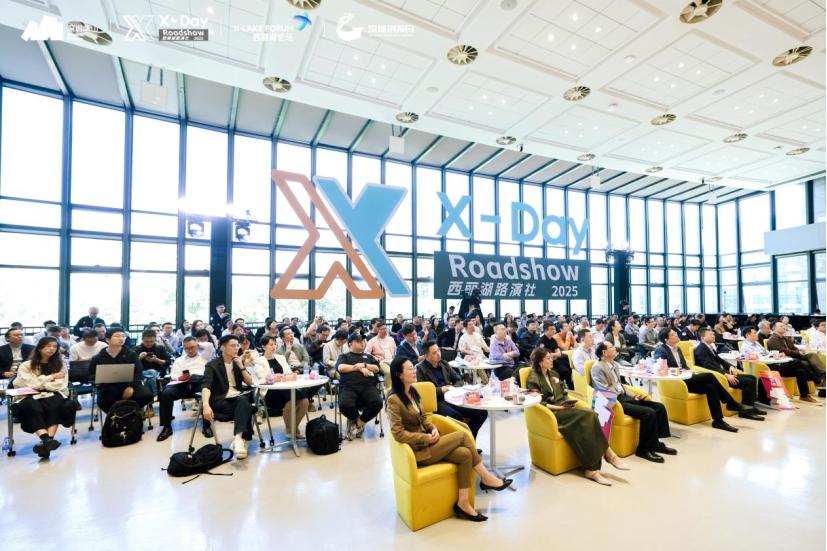
A Group of AI Founders Have Arrived Here
Before the emergence of Gongji Computing Power, "shared computing power" was not new, but co-founder Huang Li'ang brought a new breakthrough. Founded in 2023, Gongji Computing Power is led by a post-00s doctoral student, Fu Zhi, and is a Tsinghua University startup team.
Initially, several Tsinghua students built an in-school shared computing power network due to insufficient computing power in their research. In 2024, with the explosion of AI, the computing power platform started to expand beyond Tsinghua and gradually developed into a company focusing on the integrated scheduling of "computing power + energy". Now, it has received financing from several institutions such as Miracle Plus, Shuimu Venture Capital, and Xinjin Investment.
Another computing power team also has an impressive background. It has successfully advanced through multiple pitching competitions and made it into the top 10 in the entire Greater China region. At the much-anticipated Huang Renxun meet-up at the beginning of the year, Shenchong Intelligence founder Huang Kecheng was one of the three post-90s attendees.
Inspired by the entrepreneurial idea of two high school classmates hitting it off, they quickly assembled a team from prestigious universities such as MIT, Tsinghua, and Peking University, as well as leading companies like Tencent, Alibaba, Google, and NVIDIA. Now, over 90% of the company's employees have master's or doctoral degrees. The self-developed Emerging AI Digital Intelligence Management Platform has achieved independent and controllable software-hardware integrated private deployment and delivery.
Also from Tsinghua, 95-post Li Jiaxiang led a team of master's and doctoral students to establish Evolution Intelligence. This is an AI creative supply chain company that enters the trendy toy field with artificial intelligence. The AI creative model DesignGPT™ developed by the team can shorten the 30-day design cycle to 2 hours, empowering more than 100 enterprises, and its products have entered the markets of 12 countries around the world.
Currently, Evolution Intelligence has completed multiple rounds of financing, and its valuation has reached hundreds of millions of yuan. "The spotlight on Tsinghua students is a form of motivation. We hope to ride this new wave," said Li Jiaxiang.
Wang Jue, the co-founder and COO of Shiyuan Technology, is the only female on the stage. Behind her is a post-90s team with backgrounds from Tsinghua and SenseTime. The founder, Ji Cong, was an early employee of SenseTime, and there is also "Huawei's Genius Youth" and Oxford AI doctoral student Ru Binxin on the team.
Since its establishment in 2022, Shiyuan Technology has attracted a group of investors including Shenzhen Capital Group, QingSong Fund, Songhe Capital, Yunbai Capital, and Xuhui Science and Technology Innovation Investment. The team now has more than 100 people. "Extremely smart, extremely competitive, and extremely responsible," said Wang Jue. "This is a long road that most researchers are not willing to take."
Kouding Intelligence is led by Su Wen from Tsinghua University. The team is mainly composed of post-90s, and the core members are from well-known universities and companies such as Tsinghua, Microsoft, Baidu, Tencent, ByteDance, and Huawei. Its self-developed PLE model is the only platform that can generate front-end + back-end + database services end-to-end.
"In market competition, being mediocre is the original sin. The industry is bustling, but we focus more on our own business. After the bubble fades in a few years, let's see who remains," said Su Wen straightforwardly.
Yuanshi Intelligence was founded by two post-80s Hunan natives. Co-founder and CEO Luo Xuan introduced that his friend Peng Bo started learning programming at the age of 6. After graduating from university, he joined the world's largest foreign exchange hedge fund and rejected an offer from OpenAI in early 2023. Luo Xuan has worked in internet giants such as Tencent, Kingsoft, and Alibaba. He then returned to Shenzhen from Hangzhou, and Yuanshi Intelligence was established in 2022.
Currently, the self-developed RWKV architecture of Yuanshi Intelligence has become one of the most widely used open-source models, breaking the architectural monopoly of Google's Transformer. "Regardless of background or origin, this is the concept of our team and also what attracts us most about Shenzhen," said Luo Xuan.
This AI innovation talent special session was the 9th event held by the X-Day Xili Lake Roadshow Club. These young teams from top universities and leading companies together form a portrait of AI entrepreneurs.
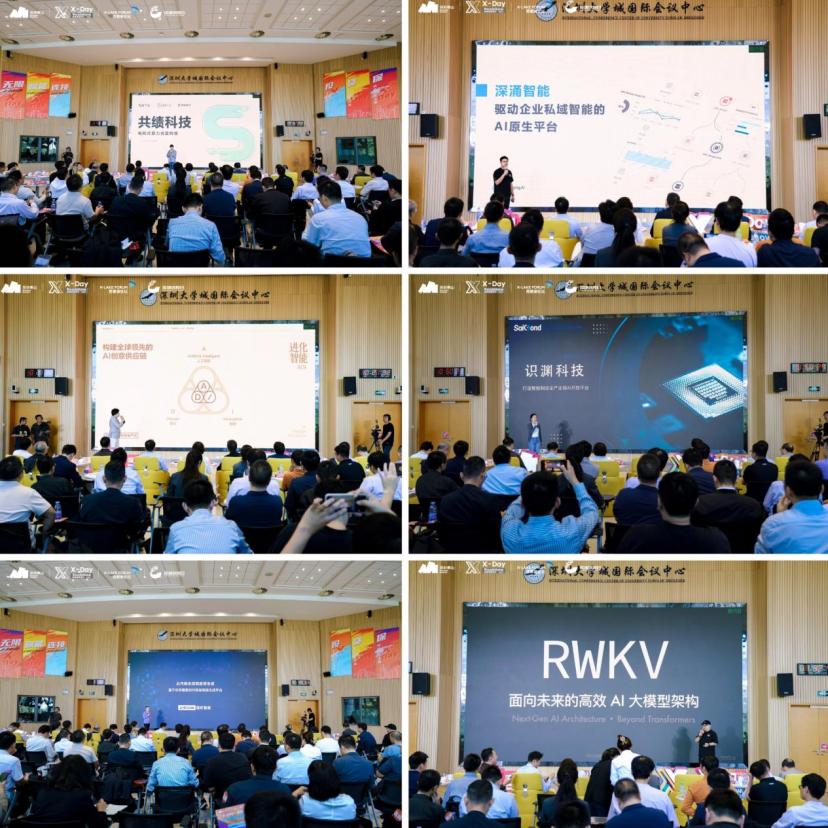
Shenzhen Launches the AI Talent War
The AI battle is ultimately a battle for talent.
Looking back at the industrial revolutions that have changed the world, the movement of highly talented individuals has never caused such waves as it does today. From Mate offering hundreds of millions of dollars in sky-high salaries for the "genius list" to domestic companies frequently launching million-dollar option incentives, the competition for AI talent is becoming increasingly fierce.
According to industry estimates, the current shortage of AI talent in China has reached the million level, with a serious imbalance between supply and demand. In this wave of the AI talent war, post-90s and post-00s with top university and industry backgrounds are gradually becoming the mainstream.
"Most of the teams in the AI and robotics fields we see now are young teams," Lin Wenbin, a partner at Guoke Jiahe, told the investment community. "The adaptability of these young people to industrial iteration and their entrepreneurial enthusiasm regardless of personal gain or loss are astonishing."
Against this background, major cities are sparing no effort to attract young entrepreneurs. The X-Day Xili Lake Roadshow Club event in Nanshan, Shenzhen, targeted "top universities, elite classes, major competitions, and industry experts" and launched a special session for AI innovation talents.
Coinciding with the opening of Shenzhen's ninth "Talent Day" and the official opening of the "Hundred Schools Street · Alumni Hall", the event also specially set up a "talent recruitment area". It simultaneously carried out talent recruitment for the pitching companies and the registration for the "X-Day" intern program, helping innovative enterprises accurately connect with high-end talents, achieving a dual-wheel drive of "financing" and "talent acquisition", and further releasing the ecological connection value of the platform.
Currently, the X-Day Xili Lake Roadshow Club has built a mature talent and project cultivation ecosystem: It has attracted a total of 214 high-quality financing projects to apply, collaborated with more than 180 investment and financial institutions, connected more than 2,200 investment institutions for 112 enterprises, promoted 17 enterprises to obtain more than 500 million yuan in equity financing, 6 enterprises to obtain more than 100 million yuan in bank credit, implemented two technology insurance policies, and provided 5.5 million yuan in product guarantees.
In addition, in combination with Shenzhen's construction of a "five-no-worries" talent environment, the X-Day Xili Lake Roadshow Club also proposed to give priority to matching core project talents with resources such as affordable housing and children's education, so that talents can "come in, live comfortably, stay, and succeed" in Nanshan.
Shenzhen has always gone all out to attract talents. A "Ranking of Chinese Cities in Terms of Attractiveness to Post-95s Talents" shows that post-95s talents tend to go to the eastern regions, especially the Yangtze River Delta and Pearl River Delta city clusters. Among them, Shenzhen has ranked first for two consecutive years, becoming the city with the largest influx of young people.
"Hard work and vitality are my first impressions of this city," said Huang Kecheng, co-founder and CEO of Shenchong Intelligence, who had traveled between different cities before finally deciding to set up the company in Shenzhen. "Here, people can focus on what they do, and the degree of focus may be 1.5 times that of other cities."
Not restricted by geography, background, or ownership, the characteristics of this city attract wave after wave of young people. It is these individuals who are changing the direction of the industrial tide. Thinking of Huang Renxun's recent statement: If you ask me who will win the generative AI competition in the next 5 - 10 years —
"China will win. It's that simple."
This article is from the WeChat official account "Investment Community" (ID: pedaily2012), author: Yang Wenjing, published by 36Kr with authorization.