A unicorn with 100 billion computing power goes public, and state-owned assets in Henan make huge profits.
On September 13, 2021, Huawei registered and established Super Fusion, taking over all the technologies, products, and core teams of Huawei's original X86 server business. Liu Hongyun, the founder of Super Fusion, had led Huawei's server business for many years, and the core team he led almost completely retained the R & D strength of Huawei's X86 servers.
At that time, X86 servers were products based on the Intel architecture. Due to sanctions, Huawei was no longer able to legally obtain authorization for American chips and software. If the department was not spun off, the team of thousands of people would have nothing to work with, and the businesses of customers who had deployed Huawei's X86 servers would also come to a standstill.
Facing the disruption of chip and software authorization caused by US technology blockade, two months later, Huawei "cut off its wrist like a brave warrior" and completed the equity transfer of Super Fusion. All the equity of Super Fusion was taken over by Henan Chaojuneng Technology, a subsidiary of Yuxin Electric Technology under Henan State - owned Assets. Huawei completely withdrew, and Super Fusion regained its new life in the storm by operating independently and avoiding overseas sanctions.
After settling in Zhengzhou, with the full support of the local government, Super Fusion accelerated its implementation. It only took 55 days from the equity transfer to the mass - production of the first server. In the early stage, it introduced national - level capital such as the China Internet Investment Fund, and with the resource tilt and strategic investment from operators like China Mobile and China Telecom, its business exploded rapidly. In 2024, Super Fusion's revenue reached 43.5 billion yuan, ranking second in the Chinese server market and sixth globally. Among them, its market share of AI servers ranked first in the industry.
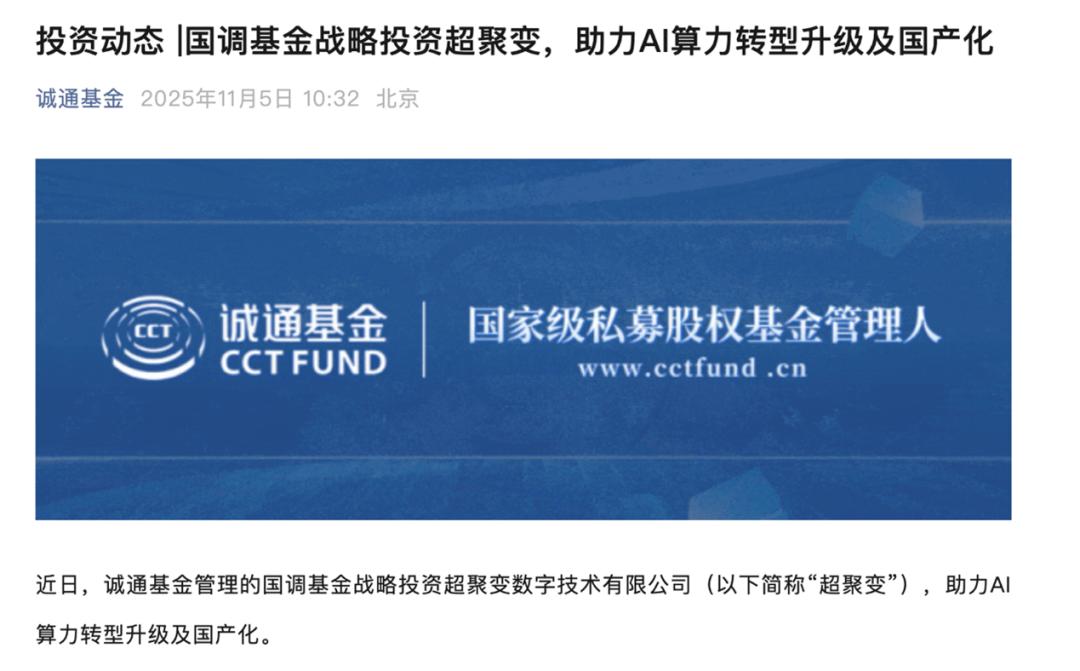
This computing power unicorn, reborn from the "fission" of Huawei, is accelerating into the fast lane of capital. Recently, the National Structural Adjustment Fund, managed by Chengtong Fund under China Chengtong, announced a strategic investment in Super Fusion Digital Technology Co., Ltd., injecting strong impetus into this flagship of AI infrastructure again.
Meanwhile, Super Fusion is planning to list on the A - share market by back - door listing through Rongke Technology. The relevant industrial and commercial changes have entered the review process of the China Securities Regulatory Commission, and it is expected to be completed as early as the end of 2025. If everything goes smoothly, Super Fusion may become the "first stock of central China's computing power".
A Computing Power Giant Inheriting Huawei's Legacy
Super Fusion's rapid comeback in a short period is closely related to its profound technological accumulation and rich product matrix.
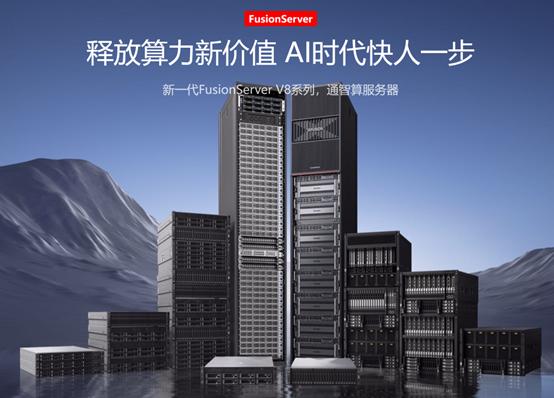
As the original team of Huawei's X86 server department, Super Fusion almost completely took over the core assets and R & D teams in Huawei's server field. The company's product lineup continues the technological heritage of Huawei's FusionServer series and KunLun series, and is subdivided into three main directions: general - purpose servers, artificial intelligence servers, and key business servers.
In Super Fusion's business, general - purpose servers meet the basic needs of enterprises such as daily data processing and office collaboration, and are the standard configuration for digital offices. AI servers are equipped with high - computing - power accelerator cards and are specifically designed to support intensive computing scenarios such as large - model training, intelligent recommendation, and iterative algorithms for autonomous driving. Key business servers focus on fields with extremely high requirements for stability and security, such as financial transactions, telecommunications billing, and government core systems, and need to have the ability to operate without failure for 7x24 hours. After divesting its X86 business, Huawei concentrated its resources on independent technology routes such as ARM - architecture Kunpeng servers and Ascend AI chips, forming a complementary layout in the computing power field with Super Fusion.
Not only are the hardware specifications consistent with those of the Huawei era, but Super Fusion has also launched its self - developed server operating system, FusionOS, based on the openEuler open - source community, achieving collaborative support for multiple architectures such as X86, ARM, and MIPS. In other words, from the perspective of customers, Super Fusion still provides an authentic "Huawei - style" computing power solution, just under a new brand.
Behind the product continuity is the continuity of technological advantages. Super Fusion has inherited the R & D accumulation of the original Huawei team in the high - end computing field over the years, including full - stack optimization capabilities in CPU, motherboard, heat dissipation, and power management. Take the liquid - cooling heat dissipation technology as an example. Super Fusion continues to use Huawei's fifth - generation 100% native liquid - cooling solution for temperature control in intensive AI computing scenarios, which is second to none in the industry.
At this year's World Artificial Intelligence Conference, the world's first plug - and - play super - cluster for multi - dimensional intelligent computing exhibited by the company attracted wide attention: a single cabinet integrates 128 AI accelerator cards, and through advanced liquid - cooling technology, it can maximize the power consumption of each card while still maintaining stability. In addition, Super Fusion also continues Huawei's advantages in the key computing field. Its KunLun large - scale models have a high - reliability reputation in key industries such as finance and telecommunications. These hardcore technological strengths make Super Fusion, although a "new company", comparable in product strength to established giants.
Source: Chaojuneng official website
Thanks to its complete product line and leading technology, Super Fusion has made rapid progress in the market in recent years. In 2022, the company achieved an output value of 23.51 billion yuan and shipped 406,000 servers. In 2023, its revenue increased to 28.38 billion yuan. In 2024, it directly exceeded the 40 - billion - yuan mark, and its market share was second only to Inspur Information, making it the second - largest server manufacturer in China. Especially in the emerging liquid - cooled server market segment, Super Fusion has ranked first in China for two consecutive years. According to the IDC report, Super Fusion currently ranks sixth in the global server market share.
In the era when large AI models drive the explosion of "computing power infrastructure", this computing power giant born from Huawei is accelerating at an impressive pace. However, the current server manufacturing industry is highly competitive, and manufacturers are engaged in price wars to seize market share, resulting in generally low profit margins. In 2023, the gross profit margin of Inspur's server business, Super Fusion's biggest competitor, dropped to 4.5%, and companies like Tsinghua Unigroup and Ruijie Networks also showed a downward trend in gross profit. While Super Fusion is growing rapidly, how to improve its profitability will be a question it must answer before going public.
Financing, Valuation, and Listing Process
Super Fusion's rapid growth has naturally attracted high attention from the capital market.
Since its spin - off from Huawei, the company has carried out multiple rounds of financing, and the shareholders it has introduced are almost all from the powerful "national team". According to statistics, from the end of 2021 to the beginning of 2023, seven strategic investment institutions successively injected capital into Super Fusion, including CMIC Capital under China Mobile, China Telecom Group Investment Co., Ltd., China Internet Investment Fund, China Insurance Investment Fund, state - owned bank - affiliated funds, direct investment of securities companies, and insurance asset management companies.
This series of financing has increased the number of Super Fusion's shareholders to more than 20, but Henan Chaojuneng, a provincial - level enterprise in Henan, still firmly controls more than 67% of the shares, making it the largest shareholder of the company and having absolute controlling rights over Super Fusion.
After several rounds of financing, the market's valuation of Super Fusion has soared. There is currently no officially disclosed accurate valuation data, but based on the predictions of multiple institutions, Super Fusion's valuation has reached the range of 80 - 100 billion yuan. Calculated based on the 43.5 - billion - yuan revenue in 2024, this is equivalent to a PS (price - to - sales ratio) of about 2 times, which is not outrageous against the backdrop of the booming AI computing power industry. It should be noted that the valuation of Honor Terminal, also spun off from Huawei, is said to reach 170 billion yuan, and overseas companies mainly engaged in AI computing power often have a PS valuation of dozens of times. In comparison, Super Fusion's valuation as a hardware manufacturer is still relatively "pragmatic". Of course, how the market will ultimately price it depends on its listing path and the company's growth potential.
Regarding the listing method, Super Fusion is currently highly expected to list through back - door listing.
The Henan State - owned Assets Supervision and Administration Commission promised at the beginning of the acquisition in 2021 to list Super Fusion as soon as possible. In 2025, this process has significantly accelerated: Super Fusion has posted multiple positions for "financial experts (listing operations)" on recruitment websites.
There are also signs that the company launched an equity incentive plan for core employees in September, obviously preparing for interest binding before the IPO.
At the end of October, people close to the company confirmed to the media that Super Fusion was preparing for listing. For a while, all the stocks related to it in the A - share market (such as Rongke Technology, Oriental Pearl, Palm Co., Ltd., etc.) soared.
Why does Super Fusion prefer back - door listing rather than queuing for an IPO? The main reason is the tight schedule. As an enterprise controlled by a provincial - level state - owned enterprise in Henan, Super Fusion undertakes the task of increasing the securitization rate of state - owned assets in Henan (to be detailed later). Through back - door listing, it can bypass the long queuing and review process of an IPO and quickly achieve the listing goal.
Of course, back - door listing also has many challenges: selection of suitable shell resources, negotiation of restructuring prices, regulatory approval, and subsequent business integration. According to people familiar with the matter, Henan has long selected a group of provincial - level listed companies as potential shell resources for Super Fusion, including Palm Co., Ltd., Rongke Technology, Chengfa Environment, and Ancai Hi - tech. Most of these companies have a relatively small market value, and their major shareholders are Henan state - owned assets, which facilitates operations. However, Super Fusion must also avoid choosing shells with too high a market value or price - to - book ratio to prevent excessive equity dilution during restructuring and great difficulty in market expectation management.
Currently, Rongke Technology is considered the most likely candidate for Super Fusion's back - door listing. The controlling shareholder of Rongke Technology is a fund under Henan Information Industry Investment Group. After tracing the equity, Henan Information Industry Group (i.e., "Yuxin Electric Technology") is one of the investors in Henan Chaojuneng, the major shareholder of Super Fusion. In other words, both Rongke and Super Fusion have the same "backer".
In April this year, Rongke Technology suddenly terminated an asset acquisition and restructuring, triggering market speculation that it was making room for the injection of Super Fusion. In August, Henan Information Industry Group also commissioned an institution to evaluate the net assets and goodwill of Rongke Technology in preparation for asset injection. All these signs indicate that Rongke Technology is very likely to become the listing vehicle for Super Fusion.
Once the relevant plan is finalized and approved by the regulators, Super Fusion is expected to quickly list on the Growth Enterprise Market and achieve the "final step" of capitalization.
Henan's Ambition and Super Fusion's Mission
As the new owner of Super Fusion, the Henan provincial government has poured all its efforts into this computing power unicorn.
On the one hand, from capital operation to industrial support, Henan regards Super Fusion as the "No. 1 project" of the province's digital economy. On the other hand, the mission of Super Fusion is not limited to the company's own growth but is also related to the grand chessboard of Henan's new - round state - owned enterprise reform and industrial upgrading.
The Henan State - owned Assets Supervision and Administration Commission controls Henan Yushang Xinlian Enterprise Management Consulting Center (Limited Partnership) through Yuxin Electronic Technology Group (holding 66.04% of the shares), which in turn holds 80% of the shares of Henan Chaojuneng Technology Co., Ltd., and Henan Chaojuneng directly holds 67.01% of the shares of Super Fusion.
Henan Information Industry Investment Group is a platform company specifically established by Henan Province to layout the electronic information and high - tech industries. It was established by the provincial government through the integration of multiple units in 2018, aiming to "develop the information industry with the strength of the whole province". Super Fusion is the largest - scale and most influential project invested by Yuxin Electric Technology in recent years. The director of the provincial state - owned assets supervision and administration commission has listed Super Fusion as the core measure for Henan to develop the digital industry on multiple occasions, requiring the group to "serve Super Fusion's listing and development with all its strength".
To promote Super Fusion's smooth listing and growth, Henan state - owned assets uses a "combined approach" in the equity structure design. In addition to pre - arranging potential shell companies, it also introduces external strategic capital through the establishment of special funds to achieve indirect shareholding and reduce the pressure of dilution.
From September to October 2025, Zhengzhou Airport Economic Zone successively launched the first - phase advanced computing fund worth 511 million yuan and the second - phase fund worth 714 million yuan, specifically to acquire the old shares of Super Fusion. Oriental Pearl under Shanghai state - owned assets invested nearly 500 million yuan in total for indirect shareholding. The two - phase funds are expected to acquire about 7.4% - 8.4% of the equity of Super Fusion, which not only introduces strategic investment but also avoids excessive direct equity dilution of Henan state - owned assets.
On November 5, 2025, the National Structural Adjustment Fund managed by Chengtong Fund announced a strategic investment in Super Fusion. This national - level investment platform, jointly funded by the Ministry of Finance and central enterprises and focusing on the structural adjustment of state - owned enterprises, has been deeply involved in key projects such as SMIC and China Tower. Its investment path has long focused on the core links of the manufacturing - power strategy and strategic emerging industries.
This investment not only reflects the importance attached by policy - based capital to the AI infrastructure front but also marks that national - level capital is continuously concentrating on the "new - quality productivity". In the sprint stage of listing, the "three forces" of central - enterprise funds, Henan state - owned assets, and local industrial capital have formed a siege situation, jointly escorting this high - growth technology enterprise to the capital market.
Source: WeChat official account of Chengtong Fund
Zhengzhou's decision to bet on Super Fusion is based on three considerations:
First, the "Three - Year Action Plan" of the Henan State - owned Assets Supervision and Administration Commission requires that the securitization rate of provincial - level state - owned enterprises reach more than 60% by the end of 2025. As of the end of August 2025, there is still a 10% gap from this goal. As the core asset of Henan Information Industry Group, Super Fusion's listing progress is directly related to the achievement of the reform goal.
Second, Henan is a large industrial province but not a strong technological province. Zhengzhou's traditional pillar industries are concentrated in equipment manufacturing, food, etc. Only in recent years have electronic information and intelligent manufacturing been listed as key cultivation directions. The establishment of Super Fusion has become an important breakthrough: the global spare parts center was put into use in 2022, the global headquarters and R & D center were put into use in 2024, and in 2025, it acquired 220 mu of industrial land to build a smart factory. Relying on "chain - leading" projects like Super Fusion, Zhengzhou Airport Economic Zone has built a complete industrial chain for advanced computing, integrated circuits, etc. In 2024, the output value of the electronic information industry reached 545.3 billion yuan, driving more than half of the cities in the province and helping Zhengzhou become an important computing power hub for the "East - to - West Computing" project.
Third, Zhengzhou has stepped out of the traditional investment - promotion model and entered the high - tech track with "capital first". In addition to Super Fusion, Yutong