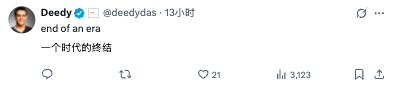
"I don't want to just work on PyTorch forever. I don't want to be tied to the same thing for decades like Linus!" The father of PyTorch posted a long resignation letter to bid farewell to Meta.
"I don't want to move forward with the regret of never exploring the world outside Meta... I don't want to work on PyTorch forever, nor do I want to be like Guido or Linus, tied to the same thing for decades."
"After my paternity leave, I suddenly realized that the team had been handling various difficult problems better and better. This project... no longer needs me."
In such a mood of half - sentiment and half - relief, Soumith Chintala, the soul figure of PyTorch and the "Father of PyTorch", after eleven years and four months at Meta, published a long and emotional resignation letter, announcing that he would officially leave this tech giant in ten days.
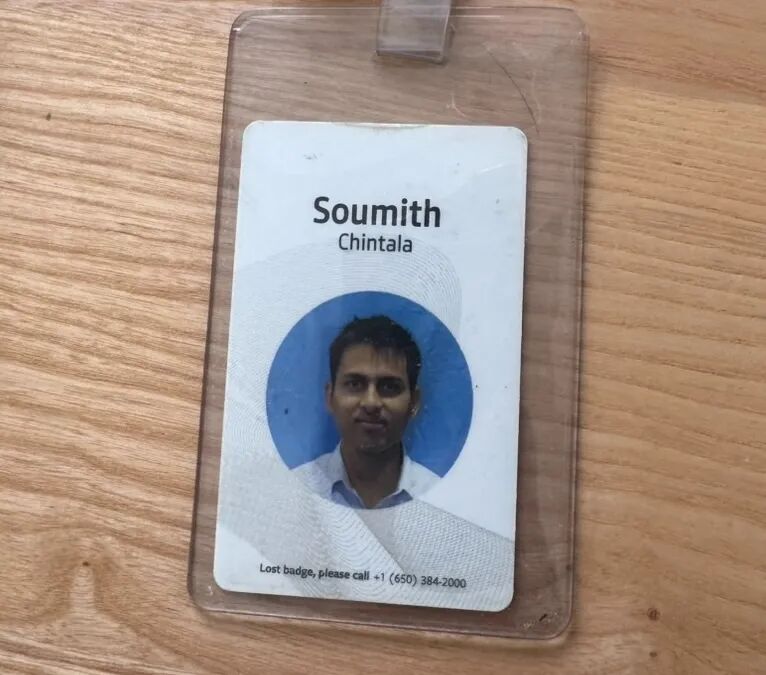
For Mark Zuckerberg, it's undoubtedly a great loss of a key figure; for the entire AI technology circle, it's a turning point in an era. After all, PyTorch has grown from an idea to one of the important infrastructures in the AI field. Its nearly one million stars on GitHub also reflect Soumith's eleven - year journey of promotion.
Now, Soumith Chintala has chosen to leave. Instead of staying in his comfort zone, he is about to embark on the next journey with a little confusion, a little excitement, and curiosity about the "unknown". He said that he wants to go out and do small, brand - new things that he doesn't fully understand and that are even a bit uncomfortable.

Soumith Chintala's Long Resignation Letter
In this long resignation letter, Soumith Chintala not only looked back on his journey at Meta but also talked about PyTorch, which is in the hand - over stage.
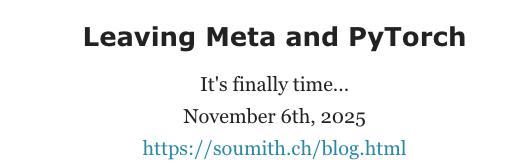
The following is Soumith Chintala's self - narration:
Working at Meta for eleven years has almost occupied my entire career. Here, I've made many lifelong friends.
For about eight years, I led PyTorch from scratch, making its adoption rate in the AI field exceed 90%. Leaving here is one of the toughest decisions I've ever made. But I'm leaving with gratitude.
Now, PyTorch can handle training at the scale of tens of billions. It supports the foundation models that are redefining intelligence, and almost every major AI company is using it in their production environments. PyTorch is being taught in scenarios ranging from MIT to rural classrooms in India.
Did I dream of making these tools more accessible? Now it's achieved.
Did I want to lower the entry barrier? Now it's almost gone.
Of course, there's still much more to do. As long as AI is developing at such an astonishing speed, PyTorch still needs to keep up. Being overly obsessed with the future sometimes makes us overlook what we've already achieved.
Thank you to everyone who built PyTorch with me - those who believe that research should be fun, that tools should be elegant, and that open - source can change everything - thank you. This is not my individual journey, but our shared journey.
What will I do next? Small, brand - new things that I don't fully understand and that are even a bit uncomfortable. I could have chosen to transfer within Meta and continue to develop in a different direction, but I feel that I need to see the outside world. I need to do some "small things" again. I can't accept the regret of never having tried things outside of Meta.
Leaving is really hard. I was sitting in one of the most influential positions in the AI industry - the software layer I was in charge of supported the operation of the entire AI industry. I could directly contact almost all major AI companies and hardware manufacturers. It's really hard to let go of this status and influence. But in the end, curiosity got the better of me.
Please continue to make AI more user - friendly and more interesting. I'll also keep an eye on it, maybe submit some issues, and definitely stay involved.
Will PyTorch Be Okay?
I don't want to work on PyTorch forever. I don't want to be like Guido (the father of Python) or Linus (the father of Linux) - tied to the same thing for decades.
In November last year, when my daughter was born, I started planning my departure with Aparna (the senior vice - president of engineering at Meta). My goal was to leave PyTorch in a good and stable state.
By August this year, during the second half of my paternity leave, I knew that Edward, Suo, Alban, Greg, John, Joe, and Jana were ready. The team no longer needed to rely on me to solve tricky personnel, product, technology, and organizational problems (unlike before). The product story they prepared for the PyTorch Conference was well - structured - really well - structured. The problems I had marked are getting better. This project no longer needs me.
Different from the period between 2020 - 2022 (when I left to work on robotics research and Lin, Dima, and Dwarak left and then came back), this time I'm fully confident that PyTorch is truly resilient. Those who best embody the values of PyTorch, such as Greg, Alban, Ed, Jason, and Joe, are now in the decision - making layer, and those with highly - aligned values - Suo, John, and Jana - have also joined the decision - making layer. If any of them leave, there's a long list of people with the same values willing to take their places at the decision - making table.
There are many small details that make me confident in the team: John has long - term experience in the Julia and open - source fields (in fact, we tried Torch.jl together in 2015), Suo has been my strongest system builder and strategic partner in the past two years, and Jana has long been responsible for building the resilience of the core system. The in - depth technical and organizational discussions I've had with her in the past few months have also given me full confidence. And the product lineup and execution in 2025 alone are enough to dispel any remaining doubts.
I believe this group of PyTorch team members will perform extremely well. PyTorch may change in style because I'm no longer imposing my taste from the top down, but I'm confident that the core values will remain the same, and the products will be excellent.
My Time at Meta
The early days at FAIR were simply magical. I became part of a small but excellent team, building cutting - edge AI technology in an open environment.
From researching generative adversarial networks (GANs) with Emily Denton, Rob Fergus, Leon Bottou, Martin Arjovsky, and the now - legendary Alec Radford, to developing a StarCraft robot with Gabriel Synnaeve, to building the first FAIR cluster with Howard Mansell, from working on object detection with Adam Lerer and Piotr Dollar, to building PyTorch, the fun of all these things can't be fully described in words.
2015 and 2016 were probably the most productive and enjoyable years of my career. I may always look back on this period with a touch of romance.
When I joined FAIR, I had severe impostor syndrome (people with this syndrome firmly believe that their success is not due to their own efforts or abilities but to luck and good timing, and they're worried about being exposed as frauds). The first three months were extremely difficult. I can't express my gratitude enough to Andrew Tulloch (a top researcher in the AI field). He was the most considerate, kind, and enthusiastic mentor. I couldn't have come this far without him. Just the fact that he's back at Meta makes me very optimistic about Meta.
My time at PyTorch was especially special.
I loved every aspect of building it - design, management, being a PM, a technical leader, a communication leader, a documentation engineer, a release engineer, fixing bugs, being a growth hacker, turning it into a full - fledged product with hundreds of participants, and transitioning it to industry stakeholders - everything.
Thank you to the core PyTorch team at Meta: engineers, researchers, open - source maintainers, documentation writers, CI infrastructure teams, hardware partners, and community builders. Thank you to hundreds of internal and external members - you've turned a library into a movement.
There are too many people to thank, but I must mention Adam Paszke, Sam Gross, Greg Chanan, Joe Spisak, Alban Desmaison, Edward Yang, Richard Zou, Tongzhou Wang, Francisco Massa, Luca Antiga, Andreas Köpf, Zach DeVito, Zeming Lin, Adam Lerer, Howard Mansell, Natalia Gimelshein, and Schrep. They made the successful launch of PyTorch possible.
Later, many others also became crucial: Lu Fang, Xiaodong Wang, Junjie Bai, Nikita Shulga, Horace He, Mark Saroufim, Jason Ansel, Dmytro Dzhulgakov, Yangqing Jia, Geeta Chauhan, Will Constable, Briah Hirsh, Jane Xu, Mario Lezcano, Piotr Balecki, Yinghai Lu, Less Wright, Andrew Tulloch, Bruce Lin, Woo Kim, Helen Suk, Chris Gottbrath, Peng Wu, Joe Isaacson, Eli Uriegas, Tristan Rice, Yanan Cao, Elias Ellison, Animesh Jain, Peter Noordhuis, Tianyu Liu, Yifu Wang, Lin Qiao, and hundreds of others.
I can't list them all, but without these people, PyTorch wouldn't exist ❤️.
The happiest moment of building PyTorch was meeting users who were eager to share their joy, love, and feedback.
I remember at NeurIPS in 2017, a graduate student ran up to me, babbling and excited, saying that he had tried for three years to make progress in his research, but after using PyTorch for three months, he had made great progress and was even ready to graduate. That moment made me truly realize that what we're doing means a lot to many people, even if you don't always hear from them. I really miss the intimacy of the PyTorch community. A 300 - person conference was like a family reunion, but considering the huge impact PyTorch has today - yes, now the conference has 3,000 people and has great market influence, and it helps more people do their best AI work - I think the loss of this intimacy is a small price. I miss this intimacy but am proud of this growth.
Thank you, Mark Zuckerberg and Mike Schroepfer, for believing that open - source is fundamentally important and a reliable business strategy. For most people, this is hard to understand, but we've always been on the same page with this strategy and never needed to discuss it. Without you, neither FAIR nor PyTorch would exist, and this means a lot to me.
Thank you, Yann LeCun and Rob Fergus, for creating the early FAIR that I admire so much.
Thank you, Aparna Ramani. You're a rare leader at Meta: you maintain extremely high standards for the organization, are technically excellent, can discuss deep infrastructure systems and industry strategies in the same conversation, and have impeccable execution! I've learned so much from you.
Thank you, Santosh, Kaushik, Delia, Oldham, and Ben, for warmly welcoming me to Infra. As a newcomer transferred from FAIR, you made me feel at home and part of the family. Thank you very much.
Thank you to all the managers who supported me in the PSC video - game project - Serkan, Howard, Jerome, Abhijit, Yoram, Joelle, Aparna, and Damien - I owe you a lifetime of drinks.
— Soumith
Well - wishes and Tributes from the AI Circle!
Soumith's departure has attracted wide attention in the AI technology circle.
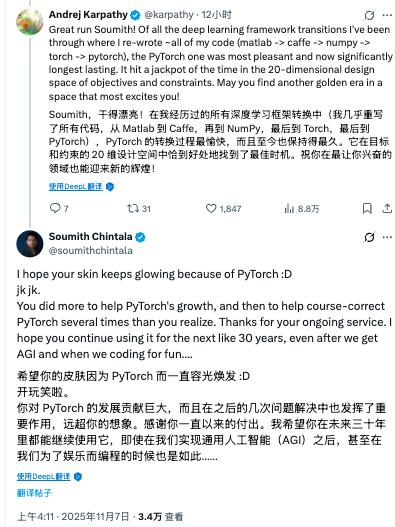
AI expert Andrej Karpathy left a message saying, "Well done, Soumith! Among all the deep - learning framework migrations I've experienced (from Matlab → Caffe → NumPy → Torch → PyTorch, almost rewriting all the code), migrating to PyTorch was the most pleasant experience, and it also seems to have the most long - lasting impact. It's a grand slam in the 20 - dimensional design space of goals and constraints. I hope you'll have your golden age again in the field that excites you the most!"
Soumith replied with a smile, "I hope your brilliance will always shine because of PyTorch. Just kidding. In fact, you've contributed more to PyTorch's growth than you realize, and you've helped it adjust its direction many times. Thank you for your continuous efforts. I hope that even if we encounter AGI in the future, we'll still see you using PyTorch for the next 30 years, even just for the fun of programming..."
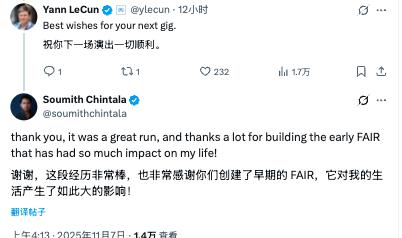
Turing Award winner Yann LeCun sent his well - wishes, "I wish you all the best in your next job."
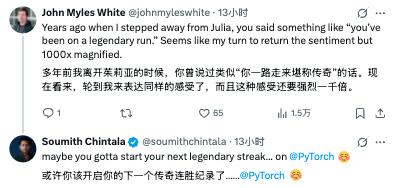
John Myles White, the engineering director of PyTorch, said, "Years ago, when I left Julia, you said something like 'You've had a legendary journey'. Now it seems to be my turn to return the sentiment, and amplify it a thousand times."
Some people sighed, "The end of an era."