Mercedes-Benz is on the decline, while domestic automakers are on the rise.
In the new energy vehicle market in 2025, a misaligned drama is unfolding.
Mercedes-Benz, which is struggling with its transformation, is targeting the lower - end market. The starting price of the all - electric CLA is 259,000 yuan. This once unattainable three - pointed star is now redefining itself with "cost - effectiveness".
This is Mercedes - Benz's "smartest" product to date. It is equipped with the NVIDIA Orin X chip, advanced intelligent driving technology, and the self - developed MB.OS operating system. However, the price has set a new low for Mercedes - Benz's all - electric products.
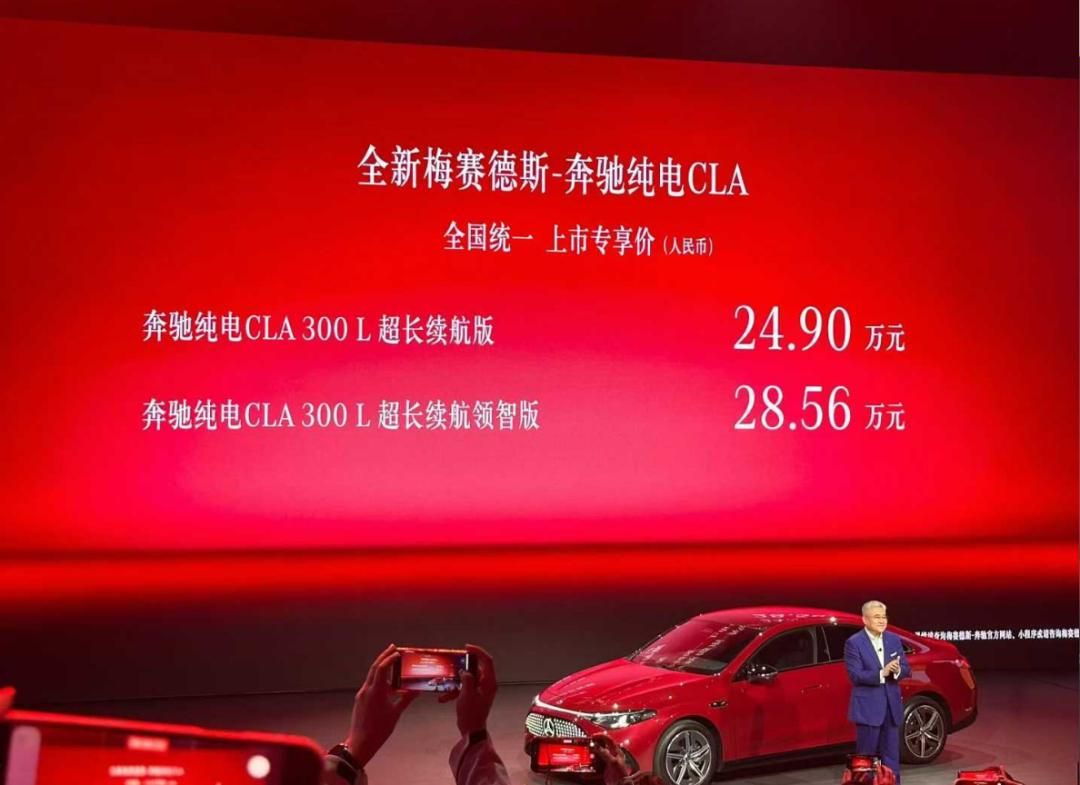
As Duan Jianjun, the president of Beijing Benz, said, "High - end ingredients often require the simplest cooking methods." Now, this "ingredient" is seeking like - minded customers at a more affordable price, which is a direct reflection of the fading brand premium.
Mercedes - Benz has found a new way to survive, and domestic automakers are also showing their cards - they are moving upmarket. They are taking over the market where BBA models are not selling well.
The prices of IM LS9 and Zeekr 9X have successively exceeded 400,000 yuan. The Voyah Taishan 9L has directly claimed to be the "strongest Chinese six - seat SUV". Domestic new energy vehicles are becoming more and more confident in their sales.
But this time, the trump card in their hands is not brand premium, but a laser radar with over 500 lines.
One is looking for a way out by targeting the lower - end market, and the other is seizing the high - end market. The dividing line lies in this laser radar.
It is foreseeable that under the leadership of brands such as Zeekr, IM, and Voyah, more future flagship models aiming for the high - end market may use laser radars with over 500 lines as their core selling points. For example, flagship models such as the Zunjie S900, the new Yangwang U8, and the NIO ES9 will most likely be equipped with laser radars with over 500 lines.
As the value system of flagship cars is being rewritten, safety and intelligence have become the new criteria - without a laser radar with over 500 lines, it can't be called a flagship.
Finally, it's time for Chinese automobile brands to define the "flagship".
01 Domestic New Energy Flagships Win with Technology First
High - end flagships have always been technological flagships.
If we compare the Zeekr 9X, the IM LS9, and the Voyah Taishan 9L, these three models have two things in common.
The first common point: They are representative works of domestic flagship technology.
Ten years ago, the choices in the high - end market were limited to traditional luxury brands. No one would spend four or five hundred thousand yuan on a domestic car.
Ten years later, the brave are the first to enjoy the world, and fewer and fewer people only consider the brand when buying a car.
Among the user group of the Zeekr 9X, over 80% are upgrading or replacing from high - end luxury brands, and over 70% own luxury cars worth over 500,000 yuan. Many users are also owners of million - level luxury cars such as the Range Rover, Cayenne, and Bentayga.
The essence of this shift is the misalignment between product definition and market demand.
The characteristic of traditional luxury brands is winning with details. The Maybach is the business card of German ultra - luxury cars, perfectly interpreting what a land yacht should be.
Domestic luxury brands advocate technological value.
A McKinsey survey shows that Chinese consumers have their own understanding of the emotional needs of flagship models, especially in the pursuit of technology and innovation.
It is undeniable that scarce attributes such as engine horsepower, vehicle design, and cabin materials are rarely seen in domestic luxury brand models. However, this does not mean that domestic automobile manufacturing technology can only simply follow and imitate that of automobile - making powerhouses.
Whether it's about details or technology, there are only two words for building a flagship car: technology.
If we only look at the technical parameters and configurations, domestic flagships can almost outperform 99% of joint - venture luxury cars in all aspects.
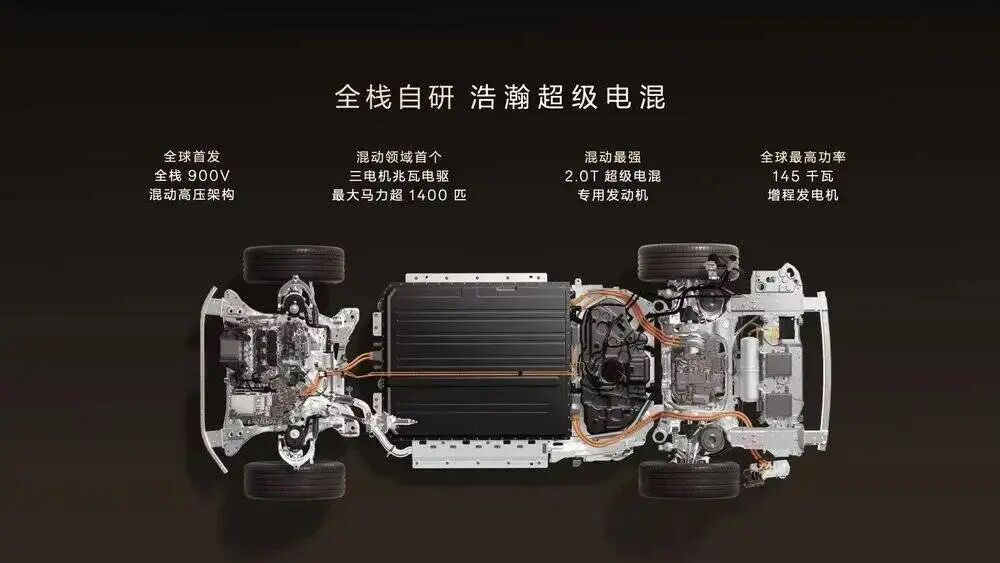
Performance: The Zeekr 9X is equipped with the world's first full - stack 900V high - voltage hybrid architecture. The IM LS9 has also launched a three - motor four - wheel drive version, with a 0 - 100km/h acceleration time of less than 3 seconds.
Comfort: In the Zeekr 9X, each passenger can have about 1.05 square meters of activity space. The seat massage in the IM LS9 has been upgraded from ordinary pneumatic to mechanical arms.
Luxury: The Voyah Taishan 9L has the largest rear door frame in its class. The Zeekr 9X is equipped with a "flying screen" and the world's most powerful Naim audio system.
For consumers, the ultimate value of technology lies not in being leading itself, but in whether it can be translated into real - world driving experiences.
In this regard, domestic automakers are like teaching joint - venture brands how to build flagship cars.
The IM LS9 for SAIC, the Zeekr 9X for Geely, and the Voyah Taishan 9L for Dongfeng are all important symbols of the upward breakthrough of the Chinese automobile industry.
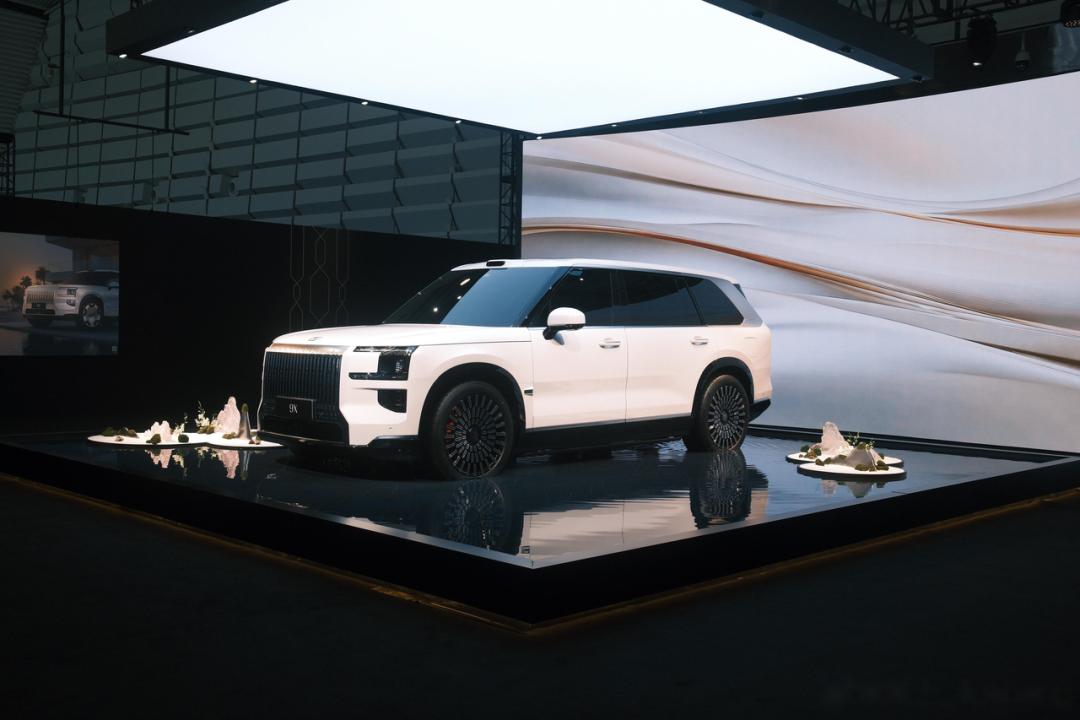
The second common point: A laser radar with over 500 lines.
Very often, scarce technology is the dividing line between flagship and non - flagship models.
Before 2021, most models equipped with laser radars were priced above 400,000 yuan, and the total number of such models was less than 20. Laser radars were exclusive sensors for flagship cars.
Now, the price of laser radars has dropped to a historic low of 150,000 - level, shifting from a high - end label to a standard feature for all.
On the contrary, in the high - end market, more powerful laser radars are taking their place.
On the one hand, in terms of both detection range and resolution, a 500 - line laser radar deserves the title of "the king of machines".
On the other hand, laser radars are not just about "good enough" pragmatism. The better the performance of the laser radar, the higher the safety ceiling. Safety is the greatest luxury - owners of the AITO M9 ranked "safety" among the top three reasons for buying a car.
If building a flagship is like a boxing match, technology solves the "physical fitness" problem of domestic cars, while safety determines the differentiated competition. Focusing on niche markets often leads to breakthroughs in specific areas.
The essence of a flagship remains unchanged over the years. Technological revolution has always been about upgrading safety and comfort.
It's just that this time, it's the domestic new energy brands that are leading the way.
02 The "Ranking Tournament" of Laser Radars: Defining "Levels" by Line Count
As intelligent driving enters an accelerated phase, there is no doubt that "whether to install a laser radar on a car" has been settled.
Laser radars are widely recognized as high - performance perception hardware. The only drawback in the past was their high price. Now, the cost has dropped significantly. The selling price has dropped to about $200, and the large - scale procurement cost for automakers is as low as a few thousand yuan, which is even cheaper than a set of genuine leather seats.
With the cost inflection point reached, automakers are daring to label their cars with "standard intelligent driving across the range" and "standard laser radar across the range". Users judge the value of intelligent driving based on the presence of a laser radar. Take the GAC Toyota C-HR EV as an example. Although the version with a laser radar is about 10,000 yuan more expensive, it has become the best - selling model.
As the algorithmic differences are narrowing, the competition in intelligent driving perception has entered the second stage - a deep - water game of sensor capabilities. Automakers are including laser radar indicators in their intelligent strategy KPIs and publicizing the radar performance parameters.
The focus of automakers has shifted to "which type of laser radar to install". The focus of the intelligent driving competition has turned to who has a stronger laser radar.
As the core perception hardware, laser radars also have different levels. Although perception models and algorithms are important, the key indicator to intuitively distinguish their quality is "line count" - the number of emission channels.
Take the 128 - line laser radar as an example. It can simultaneously emit and receive 128 laser beams, generating denser 3D point clouds. The line count is like "pixels". The higher the line count, the stronger the pixels, the denser the point cloud quality, the farther the detection range, and the smaller the blind spot. Potential risks can be detected earlier.
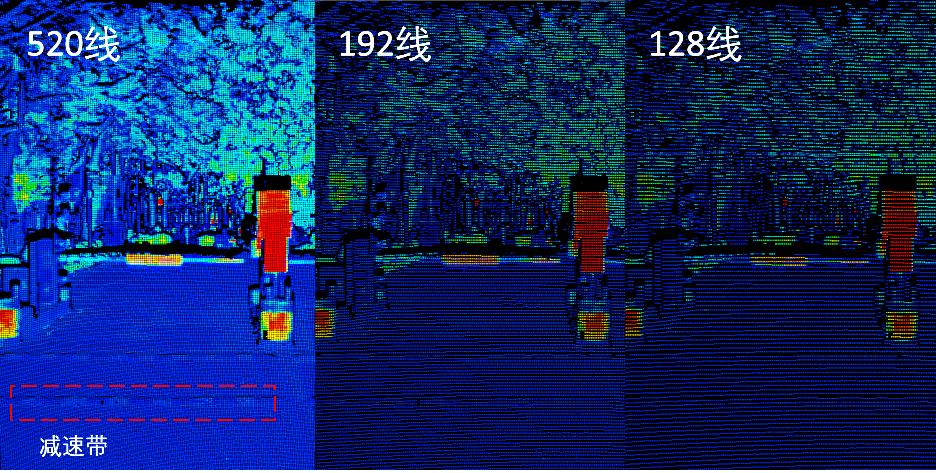
Based on the current market situation, laser radars can be divided into three levels: Bronze, Diamond, and King, according to their line count and performance.
Bronze level: 64 - 128 line laser radars - "seeing". The goal is to meet the basic needs for the large - scale implementation of intelligent driving.
Representative products include the Hesai AT128, the RoboSense M1P/M2, etc. The point frequency is about 1.53 million points per second, the effective detection range is 200 meters, and the imaging quality is equivalent to 720P.
The value of this generation of products is simple: high cost - effectiveness, low power consumption, and low computing power dependence. In the early days, they promoted the popularization of high - end intelligent driving from flagship models to the mass market, supporting the implementation of mainstream functions such as urban NOA and highway NOA.
The 64 - line and 128 - line products are basically sufficient in good urban road conditions, but they have obvious shortcomings: low detection ability for small obstacles and being greatly affected by weather and environment.
In heavy rain, thick fog, or high - speed night scenarios, the detection range is likely to be reduced, and the miss - detection rate for small obstacles is high, resulting in insufficient reaction time for the system.
Diamond level: 192 - line laser radars - "seeing clearly". They are gradually becoming the new mainstream perception hardware. Representative products include the RoboSense EMX and the Huawei D3/192 - line radar. The point frequency has increased to 2 million points per second, the maximum detection range reaches 300 meters, and the image quality has advanced to 1080P level.
The core breakthrough of the 192 - line products is the innovation of the underlying architecture, shifting from analog SiPM to a digital architecture and adopting the VCSEL + SPAD transceiver solution. This enables a longer detection range, a smaller blind spot, and more accurate capture of dynamic objects.
A new wave of "installation" has begun. The Huawei 192 - line radar has been installed in many models such as the AITO M9, the new M7, the Seres S9, and the Avatr. It has also penetrated the market below 200,000 yuan through the Seres H5. The RoboSense EMX has also been selected by many mainstream domestic and foreign automakers such as Geely and FAW Hongqi, covering models from high - end flagships to family cars.
This generation of products has promoted the high - end intelligent driving experience from "usable" to "dare to use", becoming the standard equipment for mid - to high - end intelligent driving models. However, in terms of ultra - long - range detection in extreme weather and recognition of small high - speed obstacles, the 192 - line radar still has limitations, which has led to the entry of products with higher line counts.
King level: Laser radars with over 500 lines - "seeing through". The goal is "penetrative perception". Representative products include the RoboSense EM4 and the Huawei over 500 - line radar. Among them, the RoboSense EM4 has a detection range of up to 600 meters, the point frequency exceeds 10 million, which is double that of the 192 - line radar, and the image quality is comparable to 4K.
The increase in line count has brought about an overall performance leap. From a tire dropped 300 meters away to potholes and speed bumps on the road, and cats and dogs running at night, laser radars with over 500 lines can clearly identify them all. With a strong noise - reduction ability, the RoboSense EM4 can output high - quality and pure point clouds in complex scenarios such as rain, fog, and dust.
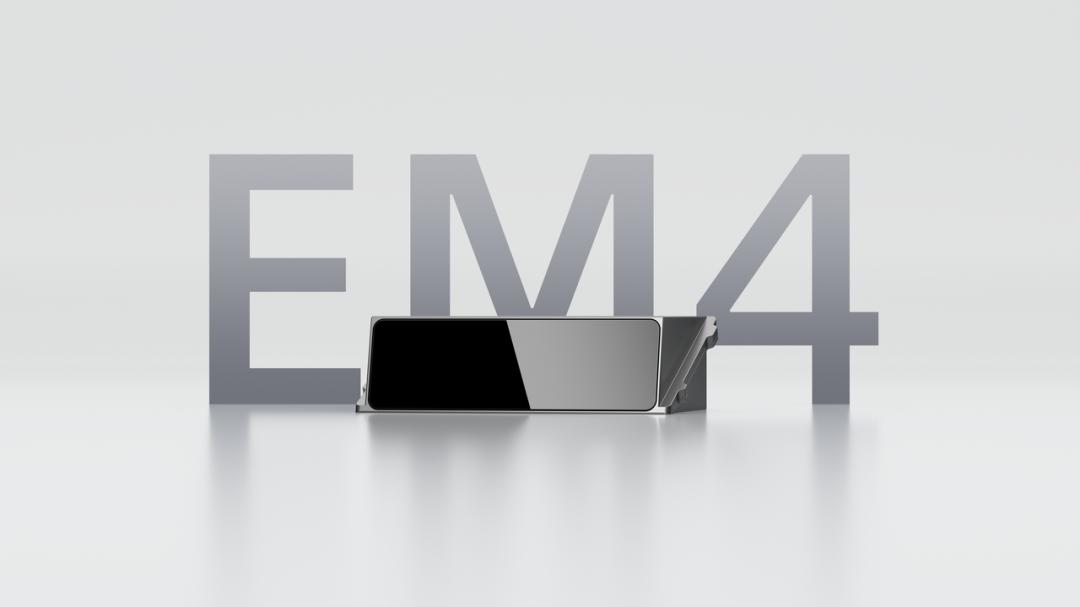
From "seeing" to "seeing clearly" and then to "seeing through", the change in the line count of laser radars is essentially a continuous improvement in the accuracy, robustness, and reliability of the intelligent driving perception system. The 128 - line radar opened the door to mass production, the 192 - line radar established the mainstream standard, and the over 500 - line radar defines the performance ceiling.
This "level" competition is not just a simple parameter race. From "seeing clearly" to "seeing through", the increase in line count actually sets a higher safety baseline for intelligent driving and points to the key to future competition in intelligent driving. Whoever can master more accurate and stable perception capabilities will have the initiative in defining intelligent driving safety.
03 Without a Laser Radar with Over 500 Lines, Don't Talk about L3 Intelligent Driving
The next crucial battle in intelligent driving lies in L3. Both automakers and suppliers are gearing up.
Luxury flagship models of various brands such as the Zunjie S800, the AITO M9, the NIO ET9, the Zeekr 9X, the Voyah Taishan, and the Mercedes - Benz S - Class have claimed to have an L3 - level architecture. Huawei also launched the commercially available ADS 4 at the Shanghai Auto Show, targeting L3.
