Talk about the architecture of an enterprise-level artificial intelligence data platform
Rethink the enterprise artificial intelligence data platform and explore the data developer platform to scale these AI systems.

I. Overview
Let's first take a look at the actual situation. Many enterprises have invested a large amount of resources in the field of artificial intelligence. Models have been deployed, decision support systems have been built, and dashboards have been automated. On the surface, everything seems intelligent. However, in reality, the systems are not truly autonomous. Every decision still requires manual approval, the systems need to be updated, and the processes need to be run.
This is predictive AI; it is intelligent but static. It can predict what will happen next but will never take the next step.
Now, agent AI has emerged. These systems not only predict outcomes but also take actions based on the results. They understand the business context, remember the interaction process, and can decide on the next action without waiting for instructions. It focuses on "what should be done now" rather than "what might happen." And this is exactly the bottleneck that most enterprises are facing.
Their data platforms are built to manage data pipelines rather than to carry the meaning of data. They can transfer data but cannot convey meaning. They store facts rather than context information.
Therefore, even though AI is becoming more and more intelligent, its underlying systems are still mechanical, passive, and rigid, waiting for someone to press the "run" button.
This is the gap exposed by agent AI: our platforms were never designed for autonomy but for coordination. To bridge this gap, we need to rebuild the infrastructure and treat data as intent rather than input.
II. What is an AI Data Platform?
If you ask most teams what their "data platform" does, you will hear words like collect, transform, store, and serve. These verbs are useful, but none of them reflects an understanding of data. These systems are designed to provide data rather than to give meaning to data.
The AI data platform is an AI infrastructure that changes the architecture. The AI data platform is a unified system designed to manage the entire lifecycle of AI. Instead of separating data storage, pipelines, and processing tools, it integrates data ingestion, transformation, cataloging, governance, and access into a single environment.
Its core advantage lies in intelligent automation. This platform enables AI agents to:
• Automatically detect and adapt to data changes.
• Coordinate workflows and pipelines with little or no human intervention.
• Proactively resolve errors and enforce compliance to ensure high-quality, trustworthy data.
The result is faster deployment of AI models, more consistent output, and the ability of the platform to evolve as business priorities and regulatory requirements change.
III. Key Components of an Enterprise-Level AI Data Platform
To build an AI data platform that can provide accurate, fast, and reliable results, some basic principles need to be followed. The following sections will discuss this:
1. Data Collection and Integration
The first step is to connect all relevant data sources, including databases, APIs, logs, streaming systems, and third-party services. Enterprises rarely have a single data source; data is scattered, isolated, and often interdependent. The platform must handle these operations without introducing manual bottlenecks. This means that automated data ingestion pipelines are needed, which can adapt to changing data patterns, changes in data frequency, and new data sources while ensuring data integrity. This feature ensures that AI or agent systems do not stall waiting for data, and downstream teams do not have to constantly catch up with upstream pipelines, which is a common pain point we see in many enterprises.
2. Unified Data Storage and Access
A modern AI data platform is a single unified layer where structured, semi-structured, and unstructured data can coexist. This allows any AI workload, whether it is a predictive model or an agent system, to query, read, and write data without switching contexts or using multiple tools. Unified access reduces friction, eliminates redundant copies, and ensures that each system sees the same "truth." From our perspective, this unified layer is crucial because agent AI relies on consistent and high-fidelity data to act autonomously. Any inconsistency will disrupt the decision-making cycle and undermine trust in the AI output.
3. Embedded Governance
The governance of an AI data platform cannot be a separate layer or a slow manual approval process. It must be embedded within the platform to automatically manage data quality, lineage, security, and compliance. Our view: governance is not just about rules; it is the core element of trust. Each model, agent, or workflow should be able to trust the data it uses without constantly questioning "Is the data clean? Is it compliant?" When the governance mechanism is integrated into the platform, AI agent systems can operate with confidence, and human teams will not be burdened with heavy manual checks.
4. Context and Memory Layer
Most platforms focus on moving data from point A to point B. The AI data platform we advocate considers context and memory as the most important factors. This layer retains historical knowledge, relationships, and business meaning so that AI systems can reason over time rather than just react to the latest batch of data. This ability is crucial for agent AI, which must remember past actions, learn from the results, and make decisions autonomously.
Today, an AI data platform without a memory layer may result in fragile intelligence. The model may predict well, but the agent cannot act reliably because the system forgets the context that makes the decision meaningful.
5. Observability and Monitoring
Finally, the platform must provide deep observability. This is not just about checking whether the pipeline is running or whether the model is producing output. Observability means tracking the health, accuracy, and reliability of every piece of data flowing into the AI system. Monitoring not only alerts the team to anomalies, deviations, or failures but also provides insights for continuous improvement. Combined with the memory layer, observability ensures that the AI system can learn from its own decisions and maintain trust across the enterprise.
IV. Business Benefits of an AI Data Platform
Let's first look at the actual situation. Most enterprises today are facing the dilemma of data fragmentation; each department has its own version of "data empowerment." The marketing department relies on business intelligence platforms and dashboards, the operations department relies on data pipelines, and the finance department relies on spreadsheets that can never be unified. AI is just superimposed on this chaos rather than integrated into it.
The AI data platform changes this situation. It not only makes data easily accessible but also makes it available to AI systems for learning, decision-making, and execution. What does this mean for enterprises?
1. Faster Decision-Making Cycles
With unified storage, automatic ingestion, and embedded governance, decisions that previously took weeks of coordination can now be made almost in real-time. Teams no longer wait for reports or data updates; they work with real-time intelligence. This is the difference between reacting to market changes and predicting market changes.
2. Reduced Operational Friction
Every data team knows the cost of dependencies. The AI data platform helps reduce this friction by integrating data flow, quality, and access into a single system. When the entire process from data ingestion to service runs synchronously, downstream users no longer have to deal with various unexpected situations. The end result is: lower work efficiency, faster delivery, and clearer responsibilities.
3. Trustworthy AI Results
Agent AI cannot run on inconsistent data. Embedded governance ensures that every action taken by the agent is supported by trustworthy, compliant, and high-quality data. For enterprise leaders, this means confidence that the decisions made by the AI system are explainable, traceable, and trustworthy.
4. Context-Aware Automation
This is where most enterprises can make the biggest leap. The context and memory layer enable AI to act consciously, not only reacting to triggers but also understanding why certain things are important.
In fact, this means that the system can remember previous transaction records, learn from historical patterns, and make adjustments autonomously. This automated system can operate stably even when the environment changes.
5. Improved AI Return on Investment
Most enterprises spend millions of dollars building models that can never be scaled because the underlying data foundation is not ready. The AI data platform solves this problem by matching data readiness with AI readiness. Once the data foundation is stable, each new model, agent, or project can create value without starting from scratch.
6. Agile Compliance
As regulations evolve, the governance mechanism embedded in the platform ensures that enterprises are compliant from the very beginning. You don't have to choose between innovation and control; the platform can achieve both. This agility is crucial for enterprises operating across regions or in highly regulated industries such as banking, financial services, and insurance (BFSI) and healthcare.
7. Cultural Shift towards Autonomous Operations
When data systems become reliable and explainable, teams stop micromanaging processes and focus on results. The AI data platform prompts organizations to shift from a reactive culture ("Is the task done?") to a proactive culture ("What can we improve next?"). This is how autonomy scales, first in the data operations area and then across the entire enterprise.
V. Data Developer Platform: From Data Platform to AI-Ready Infrastructure
All enterprises talking about "artificial intelligence" are actually talking about change: new workflows, new intelligence, and new expectations. However, they often overlook the foundation, the platform on which intelligence depends. This is where the Data Developer Platform (DDP) comes in. You can think of the DDP as the operating system for data teams. It abstracts complexity, integrates various tools, and provides a seamless experience, so that data engineers and scientists don't have to stay up late debugging pipelines or switching between different tools.
According to its specification, the Data Developer Platform (DDP) "is a unified infrastructure specification for abstracting complex and distributed subsystems and providing a consistent, results-oriented experience for non-technical end-users."
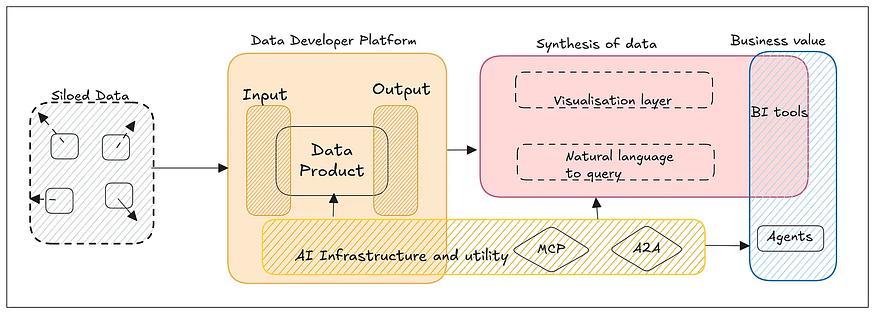
By integrating data ingestion, processing, storage, governance, and monitoring into a unified architecture, it creates an environment where data is not only easily accessible but also reliable, reusable, and scalable. When combined with the AI data platform's requirements for context, memory, and autonomy, what it has is not just infrastructure: it is an infrastructure built for agent AI. When an enterprise adopts the Data Developer Platform (DDP), it shifts from managing chaotic pipeline data to coordinating a system that can enable intelligence.
VI. How DDP Empowers Enterprise Agent AI at Scale
After the foundation is set up, the next question is: Can the system provide intelligence, not just data? For enterprise-level agent AI (i.e., systems that can act rather than just predict), you need three elements: consistent context, trustworthy data, and scalability. The Data Developer Platform can provide all three.
First, we need to understand the background: the Data Developer Platform (DDP) encourages treating data as a product ("data as a product"), making data addressable, understandable, trustworthy, and easily accessible. When data becomes a product, it carries meaning, so your AI agents get not just raw data but assets that can be used in business.
Second is trust: through embedded governance, data lineage, and the Data Developer Platform (DDP), you can build data that AI systems can rely on. No more worrying about "Has this pipeline run?" Intelligent systems can now act with confidence.
Third, scale: the DDP integrates integration, storage, transformation, and APIs into a single infrastructure, which means you can avoid the failure of AI projects caused by too many tool branches. Combining all these lays the foundation for your AI data platform, enabling it to support not only models but also agents that can remember, learn, and act.
For enterprises ready to unlock intelligent AI, the message is simple: start with a powerful data developer platform and build your AI data platform on top of it.
Frequently Asked Questions
Question 1: What is Platform as a Service (PaaS)?
Platform as a Service (PaaS) is a cloud-based model that provides developers with a ready-made environment for building, running, and scaling applications without having to manage the underlying infrastructure. Teams don't have to worry about servers, storage, or runtime environments, so they can focus on developing and deploying products faster.
AI data is like a Platform as a Service for data and AI, providing teams with all the features they need (from ingestion and governance to context and observability) without the infrastructure burden.
Q2: What is an AI Data Center?
The AI data center refers to a high-performance infrastructure built for training and running AI models. This infrastructure uses powerful GPUs, high-speed networks, and scalable storage to handle large amounts of data and computational workloads, enabling faster and more efficient AI development and deployment.
This article is from the WeChat official account "Data-Driven Intelligence" (ID: Data_0101), author: Xiaoxiao, published by 36Kr with authorization.