Surpassing the traditional 4200x speed, ETH Zurich proposes NOBLE, the first neuron modeling framework validated by human cortical data
A joint team from institutions such as the Swiss Federal Institute of Technology in Zurich, the California Institute of Technology, and the University of Alberta has proposed a deep learning framework called NOBLE. It is the first large - scale deep learning framework to have its performance verified through experimental data from the human cerebral cortex. For the first time, it has achieved the ability to directly learn the nonlinear dynamic behavior of neurons from experimental data, and its simulation speed is 4,200 times faster than that of traditional numerical solvers.
How the human brain shapes cognitive functions through complex circuits composed of hundreds of types of neurons remains a profound and unsolved mystery in life sciences to this day. Over the past decade, with the accumulation of multimodal data such as electrophysiology, morphology, and transcriptomics, scientists have gradually revealed the significant heterogeneity of human neurons in gene expression, morphological structure, and electrophysiological properties. However, how these differences affect the brain's information - processing process, such as the internal connection between specific gene expression and neurological diseases, remains an outstanding problem.
Traditionally, researchers often use models based on three - dimensional multi - compartment partial differential equations (PDEs) to simulate neuronal activities. Although such models can restore biological authenticity well, they have a fatal flaw: extremely high computational costs. Optimizing the model of a single neuron may consume approximately 600,000 CPU core - hours, and slight changes in parameters can easily lead to a serious deviation between the simulation results and experimental data. More importantly, such deterministic models have difficulty capturing the "intrinsic variability" observed in experiments. Even with the same input, the same neuron may produce different electrophysiological responses. And the method of artificially introducing randomness often brings non - mechanistic interference, further weakening the reliability of model predictions.
Facing these challenges, the joint team from institutions such as the Swiss Federal Institute of Technology in Zurich, the California Institute of Technology, and the University of Alberta proposed a deep learning framework called NOBLE (Neural Operator with Biologically - informed Latent Embeddings).
The innovation of this framework lies in that it is the first large - scale deep learning framework to have its performance verified through experimental data from the human cerebral cortex, and it has achieved the ability to directly learn the nonlinear dynamic behavior of neurons from experimental data for the first time. Its core breakthrough is the construction of a unified "neural operator", which can map the continuous latent space of neuron features to a set of voltage responses without the need to train a surrogate system for each model separately. In tests on a dataset of parvalbumin - positive (PVALB) neurons, NOBLE not only accurately reproduced the sub - threshold and firing dynamic behaviors of 50 known models and 10 unseen models, but its simulation speed was 4,200 times faster than that of traditional numerical solvers.
The relevant research results, titled "NOBLE - Neural Operator with Biologically - informed Latent Embeddings to Capture Experimental Variability in Biological Neuron Models", have been selected for NeurIPS 2025.
- Paper link: https://go.hyper.ai/Ramfp
Dataset: Covers 60 HoF models, 250 generations of evolutionary optimization, and 16 physiological indicators
To verify the effectiveness of the NOBLE framework, the research team constructed a dedicated dataset containing parvalbumin - positive (PVALB) neurons, which was derived from the simulation results of biologically realistic models of human cortical neurons. These models were constructed based on the NEURON simulation environment, using an "all active" ion - channel configuration, and were generated through a multi - objective evolutionary optimization framework to reproduce the electrophysiological features recorded in experiments.
Specifically, the dataset contains 60 HoF models, of which 50 are used for training (in - distribution models), and 10 are used as unseen models for testing (out - of - distribution models). As shown in the figure below, each model was optimized through 250 generations of evolutionary optimization. The voltage responses of different generations were collected, and then the cable equation was transformed into a coupled system of ordinary differential equations through spatial discretization and solved. Finally, the parameter combination that minimized the average z - score error between the simulated and experimental features was selected.
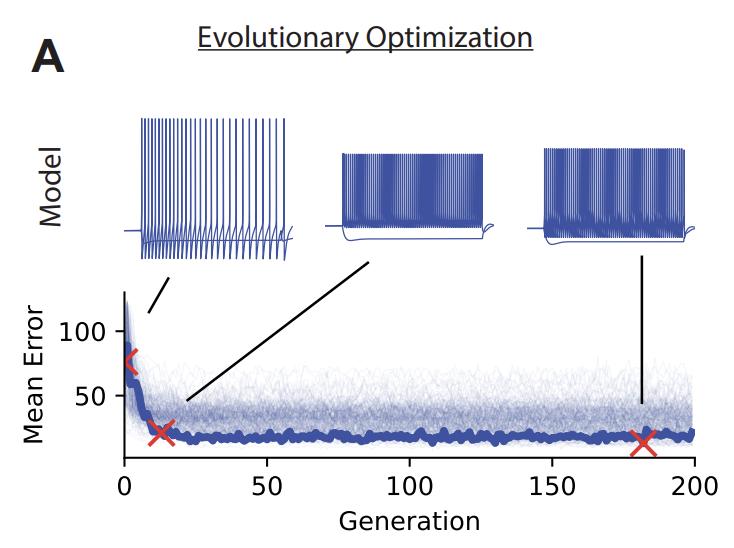
The process of evolutionary optimization of neurons
The data generation process adopted a two - stage optimization strategy: first fitting the passive sub - threshold response, and then capturing the active dynamics above the spike threshold and the complete frequency - current curve. The time - series data was sampled at a time step of 0.02 ms for a duration of 515 ms. After 3 - fold time subsampling, 8,583 time points were retained, which not only avoided the aliasing effect but also reduced the computational load.
As shown in the figure below, in addition to the voltage change curve, the dataset also marked 16 key "physiological indicators", including the display morphology (first row), experimental voltage traces (second row), simulated voltage traces (third row), spike waveforms (fourth row), and frequency - current curves (fifth row), providing a comprehensive standard for evaluating AI models. This design allows the dataset to both train AI to predict neuronal responses and evaluate the quality of predictions, achieving the integration of "teaching, learning, practice, and testing".
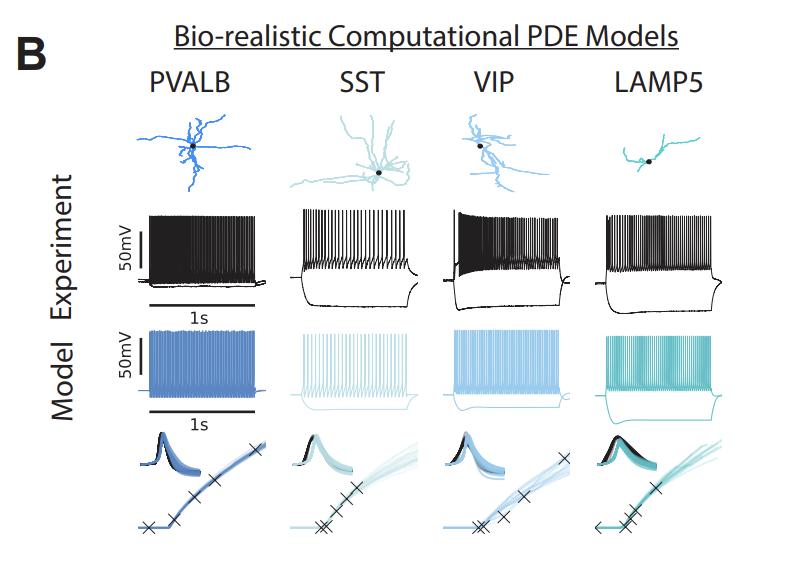
Samples of HoF models for various inhibitory cell types
NOBLE: A neural operator framework driven by FNO with dual - input embeddings
The core innovation of the NOBLE framework lies in the in - depth integration of neural operators with latent embedding techniques in bioinformatics, constructing an end - to - end mapping system from neuron features to voltage responses, which can be vividly called a "neural signal translator". The framework uses the Fourier neural operator (FNO) as the underlying architecture, and its advantage lies in its ability to efficiently process the spatio - temporal sequence data of neuronal electrophysiology. Inspired by audio signal processing, FNO analyzes equidistantly sampled electrophysiological signals in the frequency domain through the fast Fourier transform, thus becoming a class of computational tools customized for neural dynamics research.
The "translation" ability of the model comes from two key input embedding designs: neuron feature embedding and current injection embedding.
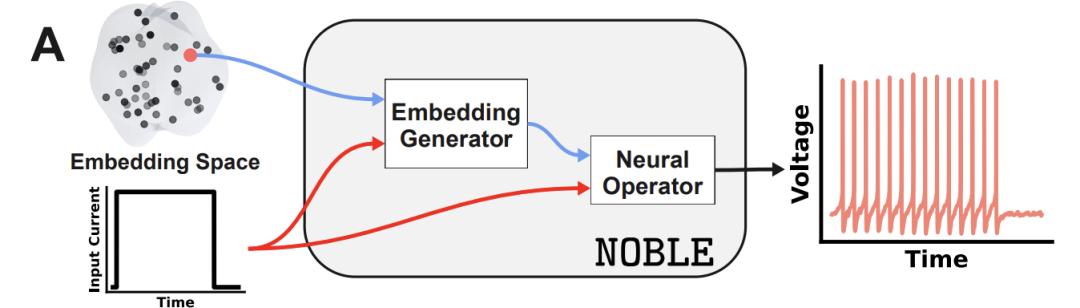
The embedding strategy of NOBLE
The former selects two indicators with clear biological interpretability, the threshold current (Ithr) and the local slope (sthr), as the core features. First, they are normalized to the [0.5, 3.5]² interval, and then transformed into a time - series stack through NeRF - style trigonometric function encoding, which is equivalent to providing the model with a "hardware parameter manual" for neurons, clearly marking their key electrophysiological properties. The latter uses a multi - frequency encoding strategy with K = 9, corresponding to the input current excitation parameters. As shown in the figure below, the input channels formed by stacking the two embeddings enable the low - dimensional features to be effectively aligned with the frequency - domain processing method of FNO, significantly enhancing the model's ability to capture the high - frequency dynamics of neural signals.
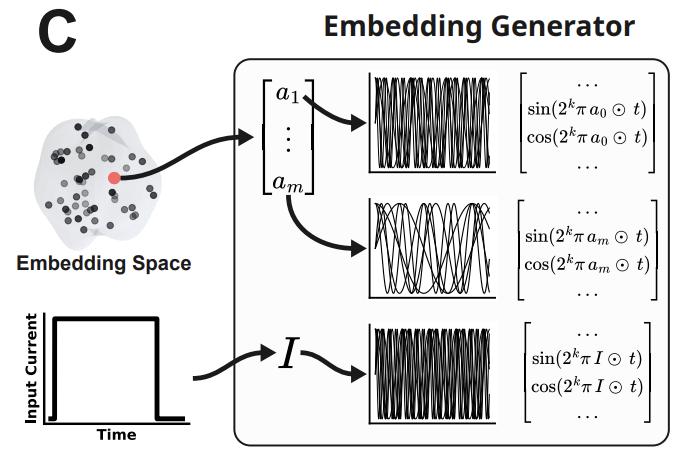
Embedding specified neuron features and current injection in NOBLE
In terms of network structure, NOBLE contains 12 hidden layers, with 24 channels in each layer and 256 Fourier modes. The number of model parameters is approximately 1.8 million, which is equivalent to constructing a simulated neural connection of the same scale. The training process borrows the strategy of "teaching students according to their aptitude": using the Adam optimizer with an initial learning rate of 0.004, and cooperating with the ReduceLROnPlateau scheduling strategy, and using the relative L4 error as the loss function, enabling the model to quickly master the basic rules and automatically adjust the learning rhythm when encountering training bottlenecks. Compared with traditional methods, NOBLE does not need to train a surrogate model for each neuron separately, but realizes a continuous mapping of the entire neuron model space through a single neural operator. This enables it to generate new neural responses with biological authenticity through latent space interpolation.
In addition, NOBLE also has the flexible expansion ability of "specialized improvement", supporting physics - informed fine - tuning for specific electrophysiological features. By introducing a weighted composite loss function L(λ), a higher weight can be assigned to the target feature (such as the sag amplitude), thereby accurately improving the modeling accuracy of key indicators without affecting the overall prediction performance.
NOBLE can correctly capture diverse neuronal dynamics and is 4200 times faster than traditional solvers
To systematically evaluate the comprehensive performance of the NOBLE framework , the research team designed multi - dimensional experiments around five core directions, including basic accuracy, generalization ability, computational efficiency, innovative generation ability, and verification of the effectiveness of core modules. The experiments used 50 HoF models of parvalbumin - positive (PVALB) neurons as the main training data, and the prediction accuracy of the model was quantified through the relative L2 error and a number of key electrophysiological indicators.
In terms of basic accuracy (in - distribution testing), NOBLE still showed excellent prediction ability for current injection signals that were not involved in training, with a relative L2 error as low as 2.18%. In addition, as shown in the figure below, the researchers further compared the voltage trajectories of experimental data, PDE simulation, and NOBLE prediction under 0.1 nA and - 0.11 nA current injections. The results showed that the PDE simulation was highly consistent with the experimental records, and the difference between the NOBLE prediction and the PDE simulation was extremely small, indicating that NOBLE reproduced the accuracy of the numerical solver and reliably captured the key physiological dynamics.
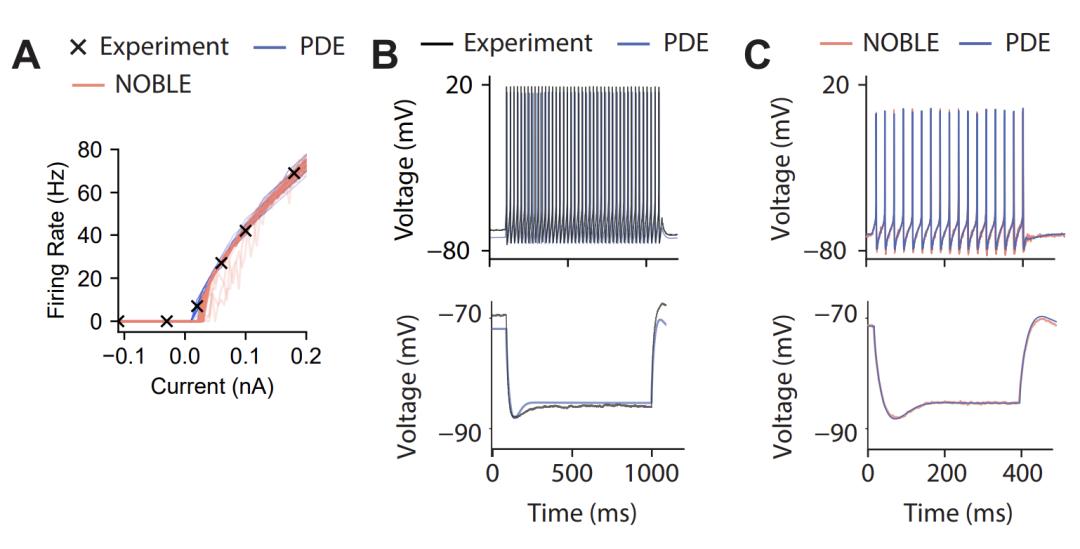
The F - I curves and voltage trajectories of experimental data, PDE simulation, and NOBLE prediction
In the evaluation of generalization ability (out - of - distribution testing), NOBLE still maintained high - precision prediction when facing 10 unseen HoF models. The research team further applied it to the data of vasoactive intestinal peptide (VIP) interneurons and also obtained stable output. This indicates that NOBLE does not simply memorize the features of the training set but truly masters the electrophysiological laws across cell types.
In terms of computational efficiency, NOBLE showed a breakthrough speed advantage. The test results showed that it only took 0.5 milliseconds to predict a single voltage trajectory, while the traditional numerical solver took 2.1 seconds to complete the same simulation, with a speed increase of approximately 4,200 times. This efficiency improvement lays the foundation for real - time simulation of million - level neuronal networks in the future, making whole - brain scale modeling computationally possible.
In terms of innovative generation ability, the research team focused on verifying the potential of NOBLE to "interpolate and create" new neuron models between known neuron features. By randomly interpolating 50 points in the latent space formed by (Ithr, sthr), NOBLE successfully generated the corresponding voltage response trajectories, and the results were highly consistent with the real experimental records, conforming to biological authenticity. In contrast, directly interpolating the parameters of partial differential equations in traditional methods would produce obvious non - physiological artifacts, forming so - called "neural model monsters". This comparison highlights that NOBLE has learned the underlying biophysical laws of neurons rather than simply performing data fitting. Further verified through an ensemble prediction experiment, the voltage distribution generated by parallel inference based on 50 training models was highly consistent with the numerical simulation results. Even when the number of sampling points was extended to 200, the generated models still maintained biological rationality.
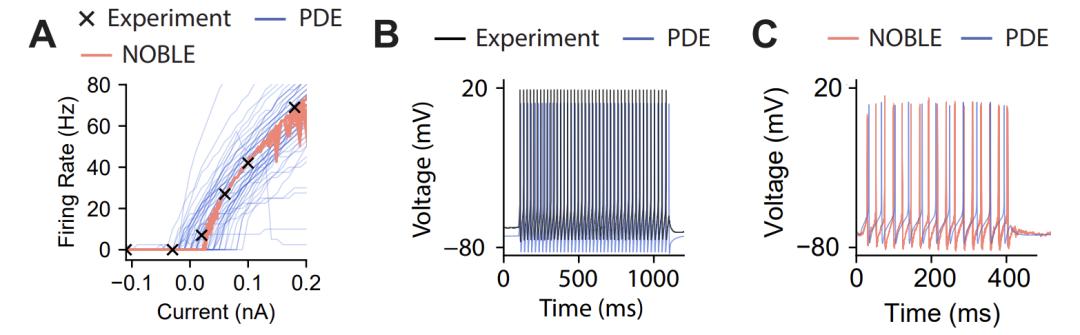
Comparison of F - I curves and results of experimental data, PDE simulation, and NOBLE for 50 interpolated HoF models
A controlled - variable experiment showed that after removing the neuron feature encoding, the prediction error soared from 2% to 12%, proving that this bioinformatics embedding is the "core engine" of the framework.
- GitHub link: github.com/neuraloperator/noble
The academic breakthrough and industrial implementation of neural operators resonate
The cross - integration of neural operators and neuron modeling is causing a deep resonance in the academic and industrial circles, promoting the research of brain science from theoretical exploration to industrial application.
At the academic forefront, the Geometry Aware Operator Transformer (GAOT) framework jointly proposed by the Swiss Federal Institute of Technology in Zurich and Carnegie Mellon University broke through the bottleneck of complex geometric domain modeling through a multi - scale attention mechanism and geometric embedding technology. This framework achieved full - resolution training of industrial - scale data with 9 million nodes for the first time, performed excellently in 28 partial differential equation benchmark tests, increased the training throughput by 50%, and reduced the inference latency by 15% - 30%, clearing the obstacles for the accurate simulation of irregular neural circuits.
- Paper title: Geometry Aware Operator Transformer as an Efficient and Accurate Neural Surrogate for PDEs on Arbitrary Domains
- Paper link: https://arxiv.org/abs/2505.18781
Meanwhile, the "multi - cell integrated brain" (miBrain) model developed by the Massachusetts Institute of Technology has made important progress in the construction of neuron entities. This three - dimensional platform integrates six major cell types in the human brain, successfully reproduced the function of the neurovascular unit using a bionic hydrogel, and revealed the synergistic effect of glial cells in Alzheimer's disease through gene editing, providing a more physiologically realistic verification environment for neural operators.
- Paper title: Engineered 3D immuno - glial - neurovascular human miBrain model
- Paper link: https