Can sodium batteries eliminate the "electric vehicle woes" in cold regions at -40°C?
There are reasons for the low number of electric vehicles in Northeast China and Inner Mongolia. In early 2025, the temperature in some parts of Northeast China and Inner Mongolia dropped to minus 40°C. Now, Northeast China has entered winter earlier, and extremely cold weather will hit again from the end of this year to the beginning of next year.
Almost all of our current electric vehicles are equipped with lithium-ion batteries. Whether it's ternary lithium batteries or lithium iron phosphate batteries, their arch-enemy is "low temperature".
In the freezing cold, lithium batteries that are not resistant to cold often break down. Buying an electric vehicle is like inviting an "electric daddy" home at a cost!
This joking term "electric daddy" resonates strongly with tens of thousands of new energy vehicle owners in cold regions. However, this situation is about to change. Currently, a technological revolution triggered by sodium ions is quietly sounding the death knell for the "electric daddy" because sodium-ion batteries can withstand minus 40°C without breaking down.
This is first due to the unique physical and chemical properties of sodium ions. With a "cold-resistant" constitution and an electrolyte with a low freezing point, it can remain in a liquid state and maintain good ionic conductivity at minus 40°C or even lower temperatures.
The latest news is that the new sodium battery released by CATL, a battery giant, has passed the new national standard certification, becoming the world's first sodium-ion battery to pass the new national standard certification. CATL's new sodium-powered passenger vehicle batteries are being developed and implemented in cooperation with multiple automobile manufacturers.
Consumers in cold regions will be able to drive electric vehicles equipped with cold-resistant sodium-ion batteries in 2026.
1. Northeast Drivers Are Fed Up with the "Electric Daddy"
In fact, in cities like Harbin where winters are relatively cold, when it comes to electric vehicles, most are plug-in hybrid or extended-range vehicles, and pure electric vehicles are still in the minority. And those who drive plug-in hybrid and extended-range vehicles are mainly concentrated among the ride-hailing community.
After the Spring Festival this year, when the Siberian cold current swept across the Northeast Plain with winds of minus 30°C, at 5 a.m. on the streets of Harbin, ride-hailing driver Lao Zhang sighed at the flashing red fault light on the dashboard. This was already his third failed attempt to start the electric vehicle. The remaining range on the in-vehicle screen dropped sharply from 210 kilometers last night to 93 kilometers, just like a body drained of blood by the cold.

Photo/Range reduction of a vehicle owner's winter travel. Source/Screenshot from "New Energy Outlook" on the Internet
"The 'electric daddy' is on strike again! Did I buy this car to be served by it or to serve it?" Lao Zhang complained in the ride-hailing group, which drew echoes from many of his colleagues.
In northern China, every winter, millions of electric vehicle users have to endure this tug-of-war with low temperatures - halved range, extremely slow charging, and failed starts, turning what was once a highly regarded new energy vehicle into an "electric daddy" in the mouths of vehicle owners.
Data from the China Association of Automobile Manufacturers shows that the breakdown rate of electric vehicles in Northeast China in winter exceeds 17%, and the number of rescue calls has increased by three times compared to summer. The root cause of all this is the inherent "cold intolerance" of lithium batteries. The low-temperature dilemma of lithium batteries stems from their internal microscopic world. At low temperatures, the electrolyte becomes extremely viscous, and lithium ions are like sloths afraid of the cold, with their migration speed between the positive and negative electrodes significantly slowed down.
Taking the common lithium iron phosphate battery as an example, when the temperature drops to -20°C, the fast charging time from 30% to 80% may increase from 30 minutes to over an hour, and the discharge capacity may also decrease by about 30%. This means slow charging and fast discharging, resulting in a significant reduction in range, even less than 40% of the CLTC range. More seriously, ultra-low temperatures may cause lithium deposition in the battery, posing a safety hazard.
The emergence of sodium batteries is like installing a "cold-resistant engine" in electric vehicles. A set of comparative experiments is impressive: when a sodium battery and a lithium battery are placed in a -40°C environment for 12 hours, the voltage of the lithium battery pack drops below 2.5V, completely losing its ability to start; while the voltage of the sodium battery pack remains at 3.2V, easily driving the motor.
This is due to the unique physical properties of sodium ions - their ionic radius is 40% larger than that of lithium ions, making them less likely to be "trapped" by the electrolyte at low temperatures, just like a strong athlete is more resistant to the cold wind.
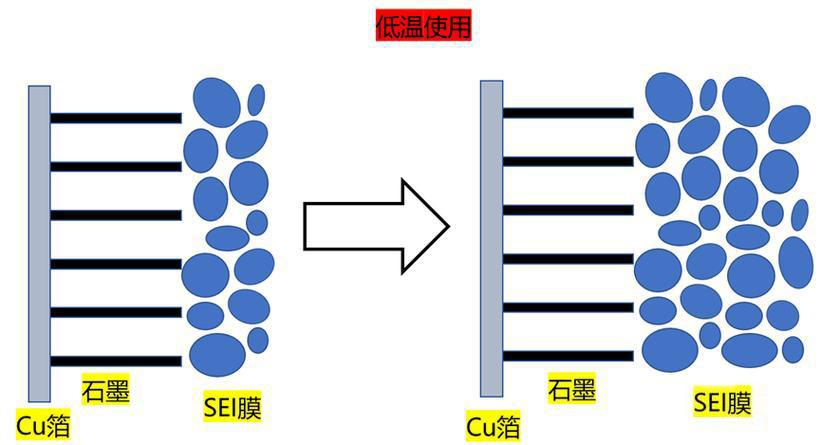
Photo/Battery status in a low-temperature environment. Source/Screenshot from "New Energy Outlook" on the Internet
Technological breakthroughs are being implemented at an accelerating pace.
In 2025, the commercial vehicle sector witnessed the first wave of changes: CATL's first 24V heavy-duty truck start-stop integrated sodium battery will be mass-produced in June. The battery management system specially designed for extremely cold regions can increase the low-temperature cold start success rate from 72% of lead-acid batteries to 98%.
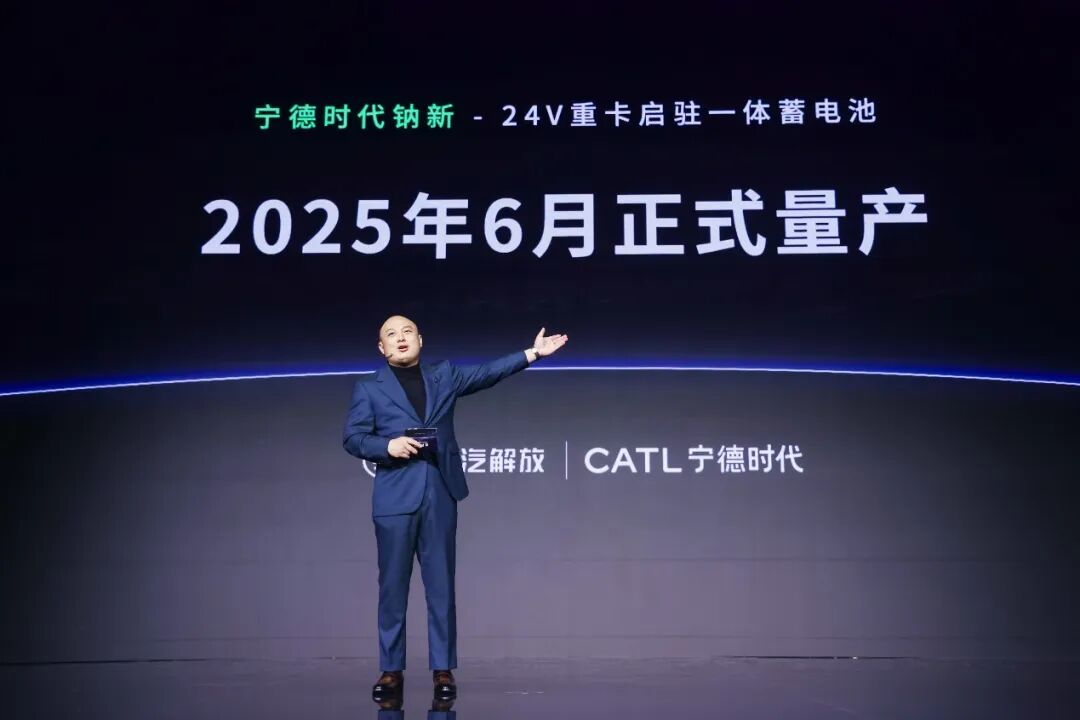
Photo/The 24V heavy-duty truck start-stop integrated sodium battery will be mass-produced in June. Source/Screenshot from "New Energy Outlook" on the Internet
Imagine that in a coal mine in Inner Mongolia, on a minus 35°C morning, heavy-duty trucks equipped with sodium batteries can start with a roar without preheating. Compared with diesel trucks that used to require up to 2 hours of preheating, the efficiency has more than doubled. In the passenger vehicle sector, the energy density of sodium-lithium hybrid battery packs has exceeded 160Wh/kg. It is expected that all-weather batteries will be launched in 2026, and northern vehicle owners will finally bid farewell to the embarrassing situation of "wrapping the battery with an electric blanket".
2. From the "Lithium Boss" to the "Sodium Junior"
Undoubtedly, in the new energy vehicle industry, lithium batteries were once the undisputed "boss".
Global lithium resources are highly concentrated in the "Lithium Triangle" region in South America. A strike by copper mine workers in Chile can cause a raw material panic in Chinese battery factories thousands of miles away. This resource hegemony not only brings price fluctuations - the price of lithium carbonate soared from 50,000 yuan per ton in 2020 to 600,000 yuan per ton in 2022, keeping the cost of electric vehicles high.
On the other hand, sodium is like a low-key "junior". Its abundance in the earth's crust is as high as 2.75%, 423 times that of lithium. There are inexhaustible sodium resources in seawater, salt lakes, and even rocks.
This resource revolution has led to a significant reduction in costs. Industry estimates show that when the cathode material of sodium batteries uses layered oxides and the anode uses hard carbon, the raw material cost is 40% lower than that of lithium batteries. After large-scale mass production, the cost of sodium battery cells can be reduced to 0.3 yuan/Wh, a direct reduction of more than 30% compared to lithium iron phosphate batteries.
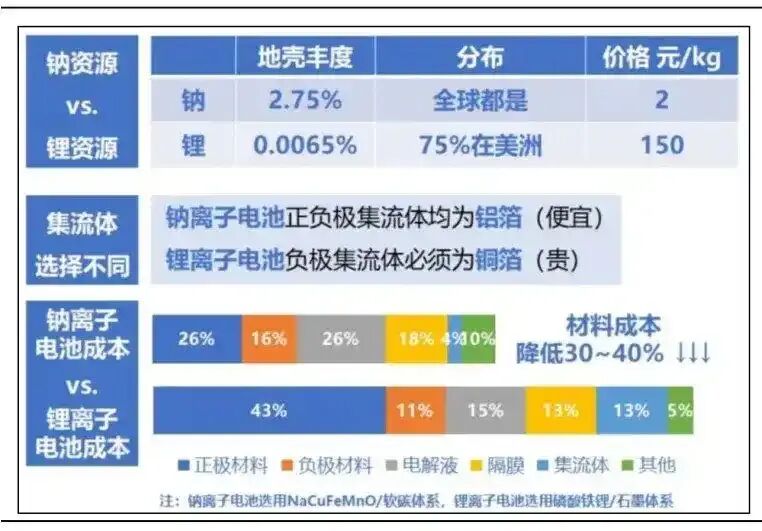
Photo/Cost advantage of sodium batteries. Source/Screenshot from the research institute of Guoyuan Securities, "New Energy Outlook" on the Internet
This means that in the future, for an electric vehicle equipped with a sodium battery, the battery cost alone can be reduced by tens of thousands of yuan. In places like Northeast China and Inner Mongolia, sodium batteries can be parked outdoors at minus 40°C without any problem, like putting a warm coat on the car. There's no need to get up in the middle of the night to warm the battery anymore.
The improvement in daily experience is also obvious. Before getting up in the morning, northern vehicle owners can finally safely turn on the in-vehicle heater remotely - the discharge efficiency of sodium batteries can still reach 85% at -20°C, while lithium batteries can only discharge 50% of their power at this time.
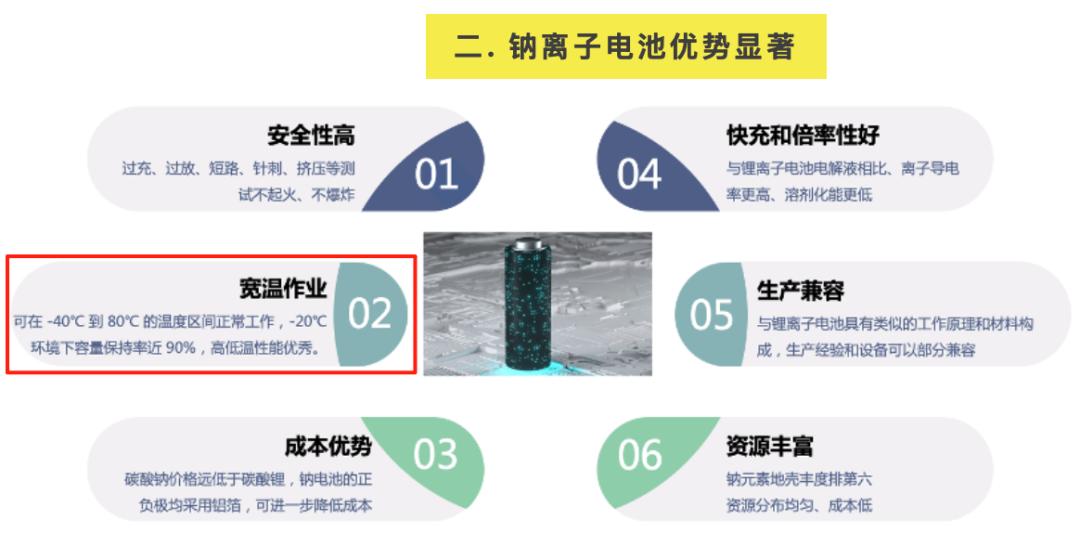
Photo/Advantages of sodium-ion batteries. Source/Screenshot from "New Energy Outlook" on the Internet
When the snow covers the road, an electric vehicle equipped with a sodium battery and snow tires can achieve a real "snow mode": the battery can quickly respond to the motor's torque requirements, avoiding power interruption during rapid acceleration, just like putting anti-skid chains on the wheels. Even more surprisingly, there is a difference in the residual value rate: third-party evaluation agencies predict that in Northeast China, the three-year residual value rate of sodium battery vehicles is 15% higher than that of lithium battery vehicles. For a 200,000-yuan vehicle, it can be sold for 30,000 yuan more after three years.
This change even touches on the deep structure of energy geopolitics. When the five Nordic countries find that sodium batteries can increase the penetration rate of electric vehicles in extremely cold regions to over 50%, and when the salt lakes in the Siberian region of Russia become new strategic resource points due to sodium extraction technology, the global energy map is undergoing a once-in-a-century reconstruction.
Countries that once relied on lithium resources are now reevaluating alternatives to this "white oil". After all, when battery raw materials can be extracted from seawater and every country can have its own domestic sodium resource supply chain, the rules of the energy hegemony game have been rewritten.
3. Will Your Next Car Be Powered by Sodium?
In the commercial vehicle market, sodium batteries are launching a "lightning war". Port cranes, mining dump trucks, cold chain logistics vehicles... These "steel warriors" that operate under high-intensity in extremely cold environments every day are in urgent need of a more reliable power source.
Taking commercial vehicle start-stop batteries as an example, the start success rate of traditional lead-acid batteries is less than 50% at -25°C, while sodium batteries, with a 98% cold start rate, are breaking into this billion-level market.
In the passenger vehicle market, there is a pattern of "coalition and confrontation". The charging pile coverage rate in the three northeastern provinces is only 60% of that in the south, and the failure rate of fast charging piles in winter is as high as 25%. The "cold-resistant constitution" of sodium batteries fills this gap.
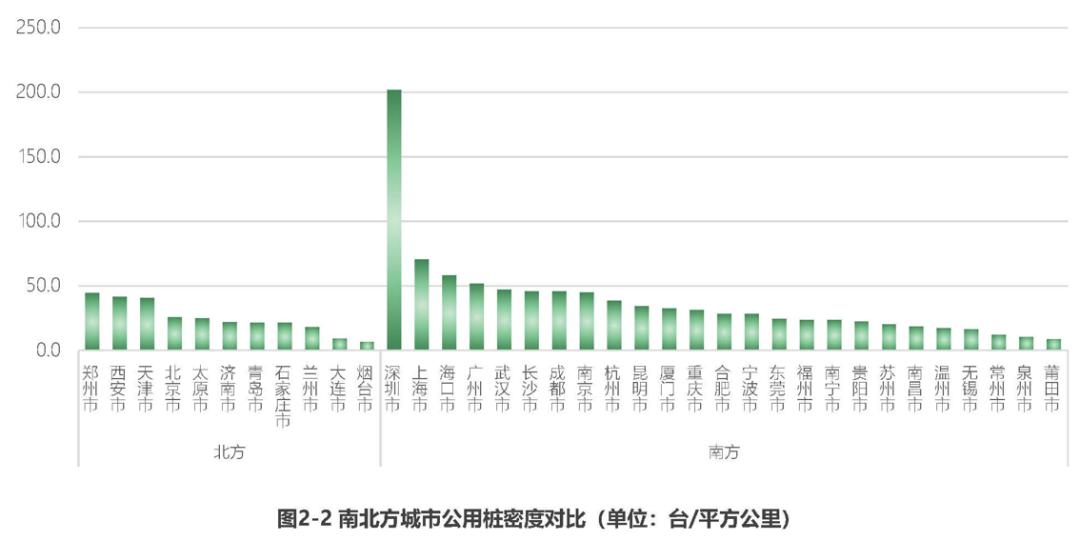
Photo/Comparison of public charging pile densities in some northern and southern cities as of 2024. Source/Screenshot from "New Energy Outlook" on the Internet
The combination of the battery swapping model and sodium batteries is even more ingenious: standardized sodium battery packs can be swapped out in just 3 minutes in a -30°C environment, saving at least an hour compared to charging, like installing a "spare fuel tank" in the electric vehicle.
The ripples of this technological revolution have also affected the global energy pattern. Stockholm University in Sweden predicts that if sodium batteries become popular by 2030, the penetration rate of electric vehicles in the Nordic region will increase from the current 45% to 75%, and the "electric vehicle desert" in extremely cold regions will turn into a "green corridor".
In Russia, the salt lakes in the Yenisei River Basin are planning to build the world's largest sodium battery raw material base. The once-sleepy Siberian wilderness is about to become a new energy hub. In terms of standard setting, China, the United States, and Europe are engaged in a fierce competition - whoever masters the technical standards for sodium batteries will hold the key to the new energy industry in the next decade.
Looking back from the vantage point of 2025, the plight of electric vehicles in extremely cold regions was once like an insurmountable ice wall. However, the emergence of sodium batteries is like the warm spring sun, gradually melting this barrier.
When drivers like Lao Zhang in Northeast China no longer have to worry about their batteries in the early morning and when electric vehicles can start as smoothly as fuel vehicles at -40°C, we can finally say that the era of the "electric daddy" that troubled northern vehicle owners is coming to an end.
In addition to the advantages of cold resistance and cost, sodium-ion batteries also have inherent advantages in terms of safety. They have a higher thermal runaway initiation temperature, a lower self-heating rate, and stronger tolerance to abuse conditions (such as puncturing, short-circuiting, and overcharging), making them inherently safer.
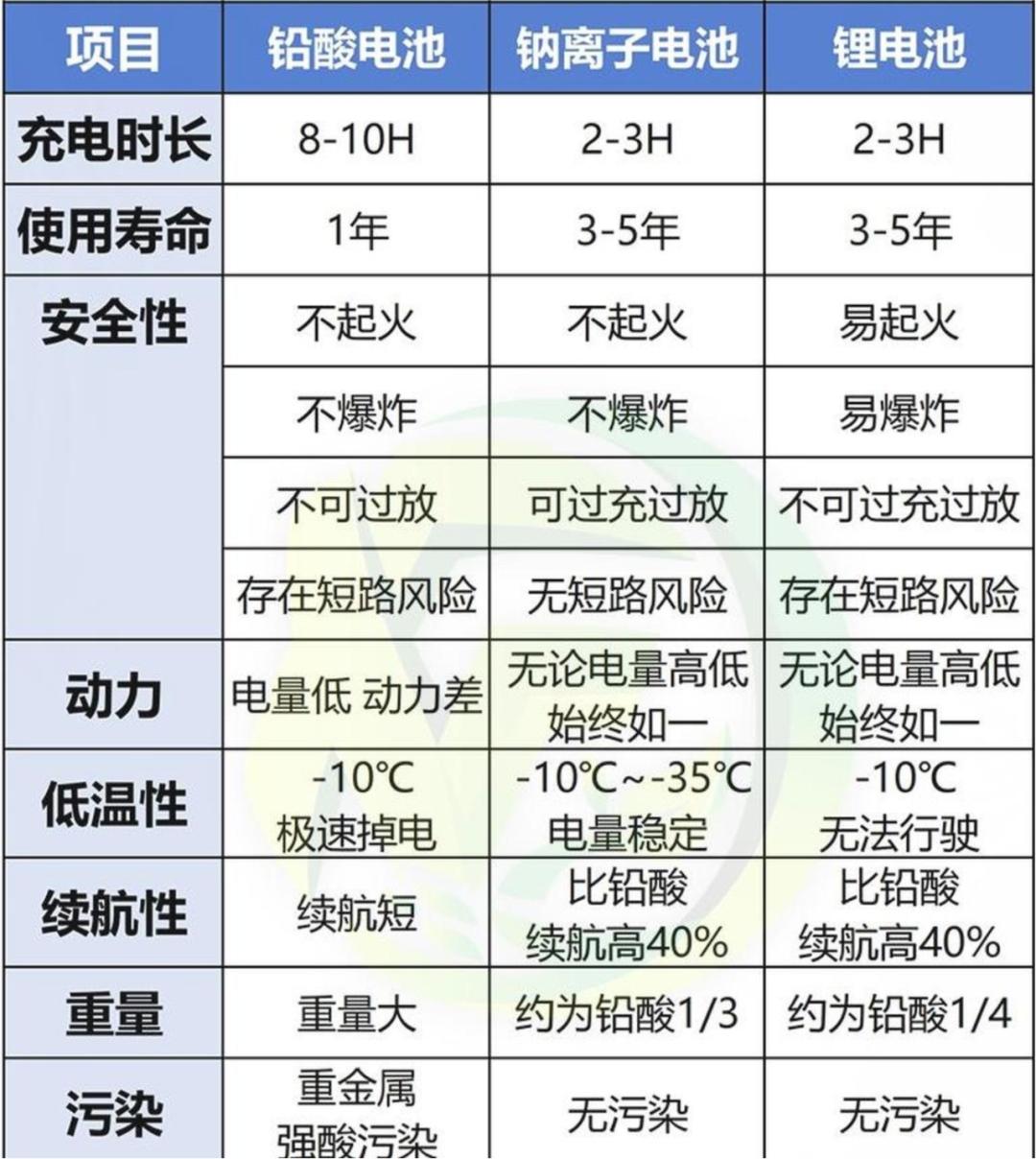
Photo/Comparison of three types of batteries. Source/Screenshot from "New Energy Outlook" on the Internet
This electric vehicle revolution triggered by sodium ions may just be the beginning - in broader fields such as energy storage power stations, two-wheeled electric vehicles, and low-speed new energy vehicles, sodium batteries, with their "cold-resistant genes", are challenging more sectors. Of course, they are not meant to replace lithium-ion batteries but rather to be a useful supplement.
For users in extremely cold and cold regions, sodium-ion batteries should be your top choice when buying a car next year.
This article is from the WeChat official account "New Energy Outlook". Author: Youjian Editorial Department. Republished by 36Kr with permission