The first silicon photonics pilot line in Northwest China is connected | Latest news
Author: Ou Xue
Editor: Yuan Silai
With the rapid development of cutting - edge technologies such as artificial intelligence, autonomous driving, and quantum communication, photon technology, as the underlying support, is becoming a strategic high - ground in global scientific and technological competition. Against this backdrop, Shaanxi launched the "Chasing Light Plan" in 2021.
On November 4th, at the Photonics Industry Summit of the 2025 Hard Technology Innovation Conference held in Xi'an, the Shaanxi Optoelectronics Pre - research Institute announced that the first 8 - inch advanced silicon photonics integrated technology innovation platform in Northwest China (hereinafter referred to as the "8 - inch silicon photonics platform") was officially put into operation. This breakthrough not only fills the gap in the regional industrial chain but also becomes the core fulcrum for Shaanxi to build a 100 - billion - level photonics industry cluster.
"Most of the global silicon photonics pilot resources are concentrated in the hands of European and American enterprises. Domestic enterprises have to pay high fees for tape - outs on foreign platforms and face problems such as long cycles and limited production capacity," pointed out Yang Junhong, the general manager of the Shaanxi Optoelectronics Pre - research Institute at the conference site. She said that the huge investment in equipment required for self - building production lines discourages small and medium - sized enterprises and research teams.
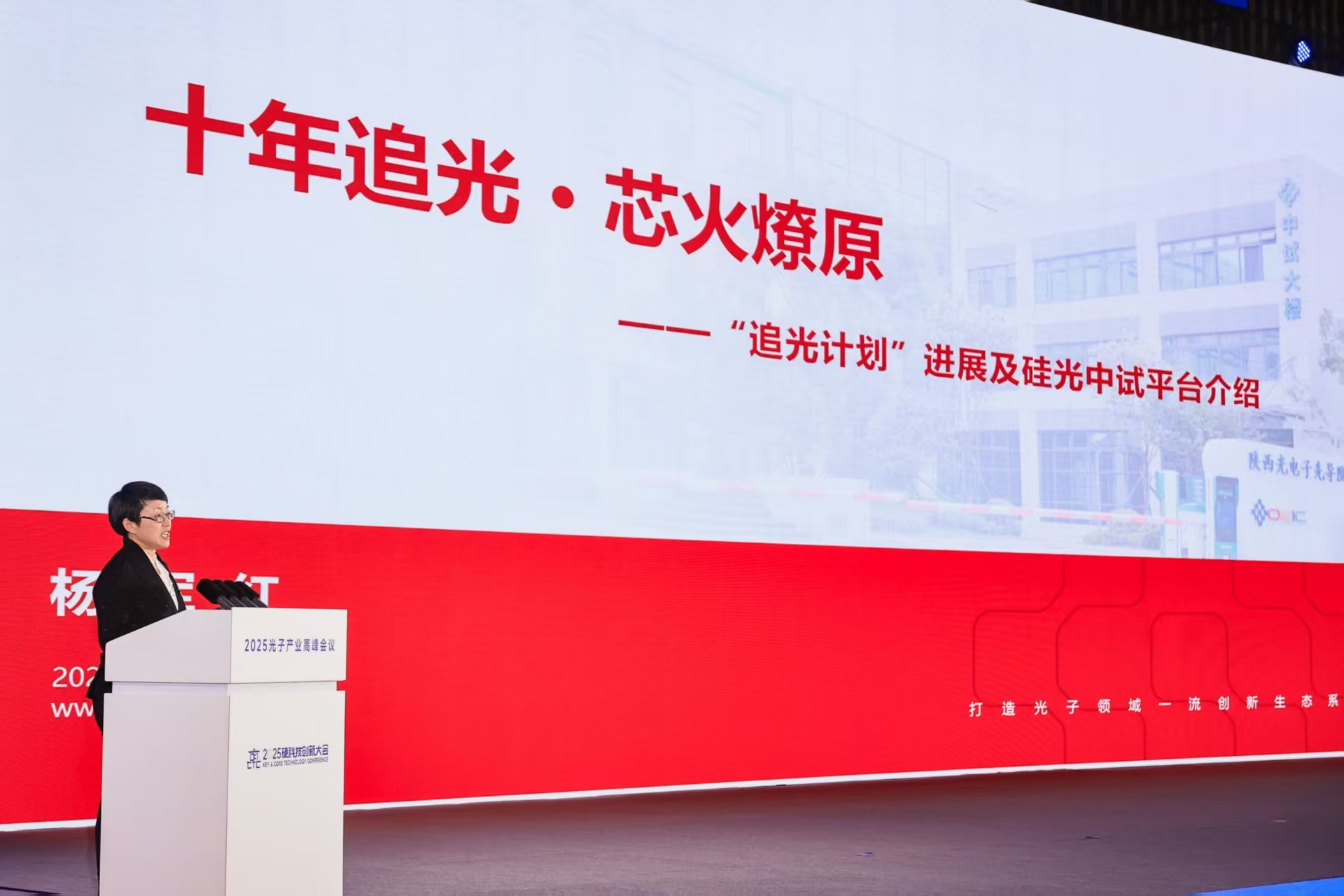
(Yang Junhong, the general manager of the Shaanxi Optoelectronics Pre - research Institute, introduces the progress of the "Chasing Light Plan" and the silicon photonics pilot platform)
36Kr learned that the 8 - inch silicon photonics platform launched by the Optoelectronics Pre - research Institute this time has a total investment of 750 million yuan. It has introduced the "130nm silicon photonics chip process package" from IMEC in Belgium and is equipped with more than 60 key equipment such as lithography and etching machines. Based on the 130nm active integrated silicon photonics main process, the platform is developing advanced processes above 90nm to build an independently controllable process system.
"This is the first pilot platform in the silicon photonics field in Northwest China. Coupled with the 6 - inch compound platform we built before, we have become one of the few innovation carriers in China with full - chain pilot capabilities," Yang Junhong introduced. The platform adopts the "1 + N" flexible engineering model. 80% of the resources of the main process platform are open to small and medium - sized enterprises for pilot tape - out services, and 20% are used to support frontier research and development, realizing efficient resource allocation and industrial collaboration.
Fu Peng, the deputy general manager of the Shaanxi Optoelectronics Pre - research Institute, pointed out in an interview with 36Kr that the explosion of artificial intelligence has put forward higher requirements for computing power and data transmission.
"In the next five years, silicon photonics will be mainly used for the 'optical replacement of copper' inside data centers - optical communication will replace electrical signals at shorter and shorter distances, even down to the centimeter level. Even the chips on the circuit boards and the interface chips will be interconnected through optical connections for data transmission," Fu Peng explained. "This requires a large number of optical chips to achieve the conversion from electricity to light and back to electricity."
After five years, he predicts that optical computing chips will gradually emerge. "Currently, some enterprises are trying to use optical computing chips to solve specific problems. Although they cannot completely replace GPUs at present, optical computing has high speed and extremely low energy consumption, and its proportion in data centers will gradually increase in the future."
In addition to artificial intelligence and data centers, Fu Peng pointed out that photon sensing is another rapidly growing market. "Lidar is not only widely used in autonomous vehicles but also has strong demand in consumer electronics and industrial automation scenarios such as sweeping robots and embodied robots. In the future, the number of lidars installed on automation equipment will continue to increase."
Since the launch of Shaanxi's "Chasing Light Plan" in 2021, it has promoted the leap - forward development of the province's photonics industry. Yang Junhong revealed at the conference that as of now, the number of photonics enterprises in Shaanxi has increased to 379, and the industrial scale has jumped from 15 billion yuan to 36.5 billion yuan, initially constructing a complete industrial chain of "materials - chips - devices - systems".
While building the platform, Shaanxi has also taken a key step in basic photonics research and mechanism innovation. At this photonics summit, Fu Yuxi, the deputy director of the Xi'an Institute of Optics and Precision Mechanics of the Chinese Academy of Sciences, publicly unveiled the construction blueprint of the "Photonics Technology Laboratory" for the first time.
It is reported that the laboratory passed the expert review in August this year and entered the cultivation and construction period. With the Xi'an Institute of Optics and Precision Mechanics of the Chinese Academy of Sciences as the director - unit, relying on the Shaanxi Optoelectronics Pre - research Institute, it will build a comprehensive laboratory integrating "large - scale scientific facilities + common technology platforms + science and technology finance + innovation consortium". The total investment exceeds 1 billion yuan, with 17 director - units, and the cultivation period is 1 - 2 years.
Fu Yuxi revealed that the short - term goals of the laboratory include introducing 30 international top - notch scientists and gathering more than 100 researchers; overcoming more than 30 "bottleneck" key core technologies in the photonics field within two years; building 3 pilot production lines and 2 professional incubation carriers; and boosting the output value of Shaanxi's photonics industry to exceed 50 billion yuan in 2027.