Is it time for a change in the Gallium Nitride (GaN) industry?
When it comes to Gallium Nitride (GaN), most people think of consumer scenarios such as fast charging below 650V. Even though some GaN HEMTs can reach a switching power of 10kW at 1200V, the breakdown voltage of commercial lateral GaN still has limitations. To enable GaN to break through the 650V range and play a role in high-power scenarios from 10kW to 10MW, the vertical structure emerged - it can increase the breakdown voltage without increasing the chip size, and optimize reliability and thermal management by transferring the peak electric field and heat to the bulk substrate.
However, the long - standing pain point of vGaN has been cost. The high price of gallium nitride wafers has restricted its economic feasibility. But this situation seems to be changing. ON Semiconductor (ONsemi) recently launched the epoch - making Vertical GaN (vGaN) and has provided samples of 700V and 1200V to early customers. Its target is the 800V systems in AI data centers, electric vehicles, energy storage, and other fields that were originally dominated by SiC. The development trajectory of GaN is being rewritten.
Is vGaN about to be scaled up?
Looking back at the past few years, NexGen, which focused on vGaN, announced its bankruptcy just before Christmas in 2023. The factory was closed, and the workers were laid off. In January 2025, ON Semiconductor (ONsemi) purchased the former NexGen Power Systems gallium nitride wafer manufacturing plant in DeWitt, New York, for $20 million, including NexGen's intellectual property and the equipment in the DeWitt factory owned by NexGen.
NexGen had made considerable progress in the vGaN field before: In February 2023, NexGen announced that it would provide GaN samples of 700V and 1200V; in July 2023, NexGen also announced that its GaN main drive project in cooperation with General Motors had received funding from the U.S. Department of Energy (DoE) - to develop a power drive system using NexGen's vGaN devices. However, the story ended abruptly with its bankruptcy.
Now, after acquiring NexGen, ON Semiconductor (ONsemi) has revived vGaN and become the first company to scale up vGaN. On its official website, ON Semiconductor fully introduced the latest progress of vGaN after absorbing this company.
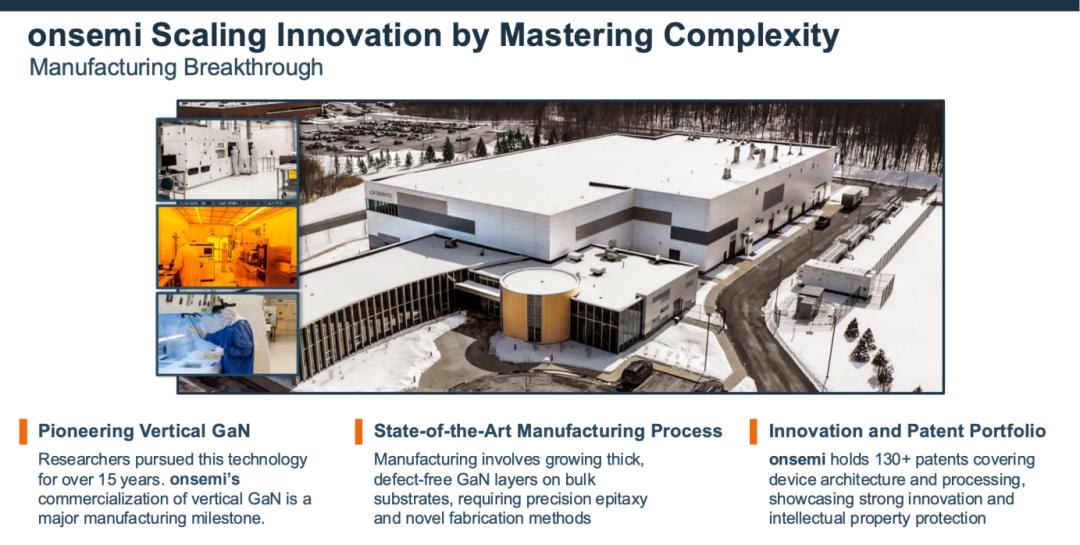
First of all, for vGaN, stable manufacturing and supply are of utmost importance. From the PPT, we can see ON Semiconductor's ambition: Its researchers have been working on this technology for more than 15 years and hold over 130 patents. The R & D work is carried out in a clean - room facility covering an area of 66,000 square feet, which is equipped with dedicated equipment for vGaN production. The next - generation GaN - on - GaN will be developed and manufactured at ON Semiconductor's wafer factory in Syracuse, New York.
Planar/lateral GaN devices are usually based on non - intrinsic/heterogeneous substrates, such as Si, SiC, sapphire, that is, GaN - on - Si / SiC / sapphire. However, the peak electric field of vGaN devices often appears away from the surface, so the mainstream uses a homogeneous substrate, that is, GaN self - supporting, which is GaN - on - GaN. All along, the cost of GaN - on - GaN has been relatively high, so some companies/teams choose to research GaN - on - Si.
ON Semiconductor's vGaN uses a GaN - on - GaN homogeneous epitaxial structure. ON Semiconductor also released a PPT showing the advantages of GaN - on - GaN:
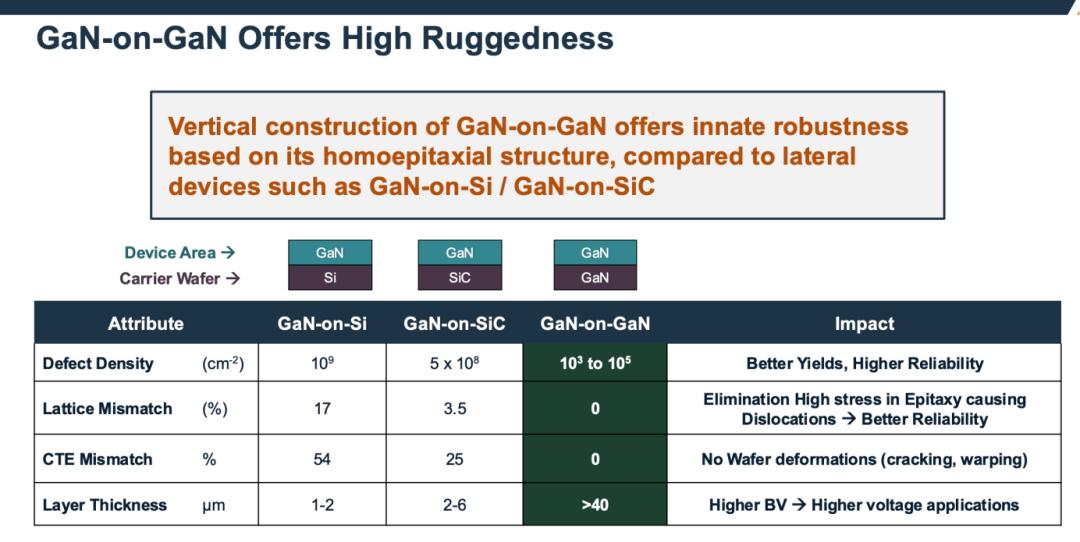
The core process uses ON Semiconductor's proprietary GaN growth process to directly grow a thick and defect - free GaN layer on the GaN wafer, which requires high - precision epitaxial technology and innovative manufacturing methods. pGaN and nGaN are grown by epitaxy. It is worth noting that ON Semiconductor has solved a key problem: mastering the technology of pGaN regrowth on a patterned surface (GaN doping needs to be carried out in - situ during epitaxial growth, and pGaN regrowth is extremely difficult), and holds multiple patents for this technology.
In terms of crystal structure, it has a hexagonal wurtzite structure, with unique electronic and optical properties, high bonding strength, and low intrinsic defects. Its stability and reliability are better than traditional materials (Si, SiC, lateral GaN). It is grown at an extremely high temperature, which further improves the stability and performance of vGaN devices.
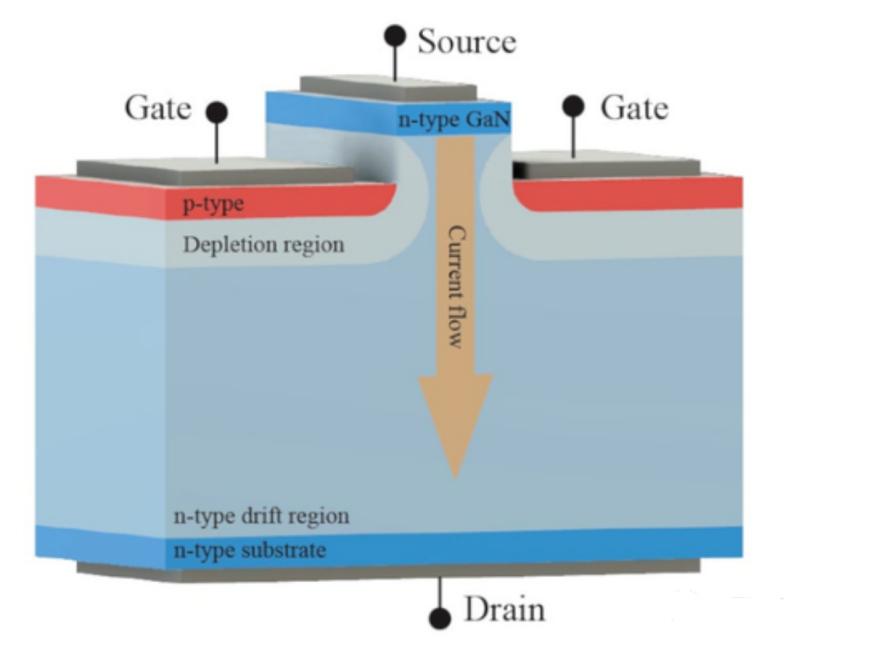
Secondly, the implementation of devices is also an important issue for vGaN. According to its PPT, ON Semiconductor chooses to use the e - JFET (Junction Field - Effect Transistor) device form, which provides a scalable, highly conductive power switch, achieves a lower overall on - resistance RDS (ON), and has complete avalanche capability.
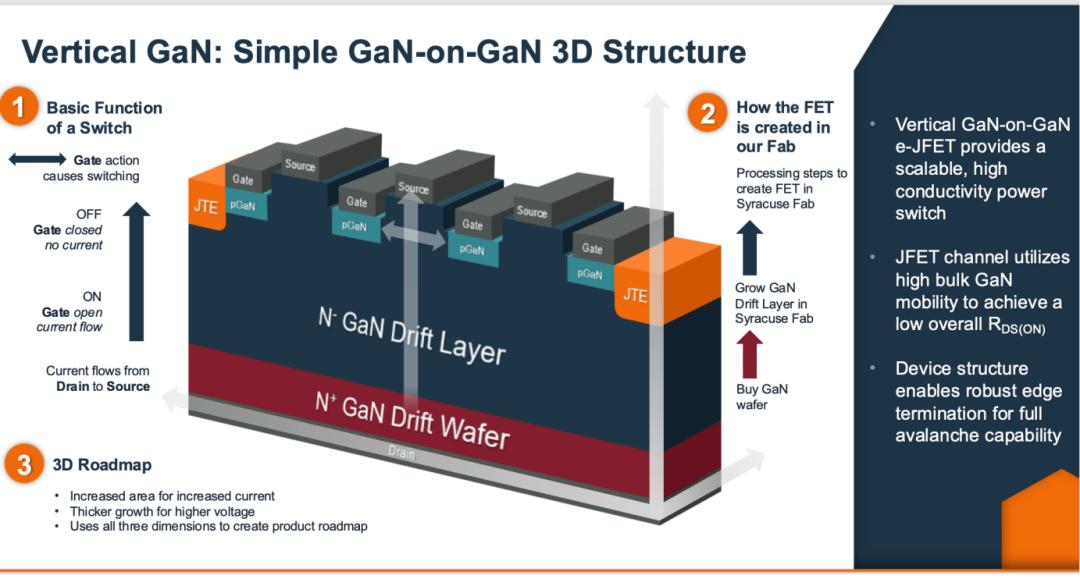
Currently, according to ON Semiconductor's disclosure, it has provided device samples of 700V and 1200V to early customers, and can achieve a voltage level of up to 3300V through technical demonstrations.
In terms of efficiency and size, its vGaN can also reduce energy loss and heat generation, making the power converter as small as a paperback book, achieving system miniaturization and high integration.
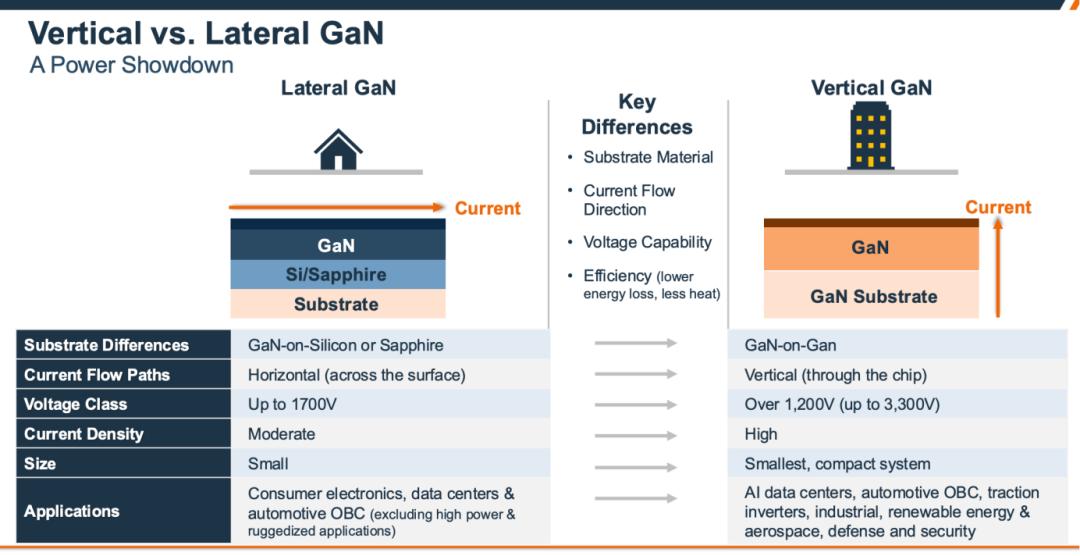
Finally, applications are also very important. ON Semiconductor believes that vGaN can fully meet the current market demand. It can meet the demand of AI data centers for improving computing density, the demand of EVs for extending range and fast charging, and the demand of renewable energy for cost - reduction and efficiency - improvement, and solve the bottlenecks of traditional materials (Si, SiC) in efficiency and size. By comparison, the material properties of GaN itself are naturally suitable for high - frequency applications:
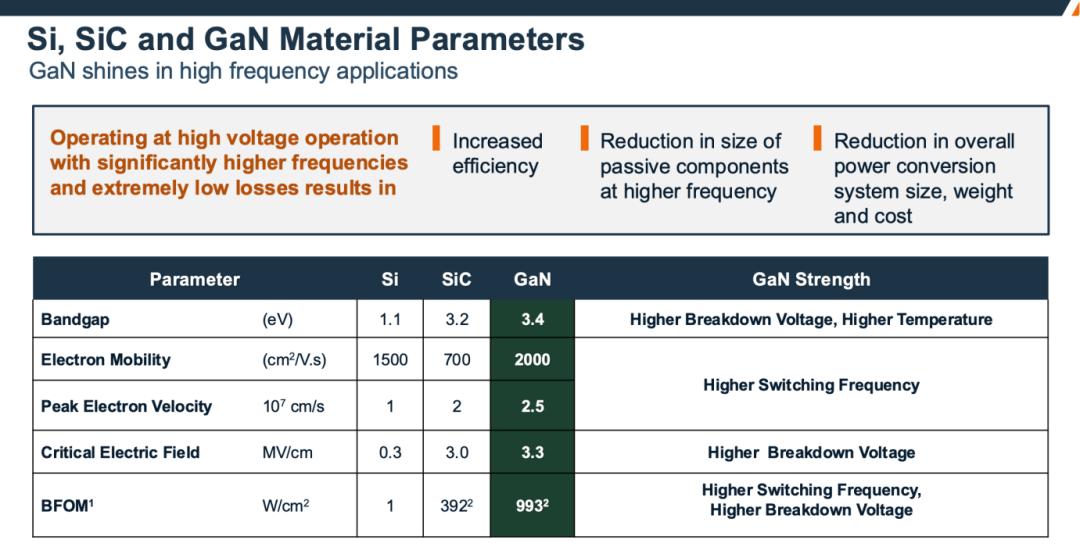
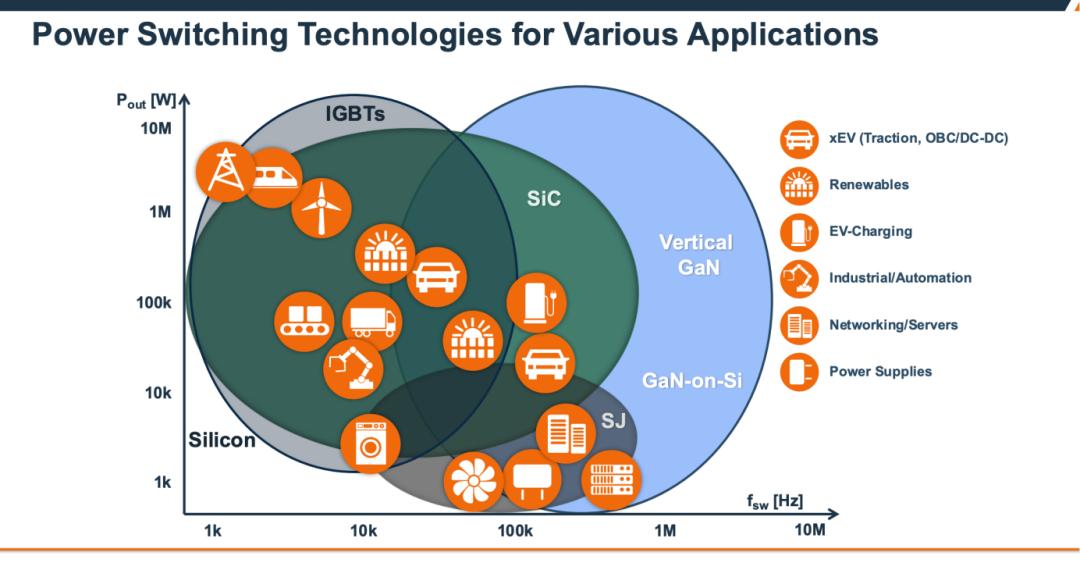
Of course, as GaN can gradually handle some high - power scenarios, how should it be allocated with SiC? ON Semiconductor, a company deeply involved in SiC, also gives an answer - technologies such as IGBT, SiC, SJ, and vGaN have overlaps, but also have their own areas of expertise:
Why is the vertical structure better than the lateral one?
Some people may wonder why when the current changes from lateral to vertical, the breakdown voltage of the device is higher, and why GaN can handle scenarios above 650V or even up to 3300V?
The core advantage of the vertical structure lies in its easier triggering of the avalanche effect. When the voltage exceeds the breakdown value, the avalanche phenomenon first occurs through the reverse - polarized gate - source diode. As the avalanche current gradually increases, the gate - source voltage will rise accordingly, which in turn opens the device channel and enables conduction. This avalanche characteristic is the key to the device's self - protection: once the voltage across the device or the conduction current reaches a peak, the device with this characteristic can absorb these surges and ensure its normal operation.
In addition, the current in vGaN semiconductors flows vertically through the material layers, which significantly reduces the resistance per unit area, improves energy efficiency, and reduces power conversion losses. It is particularly suitable for inverters in electric vehicles and other high - frequency, high - efficiency applications.
The vGaN device also has unique structural advantages. On the one hand, with the same device area, it can increase its own voltage level by increasing the thickness of the internal drift layer (whose main function is to conduct current) of the transistor, so as to adapt to higher - voltage application scenarios. On the other hand, its current conduction path area is larger, which enables it to withstand higher current density and work stably under high - current conditions.
How to determine whether a device is vGaN or lateral GaN? In fact, we need to trace back to the wafer. Although the wafer is a thin slice, it also has a front and a back. When the gate (G), source (S), and drain (D) are all on the front, but in a certain way, the electron movement path becomes "source → vertically downward → laterally through the epitaxial layer → vertically upward to the drain", it is called quasi - vertical (Quasi - vertical) GaN. When G and S are on the front and D is on the back, it is full - vertical (Full - Vertical) GaN.
In terms of device implementation, most lateral GaN uses the High - Electron - Mobility Transistor (HEMT) design. Compared with traditional silicon - based power transistors, GaN HEMT has significant performance advantages, and the cost is getting lower and lower. Another advantage of the lateral structure is the potential to integrate active or passive devices on the gallium nitride power HEMT chip to implement functions such as gate drivers, sensing, or protection circuits. This is the so - called gallium nitride power integrated circuit or gallium nitride power integration.
However, the disadvantage of the HEMT structure is that when epitaxially grown on another substrate (hetero - epitaxial growth), many lattice defects will appear in the crystal layer. For gallium nitride grown on silicon, the defect density is from 10⁸ to 10¹⁰ cm⁻². These defects will affect the reliability of the component under high voltage. Therefore, there are currently no GaN HEMTs with a rated voltage exceeding 900V on the market, and most of them have a maximum terminal voltage of 650V.
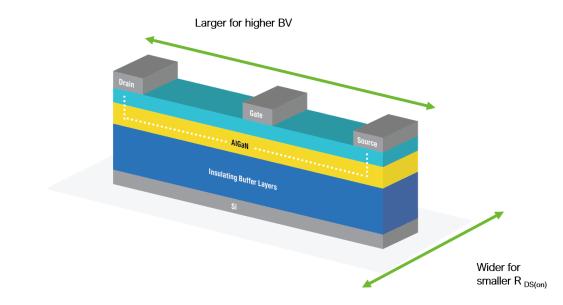
Schematic diagram of the GaN - on - Si HMET structure, source: NexGen
There are mainly five methods to implement vGaN devices:
Trench Metal - Oxide - Semiconductor Field - Effect Transistor (Trench MOSFET);
Fin - Field - Effect Transistor (FinFET);
Junction Field - Effect Transistor (JFET);
Vertical Schottky Barrier Diode (SBD);
Current Aperture Vertical Electron Transistor (CAVET).
Different manufacturers have adopted different routes: Sandia National Laboratories and Shandong University/Huawei use trench - gate vertical MOSFETs; ON Semiconductor (NexGen) uses JFETs; Odyssey uses planar - gate MOSFETs and FinFETs; Zhongjia Technology uses vertical GaN - on - GaN SBDs.
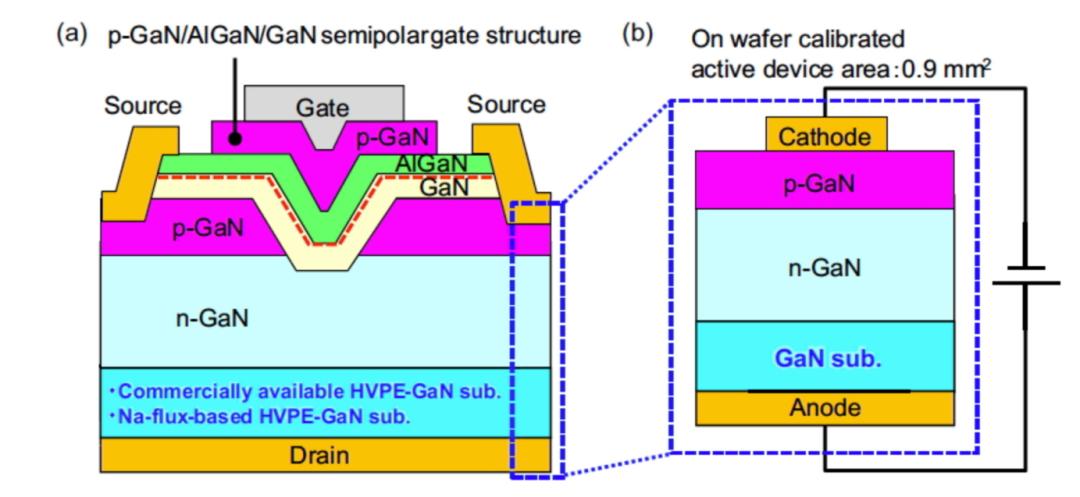
CAVET is quite special. It has the same heterostructure and the same gate module as the traditional HEMT. In CAVEAT, the source region consists of a two - dimensional electron gas (2DEG) formed in the GaN channel near the AlGaN/GaN interface, as in the HEMT. The trench aperture connects the 2DEG to the drain formed in the n - GaN region below the aperture. The Schottky gate above the aperture regulates the device current. As shown in the following figure:
More manufacturers are investing
Besides ON Semiconductor, the vGaN market is quite lively, and many manufacturers are continuously promoting the large - scale implementation of vGaN.
PI
In May 2024, Power Integrations (PI) announced the acquisition of Odyssey's assets, and Odyssey happens to be a vGaN company. Odyssey has repeatedly emphasized that its 650V and 1200V vGaN devices offer lower on - resistance and a higher figure of merit. Its on - resistance is only one - tenth of that of Silicon Carbide (SiC), and the operating frequency is significantly increased. In 2022, Odyssey said it had obtained commitments from three customers to evaluate samples of these first - generation products. In 2023, Odyssey said it was manufacturing samples of vGaN FET transistors with an operating voltage of 650V and 1200V in the United States.
Shin - Etsu Chemical
Shin - Etsu Chemical mainly masters two key technologies, which are expected to reduce the material cost by 90%: First, it achieved a withstand voltage of 1800V with a GaN engineered substrate. In 2019, Shin - Etsu Chemical obtained a patent license for the (QST) engineered substrate from QROMIS in the United States; Second, it developed a substrate - stripping technology. The reason why the QST substrate has not been commercially used on a large scale is the lack of an efficient stripping technology. Shin - Etsu Chemical, in cooperation with Oki Electric Industry Co., Ltd. (OKI) in Japan, developed the CFB (Crystal Film Bonding) technology, which realized the separation of the GaN functional layer from the QST substrate and also solved the defect problem well, thus greatly improving the high - quality QST substrate.
