The number of top scientists in China has surpassed that in the United States.
Chinese scientific research is moving away from the "quantity-driven" approach and achieving a shift from following to leading through quality and leadership. The proportion of China leading in international cooperation has risen rapidly and is approaching parity with the United States and Europe. Key sectors such as artificial intelligence, advanced communications, semiconductors, and quantum technology are accelerating across the board, with a simultaneous increase in top journal publications, highly cited research, and top-tier talent. Relying on the "Belt and Road" science network and evaluation reforms, China is expanding its influence through open cooperation and reshaping the global scientific and technological landscape.
Over the past few decades, Chinese scientific research has staged a remarkable comeback on the international stage, rising from a latecomer to a front - runner.
There was a time when Chinese scholars were labeled as a "paper - producing giant" due to the sharp increase in the number of research papers, but the quality of these papers was uneven.
Now, China is gradually shedding the stereotype of "winning by quantity" and emerging with higher - quality scientific research and stronger leadership.
In the long - distance race of international scientific research cooperation, the once - leading competitor is starting to feel the approaching footsteps from the East. China is transforming from a follower into a leader.
This transformation is not only reflected in the number of published papers but also in the change of roles in scientific research cooperation and the enhancement of the influence of research results.
A joint Sino - US paper published in the top journal PNAS (Proceedings of the National Academy of Sciences of the United States of America, a first - tier journal according to the Chinese Academy of Sciences) reached this conclusion through extensive analysis. The authors of the paper are from Wuhan University, the University of Chicago, and the University of California, Los Angeles in the United States.
Paper link: https://arxiv.org/abs/2406.05917
From Following to Leading
China's Presence in International Scientific Research Teams
Playing a leading role in global scientific research cooperation teams is an important indicator of a country's status as a scientific research powerhouse.
For a long time, researchers from developed countries such as the United States and Europe have often dominated international cooperation projects, while Chinese scholars have mostly played a following or supporting role.
However, this situation is changing rapidly.
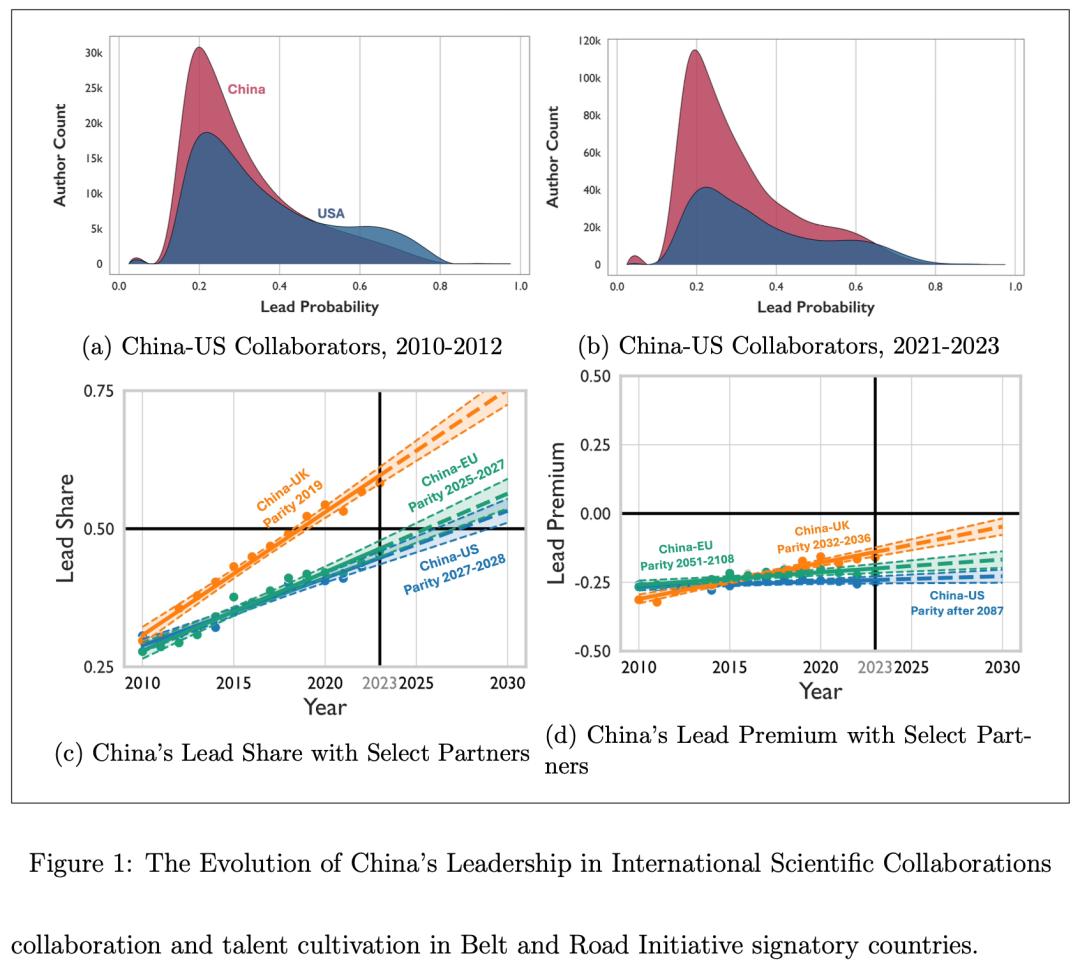
Data shows that the proportion of Chinese scientists taking the "leading" role in bilateral cooperation teams is rising significantly.
In 2010, only about 30% of the leading researchers in Sino - US joint papers were Chinese, while Americans accounted for 70%.
By 2023, this proportion had changed to about 45% for China and 55% for the United States.
In less than 15 years, the proportion of China's leadership in Sino - US scientific research cooperation has almost doubled.
According to the prediction of the research model, the proportion of leaders in Sino - US scientific research cooperation is expected to reach equilibrium around 2027.
In scientific research cooperation with the European Union, China is expected to catch up with the EU between 2025 and 2027, and it has already achieved parity with the United Kingdom in cooperation as early as 2019.
In other words, Chinese scientists are rapidly narrowing the gap with the United States and Europe in terms of leadership in international teams.
It is worth noting that the above - mentioned catch - up is mainly reflected in absolute numbers.
If we consider the base of scientific research personnel and measure the relative probability of each researcher taking on a leadership role (i.e., the "leading premium"), China still has a long way to go in catching up.
The study found that, according to the current trend, it may not be possible for China to reach the same level as the United States in terms of the frequency of each researcher taking on leadership responsibilities until the end of this century (after 2087).
Even compared with the European Union, China's catch - up in per - capita leadership may be postponed until after the middle of this century.
This means that although China has a large scientific research team, it remains a challenge to enable more "front - line researchers" to grow into leading figures capable of leading projects.
Nevertheless, there are more and more cases of Chinese top - tier scientists taking on major roles in international cooperation. This transformation from "following" to "leading" is quietly changing the global scientific research cooperation landscape.
From Artificial Intelligence to Quantum Technology
Overtaking in the Frontier Technology Race
The competition in scientific strength is concentrated in key frontier fields such as artificial intelligence, semiconductors, and communications.
In the past, these fields were long dominated by Western countries, but now China is rapidly narrowing the gap and leading in some areas.
Analysis of 11 key technology fields defined by the US National Science Foundation shows that in 8 fields, including artificial intelligence, advanced communications, and semiconductors, the proportion of Chinese scientists taking the leading role in Sino - US cooperation is expected to catch up with, equal, or even exceed that of the United States before 2030.
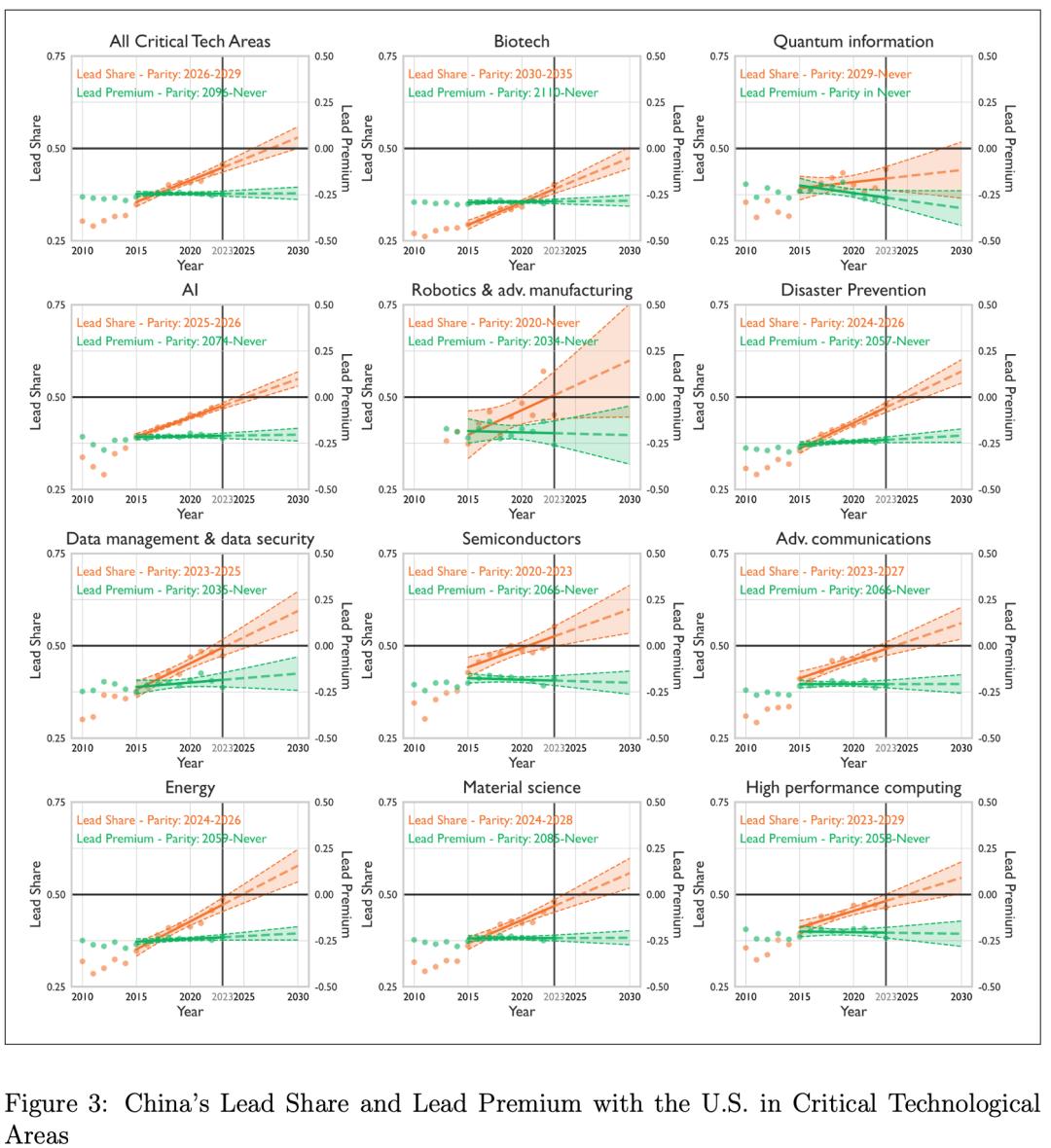
Overall, the share of leadership in Sino - US overall scientific and technological cooperation is expected to reach parity between 2026 and 2029.
In Sino - US cooperation in the field of artificial intelligence, the proportion of Chinese scientists taking the leading role is expected to approach that of the United States by the late 2020s. The same situation will also occur in many high - tech fields such as disaster prevention and mitigation, data security, advanced communications, energy technology, new materials, and high - performance computing.
In contrast, China may not catch up with the United States in terms of leadership in the biotechnology field until after 2030, and it may gradually approach the US level in the quantum information field after 2030.
The only exception is the field of robotics and advanced manufacturing. Due to limited data, the prediction is still uncertain, but the general trend is that China is rapidly approaching the leading group in most frontier technology sectors.
Take artificial intelligence as an example. This field is the focus of today's scientific and technological competition.
In recent years, China has made huge investments in the development of artificial intelligence. Not only does it rank first in the world in the number of published artificial intelligence research papers, but it also leads in patent output.
More importantly, China's artificial intelligence research is making a breakthrough from "quantity" to "quality". Although the United States still leads in the development of top - tier artificial intelligence models, the performance of China's artificial intelligence systems has improved rapidly, narrowing the gap with the United States from a "double - digit" level two years ago to almost parity today.
In 2024, although the United States produced 40 globally - renowned artificial intelligence models while China produced 15, the performance of Chinese models in key tests has almost caught up with that of the United States in the same period.
This shows that China not only leads in the number of artificial intelligence papers and patents but also rapidly narrows the gap in core artificial intelligence technologies and model capabilities.
Then, look at the semiconductor and communication fields. China is already recognized as one of the leaders in 5G communication technology, with its relevant scientific research and applications leading the world.
In the research of integrated circuits and chips, despite the pressure of technological blockade, Chinese researchers have published a large number of high - level papers in cutting - edge areas such as materials and manufacturing processes, and the number of cases where they play a leading role in international cooperation is increasing year by year.
These breakthroughs in key technology fields are not only due to the country's strategic investment but also to the extensive cooperation and catch - up efforts of Chinese scientific research teams on a global scale.
It is worth mentioning the amazing progress China has made in the field of quantum technology.
In 2020, Chinese scientists developed the "Jiuzhang" quantum computer, which demonstrated quantum supremacy (quantum hegemony) using photons. It completed a computational task in 200 seconds that would take a classical supercomputer hundreds of millions of years to finish.
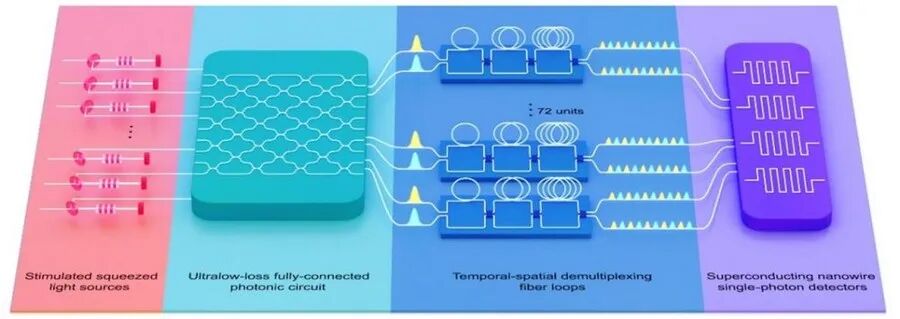
Schematic diagram of the experimental setup of the new "Jiuzhang III" quantum computer
This was the second time in the world after Google that such a milestone breakthrough was achieved, shocking the international physics and computing communities.
This photon - based quantum computing prototype demonstrated China's strong strength and creativity in quantum computing research.
In addition, as early as 2016, China launched the world's first quantum science experimental satellite, "Micius".

With the help of this satellite, scientists successfully conducted the world's first intercontinental quantum - encrypted video call between Beijing and Vienna in 2017.
This feat marked that China has taken the lead in the field of quantum communication, turning the sci - fi scenario of ultra - secure communication through quantum entanglement distribution into reality.
These breakthroughs indicate that in frontier fields such as quantum computing and quantum communication, China is no longer a follower but has started to lead the new race.
Meanwhile, China is also making steady progress in fields such as biotechnology.
As early as 2016, the number of high - impact biotechnology papers published by China had exceeded that of the United States and Europe, ranking first in the world.
By 2023, China ranked among the top in the global share of highly cited papers in cutting - edge areas such as synthetic biology, genome sequencing, and new antibiotics. More than 60% of the most frequently cited papers in the field of synthetic biology were written by Chinese researchers.
It can be said that from artificial intelligence to quantum technology, from chips to biomedicine, China is rapidly emerging as a key player in various frontier scientific and technological fields.
In the past, these high - ground areas were monopolized by the West, but now Chinese scientific research is rewriting the scientific and technological landscape with its overtaking momentum.
When Science Takes the "Silk Road"
In addition to catching up with traditional powerful countries, China has also opened up a unique "Scientific Silk Road" through the "Belt and Road" Initiative.
This new Silk Road is different from the ancient caravan routes, but it also closely connects China with many countries in Asia, Africa, and Europe. The only difference is that the goods being exchanged are knowledge and talents.
Through the "Belt and Road", China actively expands scientific research cooperation with countries along the route, supports these countries in cultivating scientific and technological talents, and plays a leading role in cooperation.
First of all, in terms of education and talent cultivation, China has spared no expense in investing in scientific research talents from "Belt and Road" countries.
According to statistics from the Chinese Ministry of Education, from 2012 to 2024, the Chinese government has cumulatively invested more than 32 billion yuan (about 4.5 billion US dollars) to support foreign students to study in China.
This huge amount is amazing. It is equivalent to 70% of the funds China uses to support its domestic students to study abroad and 66% of the annual budget of the US National Science Foundation in 2018.
In other words, China is making almost the same effort to cultivate overseas scientific and technological talents from countries along the "Belt and Road" as it does for domestic talents.
Although the number of foreign students in China declined in the early 2020s, the funding program rebounded rapidly in 2023, showing China's determination to continue promoting this educational diplomacy.
The composition of foreign students coming to China has also changed.
In the early days, most foreign students in China came from developed neighboring regions such as East Asia and Europe.
But by 2018, students from developing countries in South Asia and Africa accounted for nearly half of the total.
China has gradually tilted scholarship and enrollment quotas towards less - developed "Belt and Road" partners to help these countries cultivate much - needed scientific and technological talents.
This change means that China is directing its educational resources towards developing countries that need more help and are more likely to establish close scientific research ties with China.
Many young talents from "Belt and Road" countries are pursuing master's and doctoral degrees in Chinese universities, and many of them have chosen research directions related to the "Belt and Road".
In 2012, only 0.21% of master's and doctoral theses in China were related to the "Belt and Road" theme. By 2019, this proportion had risen to 1.17%.
The number of papers related to the "Belt and Road" written in Chinese by foreign students has increased by six times during the same period!
This shows that a large number of young scholars from developing countries are integrating into China's scientific research system and engaging in "Belt and Road" research projects under the guidance of Chinese mentors, creating a mutually - beneficial situation.
These foreign students not only strengthen the scientific and technological ties between their home countries and China but also bring diverse perspectives to Chinese scientific research.
In terms of scientific research cooperation, the "Belt and Road" Initiative has also given China greater say.
Since many countries along the route have relatively weak scientific research foundations, China often takes the leading role in cooperation with them.
For example, when analyzing countries along the "Belt and Road" by economic level:
For low - income countries, the proportion of Chinese scholars taking the leading role in bilateral cooperation papers is much higher than that of the other side.
Even when cooperating with high - income "Belt and Road" countries, China reached a level of parity in scientific research leadership around 2020.