At 22, I used AI to help 40,000 students prepare for exams and received investment from Changpeng Zhao.
Text by | Deng Yongyi
Edited by | Su Jianxun
In September 2025, Zhao Kai, the founder of VideoTutor, had his first online meeting and in - depth conversation with Changpeng Zhao, the founder of Binance. One month later, his first round of financing was successfully completed - Changpeng Zhao's YZi Labs announced leading the investment in VideoTutor, becoming the first - round external investor of this startup.
Zhao Kai said that the primary reason for quickly finalizing the financing was that both sides shared the same great enthusiasm for education. Changpeng Zhao also launched the non - profit education project GiggleAcademy after achieving success, providing educational opportunities for poor children in developing countries.
Secondly, it was the rapid iteration ability demonstrated by the VideoTutor team. After the investment was completed, Changpeng Zhao's only advice to this young man was: "Keep making the product better and don't be in such a hurry to make money."
After this round of financing, everything accelerated. Soon after, Zhao Kai made a more difficult decision - officially dropping out of school and starting a full - time entrepreneurial journey.
If Zhao Kai were to tell his own story, it would be like a fast - paced entrepreneurial novel.
In the third grade of primary school, he first read *Fire in the Valley* and books by Kevin Kelly, which gave him his first impression of the technological world across the ocean. He then began to tinker around - teaching himself programming, actively participating in various competitions, winning awards, and preparing to come to Silicon Valley.
In 2023, Zhao Kai was admitted to San Jose State University in the United States and quickly started his entrepreneurial journey: In his freshman year, he developed a dating app for college students with his senior and received a $200,000 financing. The project failed eight months later. In his sophomore year, he participated in founding the math learning app MathGPT Pro, was selected by Miracle Plus, and received early - stage investment.
However, the second entrepreneurial experience made him feel that the pure - text photo - based question - solving apps had reached their ceiling. So, in 2025, he, Google AI engineer James, and his roommate Nick officially founded the new company VideoTutor, still focusing on the problem - solving scenario for entrepreneurship.
VideoTutor is an AI problem - solving app. Students can take a photo or input a math problem (currently mainly standardized test questions such as SAT and AP). After a few dozen seconds, a video with smooth problem - solving animations (such as drawing function graphs and marking geometric figures) and clear step - by - step breakdown will be generated, providing an experience very similar to having an excellent teacher explain the problem on a whiteboard.
Currently, VideoTutor is still in the pre - testing phase. The first problem - solving video is free, and after that, it costs $3.99 for every 4 videos generated.

△Source: VideoTutor
The achievements of this app are: within 20 days of the product's launch, the number of registered users exceeded 30,000, the video views exceeded 10 million, and over 100,000 videos were generated.
Recently, VideoTutor also completed a new round of financing of over $11 million. This round of financing was led by YZi Labs under Changpeng Zhao, with joint participation from BV Baidu Ventures, Jinqiu Fund, Amino Capital, BridgeOne Capital, and several well - known investors. This is also an angel - round financing with a relatively high amount in recent North American student entrepreneurship.
Zhao Kai said that the reason he has been focusing on the education and student market is not only because the founding team members are all students and can better understand the needs of the student group.
The deeper reason is that he himself achieved today's success through higher education. After graduating from high school in China, with the help of a foreign couple and his parents even selling their house to support his education, he was finally able to come to Silicon Valley in the United States to pursue his entrepreneurial dream.
Before completing this round of financing, VideoTutor also rejected a high - value acquisition offer.
Zhao Kai told *Intelligent Emergence* that he rejected the acquisition because he believes that problem - solving is just the starting point for VideoTutor. In the future, VideoTutor can go further, expand to more subjects and learning aspects, become a multi - disciplinary product, and surpass leading education apps such as Duolingo.
Starting from generating problem - solving videos, targeting test - preparation groups
In the problem - solving scenario, accuracy is very important. The difficulty of VideoTutor's product lies in how to make the videos generated by AI accurate?
Zhao Kai explained that first, there is the difficulty of geometric analysis. Traditional OCR recognition technology is difficult to achieve high accuracy. VideoTutor has built a geometric analyzer into the product, which can convert geometric figures such as triangles, plane geometries, and lines into machine language that large models can understand, accurately describing the geometric relationships between points, lines, and planes.
Secondly, there is the issue of animation rendering. Many software products in the past have had problems with element misalignment when rendering animations. For example, curves do not appear on the correct coordinate axes.
To address this problem, the VideoTutor team rewrote an animation engine rendering protocol from the ground up, which can accurately place different elements in different positions and control the engine to render each frame of the picture through code.
The accuracy of answers is also one of the pain points. Because large models may have hallucinations, it is difficult to guarantee 100% accuracy of answers. VideoTutor uses a two - layer model to compare answers. If the question is difficult, it will be calibrated by the Claude and Gemini models, and the answer will only be output when the two models agree, ensuring accuracy.
Finally, there is a large amount of real - sample training. VideoTutor has generated over 100,000 videos and has formed a team of high - scoring SAT and AP students. These students are responsible for marking which parts of the AI - generated videos are incorrectly explained and how normal students would explain them. These real feedbacks are used to retrain the model.
"We have now fine - tuned thousands of SAT and AP sample videos," Zhao Kai said. "As the data increases, the cost of generating videos is also constantly decreasing, and a flywheel effect will be formed."
This is in sharp contrast to the previous learning model. In the past, teachers needed to use tools such as Geometer's Sketchpad, PPT, or other visualization tools to draw figures and record screen explanations. Preparing a one - hour video course required at least one to two hours of post - production time. Moreover, these videos were static and standardized, unable to be personalized.
This aspect has even given rise to a well - known IP in North America. The 3blue1brown channel on YouTube, founded by Grant Sanderson, an alumnus of Stanford's mathematics department, also mainly focuses on producing visualized math problem - solving videos and has attracted nearly 8 million subscribers.
Now, on the VideoTutor product, it only takes 60 - 90 seconds from the time a student inputs a question to the generation of a complete video.
VideoTutor's product has also attracted a lot of attention after its launch. Zhao Kai said that the team posted a comparison video on Twitter, putting a video recorded by a real teacher from Khan Academy and an AI - generated video side by side. People found that there seemed to be no difference between the two. After the product's launch, within 20 days, the number of registered users of VideoTutor exceeded 30,000, the video views exceeded 10 million, and over 100,000 videos were generated.
"Momentum is King"
It's undeniable that VideoTutor has had some good luck.
In the interview, Zhao Kai mentioned several times a well - known Silicon Valley quote: "Momentum is King", which means that startups need to maintain a continuous growth momentum in the early stage of development, whether it's product iteration, user retention, or the speed of talent and capital absorption, they need to maintain a positive and accelerating momentum.
Currently, the VideoTutor team has fewer than 10 people. The team rented a single - family villa in Sunnyvale, Silicon Valley, which is close enough to the school to visit students and teachers at any time. Team members iterate on functions on a daily basis. "Only by maintaining a small - team size and reducing communication costs can we ensure rapid product iteration," Zhao Kai said.
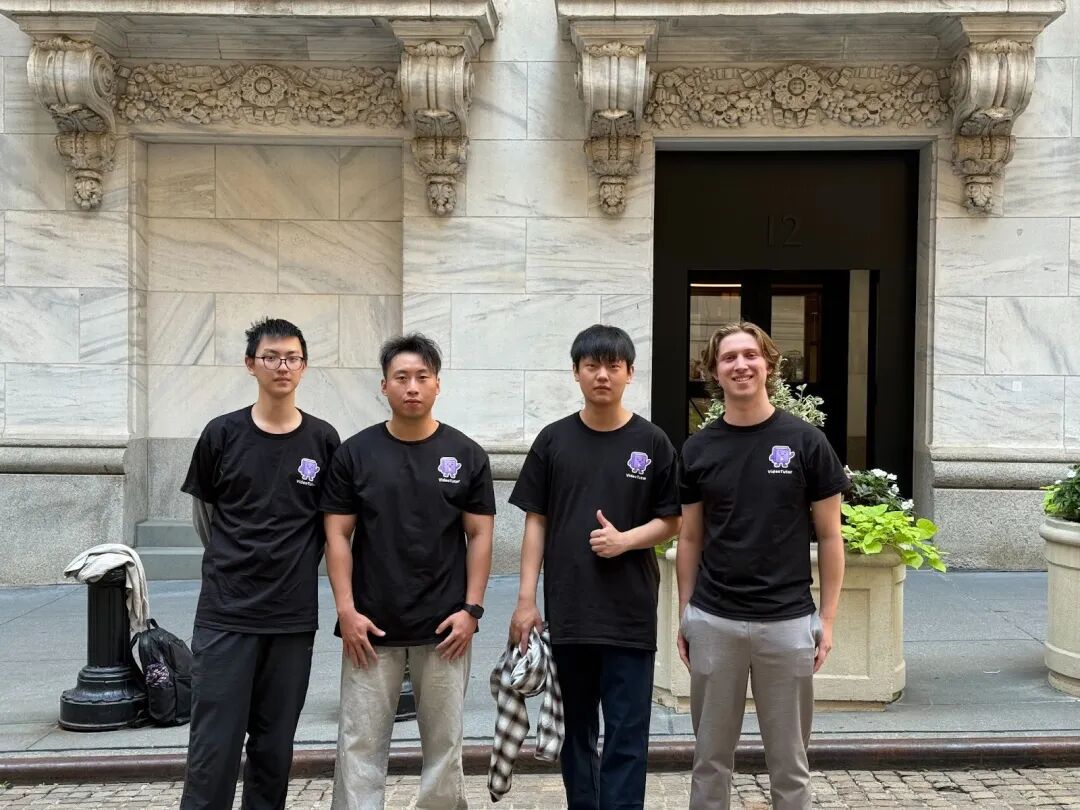
△VideoTutor team
In 2025, the foundation models were still developing rapidly, and the technological boundaries were unpredictable. The timing of entrepreneurship was undoubtedly important. After the release of models such as Claude 4.0 and GPT - 5, the reasoning ability of the foundation models was greatly enhanced, which provided a very good foundation for VideoTutor's start.
Before VideoTutor, there were also startup companies with similar models in Silicon Valley. In April 2024, Gatekeep, a similar product developed by a student team from Stanford University, also focused on AI problem - solving video generation, received financing, and caused a stir, but soon stopped updating.
Zhao Kai believes that there are two core reasons why Gatekeep struggled to continue: First, when Gatekeep started its business, the coding ability of the base models at that time was not mature enough. Claude 4.0 had not been released, and Sora had not been released either. Second, the product's animation engine was not yet able to accurately render points, lines, and planes.
However, the development of foundation models is a double - edged sword. For example, shortly after VideoTutor was founded, ChatGPT launched its Study mode.
I asked Zhao Kai if he was afraid of being swallowed up by the foundation models.
"It's very important to understand your own value," Zhao Kai replied. "The core mission of large - model manufacturers is AGI. They are unlikely to invest heavily in all niche areas, which leaves an ecological niche for application - layer companies that truly understand the industry. Our value lies in understanding education and students better than large companies."
Regarding other competitors in the market, Zhao Kai said that VideoTutor and they are not targeting exactly the same scenarios. For example, Chegg and Gauthmath are for daily homework tutoring, and students use them mainly to complete their homework and need to get answers quickly.
"The fundamental difference lies in the learning motivation," Zhao Kai explained. "Our users have a very clear goal - to pass the SAT or AP exams. They have a strong desire to actively learn and understand. Many homework - answering apps are more like passive learning tools. If the need is just to quickly get answers to complete tasks, this need can easily be met by free general large models."
From a business - model perspective, VideoTutor currently hopes that AI can gradually replace some offline tutoring services. Currently, in the United States, the price of hiring an offline tutor is at least $100 - $400 per hour, and an online course also costs about $100 per session. In terms of price, VideoTutor only charges $3.99 for generating four videos, which is dozens of times cheaper.
VideoTutor hopes to start from the test - preparation group and then expand to more fields and subjects. "In theory, all subject problems in the K12 field can have explanatory videos generated because K12 has relatively standardized textbooks and knowledge points," Zhao Kai said. "In the future, we will expand from SAT and AP math to more subjects, extend from the problem - solving aspect to learning - path planning and effect evaluation, and ultimately become the exclusive AI tutor for each student."
VideoTutor plans to develop both the C - end and B - end markets in the future.
Currently, the team has received the first batch of B - end cooperation intention orders. For example, an Indian tutoring institution with 60,000 students has signed a cooperation agreement, using VideoTutor for students to study for the JEE Advanced (Indian Institute of Technology entrance exam). In October, VideoTutor just reached a cooperation with the US campus social platform Fizz, which covers users from over 350 universities in the United States.
For ten years, Zhao Kai's profile picture on social media has been his favorite character - Hiro, the protagonist of *Big Hero 6*, a genius geek who uses his technological skills to help others and change the world.
"There are many children in the United States who can't afford a $400 - per - hour tutor, but they also need good education," Zhao Kai said. In the future, VideoTutor's biggest goal is to achieve educational equality and enable more children to have access to good educational resources.
*Videotutor official website and recruitment information: https://videotutor.io/.
Cover source | Company official

👇🏻 Scan the code to join the "Intelligent Emergence AI Exchange Group"👇🏻

Welcome to communicate