Surpassing Beijing and Shanghai, Shenzhen Tops the List as the "City with the Most Specialized and Sophisticated Enterprises"!
In the summer of 1987, Ren Zhengfei, who was 43 years old at that time, founded a small company named "Huawei" in an abandoned factory building in Shenzhen Bay. Back then, Shenzhen was just a gathering place for people from all over the country who came to "venture into business". Many people opened small factories here to produce electronic components, taking over obsolete foreign production capacities.
However, 38 years have passed. Now, Shenzhen has 1,333 national-level specialized, refined, distinctive, and innovative "little giants" enterprises, surpassing Beijing (1,210) and Shanghai (1,032) to rank first among all cities in China. This also marks that Shenzhen has officially become China's "City of Specialized, Refined, Distinctive, and Innovative Enterprises"!
Recently, the list of the seventh batch of national-level specialized, refined, distinctive, and innovative "little giants" enterprises was publicly announced. Shenzhen ranked first among all cities in China with 347 newly selected enterprises. The development of technology is not a water without a source or a tree without roots. Where did Shenzhen's "water and wood" come from?
No foundation, but full of courage
Actually, in the 1980s, Shenzhen was still a "scientific and technological desert". It is said that there were only two scientific and technological personnel in the whole city: a tractor repairman and a veterinarian.
Compared with the United States, which has Harvard and MIT, and Beijing and Shanghai, which have prestigious universities like Tsinghua, Peking, Fudan, and Jiaotong, Shenzhen had almost zero higher education resources.
The turning point came in 1987 when Shenzhen issued Document No. 18, which encouraged scientific and technological personnel to establish private high-tech enterprises and clearly defined property rights.
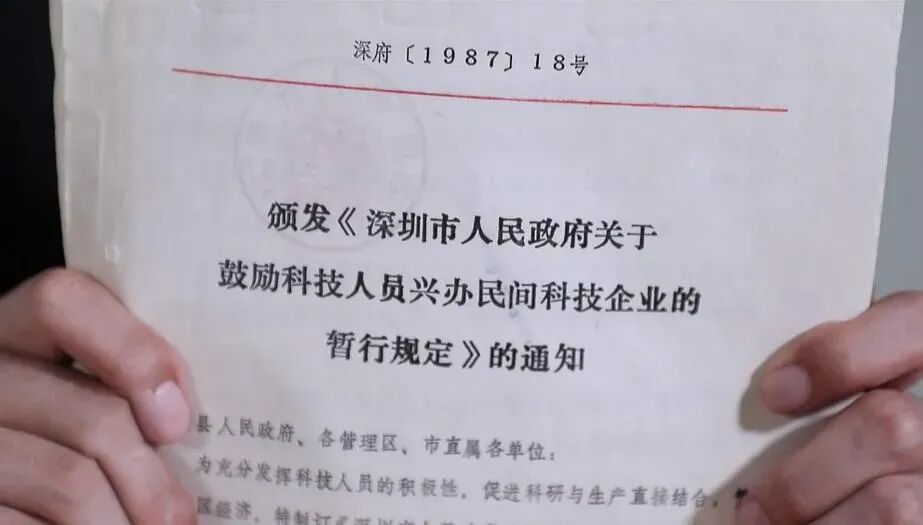
Document No. 18 issued by Shenzhen in 1987
This had a strong impact in China at that time. Most scientific research professors were used to teaching in universities. Even if they had any achievements, they would just submit a paper and contribute it to the country. It was very difficult to commercialize their achievements.
What about starting a business on their own? First, they were afraid that universities and their employers would not accept it. Second, they were afraid of being criticized by public opinion at that time. Third, they were afraid that their achievements would be copied quickly.
However, this "birth permit" from Shenzhen suddenly broadened the horizons and gave hope to many senior intellectuals. In the first year after the policy was introduced, more than 70 private high-tech enterprises were born, including the now well-known Huawei. It can be said that without the clear definition of property rights in Document No. 18 and the inability of scientific and technological personnel to hold shares with their technologies, Huawei could not have been established.
In 2000, Shenzhen encountered another crucial node. At that time, counterfeit products were prevalent in China, and most of them were just "shams". Public opinion generally believed that China was a manufacturing powerhouse and only needed to copy foreign models. Facing such a development bottleneck, Shenzhen decided to pursue independent innovation. It was the first to call for "building an independent innovation city" and focused on supporting the R & D funds of a number of leading high-tech enterprises.
This layout was more than a decade ahead of most cities in China, laying the foundation for enterprises like Huawei and BYD to challenge the traditional Western market pattern.
The third crucial node was in 2018.
In 2018, the Ministry of Industry and Information Technology launched a cultivation plan for specialized, refined, distinctive, and innovative "little giants" enterprises. The so - called specialized, refined, distinctive, and innovative "little giants" enterprises refer to outstanding small and medium - sized enterprises with specialization, refinement, and distinctiveness characteristics. DeepSeek, Ubtech Robotics, and DJI drones, which have attracted public attention in recent years, are all among the "little giants".
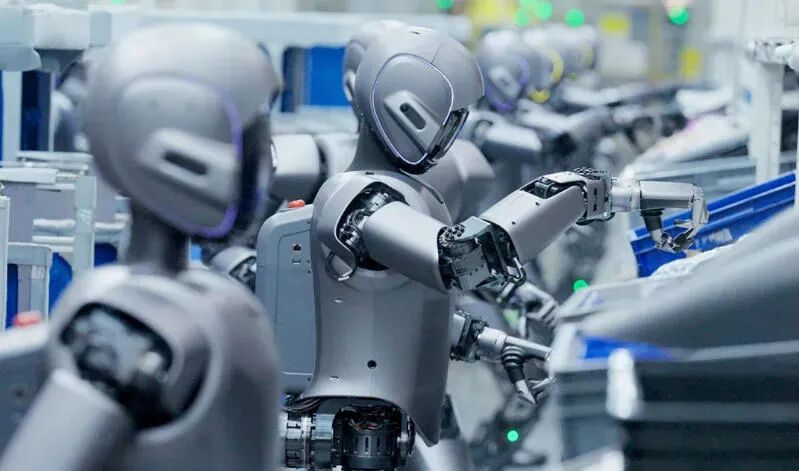
Ubtech Robotics
Shenzhen has made huge investments in this field. After the national - level cultivation plan was officially launched in 2019, Shenzhen set its sights on the goal of cultivating "little giants".
When the list of the seventh batch of national - level specialized, refined, distinctive, and innovative "little giants" enterprises was publicly announced in 2023, 310 enterprises in Shenzhen had passed the review. The number of newly selected enterprises ranked first among all cities in China. The cumulative number of national - level specialized, refined, distinctive, and innovative "little giants" enterprises in Shenzhen reached 752, exceeding the target of 600 enterprises set for 2025 ahead of schedule.
By 2024, the cumulative number of national - level specialized, refined, distinctive, and innovative "little giants" enterprises in Shenzhen had reached 1,025. The number of newly selected enterprises ranked first in China for two consecutive years. According to the latest data, as of May 2025, Shenzhen has 11,000 specialized, refined, distinctive, and innovative small and medium - sized enterprises and 21,000 innovative small and medium - sized enterprises.
From surpassing Ningbo in 2022 to achieve the "jump from fourth to third", to surpassing Shanghai in 2023 to achieve the "jump from third to second", then narrowing the gap with Beijing to only 10 enterprises in 2024, and finally successfully overtaking Beijing in 2025.
How did Shenzhen manage to overtake one city after another every year?
Break through traditions with the power of the market
As a symbol of China's reform and opening - up, Shenzhen may not have the most scientific research universities or institutional think - tanks in China, but it is the most desirable place for scientific and technological talents and scientific research universities. Different from Silicon Valley, Beijing, and Shanghai, which rely on technology transfer from universities, enterprise innovation in Shenzhen is more driven by market demand.
In Shenzhen, innovation does not happen in the ivory tower but at the front - line of production and the market. Where there is a need, innovation occurs. Where there is a pain point, solutions are sought immediately.
Ma Huateng, when looking back on Tencent's entrepreneurial history, said: "Looking back on many innovation points, we didn't set up an innovation department... Innovation opportunities usually come from the process of serving users quickly. When we find that users complain or are dissatisfied with something, that may be an opportunity for innovation."
Simply put, Tencent's innovation comes from user feedback rather than plans or research laboratories. The results of this market - driven innovation model are remarkable.
Tencent was founded in Shenzhen. It only took Ma Huateng a little over a decade to develop WeChat, which now affects 1.4 billion Chinese people, from chatting with users as a fake female netizen. Along with Tencent's growth, there are also many "little giants" enterprises with global competitiveness in niche markets.
In 2024, the number of national - level high - tech enterprises in Shenzhen exceeded 25,000, with an average of 12 enterprises per square kilometer, ranking first in China in terms of density. These enterprises may not be well - known to the public, but they master key core technologies in their respective fields. For example, Inovance Technology, which makes engines for Xiaomi, provides the core power for Xiaomi to continuously break records on the Nürburgring circuit.
Another example is JPT Opto - Electronics, which focuses on lasers, laser, and optical intelligent equipment. The shipment volume of its MOPA pulsed fiber lasers has exceeded that of its American and British counterparts, ranking first in the world. It accounts for more than 70% of the domestic market share and has remained the global sales champion for many years.
There is also Guangyue Technology, which was the first enterprise to achieve mass production in various niche markets of high - power optical devices. In 2008, it established the first high - power optical isolator production line in China. In 2021, it successfully developed a series of 10,000 - watt energy - transmitting optical cables, reaching the world - leading level. Its related products have participated in projects such as the "Mozi" quantum communication satellite, the Beijing - Shanghai Trunk Line quantum communication project, and even the Tiangong Space Station project.
Although these "little giants" are not large in scale, they are like "single - event champions" in their niche markets.
One statistic shows that the average R & D intensity of Shenzhen's "little giants" enterprises reaches 7.63%, and the average annual R & D expenditure is 33.3919 million yuan, higher than the average level of national - level specialized, refined, distinctive, and innovative "little giants" enterprises.
In addition, the sixth batch of Shenzhen's "little giants" enterprises applied for an average of 152 patents and nearly 6.5 PCT patents, significantly higher than the national average of 1.7 patents per enterprise. Nearly 30% of these enterprises have led or participated in formulating international and national standards.
The "Global Urban Industrial Innovation Index Report" released by the research team of Professor Chen Xian from the Shenzhen Industry Research Institute of Shanghai Jiao Tong University shows that Shenzhen ranked first in the comprehensive evaluation of the four dimensions of industrial innovation environment, input, output, and performance, higher than cities such as San Francisco, Beijing, and London.
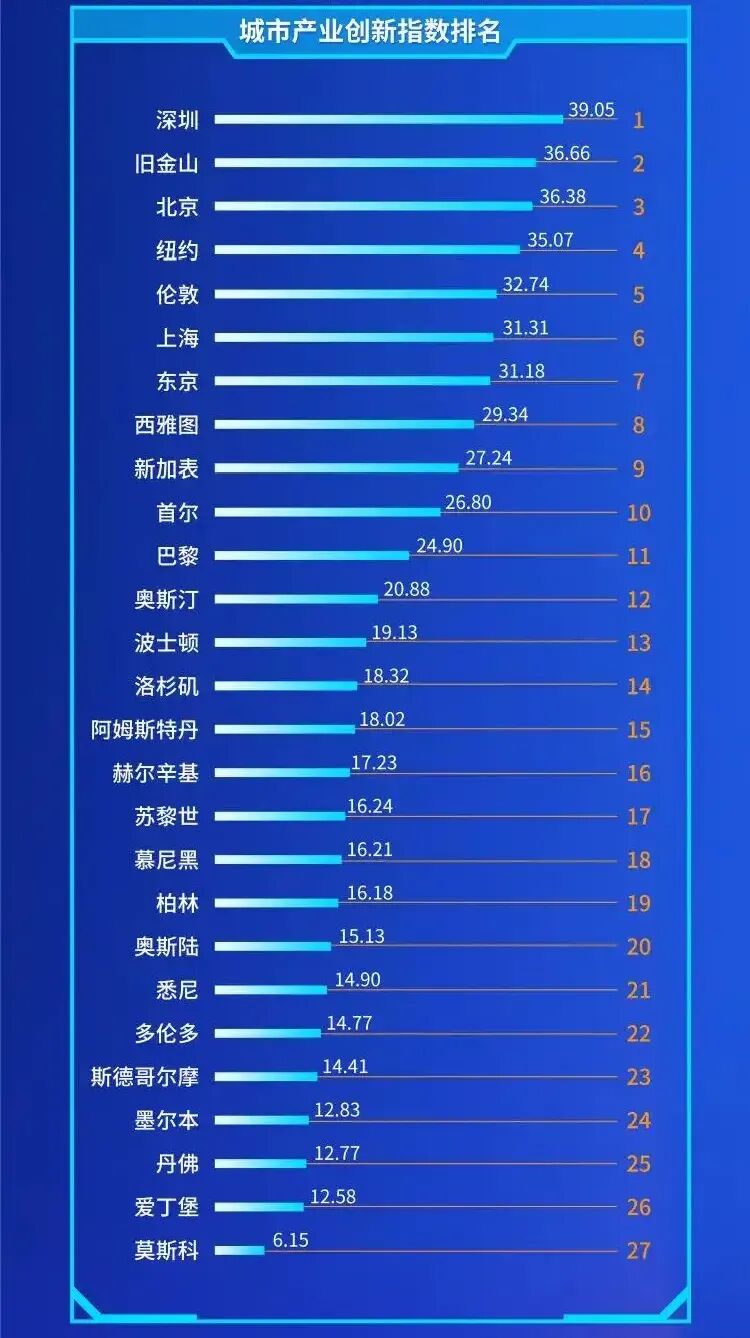
Shenzhen ranks first in the urban industrial innovation index ranking
Who says that R & D must rely on century - old scientific research institutions? In Shenzhen, enterprises are the best universities, and the market is the best professor.
Be a "nanny" rather than a "baton"
Of course, it doesn't sound like a scientific story if so many innovative achievements can be made just by leaving everything to the market.
After all, the seeds of innovation need a suitable environment. The Shenzhen government has a "secret recipe" for creating this environment.
The Shenzhen government realized early on that it cannot replace enterprises in innovation, but it can create a good environment for innovation. Different from the innovation model strongly led by the Singaporean government, the Shenzhen government prefers to be a "nanny" for innovative enterprises rather than a "baton".
What has this "nanny" done?
First, it has opened up application scenarios. We all know that Shenzhen is the "City of Low - Altitude Economy". Although many cities have drone technology, Shenzhen was the first to open up flight scenarios and plan relevant routes.
In 2018, when drone formation shows were still a novelty, the Shenzhen government took the lead in opening up a test airspace in Talent Park. After the low - altitude economy was written into the government work report in 2022, 20 application scenarios were accelerated for implementation.
Facing the latest scientific and technological achievements in the market, Shenzhen regards the whole city as a test field and tries to open up as many test scenarios as possible. This approach has achieved remarkable results.
In addition to drones, the new energy vehicle industry, which is now a leading industry, also has the support of Shenzhen.
Since 2003, at every crucial turning point in BYD's transformation, the Shenzhen government has provided strong support to the enterprise, including building a large number of charging piles and supporting the procurement of BYD electric vehicles. Now, the electrification rate of buses, taxis, and online car - hailing services in Shenzhen has reached 100%, ranking first in China in terms of public transportation electrification.
Facing some emerging technologies, Shenzhen also has its own methodology. Other cities mainly rely on subsidies and grants to cultivate new productive forces, while Shenzhen's state - owned assets focus more on market - oriented operations.
Through four major equity investment platforms: Shenzhen Capital Group, Shenzhen Investment Holdings, Shenzhen State - owned Capital Operation Group Co., Ltd., and Shenzhen Kunpeng Equity Investment Management Co., Ltd., they support the development of innovative enterprises as "long - term capital" and "patient capital".
According to statistics, among the first four batches of national - level specialized, refined, distinctive, and innovative "little giants" enterprises, Shenzhen Capital Group has invested in 198 enterprises, and Shenzhen High - tech Investment Group under Shenzhen Investment Holdings has invested in 46 enterprises.
What are the characteristics of their investments? They don't invest only after seeing the results but invest at the stage when enterprises need funds most. Ni Zewang, the former chairman of Shenzhen Capital Group, revealed that among the enterprises invested by Shenzhen Capital Group, 26% are in the startup stage, 57% are in the growth stage, and only 17% are in the mature stage.
This early - stage intervention has significantly increased the survival probability of innovative enterprises.
Shenzhen's state - owned assets also focus on creating physical space for innovative enterprises. Take the Shenzhen Bay Science and Technology Park in Nanshan District, Shenzhen as an example. After more than 10 years of operation by Shenzhen Investment Holdings, the park has gathered 191 specialized, refined, distinctive, and innovative small and medium - sized enterprises at the municipal level in Nanshan District, accounting for nearly 20% of the total in the district.
In the Shenzhen Bay Science and Technology Ecological Park, more than 100 AI startup enterprises have gathered, which is popularly known as the "Model Power Camp". This is the first large - model AI ecological community in the Guangdong - Hong Kong - Macao Greater Bay Area. Its screening criteria do not consider revenue or set a production value threshold, but only focus on technology and potential. By providing offices and test fields, Shenzhen's nanny - style policies have provided rich scenarios for the growth of "little giants" enterprises.
In terms of financial support, Shenzhen also offers a maximum reward of 500,000 yuan to enterprises recognized as national - level specialized, refined, distinctive, and innovative "little giants" and a maximum reward of 100,000 yuan to municipal - level specialized, refined, distinctive, and innovative small and medium - sized enterprises.
These reward funds are allocated in a "no - application - required" manner. Enterprises do not need to apply. Once they are recognized and the financial funds are in place, the funds will be allocated immediately. Simply put: as long as you dare to innovate, I dare to give you money. There is no requirement for immediate results, and mistakes are allowed.
In such an environment, Shenzhen now has the highest entrepreneurship density in China. Small, medium, and micro - enterprises account for more than 90% of all enterprises. These enterprises contribute more than 70% of the authorized invention patents in the city, nurture more than 80% of the national - level high - tech enterprises, and account for more than 90% of the R & D investment, providing the most fertile soil for the emergence of specialized, refined, distinctive, and innovative "little giants".
Behind Shenzhen's title of "City of Specialized, Refined, Distinctive, and Innovative Enterprises", it is not just a lead in quantity but also a lead in logic.
Shenzhen's 45 - year practice has proved that innovation does not necessarily rely on famous universities for scientific research or subsidy dividends. As long as you dare to give the market freedom, trust to enterprises, and time to innovation, every city in China can nurture its own "little giants".
This article is from the WeChat official account "Zhengjieju". Author: Zhengjieju. Republished by 36Kr with permission.