Meta's "X-ray" AI Thought Chain: CRV Reasoning Diagnosis with 92% Accuracy
In a recent paper from Meta's FAIR team, researchers have discovered an unprecedented way - they can now see the real - time thinking process of AI. This method, called CRV, makes every step of the reasoning process "visible" by replacing the MLP module inside the model. This is not a metaphor but a quantifiable phenomenon. Meta has used it to boost the error - detection accuracy to 92.47%, allowing humans to peek into how AI makes mistakes for the first time.
"Meta has just found a way to observe the breakdown of an AI's thought process in real - time."
A seemingly ordinary tweet caused a stir in the AI community.
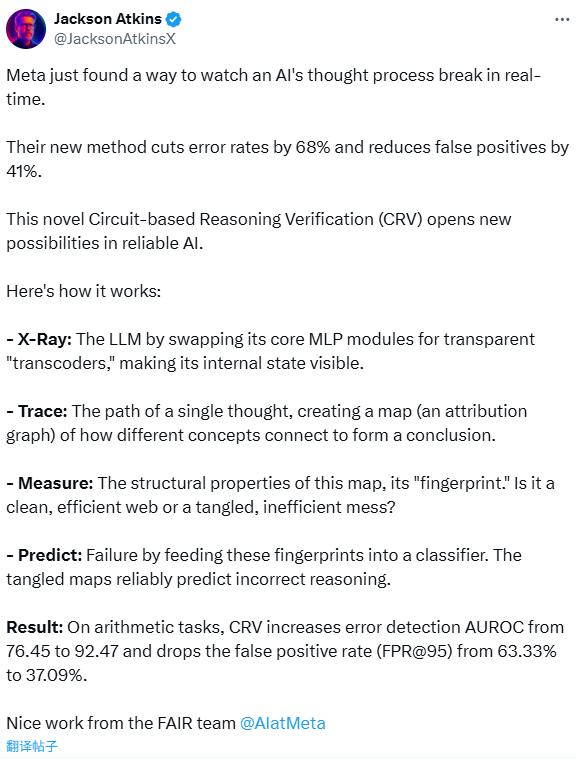
The tweet was posted by researcher @JacksonAtkinsX, who claims that Meta's new technology can make the machine's thinking "transparent" - not only can we see what the model is thinking, but also where it completely "thinks wrong".
In the paper just published by Meta's FAIR team, this new method called CRV (Circuit - based Reasoning Verification) is like an "AI brain X - ray machine":
It can track every inference of the language model, record every electrical current path, and even capture the moment when the thought process breaks down.
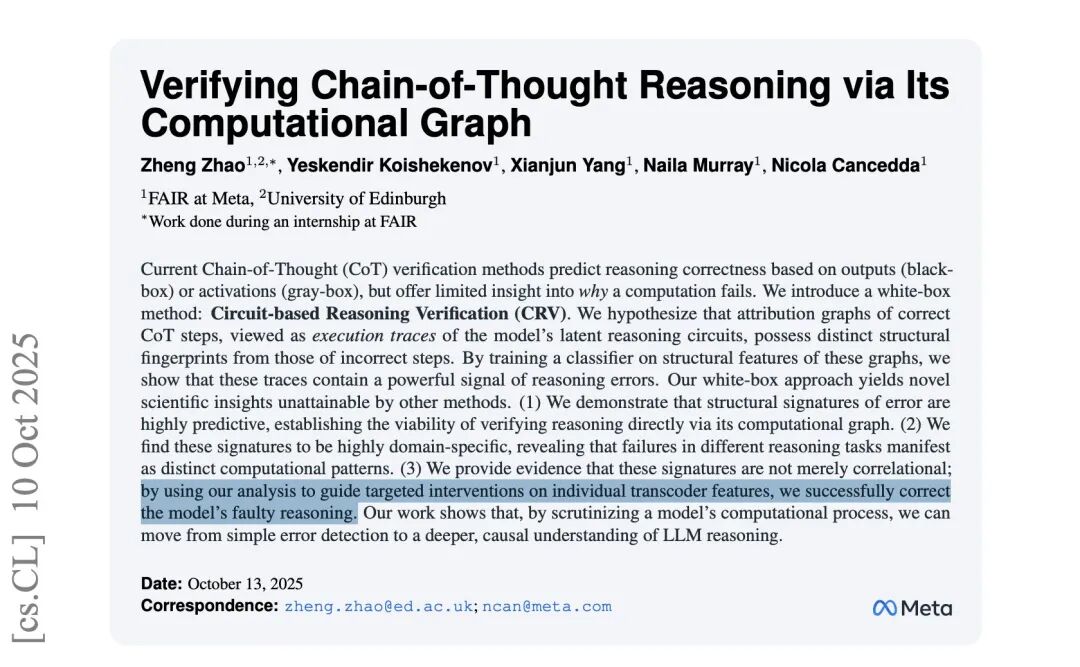
Paper link: https://arxiv.org/abs/2510.09312?utm_source
When the circuit diagram on the screen suddenly changed from a neat mesh to a chaotic tangle of wires - researchers saw for the first time how an AI's thought process breaks down.
Meta "Sees" How AI Thinks Wrong
Meta has just found a way to observe the breakdown of an AI's thought process in real - time.
When researcher Jackson Atkins posted this tweet, the AI community erupted in excitement.
At first glance, it sounds like a science - fiction plot. The AI suddenly loses its train of thought while thinking, and researchers claim they can directly witness that moment.
But this is not an exaggeration. In the paper "Verifying Chain - of - Thought Reasoning via Its Computational Graph" just published by Meta's FAIR team, they proposed a new method: CRV (Circuit - based Reasoning Verification).
This technology allows researchers to see the inference circuit of the model while it is "thinking".
When the model reasons correctly, its "internal circuit diagram" is clean and organized; once the model makes a mistake, the circuit diagram immediately becomes entangled and messy.
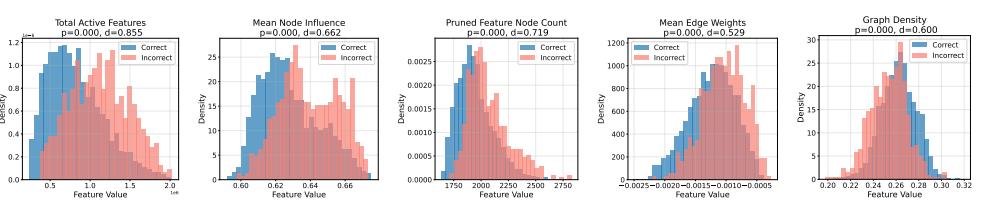
A comparison chart of reasoning fingerprint features. Incorrect inferences are generally more scattered and chaotic in these features.
The research team refers to this circuit structure as the model's "reasoning fingerprint".
They found that errors are not random but have a tangible and traceable pattern: by reading this "circuit fingerprint diagram", one can predict whether the model is about to make a mistake.
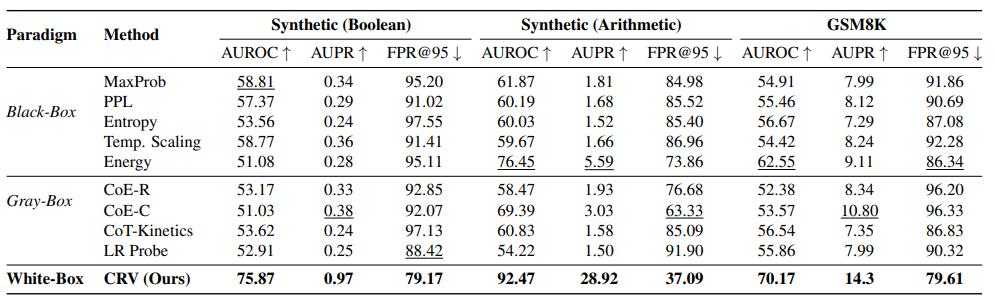
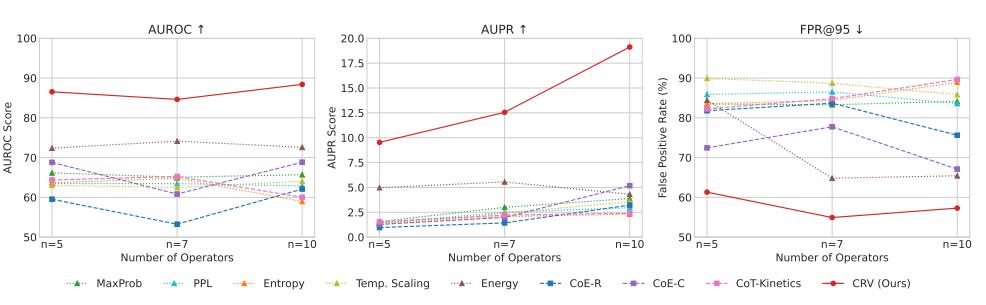
In the arithmetic reasoning experiment, the detection accuracy (AUROC) of CRV increased from 76.45 to 92.47, and the false - positive rate decreased from 63.33% to 37.09%.
Even more astonishing is that when researchers deactivated a wrongly activated multiplication feature neuron, the model immediately corrected its calculation.
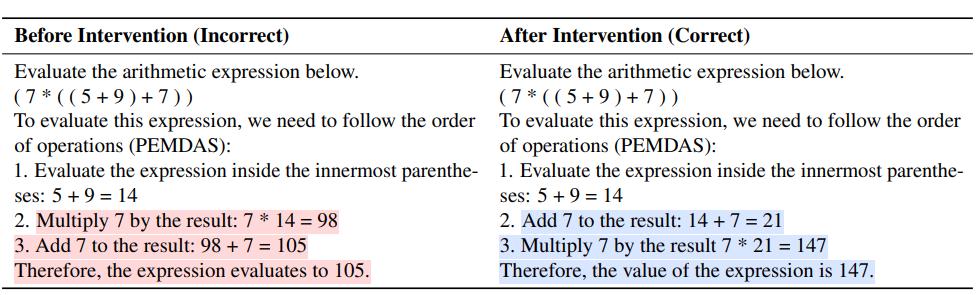
For example, in the expression (7 × ((5 + 9) + 7)), the model originally output 105, but after the intervention, it changed to 147 - completely correct.
Incorrect reasoning is not random but a structural failure in the circuit execution process.
The researchers at Meta FAIR summarized their goal in one sentence: to make AI not only "give answers" but also "prove that it thinks correctly".
Reshape the Reasoning Structure and Give Machines a "Transparent Brain"
To make the thought process of AI "visible", Meta did something that almost defies common sense: they completely redesigned the brain structure of the language model.
The core idea of this method, named CRV (Circuit - based Reasoning Verification), is not to improve the model's performance but to make every step of the AI's reasoning verifiable and traceable.
Our goal is not to make the model smarter but to make its thinking process itself verifiable.
AI's Brain Is No Longer a Black Box: Every "Neuron" Can Be Seen
The research team first replaced the traditional MLP module in the model with an interpretable sparse structure - the Transcoder layer.
After replacing the MLP with the Transcoder at different layers, the loss value of the model rapidly decreased and stabilized in a short period.
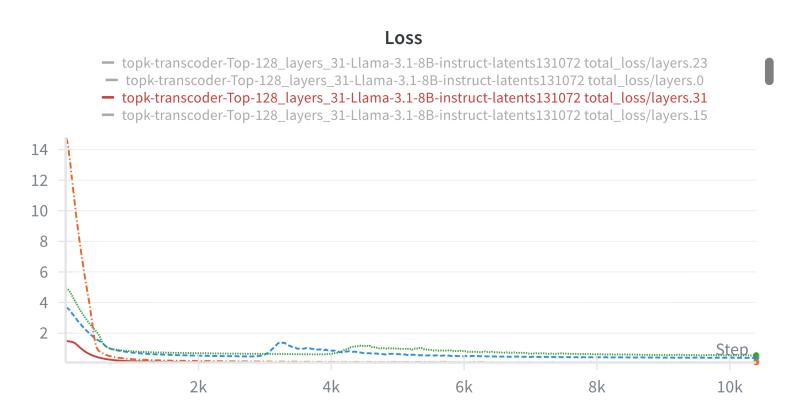
Proof of the training stability of the Transcoder layer. CRV is not a theoretical concept but a real engineering structure that can run stably on large models.
Each Transcoder is like a set of labeled neurons that can represent specific semantic features, such as "addition", "multiplication", "parentheses", or "carry".
In this way, researchers can see which neurons are activated, when they light up, and how the information is transmitted during the reasoning process.
The paper refers to this step as "X - Ray", which is like installing a "transparent skin" on the model.
Researchers describe it as "installing a camera inside the black box": the calculation process of each layer is no longer an incomprehensible vector but a clear circuit signal.
AI's Thoughts Can Be Drawn: Meta Turns Reasoning into a Circuit Diagram
When the model performs a step of reasoning, the system will draw an Attribution Graph. The nodes represent the activated features, and the edges represent the information flow between them.
Every logical jump and every combination of concepts will leave a mark on the graph.
This graph is not static but a "thought trajectory" that changes dynamically with the reasoning process.
When the model sees "3 + 5 =", researchers can see in real - time that the "addition feature" is lit up from the bottom layer and how the information converges to the output layer step by step.
When the model makes a mistake, the path will become knotted, branched, and looped - like a disordered neural signal.
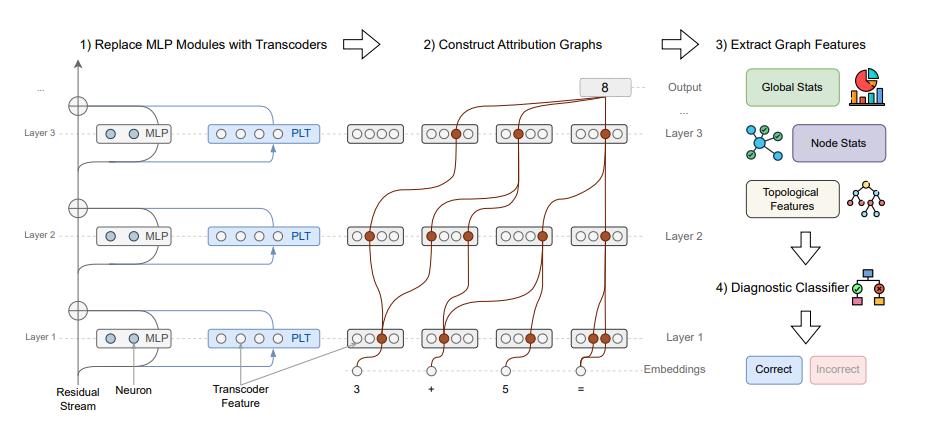
The schematic diagram of the CRV method shows the entire process from "replacing the MLP module", constructing the Attribution Graph, extracting structural features, to finally having the diagnostic classifier determine "correct/incorrect".
Let AI Expose Its Own Errors: Meta Finds the Fingerprint of "Thought Breakdown"
After generating the thought circuit diagram, Meta extracted a large number of structural features: the number of nodes, graph density, average edge weight, path length, centrality...
These data form the model's "thought fingerprint".
Then, they trained a classifier - it doesn't read text or look at the answers, but only looks at the structure. In the experiment, researchers found that:
When the graph structure is entangled and the distribution is chaotic, the model is almost certain to be making a reasoning error.
In other words, whether the model thinks correctly or not doesn't have to wait until it gives the answer. By simply observing the shape of the "circuit diagram", one can make a prediction in advance.
The emergence of CRV has given the language model a "diagnosable neural structure" for the first time.
Meta didn't make AI smarter but allowed humans to see for the first time how AI makes mistakes.
The black box is no longer completely sealed, and for the first time, intelligence has revealed its "circuit fault lines".
More Than Just a Paper: A Watershed in AI Research
After Meta announced the experimental results, the most obvious impact came from this set of comparison charts:
A performance comparison between CRV and various verification methods. The chart shows the detection performance of different methods in arithmetic reasoning tasks.
The red line represents CRV. Whether it's in terms of AUROC (detection accuracy), AUPR (correct prediction rate), or FPR@95 (false - positive rate), it far outperforms or underperforms other methods.
This means that it can not only see the structure of the reasoning circuit but also accurately determine whether the model will think wrong.
Such results made many researchers realize that CRV is not just a model transformation but a conceptual shift.
In the past, to determine whether a model reasoned correctly, we could only look at its answer.
It would write a chain - of - thought, and humans would then try to figure out if the logic was coherent and if the conclusion was correct.
All of this happened outside the black box - we could only see the output but couldn't trace "how it thought".
Meta's CRV has laid this chain of thought under the microscope for the first time. Researchers no longer have to guess but can directly see the internal logical path of the model:
Every time a feature is lit up and every signal is transmitted, there is a corresponding "circuit" on the graph.
They are not evaluating the answer but verifying the structure of the thinking itself.

More importantly, CRV has truly connected "interpretability" and "reliability" for the first time.
In past research, the former focused on understanding the model, and the latter aimed to trust the model. The two paths were almost parallel - we could see the heat map but still didn't know why the model made mistakes.
In Meta's experiment, researchers can both explain why the model makes mistakes and predict where it might make mistakes next.
CRV may be the first step towards "controllable intelligence". When reasoning errors can be structurally identified, it means they can be predicted, intervened, and even repaired.
There is a well - known example in the paper - after deactivating a wrongly activated neural feature, the model immediately corrected its answer.
This shows that errors are not accidental but circuit - level faults. If we can monitor these features in real - time in the future, we may be able to "hit the brakes" before hallucinations occur.
From this moment on, AI's errors are no longer mysterious paranormal events. They are tangible and diagnosable.
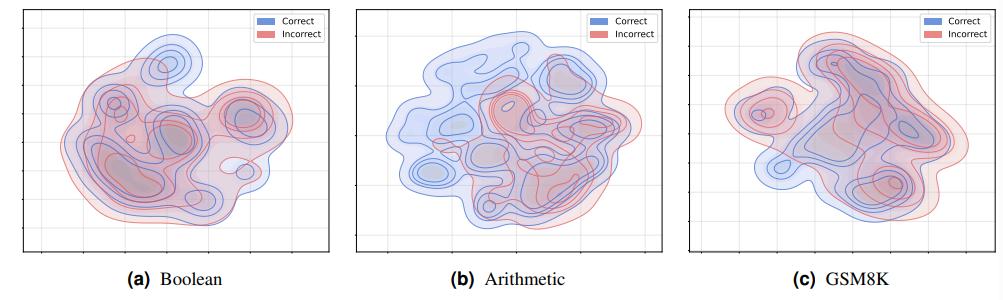
The topological feature distribution of correct and incorrect reasoning in different tasks. The blue in the chart represents correct reasoning, and the red represents incorrect reasoning.
Meta has opened a small crack in the black box - giving humans the first opportunity not only to create intelligence but also to understand intelligence itself.
When We Can Understand AI, How Far Are We from "Controllable Intelligence"?
Even though Meta can "see what AI is thinking", this technology still has a long way to go before it can be truly implemented.
At the end of the paper, the research team frankly wrote about the "limitations and unfinished business".
Our method currently requires a large amount of computing resources because we have to replace all MLP layers with Transcoder layers and calculate the complete Attribution Graph.
In other words, the cost of making the model visible is huge: every layer has to be rebuilt, and every feature has to be tracked.
Just drawing a complete Attribution Graph once may consume dozens of times the computing power of ordinary training. This is not a feature that can be easily implemented but requires a huge engineering effort.

A more practical problem is scale.
The experiment was only conducted on models with a maximum of 8B parameters. Further research is still needed to extend it to larger models.
CRV has only been verified on medium - sized models so