The AI unicorn star backed by Jensen Huang is reported to have a new round of financing. With a valuation of over 18 billion yuan after being founded for more than two years.
According to a report by Zhidongxi on October 21st, today, The Information reported, citing people familiar with the matter, that Sakana AI, a Japanese competitor to OpenAI, is reported to be raising $100 million (approximately RMB 700 million) at a valuation of $2.5 billion (approximately RMB 17.8 billion), representing a 66% increase from its valuation of $1.5 billion (approximately RMB 10.7 billion) in September last year.
People familiar with the matter revealed that Sakana AI is in talks with investors from the United States and Japan. After raising this new $100 million, Sakana AI's valuation will reach $2.6 billion (approximately RMB 18.5 billion). The company plans to use the new funds to expand its engineering, sales, and distribution teams. It currently has about 70 employees.
Sakana AI was founded in July 2023, and its founding team has an impressive background. David Ha is a former senior scientist at Google Brain and also led the research department of the image - generation model unicorn Stability AI. Another founder, Llion Jones, is one of the authors of the Transformer paper and a former Google AI researcher. In August this year, David Ha also made it onto Time's list of the top 100 AI figures in 2025.
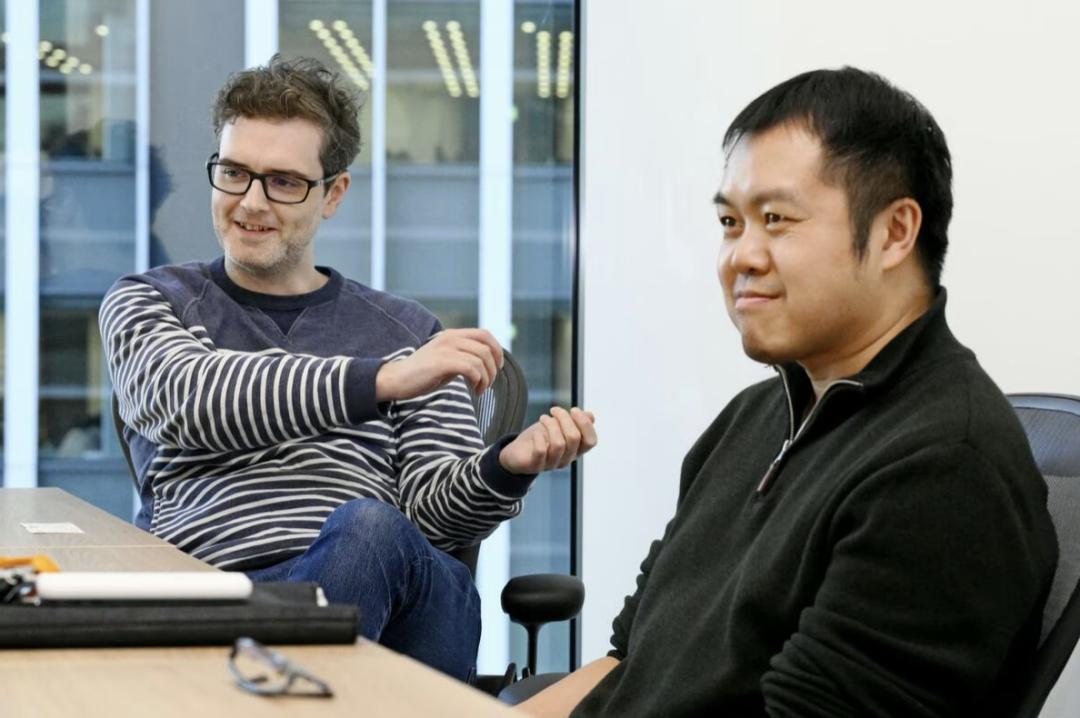
Sakana AI founders Llion Jones (left) and David Ha (right)
This startup has chosen a different path from companies like OpenAI and Anthropic. It hopes to abandon the Transformer architecture and draw inspiration from natural evolution to reduce the computational cost of the model and improve its performance. In terms of product progress, the company has released three Japanese - language models, an Edo - style chatbot named Karamaru, and an open - source framework called ShinkaEvolve.
So far, Sakana AI has raised nearly $230 million (approximately RMB 1.6 billion) in financing. In January 2024, Sakana AI received 4.5 billion yen (approximately RMB 200 million) in financing, with participation from Lux Capital, Khosla Ventures, Japanese telecommunications company NTT, and Sony Group. In September last year, Sakana AI completed a Series A financing of $214 million (approximately RMB 1.5 billion), with NVIDIA participating as a major shareholder, pushing its valuation to about $1.5 billion (approximately RMB 10.7 billion) within a year of its establishment and quickly making it a unicorn.
In addition, according to The Information, the company has also received a grant from the Japanese government to purchase computing resources for AI training.
The name Sakana AI means "fish" in Japanese. Ha previously told The Information that he intends to build a "Japanese DeepMind."
Ha revealed that its algorithm can help companies automatically create large models for processing language or images. The method is to mimic the laws of natural selection when combining, testing, and discarding data, thereby reducing the amount of manual input required. This is because training large models consumes a huge amount of electricity or resources, and he hopes to shorten this time to days or weeks.
Specifically, the algorithm used by Sakana AI takes three open - source original AI models as "parents" and "raises" more than a hundred "children" in different ways. Then, it selects the best - performing model to generate the next generation and repeats this process. After creating hundreds of generations of models, it selects the best one.
In March this year, SakanaAI released three Japanese - language models, namely the large language model EvoLLM - JP, the vision - language model EvoVLM - JP, and the image - generation model EvoSDXL - JP.
One month later, Sakana AI released the Edo - style chatbot Karamaru. This chatbot can answer users based on the worldview of the Edo period and ancient documents from that time. Its training data comes from a dataset of about 25 million characters built by the company from Edo - era books.
In September this year, Sakana AI open - sourced ShinkaEvolve. This framework combines a large model with an algorithm to help it propose solutions to various potential problems and narrow down to the most relevant ones. The company claims that this method is more efficient and can propose more creative solutions compared to the Transformer architecture.
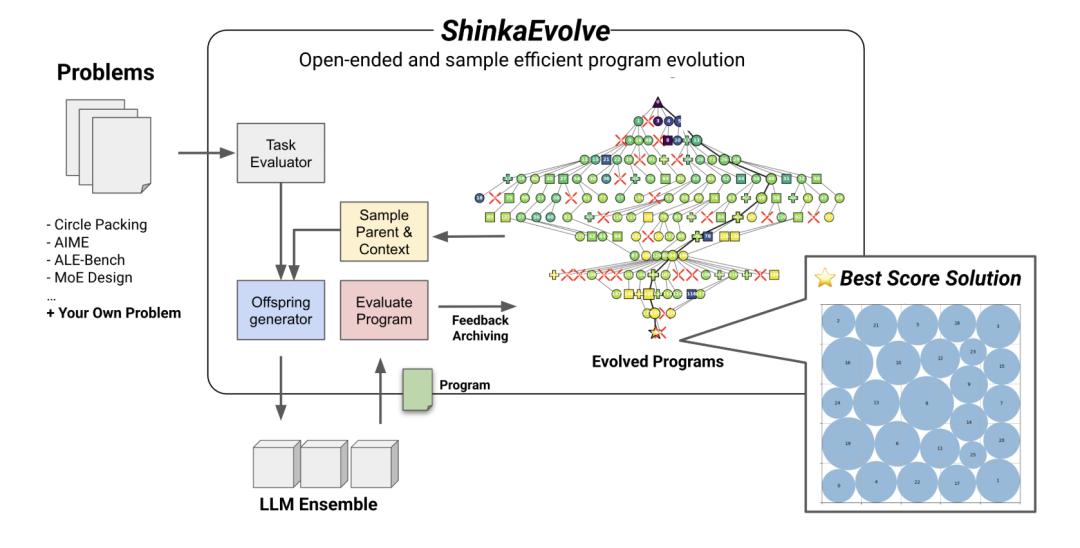
Overview of the ShinkaEvolve framework
So far, Sakana AI has signed business agreements with several large Japanese companies.
In May this year, it announced a multi - year partnership with Mitsubishi UFJ Financial Group to develop customized AI models for Japan's largest bank. After this deal was reached, Ha told foreign media that this would enable Sakana AI to achieve profitability within a year. Earlier this month, Sakana AI announced a similar partnership with Daiwa Securities Group, one of Japan's largest securities firms.
Ha mentioned that every Japanese company that wants to have its own base model can cooperate with Sakana AI or other companies like it to develop its own model, and there is still room for Japan to become an innovator.
In addition, in Japan, Sakana AI also faces competition from many large US model developers.
In February this year, OpenAI announced a partnership with SoftBank. SoftBank agreed to spend $3 billion (approximately RMB 21.4 billion) annually for itself and its subsidiaries to purchase OpenAI's technology. SoftBank and OpenAI will also establish a joint venture to specifically sell OpenAI's toolkits to Japanese companies. In August this year, Anthropic appointed a country head for Japan and is preparing to open an office in Tokyo, Japan. In August this year, Canadian large - model startup Cohere hired a country manager for Japan.
Conclusion: Sakana AI Bets on Japanese Local Large Models
Similar to French large - model startup Mistral AI and Indian large - model startup Krutrim, Sakana AI hopes to reduce its dependence on other AI technologies by developing its own large models and enabling the models to better understand the language and culture of its region. Ha believes that it makes sense for Japanese companies to have their own base models, even if they are not ultra - high - performance models.
However, compared to core players in the large - model field such as OpenAI, Anthropic, and Google, startups like Sakana AI are relatively weak in terms of funds and talent strength. They need to find a breakthrough path through algorithm innovation and other means.
This article is from the WeChat official account "Zhidongxi" (ID: zhidxcom). Author: Cheng Qian, Editor: Yun Peng. Republished by 36Kr with authorization.