ByteDance Enters the Lithium-Ion Battery Market: A Collision Between a Tech Giant and the Energy Revolution
While the outside world is still focusing on ByteDance's traffic landscape in the fields of short - videos and information distribution, this technology giant with a market value of over $250 billion has quietly opened the door to the lithium - battery industry. In September 2025, ByteDance's recruitment platform posted a position for a "Battery R & D Expert" with a high salary offer of "40 - 70k·15 salaries" (annual salary of $600,000 - $1.05 million), clearly requiring "a doctoral degree and more than 5 years of R & D experience in core lithium - battery materials or battery systems". During the same period, the "Sourcing Announcement for Energy Management Contract of Wind - Solar - Storage Microgrid in Douyin Group's Data Center" was released, planning to build a lithium - battery energy - storage microgrid system of over 200MWh. This series of actions is not a casual attempt but a strategic breakthrough of the algorithm empire in the wave of the energy revolution, based on policy, technology, and ecological logic.
01
ByteDance's Ambition for Cross - border Expansion:
Strategic Breakthrough from the Algorithm Empire to the Energy Chessboard
ByteDance's layout in the lithium - battery industry is by no means following the "new - energy trend" but the result of the resonance of three major demands: policy dividends, technological synergy, and ecological closed - loop. Every move points to "long - term energy layout" rather than short - term profit.
1. Policy Dividends and Market Demand: Seizing the "Golden Window" of Energy Transformation
Under China's "dual - carbon" goal, lithium batteries, as the core carrier of the new - energy industry, have formed a dual - driven pattern of "policy + demand". According to the data of the China Chemical and Physical Power Sources Industry Association, from January to September 2025, the global lithium - battery shipments reached 1758GWh, a year - on - year increase of 142.3%. Among them, China's shipments were 1231GWh, accounting for 70% of the global total. In the segmented fields, the demand for power batteries for new - energy vehicles in China reached 602GWh, a year - on - year increase of 38.5%, and the demand for energy - storage lithium batteries was 165GWh, a year - on - year increase of 210%. The combined demand of these two items accounted for 62% of China's total lithium - battery shipments.
At the policy level, the "New - Energy Vehicle Industry Development Plan (2021 - 2035)" clearly states that "the sales volume of new - energy vehicles will account for about 25% of new vehicle sales in 2025". As of September 2025, the penetration rate of new - energy vehicles in China has reached 48.2%, exceeding the target ahead of schedule. The "Special Action Plan for the Large - scale Construction of New - Type Energy Storage (2025 - 2027)" further proposes that "the installed capacity of new - type energy storage will exceed 180 million kilowatts in 2027", further opening up the market space for energy - storage lithium batteries. What ByteDance is targeting is the core multi - billion - dollar track in the transformation of the energy structure from "fossil - energy - dominated" to "new - energy - dominated" in the next 10 years.
2. Technological Synergy: AI Algorithms Solve the "Efficiency Bottleneck" in Lithium - Battery R & D
ByteDance's core competitiveness - AI algorithms and big - data processing capabilities - happen to match the core pain points in lithium - battery R & D. Traditional lithium - battery R & D (such as electrolyte formula optimization and electrode material screening) relies on the "trial - and - error method". It takes an average of 3 - 5 years for a new - type battery to go from laboratory R & D to mass production, and the material - screening process alone takes several months. However, ByteDance can significantly compress this cycle through the "AI + high - throughput computing" model.
According to insiders from ByteDance's internal R & D team, it has jointly established a "Lithium - Battery Materials AI R & D Laboratory" with the Institute of Physics of the Chinese Academy of Sciences. The developed "LASI - 80Si Solid - State Electrolyte AI Model" can complete the screening of 32 million material combinations within 80 hours by simulating the interface reaction between the electrolyte and the electrode through machine learning, and finally lock in 3 high - performance candidate materials. In contrast, it takes more than 6 months for the traditional experimental method to complete the same - scale screening. This "computation - driven R & D" logic is highly consistent with ByteDance's "data iteration" experience in the fields of short - video recommendation and advertising algorithms, forming a natural technological migration advantage.
3. Ecological Closed - Loop: Meeting Self - Demands and Expanding Business Boundaries
The layout of the lithium - battery industry is essentially a key part of ByteDance's improvement of the "digital service + physical hardware" ecosystem. On the one hand, ByteDance's businesses have an urgent demand for energy and batteries. In the third quarter of 2025, the power consumption of ByteDance's global data centers reached 1.86 billion kWh. If a 200MWh energy - storage microgrid is installed, the power - consumption cost can be reduced by 15% - 20% through "peak - valley arbitrage + backup power supply", while meeting the carbon - emission reduction requirements. Its in - development drones (for Douyin e - commerce logistics) and humanoid robots (for live - streaming base operation and maintenance) have a strong demand for high - energy - density batteries. In 2024, the quotes of leading domestic battery manufacturers for large customers increased by 18%. Self - developed batteries can reduce the supply - chain cost by more than 30%.
On the other hand, the lithium - battery business can also expand business boundaries. Volcengine (ByteDance's enterprise - service segment) can package the "AI Energy - Storage Management System" and sell it to other data centers and industrial and commercial customers. Douyin e - commerce can build a sales scenario of "new - energy products + energy - storage services", forming a closed - loop of "energy supply - digital service - business operation".
02
The Fiercely Competitive Lithium - Battery Industry:
The Offensive and Defensive Wars and Survival Logic of Old and New Forces
ByteDance's entry has pushed the already highly competitive lithium - battery market into the "multi - polar game" stage - traditional battery giants, Internet peers, and emerging startups are conducting differentiated competition based on their own advantages.
1. Internet Giants: Divergent Paths, Each Occupying a Niche
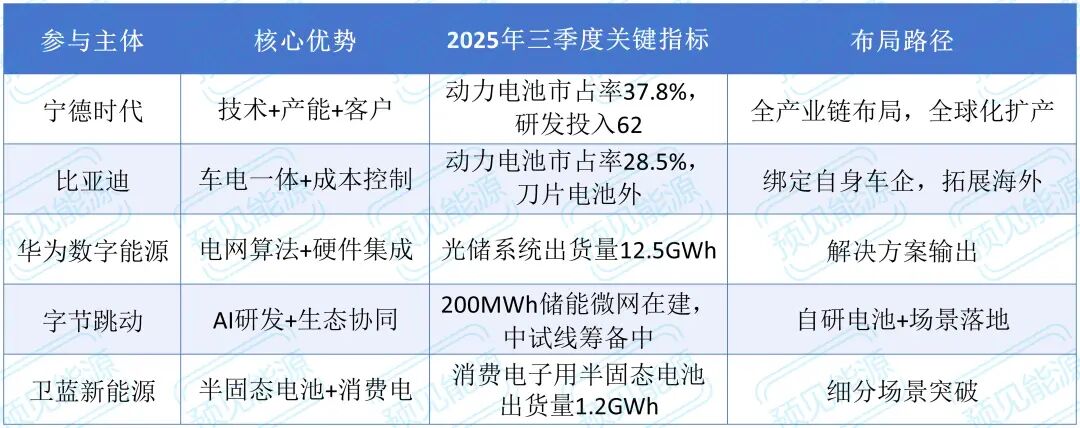
It has become a trend for technology giants to cross over into the new - energy field, but their layout paths are significantly different, and they all avoid direct confrontation with traditional battery manufacturers. Huawei Digital Power focuses on "intelligent solar - storage solutions". In the third quarter of 2025, the shipments of its solar - storage systems reached 12.5GWh, and its core competitiveness lies in "power - grid dispatching algorithms + hardware integration". Tencent has laid out through "capital + ecosystem", with a cumulative investment in 12 lithium - battery - related enterprises (including the solid - state battery startup QuantumScape), focusing on cutting - edge technologies. Alibaba Cloud has been deeply involved in the "smart energy - management platform", serving more than 500 energy - storage power stations and providing data monitoring and optimization services.
Different from the above enterprises, ByteDance is the only Internet giant that "directly enters lithium - battery R & D and production" - not only recruiting core R & D talents with high salaries but also planning to select sites in Anhui and Guangdong to build battery pilot lines, aiming to achieve small - batch mass production of solid - state batteries in 2026, trying to overtake on the curve through "underlying technological innovation" rather than "ecosystem empowerment".
2. Traditional Giants: Deep Barriers, Facing Efficiency Challenges
Traditional leading enterprises such as CATL and BYD have built triple barriers of "technology + production capacity + customers", which are difficult to be shaken in the short term. Data shows that in the third quarter of 2025, CATL's global market share of power batteries reached 37.8%, and BYD's reached 28.5%, with the two together accounting for 66.3% of the market share. In terms of R & D investment, CATL's R & D expenses in the first half of 2025 reached 6.2 billion yuan, and the energy density of its released condensed - matter battery reached 500Wh/kg, which has been installed and tested in NIO's ET Preview model. BYD's blade battery has been successfully supplied to Tesla, and its Hungarian factory (with a production capacity of 20GWh) was put into operation in September 2025, accelerating its global layout.
However, traditional giants also face the challenge of "R & D efficiency". An executive of a leading battery enterprise revealed that it takes an average of 38 months for its new - type battery to go from laboratory R & D to mass production, while ByteDance claims to be able to compress this cycle to 12 months. In addition, the products of traditional enterprises mainly focus on "new - energy vehicles + large - scale energy storage", and they have insufficient customization capabilities for segmented scenarios such as "data centers and robots", which is exactly ByteDance's breakthrough point.
3. Emerging Enterprises: Focusing on Segmented Fields, Surviving in the Niche
Startups in the solid - state battery field such as ProLogium Technology and WeLion New Energy were once sought after by capital for their "technological foresight". However, the industry's financing amount decreased by 23% year - on - year in 2024, and further shrank to 8.5 billion yuan in the third quarter of 2025, increasing their survival pressure. Facing the squeeze from giants, these enterprises have turned to "segmented tracks" to seek breakthroughs:
WeLion New Energy focuses on "semi - solid - state batteries + consumer electronics". In the third quarter of 2025, the shipments of its semi - solid - state batteries supplied to Xiaomi and Huawei reached 1.2GWh, with a unit price 25% higher than that of traditional lithium batteries and a gross profit margin of 32%.
ProLogium Technology focuses on "space - grade solid - state batteries", providing satellite energy - storage batteries for domestic commercial space companies. Although the shipments are small (0.3GWh in the third quarter), the technological barriers are high, and there are few competitors.
For emerging enterprises, ByteDance's entry is both a pressure and an opportunity. The pressure lies in that ByteDance's capital and technological advantages may accelerate industry integration, while the opportunity lies in that ByteDance's AI R & D platform may open up for cooperation, helping them improve R & D efficiency.
Industry Structure Data Reference
03
Future Trends and Breakthrough Suggestions:
Transformation and Opportunities in the Lithium - Battery Industry
ByteDance's cross - border layout is essentially a microcosm of the transformation of the lithium - battery industry from "single - material competition" to "technological integration + scenario reconstruction + global competition and cooperation". Standing at the node of 2025, three major trends in the industry have become clear, and all parties need to break through the situation accordingly.
1. Trend One: Technological Integration, Cross - disciplinary Innovation Becomes the Core Competitiveness
Lithium - battery technology is evolving from "liquid - battery iteration" to "solid - state battery breakthrough". More importantly, there is a cross - disciplinary integration of "materials science + physics + computational science". According to BNEF's prediction, the global shipments of solid - state batteries will reach 614GWh in 2030, accounting for 15% of the total lithium - battery shipments. However, issues such as the interface stability and cost control of solid - state batteries need to be jointly solved through AI algorithm optimization and the R & D of new materials.
In the future, enterprises that only master single - material technology will find it difficult to survive. "AI R & D platforms + high - throughput laboratories" will become the industry standard - this is where ByteDance's advantage lies. Traditional battery manufacturers need to accelerate cooperation with technology enterprises to make up for their algorithm shortcomings. Emerging enterprises can focus on "single - technology links" (such as solid - state electrolyte coatings and composite current collectors) and become "irreplaceable" parts in the supply chains of giants.
2. Trend Two: Scenario Reconstruction, Batteries Transform from "Power Carriers" to "Energy Hubs"
The application scenarios of batteries are extending from "new - energy vehicles and large - scale energy storage" to "data centers, robots, and low - altitude aircraft", and their roles are changing from "power providers" to "energy transfer hubs". According to BNEF data, the global energy - storage market scale will reach $400 billion in 2030, of which industrial and commercial energy storage (including data centers) will account for more than 50%. The lithium - battery demand corresponding to emerging scenarios such as eVTOL (electric vertical take - off and landing aircraft) and humanoid robots will reach 390GWh in 2030.
Under this trend, "scenario - defined products" will become the core of competition. ByteDance may develop customized battery products based on its understanding of "data centers and robots" scenarios. Traditional manufacturers need to break away from the thinking of "selling batteries by parameters" and turn to the solution model of "batteries + services". For example, CATL provides an integrated service of "battery leasing + energy - storage management" for logistics parks.
3. Trend Three: Global Competition and Cooperation, Standards and Localization Become Key
The global competition in the lithium - battery industry has been upgraded from "production - capacity competition" to "standard dominance + competition in localization capabilities". At the policy level, the EU's "New Battery Regulation" requires that from 2027, power batteries must contain more than 15% recycled cobalt and more than 20% recycled nickel, and a full - life - cycle carbon - footprint report must be provided. The US IRA Act stipulates that only batteries produced locally in North America can enjoy a subsidy of up to $7,500 per vehicle. China has launched a "power - battery traceability platform", forming a two - way mutual - recognition mechanism with the EU's "battery passport".
For Chinese enterprises, going global faces dual challenges of "compliance + localization": CATL's German factory postponed its production start - up from Q2 2025 to Q4 due to delayed environmental approvals. BYD's plan to build a factory in India has not been implemented due to the "local - parts - proportion requirement". ByteDance's global experience (such as TikTok's localized operation) may be an advantage, but its battery products need to quickly adapt to the standards of various countries to avoid compliance risks.
Breakthrough Suggestions
For enterprises: Traditional battery giants need to "make up for algorithm deficiencies and expand scenarios". For example, CATL can jointly build an AI R & D platform with Internet enterprises and at the same time layout batteries for emerging scenarios. Technology enterprises such as ByteDance need to "emphasize implementation and build production capacity" to avoid the disconnection between R & D and the market. Emerging enterprises need to "focus on segmented fields and strengthen technology", focusing on niche areas ignored by giants to form technological barriers.
For the government: It is recommended to establish a "Cross - disciplinary Lithium - Battery Innovation Fund" (with a recommended scale of 200 billion yuan) to support the integrated R & D of AI and lithium - battery technologies. Accelerate the formulation of industry standards for emerging technologies such as "solid - state batteries and sodium - ion batteries" and unify the testing and certification systems. Establish an "international - standard dialogue mechanism" to help enterprises deal with overseas compliance requirements.
For practitioners: They need to cultivate "cross - disciplinary capabilities", mastering both Materials Studio (a material R & D tool) and the basics of AI algorithms. They should focus on cutting - edge technologies such as silicon - carbon anodes, composite current collectors, and solid - state electrolytes. They should also enhance their "global vision" and be familiar with the industrial policies and standards of major markets such as the EU and the US.