Shocking: Dual Mastery of AI and Physics! Embedding the Helmholtz Equation into the Generator Eliminates Artifacts Instantly
On the eve of the 6G era, the combination of AI and physics is reshaping the industrial landscape of radio maps. Institutions such as the Hong Kong University of Science and Technology (Guangzhou) have jointly released the PhyRMDM framework, breaking through cognitive blind spots by integrating physical constraints with the capabilities of generative models. This significantly improves the generation quality and stability of high - precision radio maps. This achievement has been accepted by the top conference ACM MM 2025.
Traditional AI often leads to prediction distortion when constructing radio maps due to the lack of physical law constraints.
To solve this problem, the research team at the Hong Kong University of Science and Technology (Guangzhou) innovatively proposed the PhyRMDM framework, which combines the Physics - Informed Neural Network (PINN) with the Diffusion Model for the first time and designed a new dual - Unet architecture.
This framework guides the training process of the AI model through physical equations, achieving a perfect integration of data - driven and physical laws, and raising the generation accuracy and physical consistency of radio maps to a new level.
The achievement has been accepted by ACM MM 2025 in the form of a paper, and the code and weights have been open - sourced.
Paper link: https://arxiv.org/abs/2501.19160
Code repository: https://github.com/Hxxxz0/RMDM
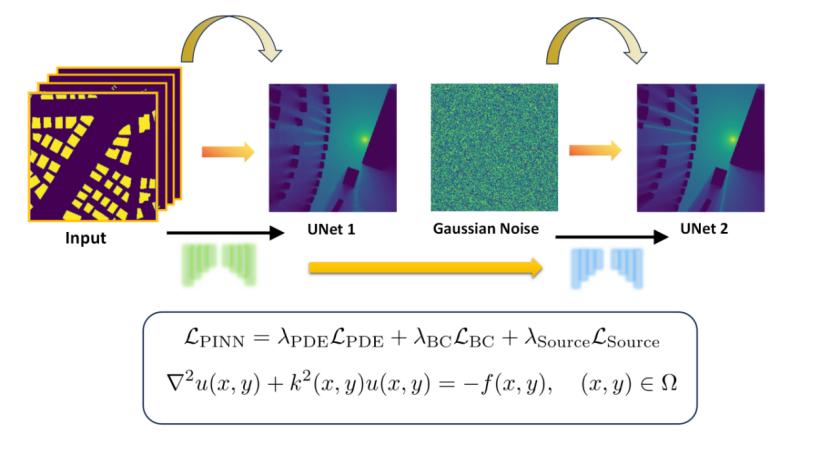
As the 6G era approaches, in fields such as intelligent communication, unmanned system navigation, and the Internet of Things, the strategic position of high - precision radio maps (RM) is becoming increasingly prominent.
However, existing pure data - driven methods, such as traditional deep - learning networks, lack the guidance of the inherent laws of the physical world during the model training process when dealing with sparse or noisy observational data. They often generate "artifacts" or distorted results that do not conform to the physical laws of electromagnetic wave propagation.
How to enable AI models to not only "learn" data but also "understand" and "obey" physical laws has become a key bottleneck in improving the quality of RM construction.
Against this background, a new framework - PhyRMDM, which integrates physical priors, probabilistic generative capabilities, and advanced attention mechanisms, has emerged.
This framework provides a powerful solution for the construction of high - fidelity and high - physical - consistency radio maps through innovative design.
PhyRMDM, a generative framework guided by physical laws
The core idea of PhyRMDM is "physics as the foundation, AI as the application."
It uses the powerful probabilistic generative capabilities of diffusion models to construct the overall spatial distribution of radio maps. At the same time, it cleverly uses the Physics - Informed Neural Network (PINN) as an unbreakable "Physics Anchor" to guide each step of the training process, so that the final model is guided by the Helmholtz equation of electromagnetic wave propagation.
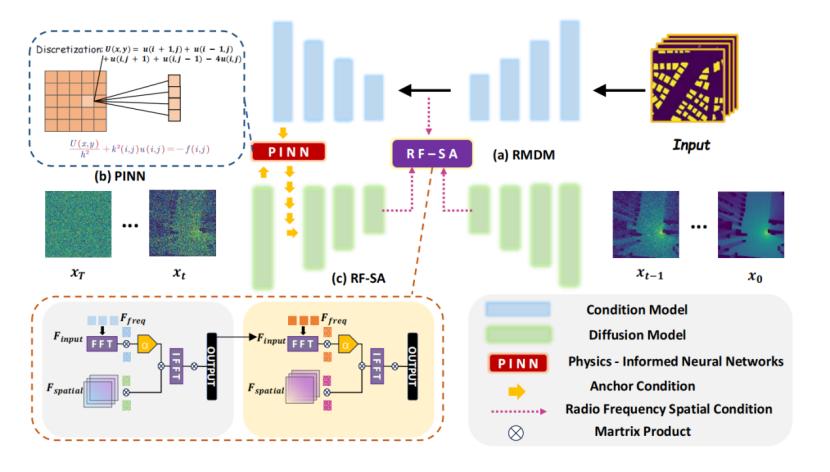
Model architecture and core modules: The overall architecture of PhyRMDM is a conditionally guided diffusion generation process.
It consists of a core generative engine and two key conditional input modules, which work together.
Core generative engine: Diffusion Model
1. The diffusion model is the cornerstone of the entire framework, responsible for generating images from scratch.
The process is divided into two steps:
Forward process: During the training phase, the model continuously adds Gaussian noise to the real radio map until it becomes a completely disordered random noise map x_T.
Reverse denoising (generation process): During the inference phase, the model starts from a pure Gaussian noise image x_T and gradually removes noise through a trained neural network over multiple time steps (Timestep). At each step (e.g., from x_t to x_{t - 1}), the model refers to the information provided by the conditional model to perform a precise "denoising" operation until a clear and real radio map x_0 is finally generated.
2. Physics Anchor: Physics - Informed Neural Network (PINN Condition)
This is the most innovative design of PhyRMDM, which ensures that the "imagination" of AI does not deviate from physical reality.
The core of the physical equation constraint module:
The discretized form of the Helmholtz equation

.
This equation describes the stable propagation state of electromagnetic waves in two - dimensional space.
As a physical representation condition, the PINN module intervenes as a strong constraint condition in each denoising step of the diffusion model.
It evaluates the extent to which the currently generated intermediate result deviates from the solution of the physical equation and uses this "physical residual" as a guiding signal to correct the generation direction, ensuring that the finally generated map satisfies the constraints of the wave equation at each pixel as much as possible.
However, due to the complexity of radio propagation, a single equation cannot accurately describe it. Therefore, PhyRMDM innovatively uses a dual - Unet architecture: one Unet is responsible for denoising, and the other is responsible for learning physical representations.
3. Spatial feature fusion: Radio Frequency - Spatial Attention Module (RF - SA)
To enable the model to more precisely capture the impact of complex phenomena on signal propagation, such as building occlusion and street corner reflection in the environment, the team designed a new Radio Frequency - Spatial Attention module.
Frequency - space dual - domain processing: This module innovatively realizes the synchronous processing of information in the spatial domain and the frequency domain. The input feature map
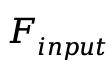
is sent to two parallel branches.
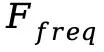
Frequency - domain analysis: One branch converts spatial features to the frequency domain through the Fast Fourier Transform (FFT) to obtain frequency features
.
This helps the model capture the periodic and global features of the signal.
Feature fusion and enhancement: The frequency - domain features and the original spatial - domain features
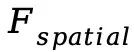
are deeply fused through methods such as matrix product and weighted through a learnable filter.
Output: Finally, the fused features are converted back to the spatial domain through the Inverse Fast Fourier Transform (IFFT) to generate an enhanced feature map (OUTPUT) with a more sensitive perception of spatial relationships.
Performance advantages and prospects
Analysis 1: Performance comparison of static radio map (SRM) construction
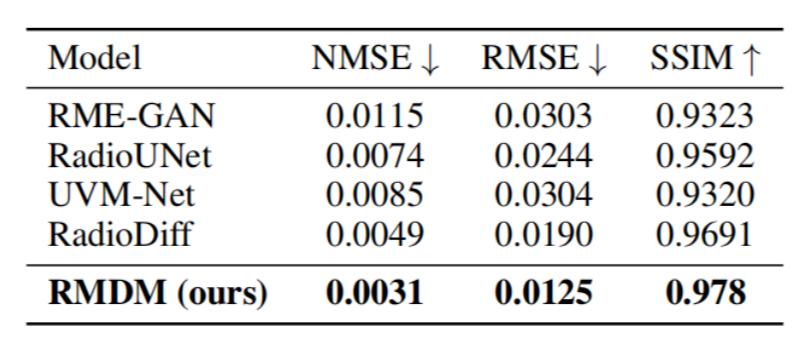
Interpretation of the table content:
This table compares the performance of multiple deep - learning models in constructing static radio maps (SRM) on the RadioMap Seer - Test dataset. The evaluation indicators are divided into two categories:
Error indicators: NMSE (Normalized Mean Squared Error) and RMSE (Root Mean Squared Error). The lower these two values are, the closer the model's prediction results are to the real values, and the higher the accuracy is.
Structural indicators: SSIM (Structural Similarity) and PSNR (Peak Signal - to - Noise Ratio). The higher these two values are, the more similar the map generated by the model is to the original image in terms of structure, edge clarity, and fidelity.
Analysis 2: Performance comparison of dynamic radio map (DRM) construction
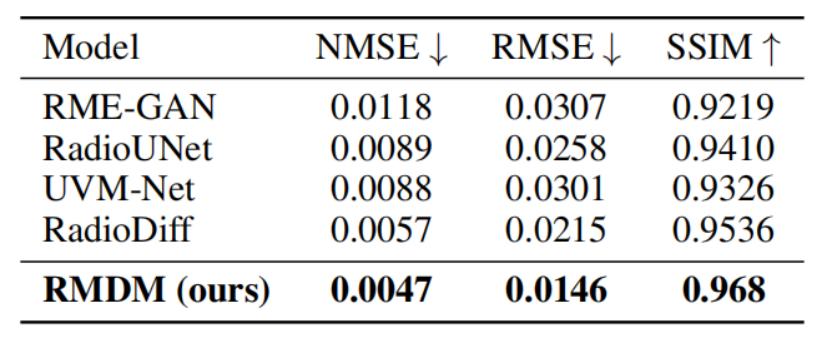
Interpretation of the table content:
This table shows the performance of each model in the more challenging dynamic radio map (DRM) scenario.
In the dynamic scenario, the model must additionally consider the impact of dynamic environmental factors such as vehicles.
Analysis 3: Ablation experiment
The ablation experiment of this study aims to explore the contributions of three key loss function parts in its model to the overall performance: L_MSE (Mean Squared Error Loss), L_PINN (Physics - Informed Loss), and L_REG (Regularization Loss).
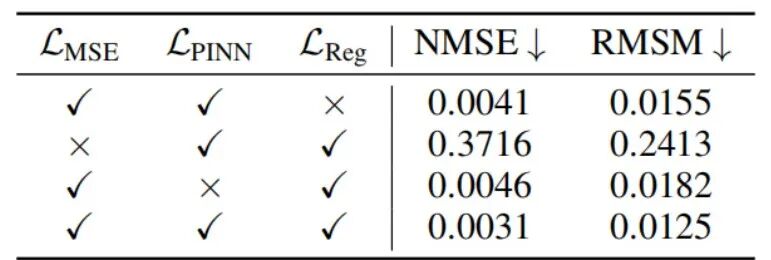
The experimental results show that the combination of these three parts yields the best results, and the model achieves the lowest NMSE (Normalized Mean Squared Error) of 0.0031 and RMSE (Root Mean Squared Error) of 0.0125.
The study found that the Mean Squared Error Loss plays a crucial role in minimizing prediction errors and aligning the model output with real data. The lack of this term will lead to a sharp decline in model performance.
At the same time, the Physics - Informed Loss effectively improves the accuracy and physical consistency of predictions by introducing physical constraints.
And the Regularization Loss helps enhance the stability and generalization ability of the model.
This study concludes that there is a synergistic effect among these three loss function parts, and their combination is crucial for achieving accurate and robust radio map reconstruction.
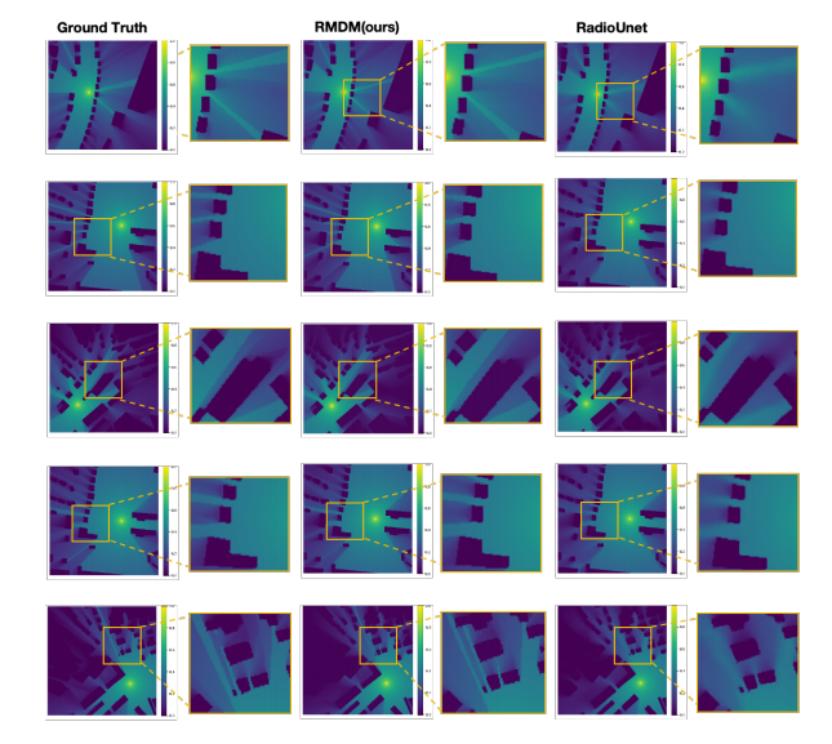
The PhyRMDM framework demonstrates excellent performance through organic combination:
High physical consistency: Due to the introduction of the PINN module, which uses the laws of electromagnetic propagation as a guide during model training, physical information can act as a new teacher to train the model better.
Powerful generative capabilities: Based on the diffusion model, PhyRMDM can still generate high - resolution radio maps with rich details and spatial continuity even when the observational data is extremely sparse.
Excellent feature extraction: The innovative RF - SA attention mechanism enables the model to more deeply understand the impact of environmental layout on signal propagation, thereby obtaining more accurate prediction results in complex scenarios.
The proposal of PhyRMDM is not only an important breakthrough in radio map construction technology but also provides a new example for the in - depth integration of AI and physical sciences.
In the future, this framework is expected to be extended to a wider range of fields, such as computational imaging, weather forecasting, and fluid mechanics simulation, which rely on the solution of physical equations, showing great application potential.
Reference links:
https://arxiv.org/abs/2501.19160
This article is from the WeChat public