What can we learn from Xiaomi's OTA recall of 110,000 SU7 vehicles?
Last week, a recall announcement issued by the State Administration for Market Regulation caught wide attention. Xiaomi Auto announced that it would recall a total of 116,887 standard - version SU7 electric vehicles produced between February 6, 2024, and August 30, 2025, starting from now.
According to the recall announcement, the reason for the recall is that "when the L2 high - speed pilot assist driving function is enabled in some vehicles, there are deficiencies in the recognition, early warning, or handling ability in extremely special scenarios. If the driver fails to intervene in time, it may increase the risk of collision, posing a safety hazard." Different from the traditional perception of many long - time consumers, the method adopted for this recall is the OTA recall, which has gradually become standardized and more frequently used in the past two years.
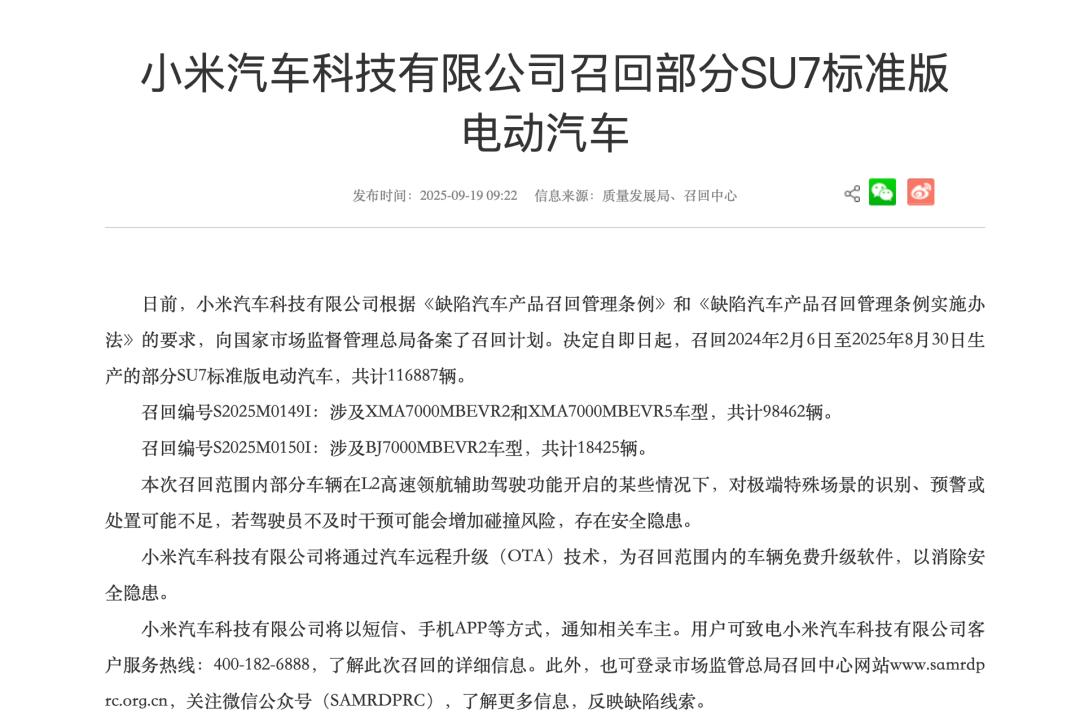
Several details are worth noting.
First of all, all the more than 110,000 Xiaomi SU7 models in this recall are standard - version models, not involving the SU7 Pro and Max models. And according to the proportion calculation, this should include all the standard - version models sold since the launch.
It can be inferred that this OTA recall based on the high - speed pilot assist driving function is mainly an upgrade of Xiaomi Pilot Pro, which is only used in the Xiaomi SU7 standard model. In contrast, both the SU7 Pro and Max models use Xiaomi HAD.
In terms of computing power, the standard - version model still uses a single NVIDIA Orin chip with a computing power of only 84 TOPS. While the SU7 Pro and Max models use two NVIDIA Orin X chips, with a total computing power of 508 TOPS. In addition, the SU7 Pro and Max models are also equipped with Hesai's 128 - line lidar.
Another detail is that although it is clear that this upgrade is due to the high - speed pilot assist driving function, the specific reason for the upgrade is more like a "software upgrade" rather than a "product defect". Therefore, choosing the OTA form can quickly complete the upgrade in a short time.
Xiaomi Auto responded that this OTA upgrade and recall aims to further improve the reliability of the assist driving function, including optimizing the speed control strategy of the assist driving and adding a dynamic vehicle speed function, making the high - speed pilot assist function more coherent. Xiaomi Auto always takes user safety as the first principle. Although this upgrade does not require any physical replacement of parts, it is still managed and filed in accordance with the recall procedure.
We are already very familiar with the OTA of mobile phones, and the OTA of the in - car system for in - car experience functions is also very common at present. However, more users are not so familiar with OTA as a remote upgrade technology. Why can OTA also be regarded as a "car recall"?
Actually, Xiaomi's OTA recall this time is not an isolated case. In 2024, a total of 233 car recalls were implemented in China, involving 11.237 million vehicles. Among them, car companies implemented 19 remote upgrades (OTA) recalls, involving 4.068 million vehicles, a year - on - year increase of 246.8%.
In 2020, the State Administration for Market Regulation issued the "Notice on Further Strengthening the Supervision of Automobile Remote Upgrade (OTA) Technology Recalls", clearly including the OTA technology in the recall supervision system for the first time. It requires that if a company uses the OTA method to eliminate product defects and implement a recall, it must file a record with the supervision department.
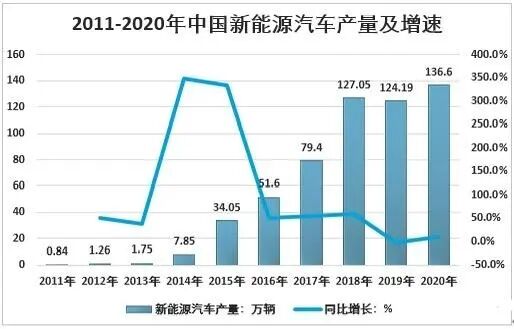
At that time, the sales volume of new energy vehicles in China had exceeded 1.36 million, and about 23.7% of the models were equipped with the OTA function. High - end and mid - end models even regarded OTA upgrade as a core configuration. However, there was a general tendency in the industry to focus on function iteration and neglect safety supervision.
As a result, some car companies packaged the software defect repair as a "function optimization" and quietly solved the safety hazards in the name of a regular OTA upgrade. They neither reported to the supervision department nor clearly informed users of the risks. This "hidden recall" not only deprived users of the right to know but also left the safety risks caused by software defects out of control.
It was against this background that the supervision notice in 2020 established the core principle of the "filing system", requiring that if a company uses the OTA method to eliminate product defects and implement a recall, it must submit complete filing materials to the market supervision department before starting the upgrade.
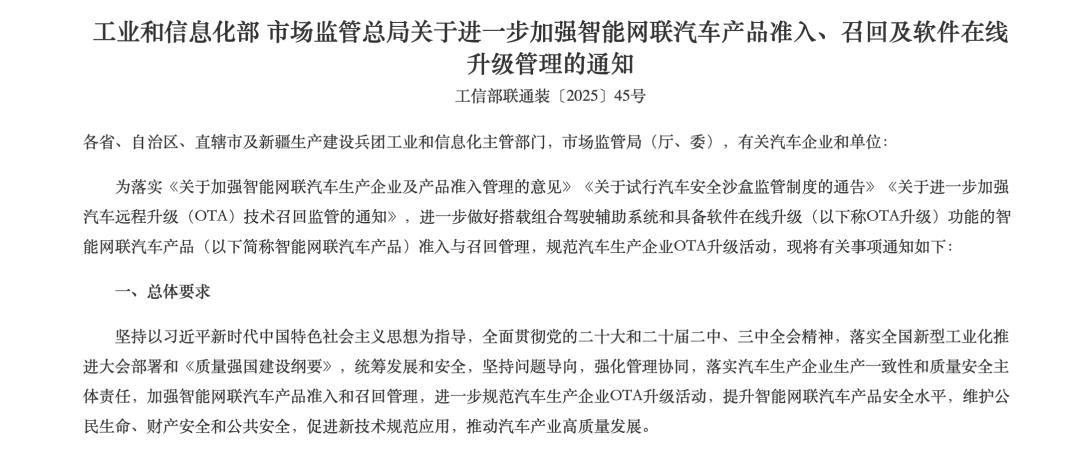
In February this year, the Ministry of Industry and Information Technology issued a notice on further strengthening the management of the access, recall, and software online upgrade of intelligent and connected vehicles. It clearly stipulates that OTA upgrade activities involving the autonomous driving function of vehicles should obtain corresponding permits in accordance with the relevant regulations of access management. When a company implements OTA upgrade activities to eliminate product defects and implement a recall, it should organize and implement in accordance with the "Implementation Measures for the Administration of Recalls of Defective Automobile Products", further strengthening the supervision of OTA recalls.
Since the policy breakthrough in 2020, China's OTA recall supervision policy has been continuously improving. This forward - looking layout not only provides a safety boundary for the innovation of the new energy vehicle industry but also gives users more solid safety guarantees while enjoying the convenience of technology by standardizing the OTA recall process. Although no physical replacement of parts is required, Xiaomi still strictly follows the filing procedure of the "Regulations on the Administration of Recalls of Defective Automobile Products", which is also the result of the State Administration for Market Regulation including OTA in the recall supervision in 2020.
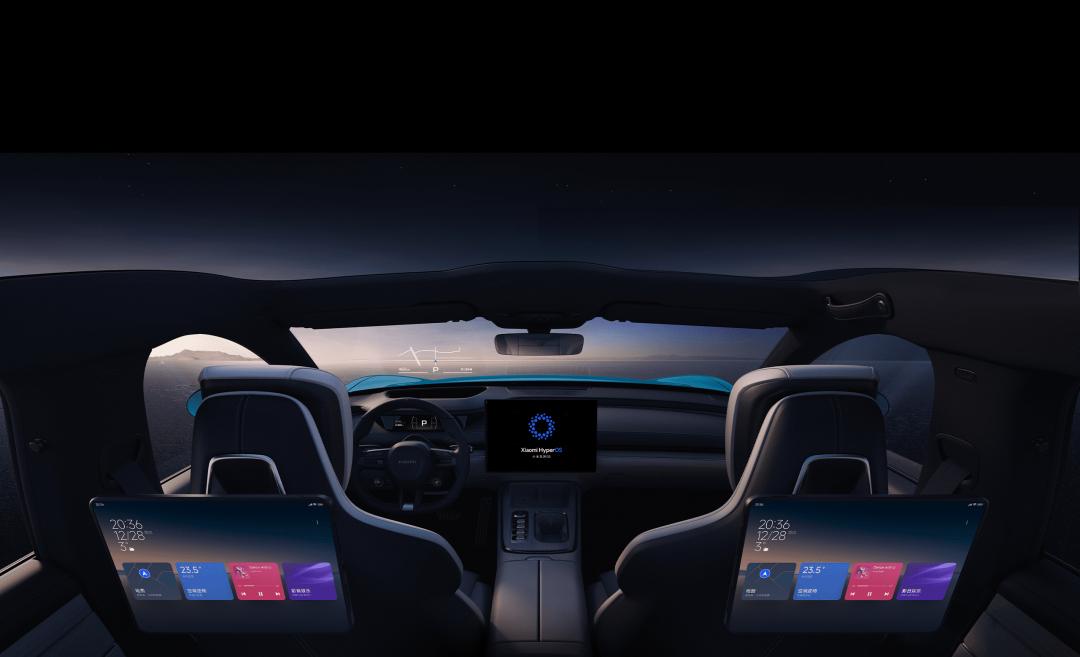
On the other hand, as intelligent driving technology is gradually penetrating into more vehicle models, many car companies will quickly launch new intelligent driving software to seize the technological timeliness and market opportunities, and some of the problems and deficiencies will be gradually upgraded in the form of OTA in the future.
In mid - August this year, the State Administration for Market Regulation and the Ministry of Industry and Information Technology specifically drafted a draft for comments on the "Notice of the State Administration for Market Regulation and the Ministry of Industry and Information Technology on Strengthening the Supervision and Management of Recalls and Production Consistency and Standardizing the Promotion of Intelligent and Connected New Energy Vehicle Products". This notice clearly mentions that "strictly implement the classified management requirements for OTA upgrade activities and do not conceal defects through the OTA method".
This also means that in order to cope with the special environment of the current automobile market and the multiple upgrades that can be carried out under OTA, relevant national departments will also fully fulfill their supervision obligations to prevent car companies from using the idea of OTA upgrade to let unreliable products enter the market.
In the era of intelligent vehicles, software has become a core safety element. The traditional recall model for hardware defects is difficult to adapt to the rapid iteration characteristics of software, while OTA technology provides an efficient path for defect repair. This rapid iteration without replacing hardware is not only responsible for users' vehicle - using safety but also significantly reduces the upgrade cost and saves the upgrade time. The OTA upgrade of vehicles is the recognition of the safety that can be achieved by software upgrade in the supervision system. This change forces car companies to improve their safety verification ability and establish a more transparent user communication mechanism. Just as Xiaomi Auto explains the technical details in detail and emphasizes the principle of safety first, it is the key to winning users' trust.
This article is from the WeChat official account "Cheyun" (ID: cheyunwang), author: QY, editor: Lu Zhiyao. It is published by 36Kr with authorization.