The payment rate is as low as 3%. It won't be long before AI manufacturers start adding ads for users.
Recently, OpenAI, the leader in the AI industry, disclosed its latest financial forecast to shareholders, projecting that its cash burn will soar to $115 billion in the next four years. Just as OpenAI's management presented this unprecedented high - stakes plan, OpenAI employees who were allegedly allowed to sell their stocks are offloading shares worth approximately $10.3 billion.
All these have reignited the debate about the AI bubble. Interestingly, during the dot - com bubble around the turn of the century, many sought - after internet startups also proved themselves by "burning money" rather than presenting a stable profit model.
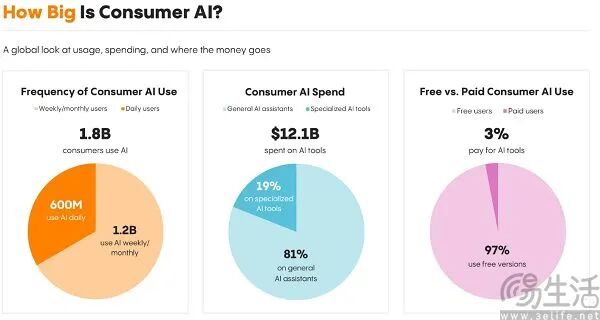
Adding fuel to the AI bubble theory is the well - known investment firm Menlo Ventures. In their latest macro report on the AI market, they revealed a set of figures: the total user base has reached 1.8 billion, with 600 million daily active users, but the payment penetration rate is only 3%.
In other words, even among the 600 million people who are most actively embracing AI, only 18 million are willing to pay. So, what level does a 3% payment penetration rate represent in the context of internet products? For comparison, the payment penetration rates of video and music streaming services in the domestic market are around 20%, the average payment conversion rate for online novels is 12.3%, and the payment penetration rate for emerging short web dramas is as high as 40%.
If it's unfair to compare with mature internet products, take Meitu, a provider of beauty photo - editing products, as an example. Its payment penetration rate in the domestic market has reached 5.2%. Clearly, the report from Menlo Ventures reveals a reality: the hype of AI in the capital market and on the internet does not match its actual influence. Users are willing to try it out but are reluctant to pay.
What makes investors even more uneasy is that in the $12.1 billion in consumer spending shown in the report, as much as 81% was spent on AI chatbots or AI companions like Character.AI. So, the question arises: why are consumers reluctant to spend money and energy on the hyped - up AI coding field? It's known that AI coding is highly touted because it depicts a blueprint of "everyone can code," and the promise of technological equality through AI is the basis for the astonishing valuations of AI programming companies.
In fact, the process of AI penetrating various industries is quite slow. The reason behind this is simple: if today's AI could truly empower everything, RPA (Robotic Process Automation) might have achieved it more than a decade ago. In other words, it's not that AI is ineffective, but its application threshold is too high, making it inaccessible to ordinary people. Adjustments are needed in the way of deployment.

Not to mention, AI empowering everything will inevitably lead to the decomposition of corporate processes and business restructuring, which will directly impact the existing management framework. Many companies have taken decades to complete their digital transformation with many difficulties. Undertaking an AI - based transformation now might be too much for them. Therefore, many business owners have realized that current AI is almost equivalent to a smart version of the Office suite. While it can serve as a useful auxiliary tool, it's still unrealistic to expect it to completely replace human labor.
Previously, the NANDA Lab at the Massachusetts Institute of Technology (MIT) revealed in "The Generative AI Gap: The State of Business AI in 2025" that many enterprises have high expectations for generative AI, but most projects have not had a real financial impact. Only about 5% of pilot projects have achieved rapid revenue growth, while the majority have stagnated and had no quantifiable impact on the company's profit and loss statement (P&L).
Therefore, the cornerstone that has supported the current AI boom, whether AI can be quickly converted into corporate profits, is now being questioned. The term "valuation pressure" now hovers over AI startups. Is there a way to refute the AI bubble theory? Of course, it's to add advertisements to AI products.
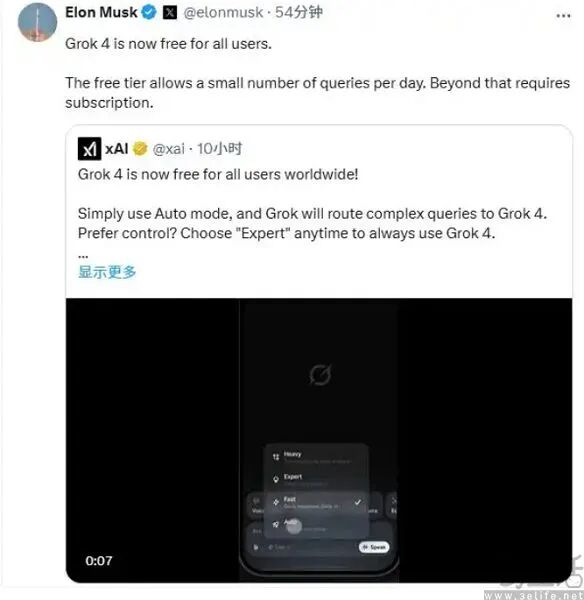
Among the leading AI products available today, whether it's ChatGPT, Grok, Gemini overseas or DeepSeek, Doubao, Yuanbao in China, they are all the result of subsidies from the underlying manufacturers. These manufacturers are willing to use real money to subsidize users and bear high costs such as computing power, data, and utilities in order to expand the market. The current user base of 1.8 billion indicates that market cultivation has achieved initial results.
However, since the payment penetration rate is as low as 3%, adding advertisements to free users who pay nothing has become a sustainable path. Moreover, researchers have confirmed that people who know less about the principles and implementation processes of AI tend to trust it blindly. Researchers call this difference in acceptance tendency the "low - cognition, high - acceptance" correlation, which means that the advertising effect in AI products may far exceed that of traditional digital advertising.
AI manufacturers even have a way to make users not resist advertisements. As is well - known, users need Tokens to use large AI models, but in many consumer - oriented products, these Tokens are paid for by the manufacturers. So, if manufacturers offer a deal like "watch a 30 - second ad to get 1000 Tokens," many users may be happy to do so. After all, Tencent Music and Qishui Music have already implemented the model of "watch ads to listen to music for free."
So, cherish the current good times. The ad - free pure AI experience may soon become a thing of the past, and the days of seeing ads inserted in AI responses may not be far off.
This article is from the WeChat official account "3eLife" (ID: IT - 3eLife), author: 3eLife Staff. It is published by 36Kr with authorization.